
Staff God : The Ancient Andean Deity of Power and Cosmic Balance
Listen
At a glance
| Description | |
|---|---|
| Origin | Chavin Mythology |
| Classification | Gods |
| Family Members | N/A |
| Region | Peru |
| Associated With | Cosmic authority, Duality, Fertility, Agriculture |
The Mythlok Perspective
In Mythlok’s Perspective, the Staff God represents one of the earliest expressions of a universal mythic archetype: the ruler who balances opposing forces. Unlike later named deities, this figure functions more as a symbolic embodiment of cosmic order than as a character in stories. The Andean vision of a staff-bearing authority parallels the staff or scepter symbolism seen in many traditions. Comparable figures appear across cultures. The Staff God’s dual authority echoes the cosmic balance embodied by Shiva, while the staff itself recalls the divine authority symbolized by Odin holding Gungnir. Across civilizations, the staff becomes a universal emblem of divine rule and cosmic control.
Staff God
Introduction
The Staff God is one of the most recognizable divine figures in ancient Andean religion and art. This powerful deity appears across multiple civilizations of the Andes, most prominently in the culture of Chavín de Huántar, which flourished roughly between 900 and 200 BCE. Archaeologists and historians consider the Staff God a central supernatural figure whose imagery shaped Andean religious iconography for more than a millennium.
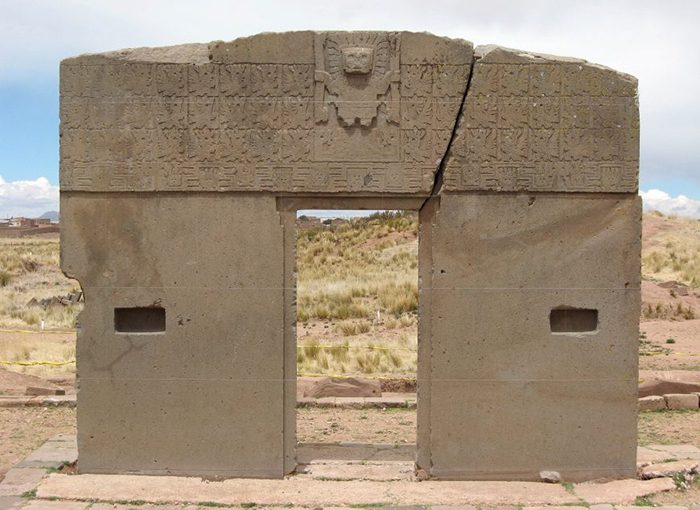
The earliest known depictions of the Staff God date to around 2000–2250 BCE on carved gourds from the Pativilca River Valley in Peru. Over time, the figure became strongly associated with Chavín culture and later appeared in the artistic traditions of civilizations such as Tiwanaku, the Nazca, Paracas, and Moche cultures. These societies adopted and transformed the imagery of a staff-bearing deity into their own religious traditions.
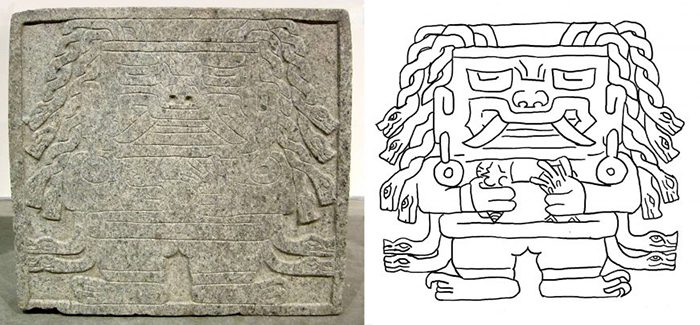
The Staff God is most famously represented on the Raimondi Stele, a large granite monolith discovered in Chavín de Huántar. This artifact displays a complex figure holding two staffs and featuring elaborate animal symbolism. Many scholars interpret the Staff God as a cosmic authority who embodied order, fertility, and the balance of opposing forces.
Although the exact identity of the Staff God remains debated, most researchers agree that it symbolized divine power and spiritual authority within Andean society. The figure’s widespread appearance across cultures suggests that it represented a shared religious concept rather than a single named deity. As a result, the Staff God stands as one of the most enduring symbols of ancient Andean belief systems.
Physical Traits
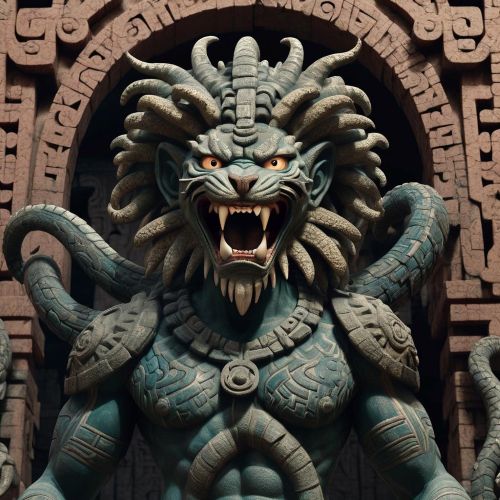
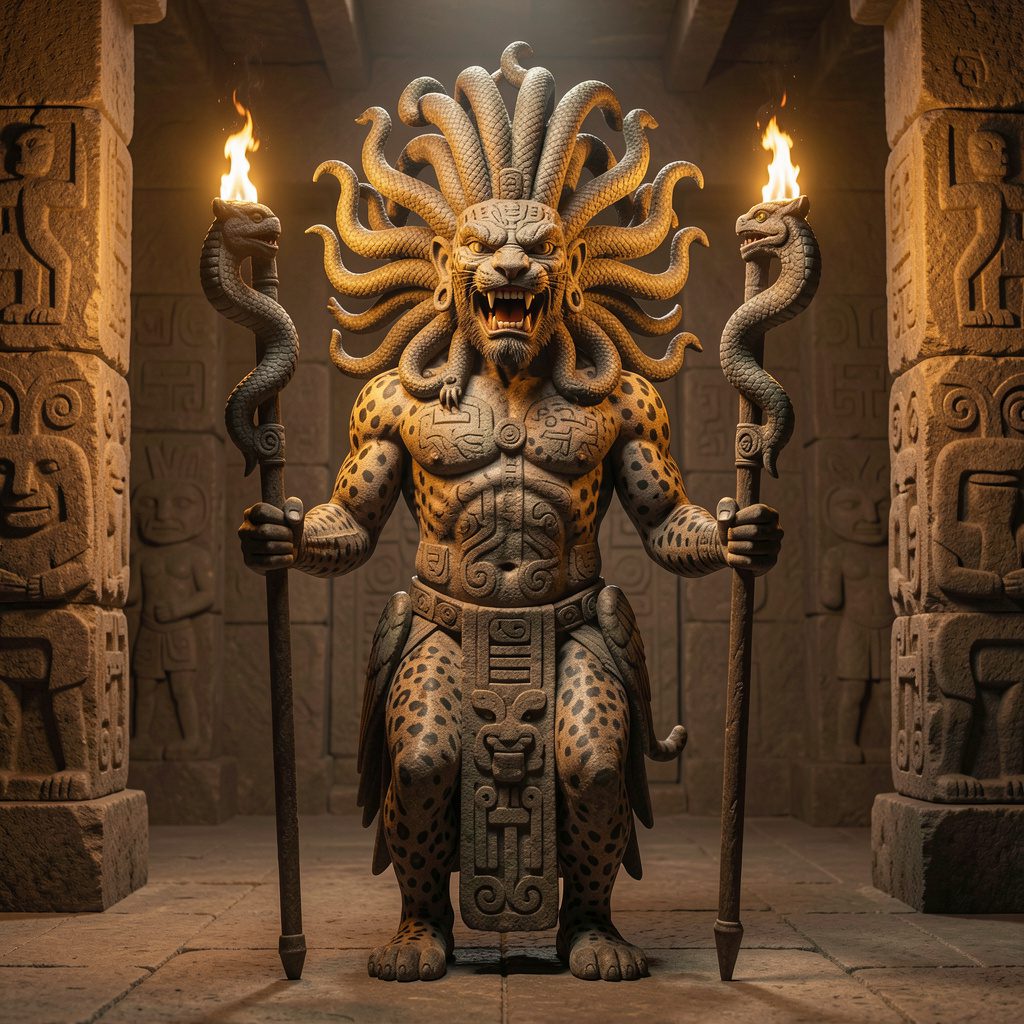
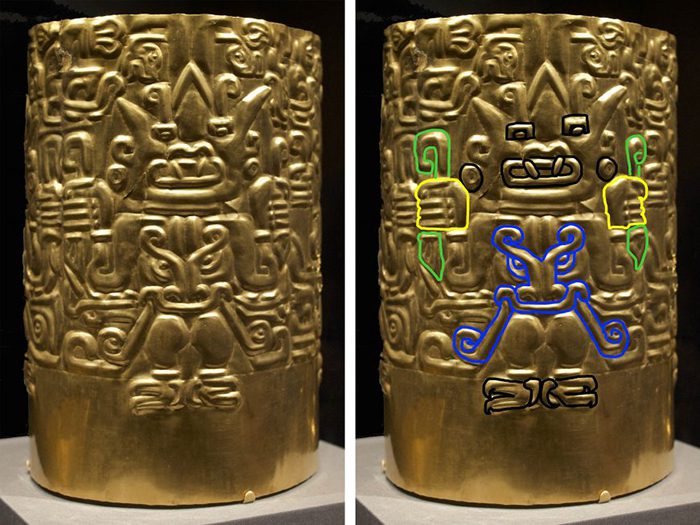
The Staff God is typically depicted as an anthropomorphic figure standing frontally while holding a staff in each hand. These staffs are usually vertical and decorated with serpentine patterns or animal heads. Their presence is the defining feature that gives the deity its modern name.
The deity’s face is often fierce and supernatural in appearance. Most representations show a wide mouth filled with sharp feline fangs, suggesting power and predatory strength. The eyes may appear large and intense, sometimes angled upward in a dramatic expression. In many carvings, the face includes layered visual patterns that allow viewers to see multiple shapes depending on how the image is viewed.
A distinctive artistic technique called contour rivalry appears in several Chavín artworks featuring the Staff God. This method uses overlapping lines and shapes to create visual illusions where one image can transform into another when viewed from a different angle. Such complexity likely had symbolic meaning, possibly reflecting hidden knowledge accessible only to initiated priests.
Animal symbolism plays a major role in the deity’s appearance. The Staff God frequently incorporates traits from powerful animals of the Andean and Amazonian ecosystems. Jaguar fangs represent terrestrial strength, serpents symbolize transformation and fertility, and birds of prey evoke the authority of the sky. In some depictions, snakes appear as hair, curling outward from the head like living strands.
Other features include talon-like hands and feet resembling those of birds or predatory animals. The headdress is often elaborate, made of swirling shapes that resemble serpents, feathers, or vegetation. Such imagery links the Staff God to multiple realms of existence: land, sky, and water.
On certain artifacts, the deity also holds symbolic shells such as Spondylus and Strombus. These marine shells were valuable ritual items in the Andes and are thought to represent gender balance and fertility. Their presence reinforces the idea that the Staff God governed cosmic harmony and the relationship between opposing forces.
Family
Unlike many mythological traditions, the religious systems of early Andean cultures rarely recorded detailed genealogies of their deities. As a result, there are no known myths describing the Staff God’s parents, consorts, or children.
Archaeological evidence suggests that the Staff God functioned as a central or supreme supernatural figure rather than part of a structured family of gods. In Chavín religious imagery, the deity appears alone or surrounded by symbolic creatures rather than divine relatives.
Some scholars have proposed connections between the Staff God and later creator figures of the Andes. For example, certain images from Tiwanaku resemble depictions of the Inca creator god Viracocha. However, these similarities remain interpretive rather than definitive evidence of lineage.
Because Chavín culture left no written texts, most knowledge about the Staff God comes from art and architecture rather than mythological narratives. For this reason, the deity’s family relationships remain unknown.
Other names
The term Staff God is a modern archaeological label rather than an ancient name. Since Chavín culture did not leave written records, the original name of this deity has not survived. In Spanish scholarship, the figure is commonly called “Dios de los Báculos,” which translates directly to “God of the Staffs.” This name refers to the staffs held in both hands in most depictions.
Several related titles appear in academic discussions. Some researchers refer to the figure on the Raimondi Stele as the Raimondi Figure. Others describe it more generally as the Central Deity of Chavín because of its importance in temple iconography. Similar staff-bearing figures also appear in the art of Tiwanaku and other Andean civilizations. Because of this continuity, historians often speak of a broader Andean Staff God tradition, rather than a single specific deity.
Powers and Abilities
The powers of the Staff God are inferred primarily from iconography and archaeological context. Although no written myths describe the deity’s actions, its symbolic features suggest several divine roles. The Staff God appears to represent cosmic authority and control over the natural world. The staffs held in each hand likely symbolize rulership or sacred power. In many cultures, staffs or scepters represent divine command, and this symbolism appears to hold true in the Andes as well.
The deity also embodies the concept of duality, which was central to Andean cosmology. Opposing forces such as life and death, male and female, sky and earth, and order and chaos were believed to exist in balance. The Staff God’s imagery often includes both destructive and creative elements, reflecting this philosophy.
Animal motifs further reinforce the deity’s connection to power. Jaguars symbolize strength and dominance, serpents represent transformation and fertility, and birds of prey suggest the ability to move between earthly and celestial realms. By combining these traits, the Staff God appears to rule over multiple layers of the cosmos.
Some scholars also associate the Staff God with agricultural fertility and seasonal cycles. The presence of marine shells and vegetation imagery hints at rituals connected to rain, crops, and sustenance. In this sense, the deity may have served as a guardian of prosperity and natural balance.
Modern Day Influence
The imagery of the Staff God continues to influence modern interpretations of Andean history and religion. Archaeologists regard the figure as one of the earliest shared religious symbols in the Americas, linking multiple ancient civilizations through a common visual tradition.
Artistic motifs derived from the Staff God appear in artifacts from cultures including Nazca, Paracas, Moche, Wari, and Tiwanaku. This continuity demonstrates how religious ideas spread across the Andes through trade, pilgrimage, and cultural exchange.
Today, the Staff God is widely displayed in museums and archaeological exhibitions that explore the ancient cultures of Peru and Bolivia. Scholars study the deity’s complex imagery to better understand the spiritual beliefs of early Andean societies.
Modern Peruvian artists and designers also draw inspiration from ancient motifs associated with the Staff God. In textiles, murals, and contemporary artworks, the ancient symbol continues to represent cultural identity and ancestral heritage. Through ongoing archaeological research, the Staff God remains an important key to understanding how religion, art, and political authority were intertwined in early Andean civilization.
Related Images

Source
Burger, R. L. (1995). Chavín and the origins of Andean civilization. Thames and Hudson.
Lumbreras, L. G. (1974). The peoples and cultures of ancient Peru. Smithsonian Institution Press.
Pillsbury, J., Potts, T., & Richter, K. N. (Eds.). (2017). Golden kingdoms: Luxury arts in the ancient Americas. Getty Trust Publications.
Rowe, J. H. (n.d.). Chavín art: An inquiry into its form and meaning. (Google Books reference).
Smarthistory. (2020). The Staff God at Chavín de Huántar and beyond. https://smarthistory.org/the-staff-god-at-chavin-de-huantar-and-beyond/
Staff God. (2004). In Wikipedia. https://en.wikipedia.org/wiki/Staff_God
World History Encyclopedia. (2015). Chavín Civilization. https://www.worldhistory.org/Chavin_Civilization/
Khan Academy. (n.d.). Complexity and vision: The Staff God at Chavín de Huántar and beyond. https://smarthistory.org/the-staff-god-at-chavin-de-huantar-and-beyond/
Frequently Asked Questions
Who was the Staff God in ancient Andean religion?
The Staff God was a powerful deity represented in the art of early Andean civilizations, especially the Chavín culture of Peru. The figure symbolized divine authority, cosmic balance, and natural forces.
Where was the Staff God worshipped?
The Staff God was prominently associated with the ceremonial center of Chavín de Huántar in Peru, though similar imagery appears in later cultures such as Tiwanaku, Nazca, and Moche.
Why is the Staff God important in Andean history?
The Staff God is one of the earliest widespread religious symbols in the Andes. Its imagery influenced multiple civilizations and provides insight into shared spiritual beliefs across ancient Andean cultures.
What does the Staff God represent?
The deity represents cosmic power, duality, and control over natural forces. Animal traits such as jaguar fangs and serpent hair symbolize strength, transformation, and fertility.
Is the Staff God the same as Viracocha?
Some scholars see similarities between the Staff God and the Inca creator deity Viracocha, but there is no direct evidence confirming they are the same figure.