


Shukra : The Brilliant Guru of the Indian Asuras and Lord of Venus
At a glance
| Description | |
|---|---|
| Origin | Indian Mythology |
| Classification | Gods |
| Family Members | Sage Bhrigu (Father), Kavyamata (Mother), Jayanti, Urjasvati (Wives), Devyani (Daughter) |
| Region | India |
| Associated With | <a class="wpil_keyword_link" href="https://mythlok.com/venus/" title="Venus : The Goddess of Love” data-wpil-keyword-link=”linked” data-wpil-monitor-id=”43753″>Venus, Wisdom, Wealth, Beauty, Love, Prosperity, Diplomacy, Resurrection, Astrology, Arts, Luxury |
The Mythlok Perspective
In Mythlok’s Perspective, Shukra is one of the most misunderstood figures in Indian mythology. Because he chose to guide the Asuras, he is often viewed through the lens of their conflicts with the Devas. Yet Shukra resembles figures like Prometheus in Greek mythology or Odin in Norse mythology, beings who pursued knowledge regardless of its consequences. His loyalty to his students never outweighed his commitment to wisdom itself. Shukra reminds us that knowledge is neither good nor evil; its true value depends on the character of the person who wields it.
Shukra
Introduction
Among the many revered sages and deities in Indian mythology, Shukra occupies a unique position. He is celebrated both as Shukracharya, the spiritual teacher of the Asuras, and as the divine personification of the planet Venus (Shukra Graha) in Hindu tradition. Unlike many mythological figures who are remembered for their strength in battle, Shukra is renowned for his wisdom, diplomacy, devotion, and extraordinary knowledge.
As one of the Navagrahas, the nine planetary deities of Hindu astrology, Shukra governs beauty, love, wealth, luxury, creativity, fertility, and harmonious relationships. His influence extends beyond mythology into astrology, religious practices, philosophy, and everyday life, making him one of the most recognized figures in Indian culture.
Although he served as the guru of the Asuras, Shukra was never portrayed as inherently evil. Instead, he represented the principle that knowledge belongs to everyone, regardless of which side they stand on. His unwavering commitment to his disciples earned him immense respect, even from the Devas, making him one of the most intellectually respected personalities in Hindu mythology.
Physical Traits
Shukra is traditionally portrayed as a radiant sage whose appearance reflects purity, wisdom, and spiritual refinement. His iconography is closely tied to the qualities of Venus, emphasizing elegance rather than martial power.
He is usually depicted wearing brilliant white garments and ornaments, symbolizing clarity, prosperity, and spiritual illumination. His complexion is often described as bright or luminous, reflecting the Sanskrit meaning of his name, which translates to “bright,” “pure,” or “clear.
Many artistic depictions show Shukra seated on a white lotus while holding a staff, prayer beads, and a lotus flower, representing discipline, meditation, and divine knowledge. Some regional traditions also portray him carrying scriptures, a bow, or a vessel filled with precious jewels to symbolize wisdom and abundance.
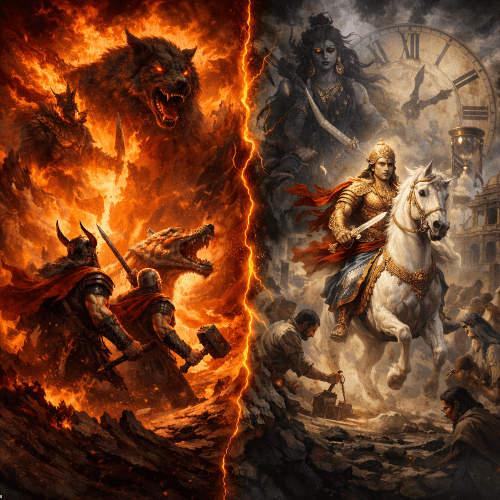
Unlike many Hindu deities with a single traditional vehicle, Shukra’s vahana varies across different texts and artistic traditions. He has been depicted riding a white horse, camel, crocodile, or even an elephant. These variations reflect the diversity of Hindu iconography rather than contradictory traditions.
Family
Shukra belongs to the illustrious Bhrigu lineage, one of the oldest and most respected families of sages in Hindu mythology. Most Puranic traditions identify him as the son of the great sage Bhrigu and Kavyamata (also called Kavya or Khyati in certain traditions). Because Bhrigu himself was one of the Saptarishis and a mind-born son of Brahma, Shukra inherited an exceptional spiritual legacy.
Different scriptures mention more than one wife, with Jayanti, the daughter of Indra, and Urjasvati (Urjaswathi) being the most commonly referenced. Such variations are common across Hindu Puranic literature.
His most famous child is Devyani, whose marriage to King Yayati became one of the defining stories in the Mahabharata and several Puranas. Through Devyani, Shukra became deeply connected to one of Indian mythology’s most important royal lineages. Despite being the teacher of the Asuras, Shukra maintained cordial relationships with sages and gods whenever righteousness demanded it, demonstrating that wisdom often transcends political alliances.
Other names
Shukra is known by several names, each highlighting a different aspect of his personality and achievements. Shukracharya is perhaps his best-known title, recognizing him as the revered teacher of the Asuras. Asuracharya and Daityaguru similarly emphasize his role as the spiritual guide of the Daityas and Asuras.
In Vedic literature, he is frequently called Ushanas or Kavi Ushanas, identifying him as an ancient sage celebrated for profound insight and poetic wisdom. He is also known as Bhargava, acknowledging his descent from the legendary sage Bhrigu. Together, these names portray Shukra not merely as a planetary deity but as one of the greatest philosophers and teachers in Hindu mythology.
Powers and Abilities
Shukra’s greatest strength has always been his intellect rather than physical might. His legendary reputation rests upon his mastery of sacred knowledge, spiritual discipline, and divine sciences. His most famous achievement was acquiring the Mrita Sanjeevani Vidya, a secret mantra granted by Lord Shiva after years of intense penance. This extraordinary knowledge enabled him to revive those who had died, allowing fallen Asura warriors to return to battle. During the wars between the Devas and Asuras, this ability dramatically shifted the balance of power and established Shukra as one of the most influential figures in the cosmic conflict.
Beyond resurrection, Shukra was an accomplished master of the Vedas, astrology, diplomacy, economics, ethics, and political science. He is traditionally credited with the Shukra Niti, an ancient treatise discussing governance, administration, and statecraft.
As the planetary deity of Venus, Shukra governs love, marriage, beauty, artistic talent, wealth, luxury, fertility, and prosperity in Vedic astrology. A strong placement of Shukra in a horoscope is traditionally associated with creativity, refined taste, harmonious relationships, and material success. His stories consistently illustrate that wisdom, patience, and strategy can often achieve what brute strength cannot.
Modern Day Influence
Shukra remains one of the most influential figures in contemporary Hindu tradition because his significance extends well beyond mythology. In Vedic astrology (Jyotisha), Shukra represents Venus and is considered one of the most benefic planetary deities. Astrologers associate his influence with romance, marriage, artistic expression, financial prosperity, luxury, beauty, and social harmony. His planetary position continues to play a major role in horoscope readings across India.
Friday, known as Shukravar, is dedicated to him. Many devotees observe fasts and perform prayers on this day to seek blessings for prosperous relationships, successful marriages, financial stability, and creative growth.
Shukra also appears regularly in television serials, devotional literature, mythological books, and educational content exploring Hindu epics and Puranas. His role as the guru of the Asuras has become a powerful reminder that knowledge itself is morally neutral. It is the intentions of the student—not the teacher—that determine how wisdom is ultimately used. His enduring popularity reflects the timeless importance of education, discipline, and ethical responsibility in Indian philosophy.
Related Images





Source
Wikipedia contributors. (n.d.). Shukra. Wikipedia. https://en.wikipedia.org/wiki/Shukra
Hindupedia. (2023, June 11). Shukra. https://hindupedia.com/en/Shukra
Koyil. (n.d.). Sukran (Venus) – Nava Grahas. https://koyil.com/sukran.html
APAM Napat. (2024, October 1). Shukra – The Guru of the Asuras – Indian Mythology. https://apam-napat.com/shukracharya/
Vedic Astro. (n.d.). The story of Shukra or Venus. https://vedicastro.com/planet-story-venus.aspx
Wisdomlib. (2019, January 27). Story of Śukra. https://www.wisdomlib.org/hinduism/compilation/puranic-encyclopaedia/d/doc241989.html
Mani, V. (1975). Puranic Encyclopaedia. Delhi: Motilal Banarsidass.
Tagare, G. V. (1988). The Bhagavata Purana. Delhi: Motilal Banarsidass.
Kane, P. V. (1930). History of Dharmashastra. Pune: Bhandarkar Oriental Research Institute.
Bhattacharya, N. N. (1996). History of the Tantric Religion. New Delhi: Manohar Publishers.
Frequently Asked Questions
Who is Shukra in Indian mythology?
Shukra is the guru of the Asuras, the planetary deity of Venus, and one of the Navagrahas in Hindu tradition. He is revered for his wisdom, knowledge, and mastery of sacred sciences.
Why is Shukra called the guru of the Asuras?
Shukra served as the spiritual teacher and advisor to the Asuras, providing them with education, discipline, diplomacy, and divine knowledge while remaining committed to the ideals of a true teacher.
What is the Mrita Sanjeevani Vidya?
It is a divine mantra that Shukra obtained from Lord Shiva after severe penance. The mantra enabled him to revive the dead, making it one of the most powerful abilities in Hindu mythology.
What does Shukra represent in Hindu astrology?
As the deity of Venus, Shukra governs love, marriage, beauty, luxury, creativity, wealth, fertility, artistic talent, and harmonious relationships.
Why is Friday associated with Shukra?
Friday, or Shukravar, is dedicated to Shukra in Hindu tradition. Devotees worship him on this day to seek prosperity, successful relationships, financial well-being, and happiness.


