

Rán : The Norse Sea Goddess of Death and the Ocean Depths
At a glance
| Description | |
|---|---|
| Origin | Norse Mythology |
| Classification | Gods |
| Family Members | Ægir (husband), Nine wave daughters, Snær (in some traditions) |
| Region | Iceland, Norway |
| Associated With | Ocean, Sea, Drowning, Fate, |
The Mythlok Perspective
In Mythlok’s Perspective, Rán represents the ocean not as a setting, but as a living force that demands respect. She is less a villain and more a reminder that nature operates beyond human morality. Similar to figures like the Greek sea spirits who claim sailors or the Japanese sea yokai that lure ships to their doom, Rán reflects a universal truth. Across cultures, the sea is never just water; it is a boundary between life and the unknown.
Rán
Introduction
Rán is one of the most haunting figures in Norse tradition, a goddess who personifies the deep, unpredictable ocean. She appears in early sources such as the Poetic Edda, Prose Edda, skaldic poetry, and several sagas, where she is consistently linked with death at sea. Unlike many divine figures who protect or guide humans, Rán represents the inevitable power of nature that cannot be controlled.
She dwells beneath the ocean in a hall shared with her husband Ægir, where even the gods are said to gather for feasts. Yet her presence carries a darker tone. For Norse seafarers, the ocean was both a source of wealth and a constant threat, and Rán embodied that tension. She is not merely a sea deity but a force that claims lives, treasures, and ships without warning.
Physical Traits
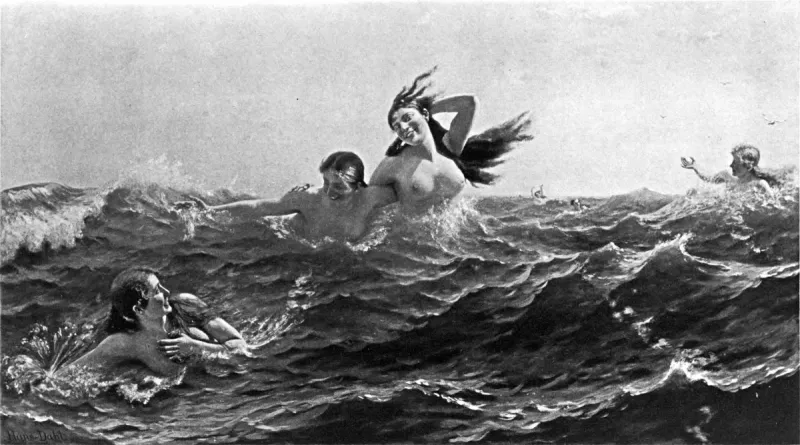
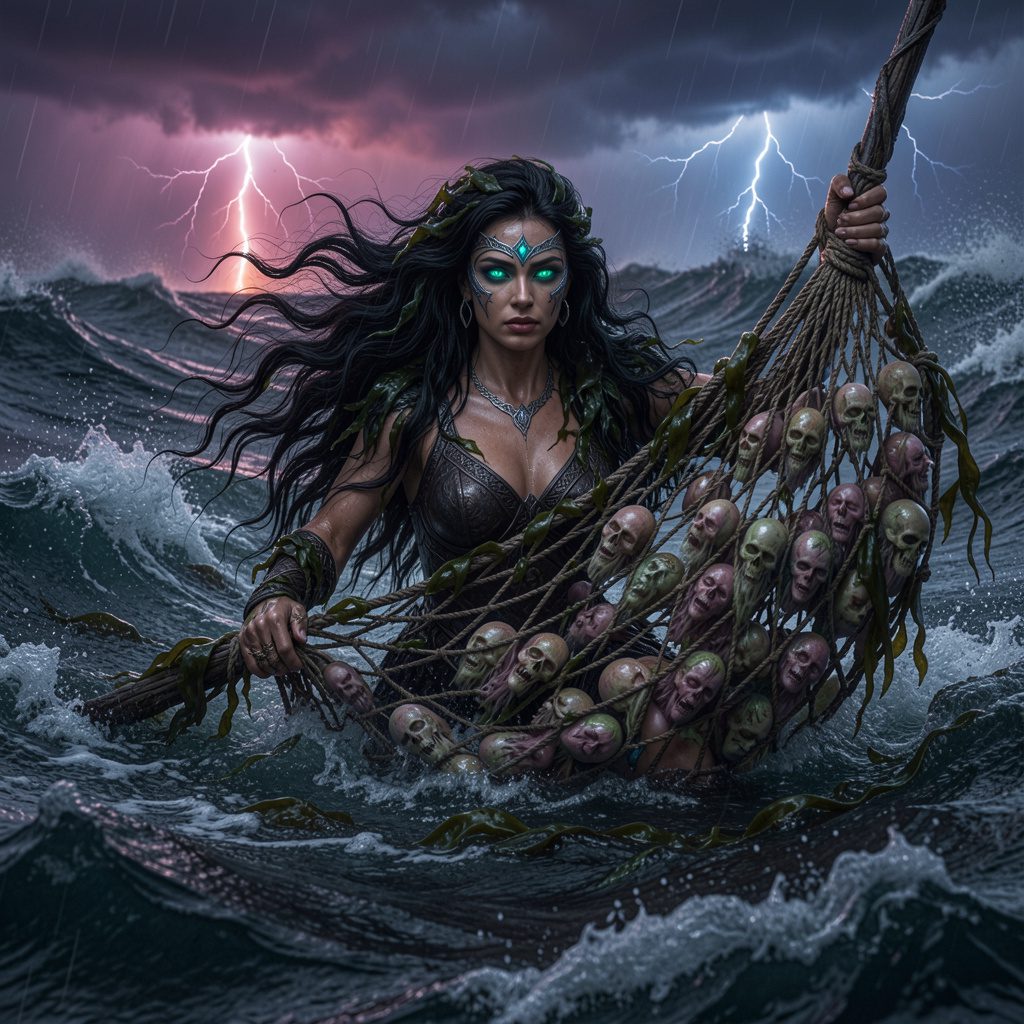
There is no clear physical description of Rán in early Norse texts. Unlike gods such as Thor or Odin, whose appearances are occasionally detailed, Rán is defined more by her presence and actions than by her form. What truly identifies her is her net, an object that becomes her symbolic extension. This net represents inevitability, suggesting that once caught, escape is impossible. Skaldic poetry often refers to the ocean itself through kennings like “Rán’s hall” or “Rán’s bed,” reinforcing the idea that her domain is not just a place, but a consuming force. Later artistic interpretations have imagined her as a mysterious sea woman, sometimes with flowing dark hair or oceanic features. However, these depictions are modern inventions rather than rooted in original sources.
Family
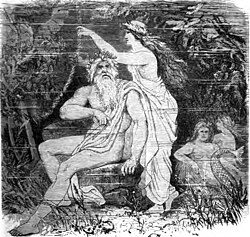
Rán belongs to a powerful family of natural forces. She is married to Ægir, a jötunn associated with the sea’s calmer and more hospitable side. Together, they represent two contrasting aspects of the ocean: Ægir as the welcoming host, and Rán as the unseen danger beneath the surface.
They have nine daughters, each personifying waves. Their names, recorded in the Prose Edda, are poetic expressions of the sea’s movement and behavior. These daughters are sometimes linked by scholars to the Nine Mothers of Heimdallr, though this connection remains debated.
Some traditions also associate Rán with other elemental figures, including Snær, who represents snow. These relationships place her within a broader mythological network where sea, wind, fire, and frost are interconnected forces shaping the world.
Other names
Rán’s name comes directly from the Old Norse word meaning “plundering” or “robbery.” This is not just a title but a definition of her nature. The sea, in Norse thought, did not simply take lives—it stole them, along with ships and riches.
Instead of alternative names, Rán appears in poetic language through kennings. Expressions like “Rán’s land” or “Rán’s way” were commonly used to describe the ocean. She is also referred to indirectly as “Ægir’s wife,” emphasizing her role within the maritime divine pair.
Powers and Abilities
Rán’s most defining ability is her use of a magical net. With it, she captures sailors and drags them into the depths, symbolizing death by drowning. This net appears in multiple sources, including a tale where Loki borrows it to capture the dwarf Andvari. Beyond this, Rán is closely tied to fate. Those lost at sea were often believed to have fallen into her grasp, suggesting that her actions were not random but part of a larger cosmic inevitability.
She is also associated with wealth beneath the sea. Gold is sometimes described in kennings as “Rán’s fire,” referencing the treasure hidden in shipwrecks. This duality—death and riches—reflects the ocean’s role as both destroyer and keeper of secrets. In some interpretations, she rules over the drowned dead, making her not just a force of nature but a guardian of a shadowy underwater realm.
Modern Day Influence
Rán continues to influence modern storytelling, particularly in fantasy and myth-inspired media. She appears in contemporary literature, including reinterpretations of Norse myths, where she is often portrayed as a dark and powerful sea goddess.
Her character has also inspired video games and comics, where themes of water control, soul collection, and maritime danger are central to her depiction. While these portrayals sometimes expand her abilities beyond original sources, they remain rooted in her core identity as a force of the ocean. In art and symbolism, Rán represents the idea that nature is neither purely benevolent nor entirely hostile. Her net, in particular, has become a lasting metaphor for inevitability, capturing the human fear of forces beyond control.
Related Images
Urban Legends
Mythical Events

Source
Larrington, C. (Trans.). (2014). The Poetic Edda. Oxford University Press. https://en.wikipedia.org/wiki/Poetic_Edda
Snorri Sturluson. (1995). Edda (A. Faulkes, Trans.). Everyman. (Original work published ca. 1220).
https://en.wikipedia.org/wiki/Prose_Edda
Simek, R. (2007). Dictionary of Northern Mythology (A. Hall, Trans.). D.S. Brewer. https://en.wikipedia.org/wiki/R%C3%A1n
Byock, J. (1990). The Saga of the Volsungs. University of California Press. https://en.wikipedia.org/wiki/R%C3%A1n
Orchard, A. (1997). Dictionary of Norse Myth and Legend. Cassell. https://norse-mythology.org/gods-and-creatures/giants/aegir-and-ran/
Davidson, H. R. E. (1993). The Lost Beliefs of Northern Europe. Routledge. https://www.encyclopedia.com/humanities/news-wires-white-papers-and-books/norse-mythology
Gaiman, N. (2017). Norse Mythology. W.W. Norton & Company. https://mythicalcreatures.blog/ran-the-norse-goddess-of-the-sea-pics-and-facts/
Riordan, R. (2015). The Sword of Summer. Disney-Hyperion. https://riordan.fandom.com/wiki/Ran
Frequently Asked Questions
Who is Rán in Norse tradition?
Rán is a sea goddess associated with drowning, ocean depths, and the capture of sailors using her magical net.
What does Rán’s net symbolize?
Her net represents inevitability and death at sea, symbolizing how the ocean claims those who enter it.
Is Rán evil or neutral?
Rán is not purely evil but represents the dangerous and uncontrollable aspects of nature.
Who is Rán’s husband?
She is married to Ægir, a sea-associated jötunn who represents a more hospitable side of the ocean.
What happens to those taken by Rán?
They are believed to dwell in her underwater realm, making her a ruler of the drowned.