


Sol : The Norse Sun Goddess of Light and Fate
At a glance
| Description | |
|---|---|
| Origin | Northern European Mythology |
| Classification | Gods |
| Family Members | Mundilfari (Father), Máni (Brother), Glenr (Husband), Álfröðull (Daughter) |
| Region | Norway, Iceland, Denmark, Sweden, Germany |
| Associated With | Sun, Light, Warmth, Time cycles, Renewal |
The Mythlok Perspective
In Mythlok’s Perspective, Sol stands at the intersection of Norse and wider Germanic belief, representing a shared understanding of the sun as both constant and vulnerable. Unlike Helios who commands the sky or Surya who embodies divine authority, Sol is defined by motion and pursuit. Her story reflects a uniquely Northern worldview where even the most essential forces are bound by fate. Yet her legacy is not one of defeat, as her light continues through her daughter, echoing cycles of renewal found across cultures.
Sol
Introduction
Sol is the radiant sun goddess found in both Norse and wider Germanic traditions, embodying the life-giving force of the sun itself. While she is most widely known from Old Norse texts like the Poetic Edda and Prose Edda, her roots extend deeper into earlier Germanic belief systems where she appears under the name Sunna. This continuity reveals that Sol is not just a regional figure, but part of a much older and shared cultural understanding of the sun as a divine feminine power.
In these traditions, the sun is not a distant celestial object but a living entity that moves across the sky with purpose. Sol’s daily journey brings light, warmth, and structure to the world, shaping time and sustaining life. Yet her story is not simply one of stability. It carries an underlying tension, as she is constantly pursued by a cosmic predator, reminding us that even the most essential forces are bound by fate.
Physical Traits
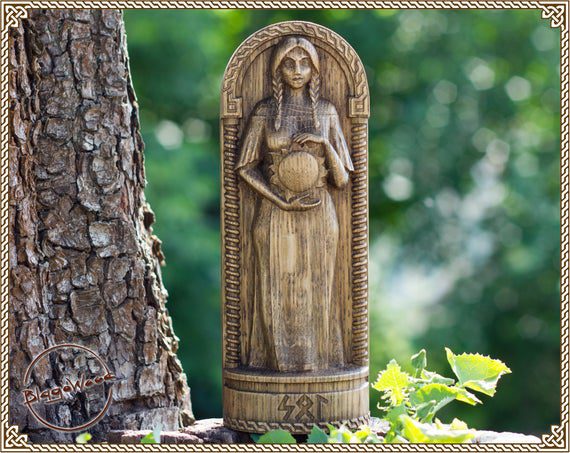
Sol is rarely described with fixed human features in early sources, reflecting how closely she is identified with the sun itself. Rather than being portrayed as a separate figure, she is often understood as the radiant body of the sun in motion. Norse poetry emphasizes her brilliance and intensity, presenting her as a force of light rather than a static goddess.
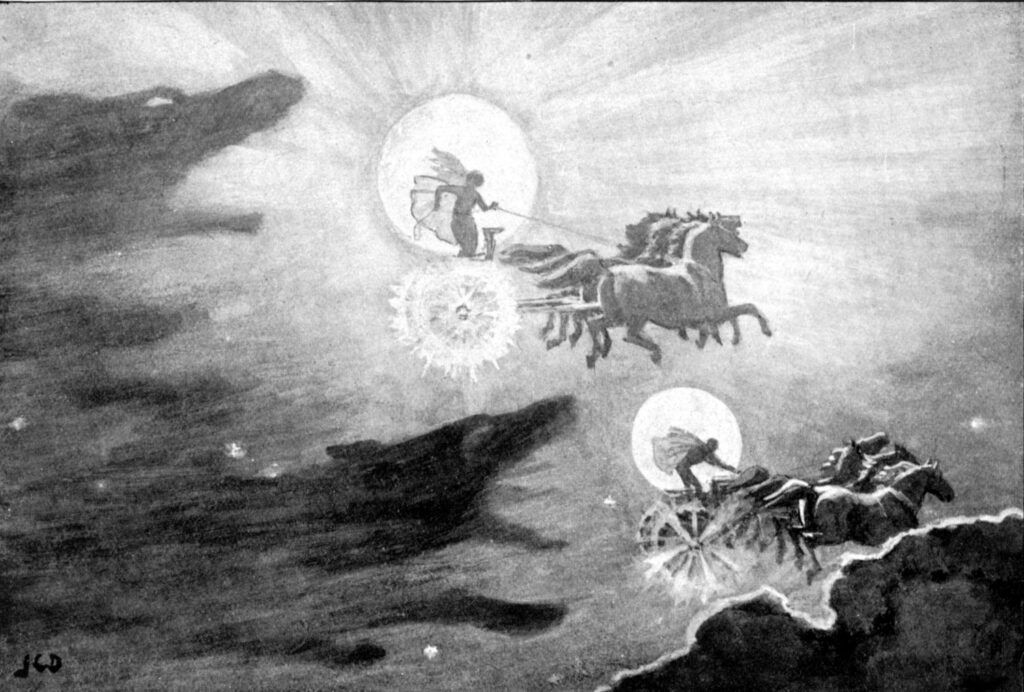
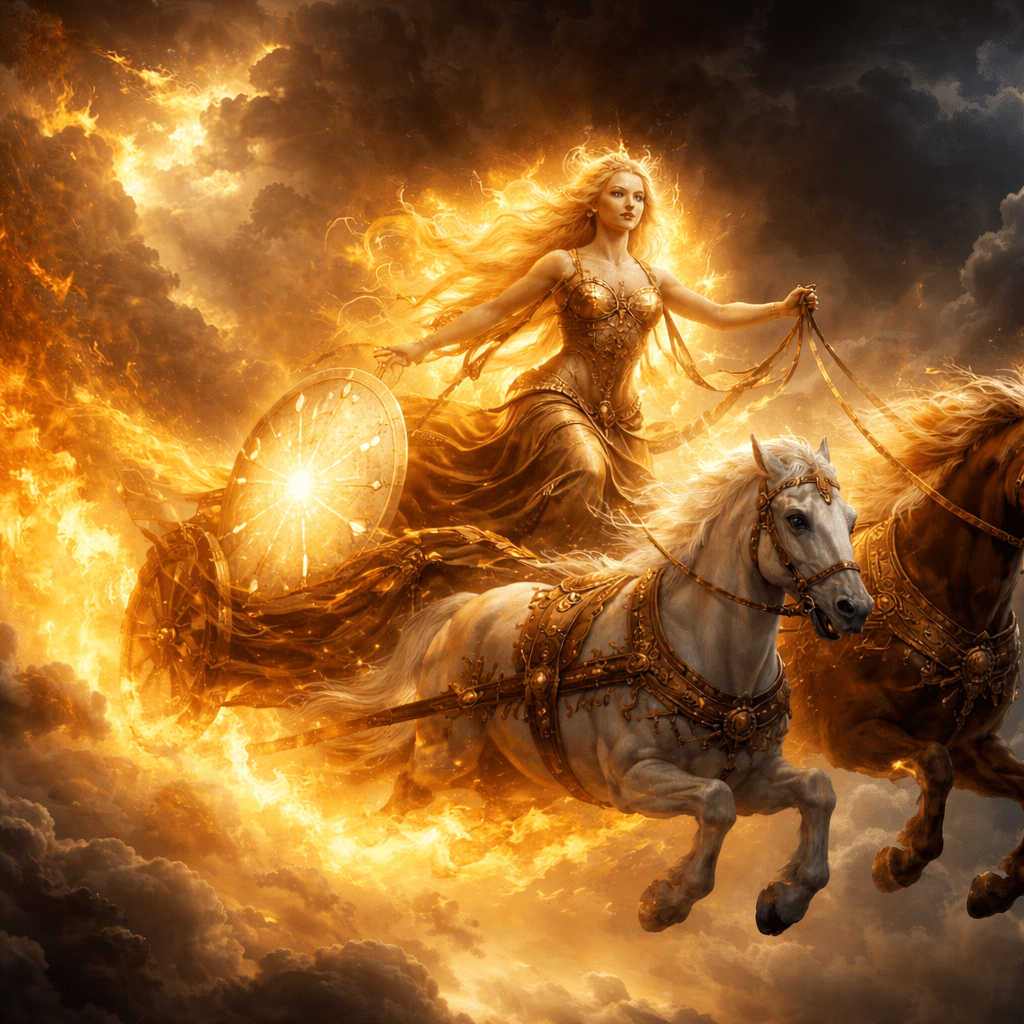
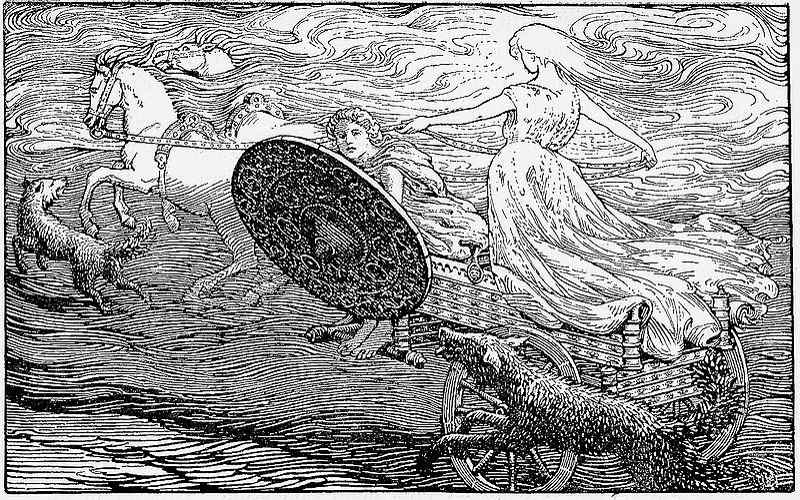
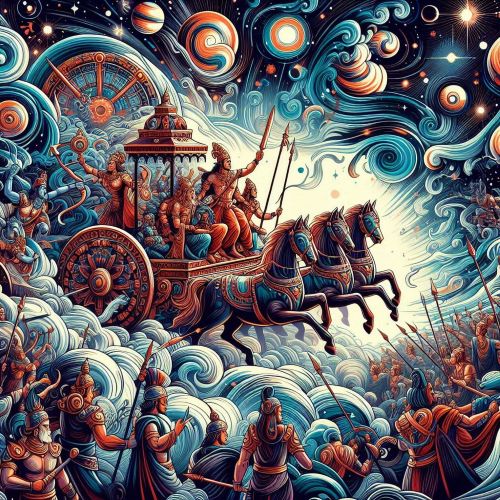
In later interpretations influenced by both Norse and Germanic traditions, Sol is imagined as a luminous female figure surrounded by a golden aura. She is typically depicted riding a blazing chariot across the sky, pulled by the horses Árvakr and Alsviðr. These horses symbolize speed and the rhythm of dawn, reinforcing the idea of constant motion.
A protective shield called Svalinn is placed before her chariot to prevent the earth from being consumed by her heat. This detail highlights a key aspect of her nature. Sol is both nurturing and dangerous, capable of sustaining life while also holding immense destructive potential if left unchecked.
Family
Sol’s familial connections reflect her role within the cosmic order. She is the daughter of Mundilfari, a figure associated with movement, cycles, and possibly the regulation of time. This link suggests that her existence is tied directly to the structure of the universe.
Her brother, Máni, personifies the moon. Together, they form a celestial pair responsible for maintaining the balance between day and night. Their roles are complementary, ensuring that time flows in a predictable and ordered manner.
Sol is also said to be married to Glenr, although little is known about him. More significantly, she is the mother of a daughter named Álfröðull. This daughter becomes crucial in the continuation of the cosmic cycle, especially after the events of Ragnarök, ensuring that the sun’s light never truly disappears from existence.
Other names
The name Sol comes from Old Norse and directly means “sun,” reflecting her complete identification with the solar body. In broader Germanic traditions, she is known as Sunna, a name preserved in Old High German sources and later revived in modern interpretations of Germanic belief systems.
These variations are not separate deities but linguistic expressions of the same solar figure across different regions. The shared Indo-European roots of these names connect Sol to a wider family of sun deities, including figures like Helios in Greek tradition and Surya in Indian belief. In poetic language, Sol is described through kennings such as the daughter of Mundilfari and the fire of the sky. These epithets emphasize her brilliance, origin, and her role as the bringer of daylight.
Powers and Abilities
Sol’s primary function is to guide the sun across the sky, creating the cycle of day and night. This role places her at the center of cosmic order, as her movement defines time, seasons, and the rhythm of life itself.
Her chariot, drawn by Árvakr and Alsviðr, moves swiftly across the heavens. The presence of Svalinn as a protective shield illustrates the immense intensity of her power. Without it, her heat would overwhelm the world, reinforcing the idea that her energy must be carefully balanced.
One of the most defining elements of her myth is the relentless pursuit by the wolf Sköll. This chase represents the inevitability of fate within Norse and Germanic cosmology. No matter how constant or powerful she is, Sol cannot escape her destiny.
During Ragnarök, this fate is fulfilled when Sköll finally catches and devours her, plunging the world into darkness. However, the myth does not end there. Her daughter Álfröðull rises to take her place, continuing the cycle of light. This transition transforms Sol’s story into one of renewal, where destruction leads to rebirth rather than finality.
Modern Day Influence
Sol’s legacy extends far beyond ancient texts, continuing to influence modern spiritual, cultural, and artistic expressions. In contemporary Germanic and Norse pagan practices, she is honored as a symbol of vitality, clarity, and daily renewal. Her journey across the sky is often seen as a metaphor for perseverance and continuity.
In modern media, Sol appears as a radiant solar figure, frequently depicted in motion or in conflict with shadowy forces. This imagery resonates with universal themes of endurance, inevitability, and transformation.
Her name also survives in modern languages and naming traditions, particularly in Scandinavian cultures. The enduring presence of Sol or Sunna in these contexts reflects a lasting cultural memory of the sun as a divine and feminine force.
Related Images


Source
Faulkes, A. (Trans.). (1995). Snorri Sturluson: Edda (Prose Edda). London: Everyman.
Orchard, A. (2011). Cassell’s encyclopedia of Norse myth and legend. London: Orion.
Vikingr. (2023). Sól (Sunna) – The Sun Goddess from Norse mythology. Retrieved 2025, March 23, from
https://vikingr.org/norse-gods-goddesses/sol
The Elementalmind. (2026). Sól: The Norse sun goddess and her cosmic role. https://theelementalmind.com/2026/01/26/sol-the-norse-sun-goddess-and-her-cosmic-role/
Gods and Goddesses. (n.d.). Sol – Norse sun goddess. https://godsandgoddesses.org/norse/sol/
Spells8. (2023). Sól, the shining Norse goddess: Symbols and mythology. https://spells8.com/lessons/sol-norse-goddess-symbols/
Thalia Took. (n.d.). Sunna, Norse Sun Goddess and Sol, the Norse Goddess of the Sun. https://www.thaliatook.com/AMGG/sunna.php
Frequently Asked Questions
Is Sol the same as Sunna?
Yes, Sol and Sunna are different names for the same sun goddess across Norse and Germanic traditions.
What mythology does Sol belong to?
She belongs to both Norse mythology and the broader Germanic mythological tradition.
Why is Sol important?
Sol represents the sun, making her essential to life, timekeeping, and cosmic order.
Who chases Sol across the sky?
She is pursued by the wolf Sköll, who eventually catches her during Ragnarök.
What happens after Sol is destroyed?
Her daughter, Álfröðull, takes her place, continuing the cycle of the sun.