


Raluvhimba : The Venda Creator God and Master of Rain and Storms
At a glance
| Description | |
|---|---|
| Origin | Venda Mythology |
| Classification | Gods |
| Family Members | N/A |
| Region | South Africa |
| Associated With | Creation, Rain, Thunder, Lightning, Sky |
The Mythlok Perspective
In Mythlok’s Perspective, Raluvhimba represents a very different model of divine power from anthropomorphic gods such as Zeus or Thor. His authority is not primarily expressed through weapons or heroic adventures, but through rain, storms, sky and creation itself. That makes Raluvhimba especially important for understanding Venda spirituality: the divine is not necessarily separate from nature, but encountered through the environment and the forces upon which human life depends.
Raluvhimba
Introduction
Raluvhimba is a supreme deity in the traditional religion of the Vhavenda people of southern Africa, particularly communities historically associated with the Limpopo region of South Africa and neighbouring areas of Zimbabwe. He is described in ethnographic and scholarly sources as a powerful creator deity whose influence extends across the natural and spiritual worlds. Rather than being represented through a fixed human-like form, Raluvhimba is understood through the forces and signs of nature, especially rain, thunder, lightning and other atmospheric or celestial phenomena.
Raluvhimba occupies an important position in Venda ideas about the relationship between the divine world, nature, ancestors and human communities. Rain is particularly significant because agriculture and community wellbeing depend on it. Traditional rainmaking practices therefore formed an important connection between the community, its ancestors and the supreme deity.
The name Raluvhimba is also closely connected with Nwali or Mwali in a number of sources. Some scholars and cultural sources treat Raluvhimba and Nwali as names for the same supreme being, while other scholarship distinguishes aspects of their traditions. This means that it is more accurate to describe the relationship as a traditional and scholarly identification rather than claiming that every Venda tradition understands the two names in exactly the same way.
Raluvhimba is therefore best understood within the wider Venda religious system rather than as a member of a large pantheon of gods. His importance comes from his position as a supreme creator and from the way his presence is perceived through the world around the Vhavenda.
Physical Traits
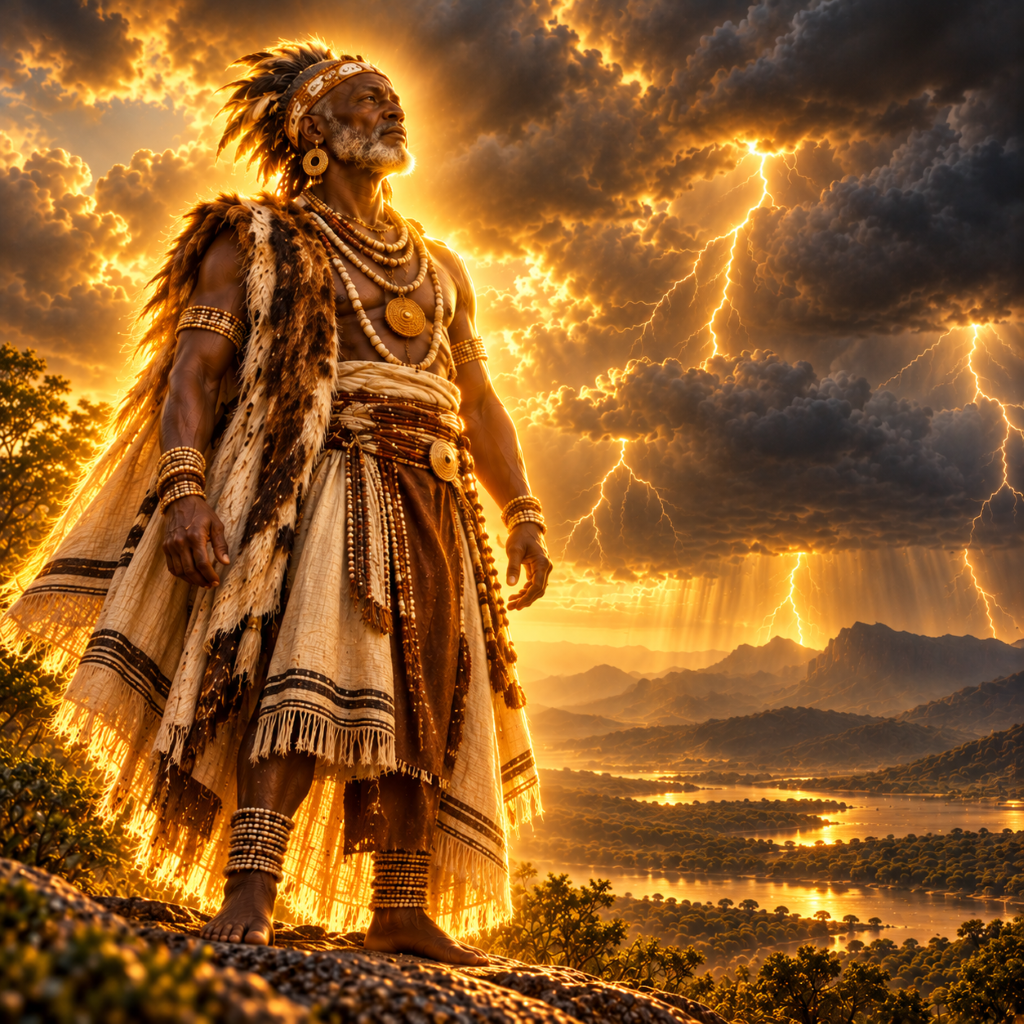
Available Venda ethnographic sources do not provide Raluvhimba with a consistent human-like physical appearance. There is no reliable description establishing his height, facial features, clothing, age or bodily form. Instead, Raluvhimba is encountered through manifestations in the natural world. Thunder and lightning are particularly important expressions of his presence. In traditional interpretations, thunder could represent Raluvhimba’s voice, while storms could communicate his power or displeasure. Rain was likewise associated with his ability to sustain life and agriculture.
Some accounts describe Raluvhimba appearing as a great flame on a rock platform above a cave at Luvhimbi, accompanied by the sound of clanking iron. The account comes from older ethnographic material, although later scholarship has questioned aspects of the association between Raluvhimba and the Luvhimbi cave. It is therefore better treated as a recorded tradition rather than an uncontested historical fact.
Other traditional descriptions connect Raluvhimba with celestial signs. Some sources describe a shooting star as Raluvhimba travelling across the sky, while eagles soaring overhead have also been interpreted as manifestations or signs associated with the deity. Clouds covering particular mountains could similarly be understood as signs of his presence. These traditions make Raluvhimba unusual in comparison with gods who possess clearly defined bodies. His identity is instead expressed through sky, weather, fire and celestial phenomena.
Family
Raluvhimba is not described in the available sources as belonging to a conventional divine family. There are no consistently documented parents, spouse, children or siblings associated with him. His status as a supreme creator places him at the top of the Venda spiritual hierarchy rather than within a genealogy of competing gods.
The most important relationships surrounding Raluvhimba are therefore religious rather than familial. Ancestors, commonly understood within the broader Venda spiritual system as intermediaries between humans and the divine, occupy an important position in communication with the supreme deity. Traditional rainmaking illustrates this relationship particularly clearly. Requests for rain could involve rituals directed through ancestral powers toward Raluvhimba, who was regarded as the ultimate source of rain.
Traditional leaders also had an important ritual relationship with Raluvhimba. Historical accounts associate chiefs with ceremonies connected with rain and communal welfare. This made the deity relevant not only to religious life but also to traditional authority and the wellbeing of the wider community. Consequently, Raluvhimba’s spiritual network is better understood as a hierarchy connecting the supreme deity, ancestors, ritual specialists, chiefs and ordinary members of the community rather than as a divine family tree.
Other names
Raluvhimba is associated with several names in Venda and neighbouring religious traditions. Nwali, also written as Ṅwali, is particularly important. Contemporary scholarship on Venda religion identifies Nwali or Mwali as a major traditional name for the supreme being, while other sources explicitly describe Raluvhimba as another name or local equivalent.
Mwali is closely related to Mwari, the name used for the supreme deity in Shona religious traditions. Historical interaction between Venda and Shona-speaking communities contributed to overlapping religious traditions and terminology across the region. Some sources consequently identify Raluvhimba with Mwari, while others distinguish particular cults and traditions.
Khuzwane is another divine name recorded within Venda religious traditions. Scholarly discussions also mention names such as Mutumbukavhathu and Musikavhathu in connection with Venda understandings of the supreme creator. These names should not automatically be treated as separate gods; in many contexts they function as names, titles or descriptions of the supreme divine being.
There is also an important modern theological debate concerning the relationship between Raluvhimba, Nwali and Jehovah. Some contemporary Venda Christian writing identifies traditional divine names with the Christian God, while scholars have pointed out that these identifications developed through processes of translation and religious interpretation. The relationship should therefore be presented as a history of cultural interpretation rather than as evidence that the traditions were originally identical.
Powers and Abilities
Raluvhimba is primarily associated with creation, rain and control over powerful natural phenomena. As a supreme creator, he is credited with the creation and ordering of existence. His authority is not limited to one particular aspect of nature but extends across the physical and spiritual realms. Rain is one of his most important associations. In the Venda environment, dependable rainfall has profound implications for crops, livestock and community survival. Traditional beliefs therefore connected Raluvhimba with rainmaking and regarded him as the ultimate source of rain. Chiefs and ritual specialists could perform ceremonies seeking favourable conditions.
Thunder and lightning are also central to his character. Thunder could be understood as Raluvhimba communicating with people, while lightning and storms demonstrated his supernatural power. Some accounts extend this relationship to droughts, floods, epidemics, locusts and other disruptive natural events. These should be understood as traditional interpretations of environmental events rather than as universally shared beliefs among all Vhavenda.
Raluvhimba is additionally associated with celestial phenomena such as shooting stars and meteors. These observations reinforced his identity as a deity connected with the heavens. His power is therefore expressed less through heroic battles or physical combat and more through creation, weather, celestial signs and the forces that sustain or threaten life.
Modern Day Influence
Raluvhimba continues to have significance in discussions of Venda religious identity, indigenous knowledge and the relationship between traditional African belief systems and Christianity. Many Vhavenda today are Christian, yet traditional concepts concerning the supreme deity, ancestors, sacred landscapes and ritual practices remain important subjects of cultural and academic discussion.
One of the most significant modern questions concerns how traditional Venda names for the supreme being were incorporated into Christian language. Contemporary Tshivenda theological writing discusses names such as Raluvhimba and Nwali in relation to the Christian concept of God. At the same time, scholars have warned against assuming that traditional Venda concepts and Christian theology are automatically identical.
Raluvhimba also remains relevant through the preservation of Venda oral traditions, historical scholarship and research into sacred landscapes. Mountains, caves, forests, lakes and other natural locations continue to feature prominently in discussions of Venda spirituality and cultural heritage. Research on Venda traditional ecological knowledge similarly demonstrates how religious ideas have historically been connected with environmental understanding and community practices.
Unlike many internationally popular mythological figures, Raluvhimba has not become a major character in mainstream film, television or video games. His contemporary importance is instead found in Venda cultural identity, religious studies, indigenous knowledge, oral tradition and scholarship on African religions.
For students of comparative mythology, Raluvhimba is especially significant because his traditions demonstrate how a supreme deity can be understood through landscape and natural phenomena rather than through an elaborate anthropomorphic form. His story also illustrates how religious traditions evolve as communities encounter new languages, religions and cultural interpretations while retaining older concepts of the divine.
Related Images

Source
Benso/RAU. (1979). The Independent Venda. Pretoria, South Africa: Bureau for Economic Research, Co-operation and Development.
Encyclopedia.com. (2018). Venda. In Encyclopedia of World Cultures Supplement. Retrieved October 9, 2026, from https://www.encyclopedia.com/humanities/encyclopedias-almanacs-transcripts-and-maps/venda
Godchecker. (2018, November 2). RALUVHIMBA – the Venda Supreme God (African mythology). Retrieved October 9, 2026, from https://www.godchecker.com/african-mythology/RALUVHIMBA/
Hanisch, E. O. M. (2018). Venda. In Encyclopedia of World Cultures Supplement. Encyclopedia.com. https://www.encyclopedia.com/humanities/encyclopedias-almanacs-transcripts-and-maps/venda
Stayt, H. A. (1968). The Bavenda (Reprint ed.). London, England: Frank Cass and Co. (Original work published 1931)
University of Pretoria. (2009). Understanding the Christian message in Venda: A study of the traditional concepts of God and of life hereafter among the Venda, with reference to the impact of these concepts on the Christian churches [Doctoral dissertation]. University of Pretoria Repository.
https://repository.up.ac.za/items/63332132-b2fc-47d2-8f91-d60dd2d374b0
Van Warmelo, N. J. (1932). Contributions towards Venda history, religion and tribal rituals. Ethnological Publications, 3. Pretoria, South Africa: Department of Native Affairs, Government Printer.
Frequently Asked Questions
Who is Raluvhimba in Venda mythology?
Raluvhimba is a supreme creator deity of Venda tradition, associated with creation, rain, thunder, lightning and the forces of nature.
What is Raluvhimba the god of?
Raluvhimba is associated mainly with creation, rain, storms, thunder, lightning and celestial phenomena within traditional Venda religion.
Is Raluvhimba the same as Nwali?
Many sources identify Raluvhimba with Nwali or Mwali, although scholars note variations in how these traditions distinguish or connect the two names.
What does Raluvhimba look like?
Venda traditions do not give Raluvhimba a consistent human appearance. He is instead represented through natural signs such as storms, thunder, lightning and celestial events.
Is Raluvhimba still worshipped today?
Raluvhimba remains important in Venda cultural and religious discussions, although many Vhavenda today practise Christianity alongside or instead of traditional religious practices.


