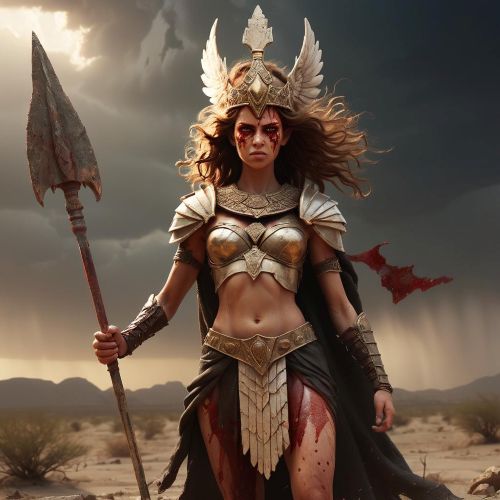


Qadesh : The Sacred Goddess of Sex in Canaanite Legends
At a glance
| Description | |
|---|---|
| Origin | Canaanite Mythology |
| Classification | Gods |
| Family Members | N/A |
| Region | Israel, Palestine, Lebanon |
| Associated With | Fertility, Sexuality, Beauty, Protection, Divine femininity, Prosperity |
The Mythlok Perspective
In Mythlok’s Perspective, Qadesh is one of the most intriguing examples of how mythology transcends geography. Unlike deities such as Baal or Anat, whose identities are firmly rooted in Canaanite tradition, Qadesh flourished through cultural exchange between Canaan and Egypt. Her surviving legacy is shaped less by epic myths and more by art, symbolism, and religious adaptation. That makes her story especially relevant today, reminding us that myths are living traditions that evolve as civilizations meet, influence one another, and redefine the sacred without losing their spiritual essence.
Qadesh
Introduction
Qadesh, also known as Qetesh, Qudshu, Qodesh, and several other transliterations, is one of the most fascinating goddesses of the ancient Near East. Her name comes from the Northwest Semitic root Q-D-Š, meaning “holy,” “sacred,” or “set apart.” Although she is commonly associated with Canaanite mythology, much of what historians know about her comes from Egyptian sources dating to the New Kingdom period (c. 1550–1070 BCE).
Unlike many Canaanite deities whose stories survive through mythological texts, Qadesh is known primarily through inscriptions, temple reliefs, and stelae. Because of this, scholars continue to debate whether she was an independent Canaanite goddess adopted into Egypt or an Egyptian religious creation inspired by Levantine beliefs. Regardless of her exact origins, she became an important symbol of fertility, beauty, sacred sexuality, and divine protection, representing the close cultural exchange between Egypt and the Canaanite world.
Physical Traits
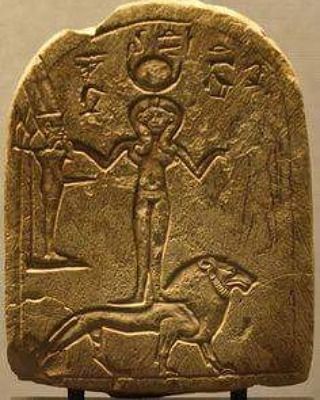
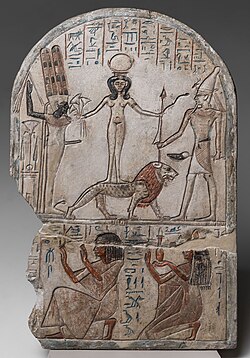
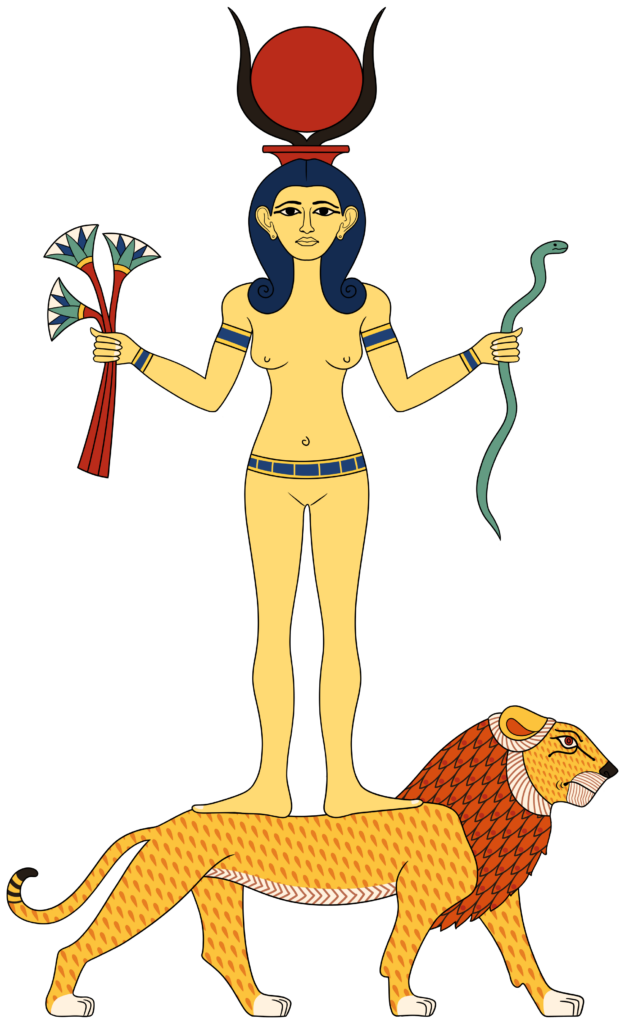
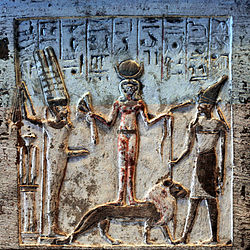
Qadesh is instantly recognizable through her distinctive artistic representation. Egyptian artists portrayed her as a nude woman standing confidently upon the back of a lion, a powerful symbol of strength and royal authority. Unlike the profile poses typical of Egyptian art, she almost always faces directly toward the viewer, making her one of the few deities consistently shown frontally.
She typically wears a Hathor-style wig, sometimes accompanied by cow horns and a solar disc that reflect Egyptian artistic influence rather than her original Canaanite identity. In one hand she usually carries lotus blossoms or papyrus stems, both associated with life, fertility, and rebirth. In the other, she often holds one or two snakes, symbols that likely represented protection, regeneration, and divine power within Egyptian religious symbolism.
Heavy necklaces, bracelets, and anklets complete her appearance, while her calm expression emphasizes sacred authority instead of aggression. Every element of her iconography blends Canaanite and Egyptian traditions, illustrating how religious ideas evolved through cultural contact.
Family
Qadesh has no universally accepted genealogy in surviving ancient texts. Unlike deities such as Baal or El, no extant Canaanite myth clearly identifies her parents, siblings, or children. In Egyptian religious art, she frequently appears between Resheph, the Levantine god associated with war, plague, and protection, and Min, the Egyptian god of fertility and male virility. This arrangement has led some scholars to describe the three as a divine triad. However, the exact nature of these relationships remains uncertain.
Some inscriptions and later interpretations suggest that Resheph served as her consort, while others associate her more closely with Min. Modern scholarship has also explored possible connections between Qadesh and major Canaanite goddesses such as Asherah (Athirat), Anat, and Astarte. These comparisons arise because the goddesses share overlapping attributes relating to fertility and divine femininity, but there is no scholarly consensus that they were the same deity. For this reason, Qadesh’s family relationships remain one of the least certain aspects of her mythology.
Other names
Because her worship crossed linguistic and cultural boundaries, Qadesh appears under numerous spellings in historical records and modern scholarship. Common variants include Qetesh, Qudshu, Qodesh, Qedesh, Qades, Qadshu, Qadashu, Kadesh, and Kadeš.
These different names do not represent separate goddesses. Instead, they reflect varying methods of transliterating ancient Egyptian and Northwest Semitic writing systems into modern languages. Regardless of spelling, all forms derive from the same Semitic word meaning “holy” or “sacred,” highlighting the goddess’s central identity as a divine embodiment of sanctity.
Powers and Abilities
Qadesh was primarily associated with fertility, love, beauty, and sacred sexuality. Rather than representing romantic affection alone, she embodied the creative force that sustained life, agriculture, and human reproduction.
Her imagery also suggests a protective role. The snakes she carries may symbolize magical power, healing, and divine guardianship within Egyptian religious thought. Likewise, the lion beneath her feet communicates authority, courage, and mastery over dangerous forces.
Some Egyptian inscriptions refer to her as the “Lady of the Stars of Heaven,” indicating a possible celestial dimension to her worship. While the exact meaning of this title remains uncertain, it suggests that her influence extended beyond earthly fertility into the cosmic order.
Modern writers sometimes associate Qadesh with sacred marriage rituals and ecstatic worship. Although fertility ceremonies were important throughout the ancient Near East, direct evidence linking Qadesh herself to specific ritual practices is limited. Most such interpretations are based on comparative religious studies rather than surviving ancient texts. Ultimately, her enduring power lay in representing creation, prosperity, beauty, and the sacred aspects of human life.
Modern Day Influence
Although Qadesh’s worship disappeared thousands of years ago, her importance has continued to grow within modern scholarship. Historians frequently cite her as one of the clearest examples of cultural and religious exchange between ancient Egypt and the Levant. Her unique iconography appears in museums worldwide and features prominently in studies of Egyptian religion, Canaanite mythology, and comparative mythology. Researchers also examine her when exploring how ancient civilizations adapted foreign gods into their own religious traditions.
Outside academia, Qadesh has attracted attention within modern Neo-Pagan and Kemetic spiritual communities, where she is sometimes honored as a symbol of feminine strength, fertility, beauty, and sacred sexuality. Artists, writers, and historians continue to reinterpret her imagery, ensuring that her legacy remains visible despite the absence of surviving myths devoted solely to her.
Rather than being remembered through epic stories, Qadesh endures as a remarkable example of how ancient cultures shared beliefs, transformed traditions, and created new expressions of the divine.
Related Images






Source
Thalia Took. (n.d.). Qadshu, the Holy One, Goddess of Sexuality. https://www.thaliatook.com/OGOD/qadshu.php
Wikipedia contributors. (n.d.). Qetesh. https://en.wikipedia.org/wiki/Qetesh
Henadology. (n.d.). Qadesh. https://henadology.wordpress.com/theology/netjeru/qadesh/
Ancient Egypt Online. (n.d.). Qadesh. https://ancientegyptonline.co.uk/qadesh/
Britannica. (n.d.). Kadesh. https://www.britannica.com/place/Kadesh
Tour Egypt. (n.d.). Qadesh – Goddess of Ecstasy and Sexual Pleasure. https://www.touregypt.net/godsofegypt/qadesh.htm
Pezard, M. (1931). Qadesh: Mission archéologique à Tell Nebi Mend. 1921-1922. Paris, France: A. Picard.
Smith, M. S. (2001). The Origins of Biblical Monotheism: Israel’s Polytheistic Background and the Ugaritic Texts. Oxford University Press.
Wyatt, N. (2002). Religious Texts from Ugarit: The Words of Ilimilku and His Colleagues. Sheffield Academic Press.
Frequently Asked Questions
Who is Qadesh in Canaanite mythology?
Qadesh is a sacred goddess associated with fertility, beauty, sacred sexuality, and protection. She later became part of Egyptian religion during the New Kingdom.
What does the name Qadesh mean?
The name Qadesh comes from the Semitic root Q-D-Š, meaning “holy,” “sacred,” or “set apart.”
Was Qadesh an Egyptian or Canaanite goddess?
Most scholars believe Qadesh has Canaanite roots but is primarily known through Egyptian religious art, where her worship became especially prominent.
Why is Qadesh shown standing on a lion?
The lion symbolizes strength, authority, and divine power. It also reflects artistic influences shared across the ancient Near East.
Is Qadesh the same as Astarte or Asherah?
No. Although scholars have compared Qadesh with Astarte, Asherah, and Anat because of their overlapping roles, there is no consensus that they were the same goddess.