


Poharua Te Pō : The Ancestral Mother of Aoraki in Māori Tradition
At a glance
| Description | |
|---|---|
| Origin | Maori Mythology |
| Classification | Gods |
| Family Members | Raki (Husband), Aoraki, Rakirua, Rakiroa, and Rarakiroa (Sons) |
| Region | New Zealand |
| Associated With | Primordial darkness, Creation, Ancestral, Winds |
The Mythlok Perspective
In Mythlok’s Perspective, Poharua Te Pō represents the ancestral forces behind landscapes considered sacred. Like Gaia in Greek mythology, whose union with Uranus produces generations of divine beings, Poharua Te Pō connects cosmic origins with the natural world through ancestry. However, while Gaia embodies the Earth itself, Poharua Te Pō belongs to a creation tradition linking primordial darkness, Raki, Aoraki, and the winds. Her story highlights a distinctive Ngāi Tahu understanding of mountains not merely as geological formations, but as ancestors whose presence sustains cultural identity.
Poharua Te Pō
Introduction
Poharua Te Pō is an ancestral female figure in Māori cosmology, particularly significant in the creation traditions of Ngāi Tahu, the Māori iwi (tribe) associated with much of New Zealand’s South Island. She is remembered as the first wife of Raki, the Sky Father, and as the mother of Aoraki, the sacred ancestral mountain known today as Aoraki/Mount Cook. Her place in these traditions connects the primordial darkness with the emergence of life, the origins of the winds, and the ancestral landscape of the South Island.
The name Poharua Te Pō appears in several written forms, including Pōharua o Te Pō and Pokoharua-te-pō. These variations occur in different records of southern Māori creation traditions. Rather than treating every spelling as a separate character, it is more appropriate to recognise them as forms associated with the same ancestral figure within the relevant accounts.
One traditional description calls her the breath of life found in the womb of darkness. This expression captures her significance within the creation narrative. Poharua Te Pō is not simply a character in a family genealogy; she represents a connection between the primordial world and the emergence of ancestral beings who shape the natural environment.
Her story is particularly important because Māori creation traditions are not uniform across every iwi. The account associated with Ngāi Tahu has its own genealogies, names, and explanations of the landscape. Understanding Poharua Te Pō therefore requires attention to the specific traditions in which she appears rather than assuming that every Māori creation story follows the same sequence.
Physical Traits
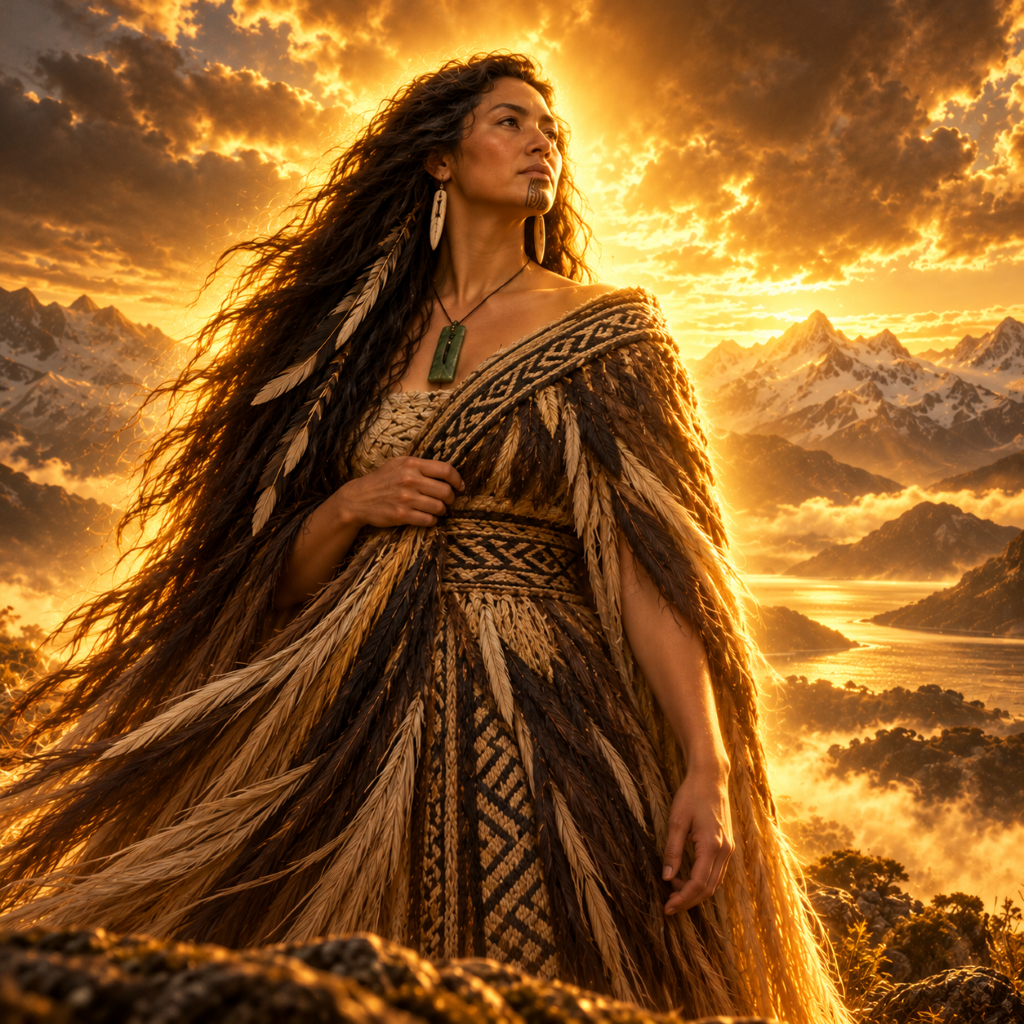
Traditional accounts do not provide a detailed physical description of Poharua Te Pō. There is no consistently documented portrait specifying her facial features, clothing, height, or bodily appearance. Instead, her identity emerges through the language of creation, genealogy, and the natural world. The description of Poharua Te Pō as the breath of life within darkness is especially revealing. It presents her as a generative presence associated with the transition from primordial existence to the emergence of ancestral life. Her significance lies in what she represents within the creation sequence rather than in a particular physical form.
This distinction matters when interpreting her through modern illustrations. Portraying Poharua Te Pō as a conventional goddess with elaborate clothing, supernatural weapons, or exaggerated magical features would introduce details not established by the available traditional accounts. A more culturally grounded interpretation would evoke darkness, the night sky, the first breath of life, and the natural world emerging from an unseen beginning. Such imagery can communicate her cosmological importance without suggesting that Māori traditions prescribe a specific appearance for her.
Family
Poharua Te Pō is identified as the first wife of Raki, the Sky Father, in Ngāi Tahu creation traditions. Raki is also commonly rendered as Ranginui in broader discussions of Māori cosmology. Their relationship belongs to an earlier stage of the ancestral genealogy than Raki’s subsequent union with Papatūānuku, the Earth Mother.
The children attributed to Poharua Te Pō differ between recorded accounts. In one Ngāi Tahu tradition, Raki and Pokoharua-te-pō have four sons: Aoraki, Rakirua, Rakiroa, and Rarakiroa. These brothers later become associated with the mountains of the South Island. Another creation chant describes Raki’s union with Pokoharuatepō as giving rise to Te Hānuioraki and the winds of the world. These accounts should be presented as distinct versions rather than combined into one definitive family tree.
Aoraki is the most prominent of the ancestral figures associated with her. In Ngāi Tahu tradition, Aoraki and his brothers travel from the heavens in a canoe called Te Waka o Aoraki. Their journey becomes part of the explanation for the formation of the Southern Alps, known in Māori as Kā Tiritiri o te Moana. After their return journey fails, the brothers turn to stone and become the mountain peaks. The canoe itself becomes associated with the South Island, Te Waka o Aoraki. Through this genealogy, Poharua Te Pō is connected to the ancestral landscape and cultural identity of Ngāi Tahu.
Other names
Poharua Te Pō appears under several spellings in written accounts of Māori creation traditions. These include Pōharua Te Pō, Poharua o Te Pō, Pōharoa-o-te-pō, Pokoharuatepō, and Pokoharua-te-pō. The variation reflects differences between recorded traditions, orthography, and the ways names have been transcribed in English-language publications. For example, the Ngāi Tahu creation material associated with Matiaha Tiramōrehu uses the form Pokoharuatepō, while New Zealand heritage material refers to Poharua Te Po.
The word pō is associated with night or darkness in Māori cosmological language. Darkness is not necessarily equivalent to evil or destruction in these traditions. It can represent an early stage of existence from which life and the ordered world emerge. The available sources do not establish one universally preferred spelling across every context. For an article focused on search visibility, Poharua Te Po can be used as the primary keyword, while Poharua Te Pō and Pokoharuatepō can appear naturally in the text to help readers recognise alternative forms.
Powers and Abilities
Poharua Te Pō’s significance is primarily cosmological and ancestral rather than that of a deity defined by a catalogue of supernatural powers. Her principal association is with the emergence of life from primordial darkness. The description of her as the breath of life within the womb of darkness places her within a creation sequence in which existence develops through successive stages before the appearance of the world as people know it.
She is also connected to the origins of the winds. In the Ngāi Tahu creation chant recorded from Matiaha Tiramōrehu, Raki’s union with Pokoharuatepō gives rise to Te Hānuioraki and the many winds of the world. Another account names Aoraki and Rakamaomao, the ancestral figure associated with the southern winds, among the descendants connected to Raki and Poharua Te Pō. The details differ between genealogies, so these relationships should not be presented as a single universal account.
Her importance also lies in whakapapa, the interconnected genealogies through which Māori traditions explain relationships between ancestral beings, people, and the natural environment. In this context, genealogy is more than a record of parentage. It expresses connections between the spiritual world and the physical landscape. Poharua Te Pō’s position within the ancestry of Aoraki helps establish the mountain’s significance beyond its geographical features. Rather than portraying her as a goddess who directly commands every storm or controls all atmospheric phenomena, it is more accurate to describe her as an ancestral figure whose place in creation traditions connects darkness, life, winds, and the natural world.
Modern Day Influence
Poharua Te Pō remains relevant through the preservation and interpretation of Ngāi Tahu creation traditions. Her significance is particularly visible in educational resources and heritage narratives that explain the ancestry of Aoraki and the relationship between Māori communities and the landscapes of the South Island. Te Rūnanga o Ngāi Tahu provides educational material on Aoraki and the creation traditions associated with the mountain. These resources help readers understand how the ancestral narrative connects the heavens, the canoe, the mountains, and Ngāi Tahu identity.
The significance of Aoraki also extends into contemporary cultural recognition. The mountain is understood by Ngāi Tahu as a sacred ancestor, not merely a geographical landmark. Its place in the creation narrative reflects the close relationship between whakapapa, whenua (land), and cultural identity. Poharua Te Pō has also appeared in contemporary artistic expression. The 2026 release Hoki Mai Rā by Lee Stuart is one example of recent musical work associated with her name and story. This demonstrates that ancestral figures can continue to inspire creative interpretation beyond written mythology and formal heritage education.
Nevertheless, the available evidence does not establish that Poharua Te Pō has become a widely recognised figure in global popular culture. Her importance is better understood through the continuing transmission of Māori ancestral traditions, particularly those maintained by Ngāi Tahu. Her story reminds readers that creation narratives can preserve relationships between people and place. Through her connection to Raki, Aoraki, and the winds, Poharua Te Pō remains part of a living cultural framework that explains how the natural world carries ancestral meaning.
Related Images
Source
Heritage New Zealand Pouhere Taonga. (2019, November 18). Takiroa Historic Area. https://www.heritage.org.nz/list-details/7769/Takiroa%20Historic%20Area
New Zealand Government. (1998, October 13). Ngai Tahu settlement. https://www.beehive.govt.nz/feature/ngai-tahu-settlement-3
Te Rūnanga o Ngāi Tahu. (2024). Aoraki: So much more than an ancestral mountain (Teacher support material, v. 5). https://ngaitahu.iwi.nz/assets/Documents/Aoraki-TSM-v.5-November-2024.pdf
Te Rūnanga o Ngāi Tahu. (2024, June). Tu-te-Rakiwhanoa (Teacher support material, v. 4).
https://ngaitahu.iwi.nz/assets/Documents/Tu-te-Rakiwhanoa-TSM-v.4-Jun-24.pdf
Te Rūnanga o Ngāi Tahu. (n.d.). Tu-te-Rakiwhanoa (Teacher support material).
https://ngaitahu.iwi.nz/assets/Documents/Tu-te-Rakiwhanoa-teacher-support-material-FINAL.pdf
Ministry for Culture and Heritage. (2004, February 1). Ranginui – the sky. Te Ara: The Encyclopedia of New Zealand. https://teara.govt.nz/en/ranginui-the-sky/print
Ministry for Culture and Heritage. (2004, February 1). Whakapapa – genealogy. Te Ara: The Encyclopedia of New Zealand. https://teara.govt.nz/en/whakapapa-genealogy/page-2
Van Ballekom, M., & Harlow, R. (Eds.). (1987). Te waiatatanga mai o te Atua: South Island traditions recorded by Matiaha Tiramōrehu. Department of Māori, University of Canterbury. https://www.komako.org.nz/person/1262
Frequently Asked Questions
Who is Poharua Te Po in Māori mythology?
Poharua Te Po is an ancestral female figure in Māori creation traditions, especially those of Ngāi Tahu. She is remembered as the first wife of Raki, the Sky Father.
Who is the husband of Poharua Te Po?
Poharua Te Po is identified as the first wife of Raki, also known as Ranginui in broader Māori cosmology. Their union belongs to an early stage of creation.
Who are the children of Poharua Te Po?
One Ngāi Tahu tradition names Aoraki, Rakirua, Rakiroa, and Rarakiroa as her sons. Another account connects her union with Raki to Te Hānuioraki and the winds.
What powers does Poharua Te Po have?
Poharua Te Po is associated with the emergence of life from darkness and the origins of the winds. Her importance is primarily cosmological and genealogical, rather than based on individual magical feats.
Why is Poharua Te Po important in Māori tradition?
Poharua Te Po is important because her ancestry connects Raki, Aoraki, the winds, and the South Island landscape within Ngāi Tahu creation traditions.


