

Glasir : The Golden Tree That Guarded Valhalla
| Description | |
|---|---|
| Origin | Norse Mythology |
| Description | Golden-leaved tree/grove before Valhalla |
| Associated Characters | Odin, warriors of Valhalla |
| Symbolism | Wealth, Beauty, Liminality, Divine abundance |
| Source Texts | Prose Edda (Skáldskaparmál), Poetic Edda (Helgakviða Hjörvarðssonar) |
Mythlok Perspective
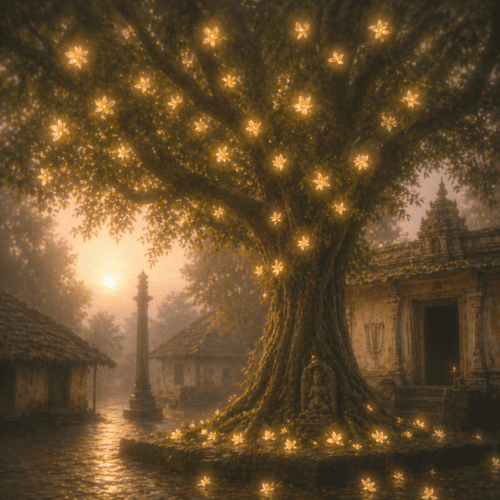
In the Mythlok Perspective, Glasir is not simply a beautiful tree but a statement about how civilizations imagine paradise. Unlike the biblical Tree of Life, which promises eternal existence, or the Indian Kalpavriksha, which grants every desire, Glasir offers neither immortality nor wishes. Instead, it stands silently before Valhalla, suggesting that true glory is earned before it is admired. Its golden leaves remind us that in Norse thought, wealth was never separated from honor—the greatest treasures belonged not to those who possessed them, but to those who proved worthy of reaching them.
Glasir
Introduction
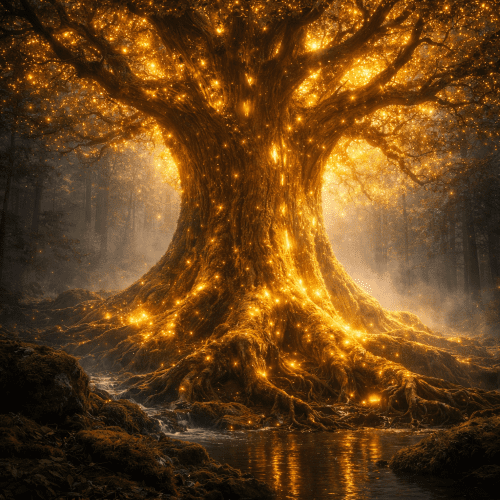
Glasir is one of the most visually striking yet often overlooked symbols in Norse mythology. Unlike Yggdrasil, the immense World Tree that supports the Nine Realms, Glasir is celebrated for its extraordinary beauty rather than its cosmic role. According to the Old Norse sources, its branches bore shimmering golden-red leaves, making it “the most beautiful among gods and men.” Standing outside Valhalla, the great hall where Odin welcomed fallen warriors, Glasir transformed the entrance into a place of unmatched splendor.
Although Glasir appears only briefly in surviving Norse texts, its significance extends far beyond its limited mentions. It became an enduring poetic symbol of wealth, divine glory, and sacred beauty. Skaldic poets frequently used its golden foliage as a metaphor for gold itself, demonstrating how deeply myth and poetry were intertwined in medieval Scandinavia. Rather than being remembered through heroic deeds, Glasir survives as a powerful image that reflects the Norse appreciation for symbolism, craftsmanship, and the sacred landscape.
Description
Glasir is a sacred tree or grove in Norse mythology renowned for its extraordinary golden-red foliage and its place outside the doors of Valhalla. Though it appears only briefly in the surviving Eddas, it became one of the most recognizable symbols of divine beauty in Old Norse poetry. Rather than serving as a character in myth, Glasir functions as a landmark that reflects the grandeur of Asgard and the honor associated with Odin’s hall. Its radiant leaves inspired poetic expressions for gold, allowing the tree to transcend its physical form and become a lasting symbol of prosperity, sacred space, and the splendor of the gods.
Mythological Background
Glasir performs several important symbolic functions within Norse mythology despite its limited appearances in surviving literature. Its most significant role is as a poetic representation of gold. Medieval skalds frequently referred to gold through kennings such as “Glasir’s leaves” or “Glasir’s foliage.” These poetic expressions allowed writers to enrich their verses by drawing upon familiar mythological imagery. Rather than describing wealth directly, poets invoked Glasir to suggest beauty, brilliance, and divine value simultaneously.
Glasir also serves as an important architectural feature within Asgard. Positioned directly outside Valhalla, it marks the threshold of Odin’s great hall. Every warrior entering the afterlife would symbolically pass beneath the gleaming branches of this magnificent tree before joining the Einherjar. Its placement emphasizes that Valhalla was not simply a hall of warriors but a realm filled with supernatural grandeur.
Finally, Glasir represents the ideal of divine craftsmanship. The transformation of ordinary leaves into precious gold reflects a recurring Norse theme in which nature itself becomes elevated within the world of the gods. Instead of separating wealth from the natural world, Glasir unites both into a single sacred image.
Mythological Functions
Glasir performs several important symbolic functions within Norse mythology despite its limited appearances in surviving literature. Its most significant role is as a poetic representation of gold. Medieval skalds frequently referred to gold through kennings such as “Glasir’s leaves” or “Glasir’s foliage.” These poetic expressions allowed writers to enrich their verses by drawing upon familiar mythological imagery. Rather than describing wealth directly, poets invoked Glasir to suggest beauty, brilliance, and divine value simultaneously.
Glasir also serves as an important architectural feature within Asgard. Positioned directly outside Valhalla, it marks the threshold of Odin’s great hall. Every warrior entering the afterlife would symbolically pass beneath the gleaming branches of this magnificent tree before joining the Einherjar. Its placement emphasizes that Valhalla was not simply a hall of warriors but a realm filled with supernatural grandeur.
Finally, Glasir represents the ideal of divine craftsmanship. The transformation of ordinary leaves into precious gold reflects a recurring Norse theme in which nature itself becomes elevated within the world of the gods. Instead of separating wealth from the natural world, Glasir unites both into a single sacred image.
Origins & Geographic Context
The name Glasir is generally understood to derive from the Old Norse word meaning “gleaming” or “shining,” an appropriate description for a tree whose leaves resemble burnished gold. While the exact etymology remains debated among linguists, the association with brightness and radiance is widely accepted.
Within Norse cosmology, Glasir is firmly located in Asgard, specifically outside the entrance to Valhalla. This placement distinguishes it from Yggdrasil, whose roots and branches connect the entire universe. Glasir belongs exclusively to the divine realm and serves as one of its most recognizable landmarks.
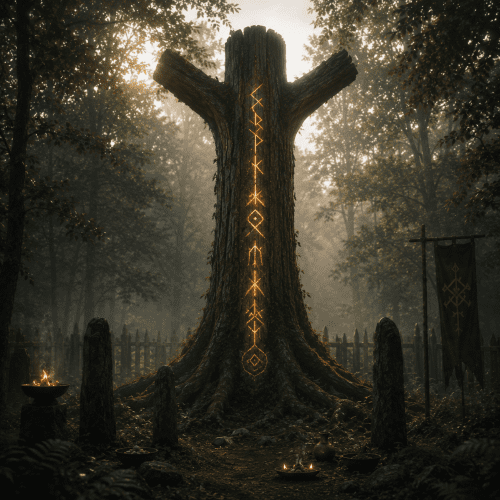
Some scholars have suggested that Glasir may preserve echoes of ancient Germanic sacred groves. Historical accounts indicate that pre-Christian Germanic peoples often regarded trees and wooded areas as holy places where rituals and assemblies were held. While no surviving text explicitly identifies Glasir as an object of worship, its portrayal as a sacred golden grove may reflect these older religious traditions transformed into literary symbolism. Because the surviving evidence is limited, Glasir is best understood as a poetic and mythological landmark rather than a deity or independently worshipped sacred object.
Symbolism and Archetypes
Glasir embodies several powerful symbolic themes that extend beyond its physical description. Most obviously, it symbolizes divine wealth. Gold in Norse mythology represented more than material riches. It signified honor, prestige, generosity, and the favor of the gods. By giving a tree golden leaves, Norse mythology transforms nature into an expression of sacred abundance.
Glasir also functions as an archetypal threshold tree. Trees frequently mark transitions in world mythology, separating ordinary existence from sacred space. Standing before Valhalla, Glasir becomes the final symbol encountered before entering the realm of heroic immortality. It reminds visitors that they are crossing into a world beyond mortal experience.
Its radiant appearance further represents divine presence. Across many mythological traditions, extraordinary light signifies holiness. Glasir’s gleaming foliage reflects this universal symbolism, suggesting that beauty itself can reveal the presence of the divine.
Although often compared with Yggdrasil, Glasir fulfills a very different archetypal role. Yggdrasil represents the structure of the cosmos and the interconnectedness of all existence. Glasir, by contrast, celebrates beauty, prosperity, and the splendor of the gods’ kingdom. Together, the two trees illustrate different aspects of the Norse understanding of sacred landscapes.
Cultural Significance
Glasir demonstrates how much importance medieval Norse culture placed on symbolic language. Rather than existing primarily as the subject of myths, Glasir became part of the sophisticated vocabulary of skaldic poetry. Listeners familiar with Norse traditions would immediately recognize references to “Glasir’s leaves” as poetic expressions for gold, adding depth and elegance to the verse.
Its association with Valhalla also reinforces central Norse ideals surrounding courage and honor. The most glorious destination for a fallen warrior was not merely Odin’s hall itself but the magnificent environment surrounding it. Glasir contributed to the image of Valhalla as a place where divine beauty matched heroic achievement.
Today, Glasir remains valuable to historians and mythologists because it reveals how Norse literature used landscapes to communicate cultural values. Rather than describing wealth, prestige, or divine majesty directly, poets embedded these ideas within memorable natural symbols that audiences could instantly recognize.
Modern Influence
Although Glasir rarely appears as prominently as Yggdrasil in modern adaptations of Norse mythology, its imagery continues to influence contemporary storytelling. Fantasy novels, films, and video games frequently feature radiant trees or golden groves marking sacred kingdoms, magical sanctuaries, or entrances to otherworldly realms. These settings reflect the same visual language that Glasir established centuries ago.
The symbolism of golden trees also appears in modern architecture, branding, and art, where gold continues to evoke luxury, excellence, and timeless beauty. Glasir demonstrates that this connection between brilliance and prestige has deep mythological roots stretching back to medieval Scandinavia.
For modern audiences, Glasir offers a reminder that mythology is not only about legendary heroes and epic battles. Sometimes a single luminous tree can communicate an entire worldview, expressing ideas of honor, prosperity, sacred space, and eternal beauty through one unforgettable image.



Sources
Lindow, J. (2001). Norse mythology: A guide to the gods, heroes, rituals, and beliefs. Oxford University Press.
Lindblad, M. (n.d.). Glasir. In Pantheon.org. https://pantheon.org/articles/g/glasir.html
McKinnell, J. (2005). Meeting the other in Norse myth and legend. D.S. Brewer.
Simek, R. (2007). Dictionary of Northern mythology. D.S. Brewer.
Snorri Sturluson. (2018). The prose Edda (A. Faulkes, Trans.). Everyman.
Price, N. (2019). Children of Ash and Elm: A history of the Vikings. Basic Books.
Zalewski, M. (2020). The sacred grove in Germanic religion and myth. Journal of Northern Studies, 14(2), 33–52.
The Poetic Edda: Helgakviða Hjörvarðssonar. (n.d.). In The Poetic Edda
Wikipedia contributors. (2024). Glasir. In Wikipedia. Retrieved from https://en.wikipedia.org/wiki/Glasir
DBpedia Association. (2024). About: Glasir. Retrieved from http://dbpedia.org/resource/Glasir
Frequently Asked Questions
What is Glasir in Norse mythology?
Glasir is a legendary golden tree or grove that stands outside Valhalla in Asgard and is described as the most beautiful among gods and humans.
Where is Glasir located?
Glasir is located directly outside Valhalla, Odin’s great hall in Asgard, where fallen heroes are welcomed after death.
Why is Glasir important in Norse mythology?
Glasir symbolizes divine beauty, wealth, and honor, while also serving as a famous poetic metaphor for gold in Old Norse literature.
Is Glasir the same as Yggdrasil?
No. Yggdrasil is the World Tree connecting the Nine Realms, while Glasir is a sacred golden tree associated specifically with Valhalla.
What do Glasir's golden leaves represent?
Its golden leaves symbolize divine abundance, sacred beauty, prosperity, and the eternal glory of the gods.