


Phra In : The Thai God of Storms Who Rides Erawan
At a glance
| Description | |
|---|---|
| Origin | Thai Mythology |
| Classification | Gods |
| Family Members | Phali (Son) |
| Region | Thailand |
| Associated With | Thunder, Lightning, Rain, Storms, Warfare, Divine authority, Protection, Kingship, Fertility |
The Mythlok Perspective
In Mythlok’s Perspective, Phra In is most compelling as a bridge between religious traditions rather than simply Thailand’s version of Indra. Like Zeus in Greek mythology, he commands the storm-filled sky, but his Buddhist identity makes his authority more conditional and impermanent. His presence in the Ramakien and Thai Buddhist culture shows how a foreign deity can become distinctly local, acquiring meanings shaped by Thai ideas of kingship, protection and cosmic order.
Phra In
Introduction
Phra In (พระอินทร์) is the Thai form of Indra, an ancient deity whose traditions travelled from South Asian religious literature into the Buddhist cosmology and literature of Thailand. His identity is therefore more complex than simply being a Hindu god adopted by Thailand. In Theravada Buddhist tradition, Indra is known as Sakka and serves as the ruler of Tavatimsa, the Heaven of the Thirty-Three. He remains a celestial being within the Buddhist universe rather than an ultimate or eternal creator.
In Thailand, this Buddhist understanding exists alongside older Brahmanical traditions and Thai literary adaptations. The Thai Fine Arts Department identifies Phra In particularly with storms, rain and lightning, reflecting the older Indian conception of Indra as a powerful sky and weather deity.
Phra In also appears in the Ramakien, Thailand’s celebrated adaptation of the Ramayana. There he occupies the world of celestial beings and is associated with Phali, the Thai counterpart of Vali, as his divine father. The character consequently belongs to several overlapping traditions rather than one fixed mythology.
Physical Traits
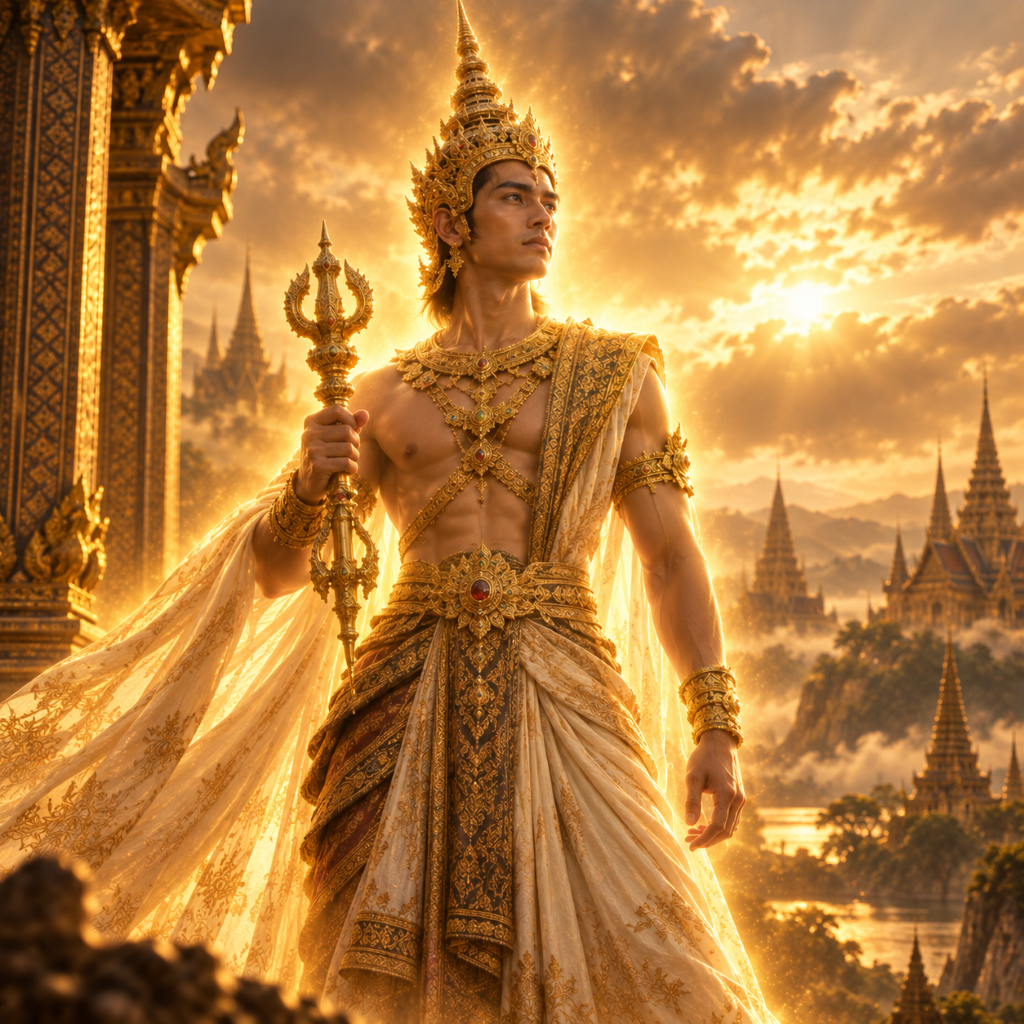
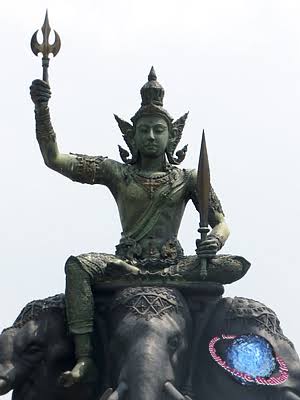
Thai artistic representations generally portray Phra In as a regal celestial figure, reflecting his position as ruler of the devas. One of his most recognizable attributes is his elephant mount, Erawan, the Thai form of Airavata. Thai museum and Fine Arts Department records specifically depict Indra seated upon the three-headed Erawan.
His most important object is the vajra, the thunderbolt associated with his authority over storms and lightning. Thai iconography can vary, however, and representations may show him carrying other attributes. The Fine Arts Department notes that traditional depictions can include the vajra and, in some representations, a lotus.
Rather than assigning Phra In a single standardized appearance, Thai art presents him through recognizable symbols of celestial rank: royal dress, divine ornaments, a commanding posture and Erawan beneath him. This makes the elephant and thunderbolt more reliable identifiers than details such as complexion, number of arms or facial features, which can differ between artistic traditions.
Family
Phra In’s family relationships vary considerably according to the tradition being followed. This is important because his Buddhist identity as Sakka does not preserve exactly the same genealogy as the Hindu Indra of Sanskrit mythology or the Phra In of the Ramakien. The clearest Thai literary relationship is with Phali, the Thai version of Vali. The Ramakien identifies Phra In as Phali’s divine father, making their relationship part of the epic’s network of gods and vanara heroes.
In the wider Indian tradition, Indra is also associated with other divine and heroic figures, including Arjuna in the Mahabharata. Those relationships should not automatically be treated as part of specifically Thai mythology. Similarly, the identity of Phra In’s consort is not consistently emphasized across Thai sources. Rather than presenting a single detailed family tree as universally accepted, it is more accurate to recognize that his genealogy changes according to the Buddhist, Brahmanical and Thai literary source being consulted.
Other names
Phra In is the standard Thai name for Indra. The Sanskrit name Indra belongs to the older Vedic and Hindu tradition, where he is one of the major gods and a powerful warrior associated with storms and the defeat of hostile forces. In Buddhist literature, he is commonly known as Sakka, or Sakka Devarāja, meaning the ruler of the devas. Pali Buddhist texts repeatedly identify Sakka as the lord of Tavatimsa and depict him interacting with the Buddha.
The different names therefore reflect more than changes in pronunciation. They show how the same broad mythological figure was interpreted through different religious systems. In Thai contexts, Phra In identifies the deity within Thailand’s linguistic, artistic and religious environment, while Indra and Sakka help trace his Sanskrit and Buddhist identities.
Powers and Abilities
Phra In’s most prominent associations are rain, storms, thunder and lightning. The Thai Fine Arts Department explicitly describes him as a god of storms and rain, while Thai archaeological and artistic records associate him with thunder and his elephant Erawan.
His thunderbolt, or vajra, represents both destructive force and divine authority. In older Indian mythology, Indra is a warrior god who battles powerful adversaries and protects the cosmic and social order. This martial dimension survives in Thai representations of Phra In, although his Buddhist identity gives the character a somewhat different emphasis.
As Sakka, he is ruler of Tavatimsa and appears as a powerful but ultimately impermanent celestial being. Buddhist texts make an important distinction here: Sakka is a deva who has accumulated merit, but he remains subject to change and rebirth like other beings within samsara. Buddhist stories also portray him as a protector and supporter of the Buddha. In the Sakka-pañha Sutta, Sakka approaches the Buddha with questions concerning ethical and spiritual problems, while other Buddhist texts portray him as the leader of the devas during conflicts with the asuras.
In Thai culture, these different strands combine to give Phra In associations with protection, righteous authority, rain, fertility, warfare and celestial guardianship. His power is therefore not limited to controlling weather; it also reflects the older idea of a divine king responsible for maintaining order.
Modern Day Influence
Phra In continues to occupy a visible place in Thailand’s religious art, literature and cultural memory. His image appears in temple art and historical objects, often recognizable through Erawan and the thunderbolt. The Fine Arts Department records several Thai representations of Indra riding Erawan, demonstrating the longevity of this iconography.
His influence can also be seen in the Ramakien, where gods derived from Indian mythology were incorporated into a distinctly Thai literary world. The Ramakien became closely connected with Thai kingship and court culture, while its characters were reshaped according to Thai literary and Buddhist ideas.
Northern Thailand provides another important example through the Inthakhin tradition. Chiang Mai’s Inthakhin, literally associated with Indra’s pillar, is connected with a legend in which Indra provides a protective pillar to safeguard the community from disaster. The associated festival continues to combine local, Brahmanical and Buddhist elements.
Phra In therefore survives not simply as an imported Hindu deity but as a deeply localized figure. His story demonstrates how Thai religious culture can incorporate Hindu and Buddhist cosmological beings into a shared sacred landscape. For modern audiences, he remains recognizable as the celestial ruler of thunder and rain, the rider of Erawan and one of the most enduring divine figures linking Indian mythology with Thai cultural traditions.
Related Images



Source
Boonlong, P. (2024). Spirits. In Holy Things: The Genealogy of the Sacred in Thai Religion. Oxford University Press. https://academic.oup.com/book/57518/chapter/467370539
Mythical Encyclopedia. (2023, December 31). Most popular Thai gods: A friendly guide to divine beings. https://mythicalencyclopedia.com/most-popular-thai-gods/
TCI-Thaijo. (n.d.). An analysis of the roles of Sakka Devarāja (Sakka, King of the Devas) in recent Thai society. https://so03.tci-thaijo.org/index.php/ibsc/article/download/271669/179999/1134048
THAILEX. (n.d.). Phra In (Indra) on three-headed elephant Erawan. https://www.thailex.info/THAILEX/THAILEXENG/LEXICON/Phra%20In%20(Indra)%20on%20three-headed%20elephant%20Erawan.htm
Wisdom Library. (2025, February 15). Phali (Valin)/Kakat (Kakasa). https://www.wisdomlib.org/gallery/ramakien-characters/8367
Wisdom Library. (2025, February 15). Phra in: 2 definitions. https://www.wisdomlib.org/definition/phra-in
Wikipedia. (n.d.). Phra Lak Phra Ram. https://en.wikipedia.org/wiki/Phra_Lak_Phra_Ram
Wikipedia. (n.d.). Ramakien. https://en.wikipedia.org/wiki/Ramakien
Wyatt, D. K. (2003). Thailand: A Short History. Yale University Press.
Richman, P. (1991). Many Ramayanas: The Diversity of a Narrative Tradition in South Asia. University of California Press.
Woodward, H. (1997). The Sacred Sculpture of Thailand. Oxford University Press.
Frequently Asked Questions
Who is Phra In in Thai mythology?
Phra In is the Thai form of Indra, a powerful deva associated with rain, thunder, lightning and celestial authority in Thai Buddhist and literary traditions.
Is Phra In the same as the Hindu god Indra?
Yes. Phra In derives from Indra, but Thai traditions reinterpret him through Buddhist cosmology, Thai literature and local religious culture.
What is Phra In's connection to Erawan?
Erawan, the three-headed elephant, is Phra In’s traditional mount and one of the most recognizable symbols used to identify him in Thai art.
What is Phra In's role in Buddhism?
As Sakka, Phra In rules Tavatimsa, the Heaven of the Thirty-Three, and appears in Buddhist texts as a powerful deva who respects and supports the Buddha.
What is Phra In the god of?
Phra In is principally associated with rain, storms, thunder and lightning, while also representing protection, warfare, divine authority and celestial kingship.


