

Panlong : The Coiling Dragon of Chinese Mythology
At a glance
| Description | |
|---|---|
| Origin | Chinese Mythology |
| Classification | Animals |
| Family Members | N/A |
| Region | China |
| Associated With | Water, Rivers, Lakes |
Mythlok Perspective
In Mythlok’s Perspective, Panlong is compelling precisely because its power is defined by what remains unrealized. Unlike dragons such as the Chinese Dragon Kings, whose authority is already established, Panlong represents a dragon that has not yet ascended to heaven. Its coiled form therefore becomes a powerful metaphor for potential held in reserve. This makes Panlong comparable to the Greek Typhon, another immense serpent-like force associated with primordial power, although Panlong is far less destructive and more closely tied to water, rain, and auspicious transformation.
Panlong
Introduction
In Chinese mythology and traditional culture, dragons are closely associated with water, rain, power, and auspiciousness. Among the many dragon forms found in Chinese tradition, Panlong (蟠龙) is particularly associated with the image of a dragon coiled upon itself. The name is commonly translated as “Coiling Dragon” or “Coiled Dragon,” combining pan (蟠), meaning to coil, curl, or wind around, with long (龙), meaning dragon.
Panlong is especially notable because early Chinese textual traditions distinguish it from a dragon that has already reached the heavens. In Yang Xiong’s Fangyan, a major lexicographical work from the Han period, Panlong is described as a dragon that has not yet ascended to heaven. This distinction gives the creature an important place within Chinese ideas about dragons as beings capable of moving between earthly and celestial realms.
The Panlong tradition is also connected with water. Later sources associate the creature with aquatic environments and rainmaking, while the coiled-dragon image became an important motif in Chinese decorative art. Rather than representing a single deity with a fixed mythology, Panlong is better understood as a distinctive dragon form whose meaning developed through literature, art, folklore, and symbolism.
Physical Traits
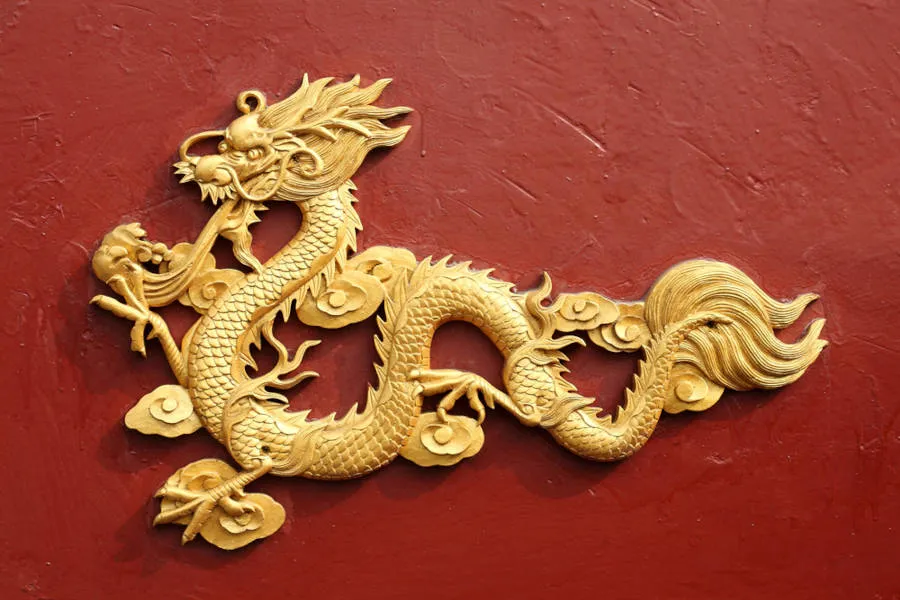
Panlong is traditionally represented as a long, serpentine dragon whose body is arranged in pronounced coils. This coiled posture is central to its identity and distinguishes Panlong from representations that emphasize a dragon flying freely through the heavens. In Chinese art, coiling dragons may be shown winding around architectural elements, objects, or themselves, creating a sense of movement contained within a compact form.
Historical descriptions provide more specific details than many later artistic depictions. A description preserved in the Taiping Yulan, drawing on an earlier geographical work, portrays a Panlong as a large dragon with a blue-black body marked by red bands. The account also associates it with movement through water toward the sea. Such descriptions demonstrate that Panlong was not simply an abstract decorative pattern but could be imagined as a formidable aquatic creature.
Its appearance can overlap with other Chinese dragon traditions, particularly aquatic beings such as the Jiaolong (蛟龙). However, the terms should not automatically be treated as interchangeable. Chinese dragon terminology developed across different texts and periods, and individual creatures can have overlapping characteristics without being identical mythological beings.
Unlike the winged dragons common in European fantasy, Panlong is generally conceived according to the traditional Chinese dragon form, which does not depend on wings for supernatural movement. Its power comes from its mythological nature rather than from a Western-style anatomical system of wings, fire, and flight.
Family
Panlong does not have a consistently documented family tree comparable to the genealogies associated with some major Chinese deities. There is no securely established set of parents, spouse, or children that forms a central part of the Panlong tradition.
Instead, Panlong belongs to the broader and diverse world of Chinese dragons. Traditional Chinese texts describe numerous dragon forms, including Tianlong, the celestial dragon; Shenlong, the spiritual or divine dragon associated with rain and agriculture; Dilong, the earth dragon associated with terrestrial and subterranean waters; and Jiaolong, an aquatic dragon appearing in a variety of early and later traditions.
These categories should not be understood as a single universally agreed dragon family tree. Chinese mythology developed through many literary, religious, regional, and folk traditions, so classifications can vary considerably between sources. Panlong’s importance comes less from ancestry than from its distinctive status as a coiling dragon that has not yet ascended to heaven. This places the creature within the broader Chinese conception of dragons as beings whose powers and status can be connected with the relationship between water, earth, and heaven.
Other names
The most common English rendering of Panlong (蟠龙) is “Coiling Dragon” or “Coiled Dragon.” The character pan conveys the idea of winding or coiling, making the name a direct description of the dragon’s characteristic form. The form 盤龍 (Panlong) is also encountered, using a different Chinese character with a related meaning of coiling or winding. Another expression, Longpan (龙蟠), reverses the order of the characters. While it can literally evoke a dragon that is coiled or winding, Longpan also acquired an important literary meaning.
In classical Chinese literature, the image of a coiled dragon became a metaphor for unrecognized talent or unrealized potential. A dragon that remains coiled has not yet revealed the full extent of its power, making the image an effective comparison for a capable person whose abilities have not yet been recognized.
Panlong is sometimes discussed alongside Jiaolong, particularly when describing aquatic dragons, but the two names should not simply be treated as synonyms. Jiaolong has its own extensive textual history and can refer to different kinds of aquatic or dragon-like creatures depending on the source and period.
Powers and Abilities
Panlong’s most important supernatural associations are connected with water and rain. Chinese dragon traditions broadly link dragons with rainfall, rivers, lakes, storms, and the agricultural cycle, and Panlong participates in this wider association with water.
Evidence for the connection between the coiled dragon and rainmaking appears in later Chinese sources. A recorded rainmaking practice involved a mirror decorated with a coiled-dragon design, reflecting the belief that dragon imagery could be used in rituals intended to encourage rainfall. Such evidence is valuable because it connects the Panlong motif with an actual historical ritual tradition rather than relying solely on modern interpretations.
Panlong’s aquatic character also reflects the importance of water in traditional Chinese society. Rainfall was essential for agriculture, while rivers and other waterways could sustain communities but also cause destructive floods. Dragons therefore occupied an ambiguous position in Chinese tradition: they could be powerful and benevolent bringers of life-giving rain, while their association with water also connected them with forces that humans could not easily control.
The idea of Panlong as a dragon that has not yet ascended to heaven adds another dimension to its mythology. The creature can be understood as occupying a transitional position between earthly and celestial existence. This quality helped make the coiled dragon an effective literary symbol for power that remains unrealized.
The related image of the coiled dragon became particularly important as a metaphor for hidden ability. Rather than suggesting that Panlong possesses a separate power to control time or generate thunder whenever it is struck, the better-supported traditions emphasize its relationship with water, rain, transformation, and unrealized potential.
Modern Day Influence
Panlong remains influential primarily through the enduring popularity of the coiled-dragon motif in Chinese art and visual culture. Dragons have appeared for centuries in jade carving, ceramics, textiles, architecture, decorative objects, and other forms of Chinese craftsmanship. The coiled form is particularly effective artistically because it allows the dragon’s long body to wrap around an object or fill a decorative space while retaining a strong sense of movement.
The name and image of Panlong have also entered modern popular culture. One prominent example is the Chinese fantasy novel Coiling Dragon (盘龙) by I Eat Tomatoes, which uses the image of the coiled dragon within a fictional world inspired by Chinese fantasy traditions. Although the novel is a modern work rather than an ancient Panlong myth, its popularity demonstrates how the symbolism of the coiled dragon continues to inspire contemporary storytelling.
Panlong has also appeared in modern numismatics. The Royal Canadian Mint has issued gold and silver coins featuring the Panlong or Coiling Water Dragon, presenting the creature as an auspicious symbol associated with water, prosperity, and good fortune. This modern interpretation reflects the continuing international appeal of Chinese dragon symbolism.
The name Panlong is also used in modern Chinese geography and place names. Panlong District in Kunming, for example, takes its name from the Panlong River rather than being evidence that the district itself was named after the mythological dragon. The continued use of the name nevertheless demonstrates how deeply the term remains embedded in Chinese cultural and geographical vocabulary.
Today, Panlong is best understood as more than simply another Chinese dragon. Its distinctive coiled form, association with water, connection with rainmaking traditions, and classical metaphor of unrealized potential have allowed it to survive across different forms of Chinese culture. From early literature and ritual traditions to art, fiction, and modern design, the Panlong remains an enduring image of power held in reserve, waiting to rise.
Related Images




Source
Britannica. (1998). Long | Folklore, Legends & Myths. Britannica. https://www.britannica.com/topic/long-Chinese-mythology
Wikipedia contributors. (2025). Panlong (mythology). Wikipedia. https://en.wikipedia.org/wiki/Panlong_(mythology)
Research Starters. (2021). Chinese mythology. EBSCO. https://ebsco.com/chinese-mythology
Ecumenical Buddhism. (2010). Lóng, the Chinese Dragon. https://ecumenicalbuddhism.blogspot.com/2010/10/
Wang, Z. (1592). Wu Za Zu (五雜俎). Song Dynasty literary collection.
Yang, X. (18 CE). Fangyan (Regional Speech) dictionary. Ancient Chinese linguistic work.
Ouyang, X. (7th century). Yiwen Leiju (Classified Anthology of Literary Works). Ancient Chinese encyclopedia.
Schafer, E. H. (1963). The Golden Peaches of Samarkand: A Study of T’ang Exotics. University of California Press.
Lagerwey, J. (2010). Daoism and Local Cults in Early Medieval China. Harvard University Asia Center.
Frequently Asked Questions
What is Panlong in Chinese mythology?
Panlong is a coiling water dragon from Chinese mythology, known for dwelling in lakes and rivers and symbolizing hidden strength, balance, and potential.
Is Panlong different from other Chinese dragons?
Yes. While celestial dragons ascend to the skies, Panlong remains bound to freshwater and subterranean domains, representing dormant power and earthly guardianship.
What powers is Panlong believed to have?
Panlong controls rain, water currents, and weather patterns. It also serves as a spiritual guardian of temples, treasures, and balance in nature.
What does the name Panlong mean?
“Panlong” translates to “Coiling Dragon,” referring to its iconic curled posture and metaphorical meaning of latent energy awaiting awakening.
How is Panlong represented in modern culture?
Today, Panlong appears in art, literature, feng shui design, and even in numismatics, representing protection, prosperity, and the strength of untapped potential.
