


Jiaolong : The Ancient Chinese Dragon of Rivers and Storms
At a glance
| Description | |
|---|---|
| Origin | Chinese Mythology |
| Classification | Animals |
| Family Members | N/A |
| Region | China |
| Associated With | Floods, Storms |
Mythlok Perspective
In Mythlok’s Perspective, Jiaolong represents a fascinating side of Chinese dragon mythology—less celestial ruler and more untamed force of the natural world. Its stories place danger beneath rivers and deep waters, much like the nāga traditions of South and Southeast Asia, where serpentine beings are similarly connected with water and mystery. Yet Jiaolong’s role as a creature that can be confronted by human heroes gives it a distinctly adversarial character, embodying nature not as a guardian, but as a formidable challenge.
Jiaolong
Introduction
Jiaolong (蛟龙, jiāolóng) is a powerful dragonlike creature from Chinese mythology, closely associated with deep waters, rivers and dangerous aquatic places. In early Chinese literature, the creature is generally portrayed less as a benevolent celestial dragon and more as a formidable being that inhabits the watery world and can pose a serious threat to humans.
The term is closely connected with 蛟 (jiāo), an ancient Chinese word used for a particular kind of mythical aquatic creature belonging to the broader dragon tradition. Classical texts do not provide one completely consistent description of the Jiaolong, and its characteristics developed across different periods and literary traditions. Some sources describe it as serpent-like and four-legged, while others place it within elaborate classifications of different dragon types.
Jiaolong therefore occupies an intriguing position in Chinese mythology. It belongs to the world of dragons, yet its stories are often rooted in the dangers of rivers and deep water rather than the heavenly realm. Tales of people confronting or killing Jiaolong also reveal an ancient fascination with the unpredictable power of nature.
Physical Traits
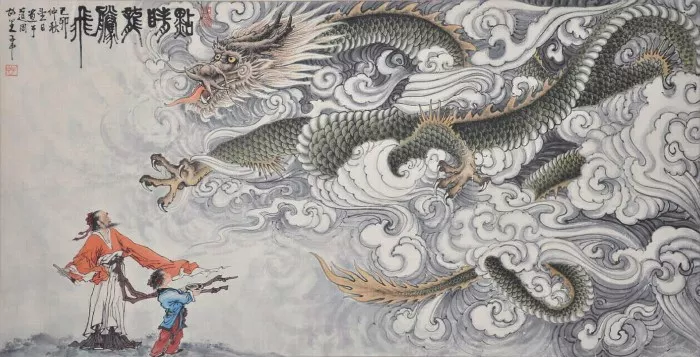
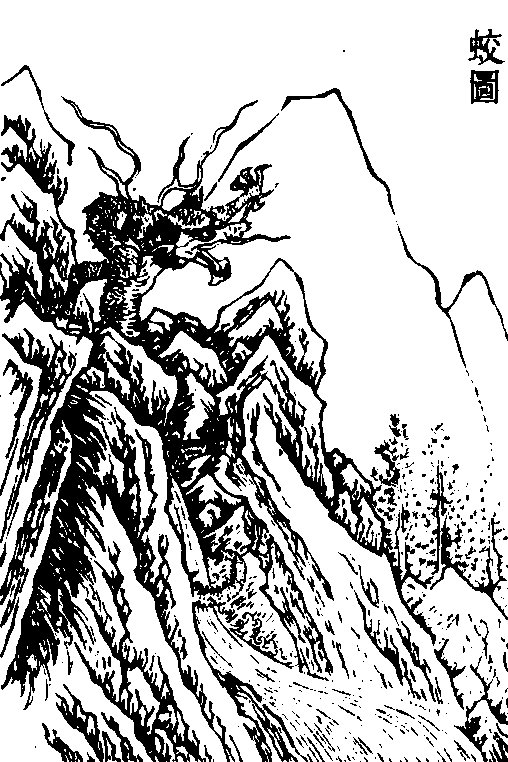
Descriptions of Jiaolong vary between classical Chinese sources, but its physical form is generally associated with a serpent-like or dragonlike body. One traditional description portrays the creature as resembling a snake, with a relatively small head, a slender neck and four limbs. Other texts classify it according to its scales and distinguish it from other kinds of dragons. Unlike the highly standardized appearance of the Chinese dragon in much modern art, Jiaolong does not have one fixed visual form. Classical mythology frequently used different names to distinguish aquatic and dragonlike creatures, and these categories could overlap depending on the source.
Its connection with water is therefore more important than any single physical feature. Jiaolong is associated with rivers, lakes, deep pools and other aquatic environments, giving it a distinctly terrestrial and aquatic character. Its serpentine form also places it within a broader tradition of Chinese mythical creatures whose appearances combine characteristics of snakes, reptiles and dragons. Rather than imagining Jiaolong as simply another version of the familiar imperial dragon, it is better understood as an ancient water-dwelling dragonlike being whose appearance reflects the mysterious and dangerous nature of deep water.
Family
Jiaolong does not have a clearly defined family tree comparable to the genealogies sometimes associated with major Chinese deities or the Dragon Kings. Instead, it belongs to the wider and varied dragon tradition of Chinese mythology. Classical Chinese literature contains numerous terms for different dragonlike beings, and Jiaolong appears among these categories rather than as a single character with a fixed genealogy.
Some traditions also associate Jiaolong with a process of transformation between different aquatic creatures and dragons. Later writings preserve ideas in which certain serpentine water creatures develop into Jiaolong and eventually become dragons. These traditions contributed to the idea that some aquatic creatures could gradually attain a higher mythical form.
This makes Jiaolong particularly interesting within Chinese mythology. It can be understood not simply as an isolated monster, but as part of a wider mythical landscape in which serpents, aquatic creatures and dragons exist along a shifting spectrum. It should not, however, be confused with the Four Dragon Kings, who are distinct figures associated with the governance of seas, rain and waterways. Jiaolong is better represented as a dragonlike aquatic creature than as one of the established Dragon Kings.
Other Names
The most recognizable modern form of the name is Jiaolong (蛟龙, jiāolóng). The character 蛟 (jiāo) is especially important because it is the older term found throughout classical Chinese literature. Depending on the period and translation, 蛟 may be rendered as a flood dragon, water dragon, dragon or aquatic dragon. These translations capture aspects of its mythology but should not be treated as exact equivalents in every context.
The addition of 龙 (lóng), meaning dragon, produces 蛟龙 (jiāolóng), literally combining the terms for Jiaolong and dragon. English-language sources consequently use names such as Jiaolong, Jiao Dragon and Water Dragon. The spelling Jiaolong is the appropriate modern pinyin form for Mythlok. In Chinese, the simplified form is 蛟龙, while the traditional form is 蛟龍. The pinyin is jiāolóng, with the first syllable carrying the first tone and the second also carrying the second tone. Because the ancient concept of 蛟 changed across texts, it is more accurate to treat Jiaolong as a traditional category of dragonlike aquatic being than to impose a single fixed definition upon every historical reference.
Powers and Abilities
Jiaolong’s power comes primarily from its relationship with water and the dangerous environments in which it dwells. Ancient stories portray the creature as sufficiently formidable to threaten people travelling on rivers and entering deep waters. One of the clearest examples appears in the story of Cifei, recorded in the Lüshi Chunqiu. When two Jiaolong surround his boat, he enters the water and kills them with his sword. The episode presents Jiaolong not as a distant celestial deity but as a dangerous aquatic creature capable of directly confronting human beings.
Another famous story concerns Zhou Chu, whose legendary exploits include confronting a Jiaolong that had become a threat to the local community. Zhou Chu enters the water to fight the creature, making the Jiaolong an embodiment of a danger that must be faced rather than merely worshipped. Water is therefore central to the creature’s mythical power. Jiaolong inhabits places where humans have historically been vulnerable to drowning, floods, currents and unknown creatures beneath the surface. Its mythology transforms those real dangers into a supernatural presence.
Some later traditions connect Jiaolong with rain, floods and transformation into higher forms of dragon. However, these ideas vary between sources and periods. Jiaolong should not be given a rigid list of supernatural abilities as though it were a standardized fantasy character. Its most enduring power is symbolic as well as physical: Jiaolong represents the unpredictable force concealed beneath the surface of the water.
Modern Day Influences
Jiaolong continues to attract interest as part of the broader revival of Chinese mythology in literature, film, television, games and popular fantasy. Its association with water and its relatively flexible appearance make it particularly adaptable to modern storytelling. Contemporary artists may depict Jiaolong as a serpentine water dragon, an enormous aquatic monster or a transitional creature between a serpent and a fully developed dragon. These interpretations draw upon genuine elements of traditional mythology while often adding visual features that belong specifically to modern fantasy.
The name has also acquired modern cultural associations beyond mythology. Jiaolong is used in contemporary China for things connected with the sea, exploration and technological achievement, reflecting the traditional image of a powerful creature emerging from the depths. Yet its mythological identity remains distinctive. Unlike the celestial dragons that became closely associated with imperial authority and cosmic order, Jiaolong retains a more elemental character. Its stories place humans at the edge of rivers and deep waters, confronting something powerful, mysterious and potentially deadly.
That makes Jiaolong an important figure in the development of Chinese dragon mythology. It demonstrates that the Chinese dragon was never represented by a single uniform creature. Different dragonlike beings occupied different environments and played different roles, from heavenly and rain-associated dragons to dangerous aquatic creatures such as Jiaolong.
Jiaolong ultimately embodies the wild side of the dragon tradition: ancient, aquatic and difficult to control. Its mythology reflects a world in which deep water could conceal both mystery and danger, turning the creature into a natural symbol of the forces that humans could enter, challenge and never completely master.
Related Images





Source
Wikipedia contributors. (2025). Jiaolong. In Wikipedia, The Free Encyclopedia. Retrieved November 22, 2025, from https://en.wikipedia.org/wiki/Jiaolong
StorytellingDB. (2025, October 30). Dragons of Chinese Mythology: Guardians of Celestial Forces. Retrieved from https://storytellingdb.com/dragon-chinese-mythology/
All About Dragons. Jiaolong. Retrieved from https://allaboutdragons.com/dragons/Jiaolong
China Market Advisor. (2025, February 5). How Chinese Folklore Influences Contemporary Culture and Media. Retrieved from https://chinamarketadvisor.com/how-chinese-folklore-influences-contemporary-culture-and-media/
Wikipedia contributors. (2025). Chinese dragon. In Wikipedia, The Free Encyclopedia. Retrieved November 22, 2025, from https://en.wikipedia.org/wiki/Chinese_dragon
Royal Lite Global. (2025, July 10). The Evolution of the Dragon in China: A Discourse. Retrieved from https://royalliteglobal.com/advanced-humanities/article/view/1872
Gods and Monsters. Jiaolong. Retrieved from https://godsandmonsters.info/jiaolong/
Age of Empires Series Wiki. (2025, September 16). Jiao-Long. Retrieved from https://ageofempires.fandom.com/wiki/Jiao-Long
Frequently Asked Questions
What is the Jiaolong in Chinese mythology?
The Jiaolong is a hornless flood dragon associated with rivers, lakes, and storms, known for its immense power over water.
Is the Jiaolong considered a true dragon?
In mythology, the Jiaolong is viewed as an intermediate stage; after centuries of cultivation it can transform into a full dragon.
What does the Jiaolong look like?
It is described as a long, scaled, serpent-like creature with four limbs, a crocodile-like snout, and no horns.
What powers does the Jiaolong have?
The Jiaolong can stir storms, cause floods, create whirlpools, and overpower boats or structures with its strength.
Why is China’s deep-sea submersible named Jiaolong?
It is named after the mythical creature to symbolize deep-water exploration and mastery over powerful aquatic environments.


