


Nentašu : The Washoe Creator and Guardian of Life
At a glance
| Description | |
|---|---|
| Origin | Washoe Mythology |
| Classification | Gods |
| Family Members | N/A |
| Region | United States of America |
| Associated With | Creation, Plants, Medicinal resources, Animals, Rain, Stars |
The Mythlok Perspective
In Mythlok’s Perspective, Nentašu represents creation as a relationship built on reciprocity rather than domination. Like Gaia in Greek mythology, who embodies the Earth and the source of life, Nentašu connects existence with the natural world. However, while Gaia is closely associated with the Earth as a primordial divine being, Nentašu’s Washoe narratives emphasize the practical responsibilities linking people, plants, animals and their ancestral homeland. Her story presents creation not simply as the beginning of life, but as an enduring obligation to protect what sustains it.
Nentašu
Introduction
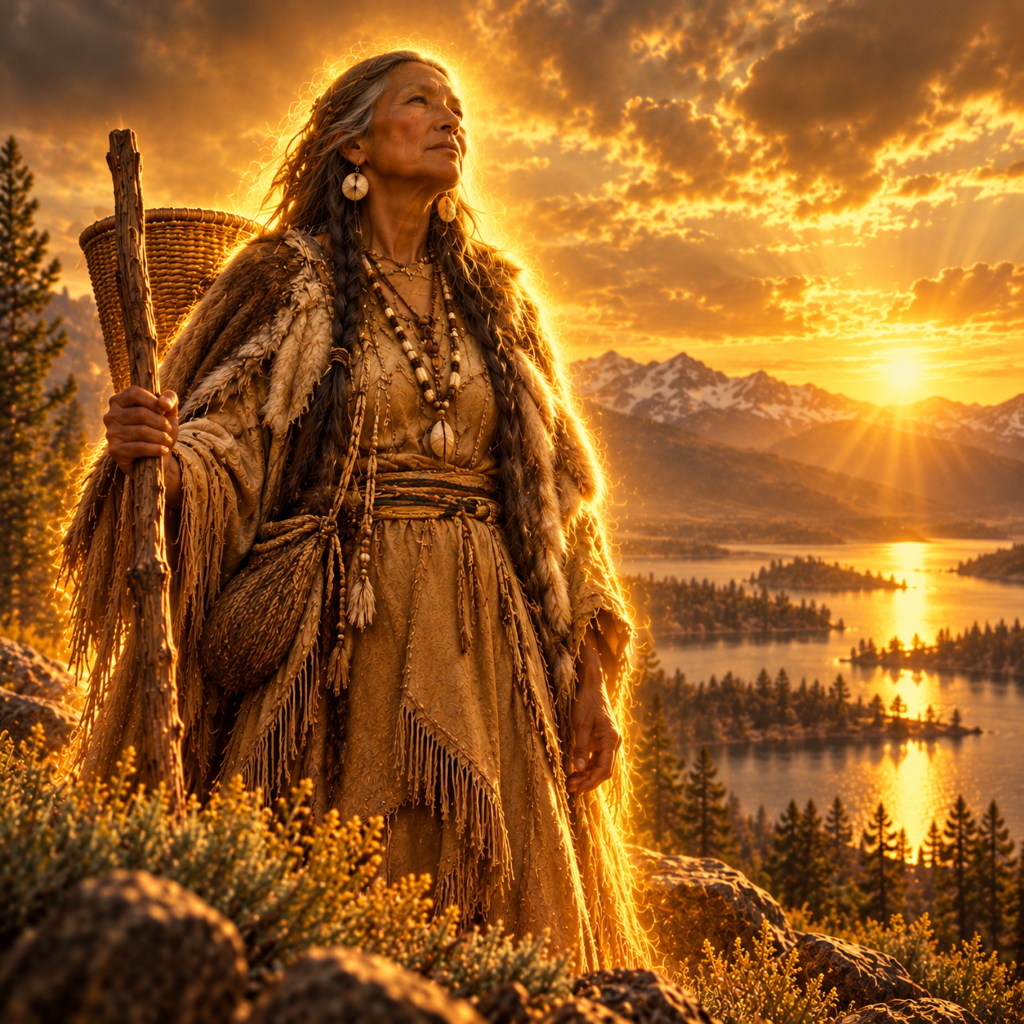
Nentašu is a female creator figure in Washoe mythology, associated with the origins of the Wašiw people, the abundance of the natural world and the relationship between a community and its ancestral homeland. Her stories connect human existence with the plants, animals, waters and landscapes that sustain life. Rather than portraying creation as an isolated supernatural event, Washoe traditions describe relationships between people and the environment as fundamental to their existence.
The Washoe people, also known as the Wašiw, are Indigenous to the Lake Tahoe region and surrounding areas of the eastern Sierra Nevada and western Great Basin, across present-day California and Nevada. Lake Tahoe, known as Daʔaw in some Washoe-language representations, occupies a central place in their cultural and geographical heritage.
In one creation account, Gewe, the Coyote, brings the Washoe people to their homeland. Nentašu then instructs the plants, medicines and animals to grow strong enough to nourish them. She also reminds the people of their responsibility to care for the land. This narrative presents belonging as a relationship of mutual obligation rather than simply a claim to territory.
Other recorded traditions offer additional perspectives on Nentašu’s creative role. In a version documented by Grace Dangberg, the old woman Nentusu prepares cattail seeds that become different peoples, including the Paiutes, Western Miwoks and Washoe. A separate narrative describes her involvement in the origin of the stars.
Physical Traits
Washoe accounts do not establish a consistent physical description of Nentašu. The available published narratives focus on her actions, instructions and creative responsibilities rather than specifying her facial features, clothing, height or bodily characteristics. In a star-origin narrative published by Moonshine Ink, she is identified as nentushu, translated as “old lady,” and described as an old lady creator. This portrayal establishes her as an elder female figure, but it does not provide enough evidence to reconstruct a canonical appearance. Her characterization is therefore best understood through her position in the stories. She prepares the materials from which people emerge, directs the growth of living things and entrusts other beings with responsibilities in the creation of the world.
Family
No consistently documented family tree identifies Nentašu’s parents, spouse, siblings or children. Her place in Washoe mythology is defined primarily by her creative role rather than by a genealogy comparable to those found in some other mythological traditions. Her narratives feature several important beings, including Gewe, the Coyote, and Tulishi, the Wolf. Their relationships with Nentašu are established through the tasks they perform in particular stories, not through documented family connections.
In the creation account associated with Lake Tahoe, Gewe brings the Washoe people to their homeland before Nentašu instructs the natural world to provide for them. In another narrative, she entrusts Tulishi with a sack of stars and directs him to arrange them in the sky. These episodes position her as a figure who establishes responsibilities and enables other beings to contribute to the creation of the world.
Another account recorded in Washo Tales describes Nentusu preparing cattail seeds that become different peoples. She then asks Coyote to carry the Washoe seeds to their designated valley. Although this narrative connects her with the origins of several communities, it does not establish those peoples as her biological descendants. Consequently, Nentašu’s relationship with other figures is best described through the roles they occupy in the stories rather than through unverified familial connections.
Other names
Nentašu appears under several spellings and descriptive titles in published accounts of Washoe traditions. These differences reflect variations in transcription, language representation and the ways individual narratives have been recorded in English. Nentašu is the spelling used in Washoe regional-history materials describing her role in bringing the people to their homeland and establishing their relationship with the natural world. Nentusu appears in discussions of Grace Dangberg’s recorded creation narratives, while Nentushu occurs in the star-origin story published by Moonshine Ink.
She is also described using English expressions such as “old lady creator” and “creator woman.” These terms emphasize her age, gender and creative role without necessarily establishing a formal divine title. Some secondary sources call her a goddess. Although this terminology can help readers understand her importance, it should be recognized as an interpretive label rather than proof that Washoe spiritual concepts correspond exactly to those of other religious traditions.
Powers and Abilities
Nentašu’s principal abilities centre on the creation of peoples and the flourishing of the natural world. In a creation account recorded by Grace Dangberg, Nentusu processes cattail seeds and separates them into groups associated with the Paiutes, Western Miwoks and Washoe. She places the seeds intended for the Washoe in a water jug and asks Gewe, the Coyote, to carry them to their homeland. This narrative connects the origins of human communities with the plants of the region, presenting nature as an integral part of creation rather than merely a resource for survival.
Nentašu also possesses the ability to nurture living things and establish their relationship with humanity. In Washoe traditions, she instructs plants, medicinal herbs and animals to grow strong so they can provide nourishment for the people. Some recorded accounts also associate her creative role with thunder, rain and the growth of important plant foods. Her influence extends to the heavens in a separate star-origin narrative, in which she entrusts Tulishi, the Wolf, with a sack of stars and instructs him to arrange them in the sky. When Gewe interferes and the stars scatter, the story offers a traditional explanation for their distribution across the night sky.
These narratives portray Nentašu as a creator whose influence sustains life through growth, nourishment and the relationships between people and their environment. Rather than depicting her primarily as a warrior or a figure who exercises power through destruction, Washoe traditions emphasise her role in establishing the conditions necessary for communities to flourish. Her documented abilities are rooted in creation, natural abundance and the ordering of the world, while claims about powers such as shapeshifting, immortality or unrestricted control over natural forces remain unsupported by the available accounts.
Modern Day Influence
Nentašu remains relevant to the way Washoe history and cultural identity are explained in educational and regional heritage materials. Her story connects the Wašiw people with Lake Tahoe and the surrounding landscapes, emphasizing that the homeland is not merely a geographical location but a place embedded in cultural memory and responsibility.
The Washoe Tribe’s historical materials describe how Nentašu instructed plants, medicines and animals to flourish for the people while reminding the community to care for the land. This reciprocal relationship offers an important perspective on environmental stewardship: human survival depends on the natural world, and people have responsibilities toward the places that sustain them.
Her association with plants and medicines also provides a way to understand the importance of traditional ecological knowledge. Food gathering, seasonal movement and familiarity with local resources developed within a landscape that supported the Washoe way of life. Nentašu’s stories place these relationships within a wider cultural understanding of belonging.
Interest in Washoe astronomy has also brought renewed attention to traditional narratives about the sky. A 2024 article in Moonshine Ink, written by Darrel Cruz with contributions from Washoe cultural and research participants, recounts the story of Tulishi, Gewe and the scattered stars. The article also discusses collaborative research involving the Washoe Tribe and the University of Nevada, Reno into possible astronomical knowledge preserved in cultural landscape features.
Related Images


Source
California Trail Interpretive Center. (2017, June 5). Washoe Indian Tribe. https://californiatrailcenter.org/washoe-indian-tribe/
Dangberg, G. M. (1968). Washo tales. Nevada State Museum.
Downs, J. F. (1966). Washo religion. University of California Press.
https://www.gutenberg.org/files/31429/31429-h/31429-h.html
Moonshine Ink. (2025, February 15). We came from the stars. https://www.moonshineink.com/mountain-life/we-came-from-the-stars/
Nevers, J. (1976). Wa she shu: A Washo tribal history. Inter-Tribal Council of Nevada.
https://eric.ed.gov/?id=ED198965
Sierra State Parks Foundation. (2024, November 12). What did the Washoe Tribe call home in Tahoe?
https://www.sierrastateparks.org/blog/washoe-tribe-dwellings
Tahoe Quarterly. (2026, June 27). The long return. https://tahoequarterly.com/features/the-long-return
Visit Truckee Tahoe. (n.d.). Native American history. https://www.visittruckeetahoe.com/explore/history-heritage/native-american-history
Frequently Asked Questions
Who is Nentašu in Washoe mythology?
Nentašu is a female creator figure in Washoe oral tradition associated with the origins of the Wašiw people, the abundance of nature and the responsibility to care for the ancestral homeland.
What are Nentašu's powers and abilities?
Nentašu is associated with creating peoples, encouraging plants and animals to flourish, sustaining food and medicine resources, and entrusting Tulishi the Wolf with placing stars in the sky.
What is Nentašu's connection to Lake Tahoe?
Nentašu is connected to the Washoe homeland surrounding Lake Tahoe. In one creation account, Gewe the Coyote brings the people there, and Nentašu establishes their relationship with the land.
Who are Nentašu's family members?
Published accounts do not establish Nentašu’s parents, spouse, children or siblings. Gewe the Coyote and Tulishi the Wolf appear in related stories, but their roles do not establish family relationships.
What is the difference between Nentašu and Nentusu?
Nentašu and Nentusu are variant spellings found in published accounts of Washoe oral traditions. Both are associated with a female creator figure, although details differ between recorded narratives.
