


Manaul : The Bird Behind Creation in Philippine Tradition
At a glance
| Description | |
|---|---|
| Origin | Philippine Mythology |
| Classification | Animals |
| Family Members | N/A |
| Region | Philippines |
| Associated With | Creation, Messaging |
Mythlok Perspective
In Mythlok’s Perspective, Manaul represents the delicate relationship between creation and conflict, where a bird can shape humanity’s beginnings and influence the formation of the natural world. Like Odin’s ravens in Norse mythology, Manaul connects the avian world with forces beyond human understanding, yet its role extends into creation itself. Unlike divine messengers who primarily convey knowledge, Manaul becomes an agent of transformation, revealing how Philippine mythology places nature at the centre of cosmic change.
Manaul
Introduction
Manaul is a mythical bird associated with creation, divine conflict, and the origins of the natural world in Philippine mythology. Appearing in different regional traditions, Manaul occupies a distinctive place in stories that explain the emergence of humanity and the formation of islands. Its legends connect the natural world with the actions of powerful supernatural beings, reflecting how early communities understood the relationship between the heavens, the sea, and the land.
In some Tagalog creation narratives, a bird pecks open a bamboo stalk from which the first man and woman, Malakas and Maganda, emerge. Later retellings associate this bird with Manaul, although the identity of the bird varies across accounts. The story presents a seemingly ordinary creature as an essential participant in the beginning of human life.
Visayan traditions give Manaul a different but equally significant role. Here, the bird appears in narratives involving powerful deities, opposing forces of nature, and the origins of the islands. One account describes Manaul as the king of birds, whose conflict with supernatural beings ultimately leads to the appearance of land. Other versions associate the bird with attempts to interrupt disputes between the sky and water deities.
These stories establish Manaul as more than a creature of the sky. Its actions influence the world below, connecting the origins of humanity with the larger forces that shape the natural environment. The differences between regional accounts also reveal the diversity of Philippine mythology, where related themes developed through distinct cultural traditions.
Physical Traits
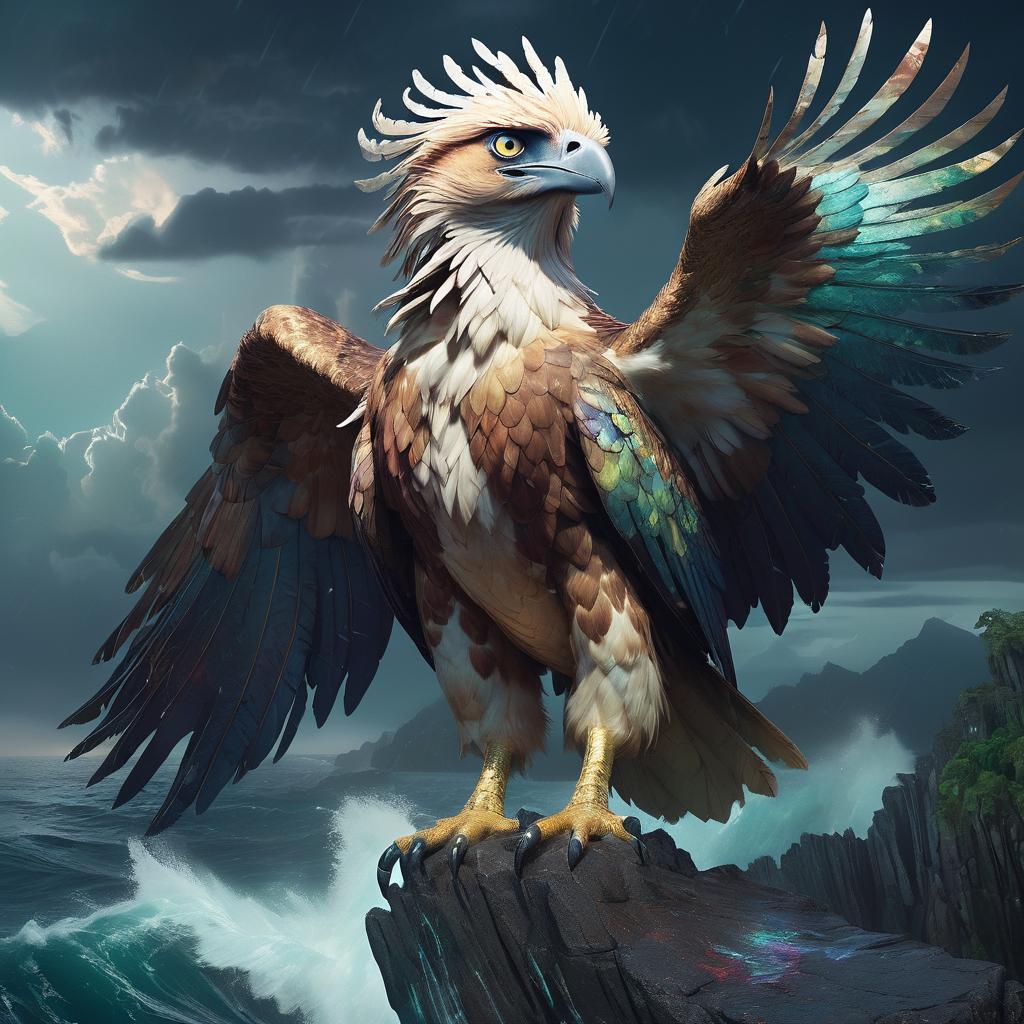
Manaul is primarily described as a powerful bird whose importance comes from its mythological role rather than a consistently recorded physical appearance. In Visayan narratives, it is portrayed as a formidable avian figure, sometimes associated with the king of birds. Its extraordinary status distinguishes it from ordinary creatures and places it within a world inhabited by powerful deities and supernatural forces.
Some accounts connect Manaul with an eagle-like form. In a Visayan narrative, a king is transformed into a bird as a consequence of his actions. Such descriptions contribute to the association between Manaul and large birds of prey, although they do not establish a single appearance shared by every tradition.
The surviving accounts do not provide a consistent description of Manaul’s plumage, wingspan, or other specific anatomical features. Its appearance is therefore best understood through the role it plays in each story. As a bird capable of participating in events that affect the natural world, Manaul represents the significance attributed to avian creatures in traditional Philippine beliefs.
Its position between the heavens and the earth also carries symbolic weight. Birds can move across boundaries that separate different parts of the natural world, making them meaningful figures in stories about communication, transformation, and the origins of life. Manaul’s mythological importance rests on this connection between the sky and the events unfolding beneath it.
Family
Manaul does not have a consistently documented family lineage in Philippine mythology. Rather than belonging to a clearly defined divine genealogy, the bird appears in narratives shaped by its encounters with supernatural beings. Its relationships are best understood through these interactions and the roles that other figures play in the stories.
In Visayan mythology, Manaul is associated with Kaptan, the powerful deity of the sky, and Maguayan, a deity connected with the waters. Their relationship forms part of a wider mythological framework in which opposing forces influence the natural world. The precise roles of these figures differ between narratives, and their conflicts should not be treated as a single account shared throughout the Visayas.
Another Visayan narrative involves Tubluck Laui, a figure associated with the winds. Manaul becomes entangled in a conflict involving supernatural powers, leading to consequences that extend beyond the immediate participants. In the account discussed by folklorist Francisco R. Demetrio, the actions of these figures contribute to a story explaining the appearance of land.
Canuay and Amihan also appear in the broader narrative tradition surrounding these events. Their roles are connected with the supernatural forces involved in the conflict rather than establishing a conventional family relationship with Manaul. These associations place Manaul within a larger network of mythological figures whose actions explain the origins and character of the natural world. The bird’s significance comes from its involvement in these events, not from a fixed position within a divine family tree.
Other names
Manaul appears in a body of Philippine folklore shaped by regional storytelling and variations in oral tradition. Related stories sometimes associate the bird with other supernatural figures, but these connections require careful distinction because similar roles do not necessarily indicate identical identities. Amihan is one figure linked with Manaul in certain retellings. In some versions of the Tagalog creation narrative, Amihan is associated with the bird that opens the bamboo stalk containing the first humans. Other traditions present Amihan as a supernatural figure connected with the air and winds. The relationship between Amihan and Manaul therefore depends on the particular account being followed.
The tigmamanukan belongs to traditional Tagalog beliefs concerning omen birds. These birds were associated with interpreting signs through their calls or flight, which could influence how people understood journeys and important decisions. Some retellings connect an omen bird with the bamboo-origin story, creating an association between the tigmamanukan and Manaul. However, the names should not automatically be treated as interchangeable across all accounts.
The Maranao Sarimanok represents another important bird figure in Philippine cultural traditions. Recognised for its distinctive artistic representation and association with good fortune, the Sarimanok belongs to a particular Maranao cultural context. Its resemblance to other mythological birds does not establish that it is another name for Manaul.
These distinctions demonstrate how Philippine traditions developed through different communities, each preserving its own stories, symbols, and interpretations. Understanding Manaul requires attention to the context in which its name appears rather than assuming that every legendary bird belongs to the same tradition.
Powers and Abilities
Manaul’s powers are expressed through its involvement in creation narratives and conflicts between supernatural forces. Rather than following a single established list of abilities, the bird’s significance emerges from the consequences of its actions in different regional stories.
One of the best-known themes associated with Manaul is the emergence of humanity from bamboo. In some Tagalog retellings, a bird pecks open the bamboo stalk that releases Malakas and Maganda, the first man and woman. This act connects the bird with the beginning of human life, making it an important participant in a creation narrative. The bird’s identity varies between versions, so Manaul’s role should be understood within the specific retelling.
Visayan traditions associate Manaul with stories explaining the formation of land. In one account, the bird becomes involved in a conflict with supernatural beings, and the intervention of Kaptan results in rocks falling from the sky. These rocks are connected with the emergence of land in the Visayas. The narrative presents the landscape as the outcome of a struggle involving powerful forces rather than simply the result of the bird deliberately creating islands.
Manaul also occupies a significant position in stories about divine conflict. Its actions influence events involving beings associated with the sky, the sea, and the winds. Depending on the narrative, the bird’s involvement contributes to the escalation or resolution of these conflicts, illustrating how the actions of one creature can produce consequences on a much larger scale.
Transformation is another element associated with the wider body of stories surrounding Manaul. In a Visayan account, a king is transformed into a bird as a consequence of his behaviour. This motif connects the bird’s form with supernatural intervention, although it does not establish that Manaul possesses an independent ability to change shape in every tradition.
Together, these narratives portray Manaul as a figure associated with creation, transformation, and the consequences of conflict. Its importance lies in the way its actions connect individual events with the origins of humanity and the physical world.
Modern Day Influence
Manaul remains an important subject for exploring the diversity of Philippine mythology and the ways traditional stories can be interpreted by contemporary audiences. Its association with creation and the formation of land provides a starting point for examining how communities explained the world through narratives involving animals, supernatural beings, and the forces of nature.
Contemporary writers, illustrators, educators, and storytellers can draw on Manaul’s legends to introduce regional Philippine traditions to new audiences. Visual interpretations can explore the bird’s relationship with the sky, bamboo, and the natural landscape, while literary retellings can examine the differences between Tagalog and Visayan accounts. Such approaches offer opportunities to preserve the distinctions between regional traditions while making their stories accessible to younger generations.
Manaul also provides a useful subject for discussions about the cultural significance of birds in traditional societies. Across many cultures, birds appear in stories about creation, omens, divine communication, and the boundaries between different realms of existence. Manaul can be examined within this broader context without assuming that its symbolism is identical to that of birds from other traditions.
Its connection with the emergence of humanity offers another avenue for contemporary interpretation. The bamboo-origin narrative places a natural object at the centre of human beginnings, linking the environment with ancestry and cultural identity. Meanwhile, the Visayan stories connect the formation of the landscape with conflicts among supernatural powers, presenting the natural world as a place shaped by events beyond ordinary human control.
The continued study and retelling of Manaul’s stories can contribute to a broader understanding of Philippine cultural heritage. By examining the bird within its original regional contexts, readers can appreciate both the shared themes and the distinctive narratives that make Philippine mythology a diverse and evolving tradition.
Related Images


Source
De Guzman, D. (2017). The Role of Birds and Serpents in Philippine Mythology. The Aswang Project. https://www.aswangproject.com/role-birds-serpents-philippine-mythology/
Kennedy, R. S., Gonzales, P. C., Dickinson, E. C., Miranda, H. C. Jr., & Fisher, T. H. (2000). A Guide to the Birds of the Philippines. Oxford University Press.
Morrow, P. (2008). The Fraudulent Legal Code of Kalantiaw. Retrieved from https://web.archive.org/web/20080510153401/http://www.mts.net/~pmorrow/kalant.htm
Mythical Encyclopedia. (n.d.). Manaul: Mythical Creatures. https://mythicalencyclopedia.com/manaul/
Monstropedia. (n.d.). Manaul. https://www.monstropedia.org/index.php?title=Manaul
Wikipedia contributors. (n.d.). Manaul. Wikipedia. https://en.wikipedia.org/wiki/Manaul
Frequently Asked Questions
Who is Manaul in Philippine mythology?
Manaul is a mythical bird in Philippine mythology associated with creation and divine conflicts. In some traditions, it helps bring humanity into existence and plays a role in the formation of islands.
What is Manaul known for?
Manaul is known for its role in creation stories, including the emergence of the first humans from bamboo in some retellings and its involvement in Visayan legends about the formation of land.
What are Manaul's powers and abilities?
Manaul is associated with creation, supernatural conflicts, and events that shape the natural world. Its actions influence human origins and the formation of land in different Philippine mythological traditions.
Is Manaul the same as Amihan?
Manaul and Amihan are associated in some Philippine creation stories, but they are not universally identical. Their roles and identities vary across regional traditions and different versions of the myths.
What is the significance of Manaul in Philippine mythology?
Manaul symbolises the connection between nature, creation, and supernatural forces. Its stories explain humanity’s origins and aspects of the landscape while preserving the diversity of Philippine cultural traditions.


