


Kurrea : The Giant Water Serpent of Wiradjuri Tradition
At a glance
| Description | |
|---|---|
| Origin | Wiradjuri Mythology |
| Classification | Spirits |
| Family Members | N/A |
| Region | Australia |
| Associated With | Deep lagoons, Waterways, Danger, Immense strength |
The Mythlok Perspective
In Mythlok’s Perspective, Kurrea reflects humanity’s ancient fear of waters that conceal unseen dangers. Like Jörmungandr, the world-encircling serpent of Norse mythology, Kurrea demonstrates how serpentine beings can embody forces far greater than human control. However, while Jörmungandr is associated with cosmic destruction and Ragnarök, Kurrea’s stories are rooted in specific Australian waterways and their cultural significance. This distinction reveals how different cultures use powerful serpents to express humanity’s relationship with nature, danger, and the mysteries of the landscape.
Kurrea
Introduction
Kurrea is a giant water serpent recorded in Aboriginal Australian traditions, particularly in stories associated with Wiradjuri, Kamilaroi (Gamilaraay), and neighbouring peoples of New South Wales. Described as an enormous creature inhabiting deep lagoons and waterways, Kurrea represents the formidable presence of the natural world and the dangers associated with entering certain waters.
One of the best-known places connected with Kurrea is Boobera Lagoon, near the New South Wales and Queensland border. Situated within the wider cultural landscape of the Gomeroi and Kamilaroi peoples, the lagoon holds considerable Aboriginal cultural and spiritual significance. A story recorded by the Australian surveyor and ethnographer R. H. Mathews in the late nineteenth century describes a warrior confronting a powerful serpent associated with this waterway. The narrative, published as The Kurrea and the Warrior, connects the creature to the formation of channels across the landscape.
Kurrea also appears in reference material documenting Wiradjuri traditions, where it is identified among the giant serpent and ancestral figures associated with the region’s traditional stories. However, the surviving accounts do not establish that every narrative about Kurrea originated with the Wiradjuri people. Stories involving Boobera Lagoon and the Narran waterways belong to a broader regional cultural landscape, and their details vary between recorded versions.
Rather than viewing Kurrea simply as a legendary monster, it is useful to understand the creature through its relationship with water, land, and traditional knowledge. Its stories connect a powerful supernatural being to particular places, explaining their dangers and reinforcing the importance of respecting culturally significant waterways.
Physical Traits
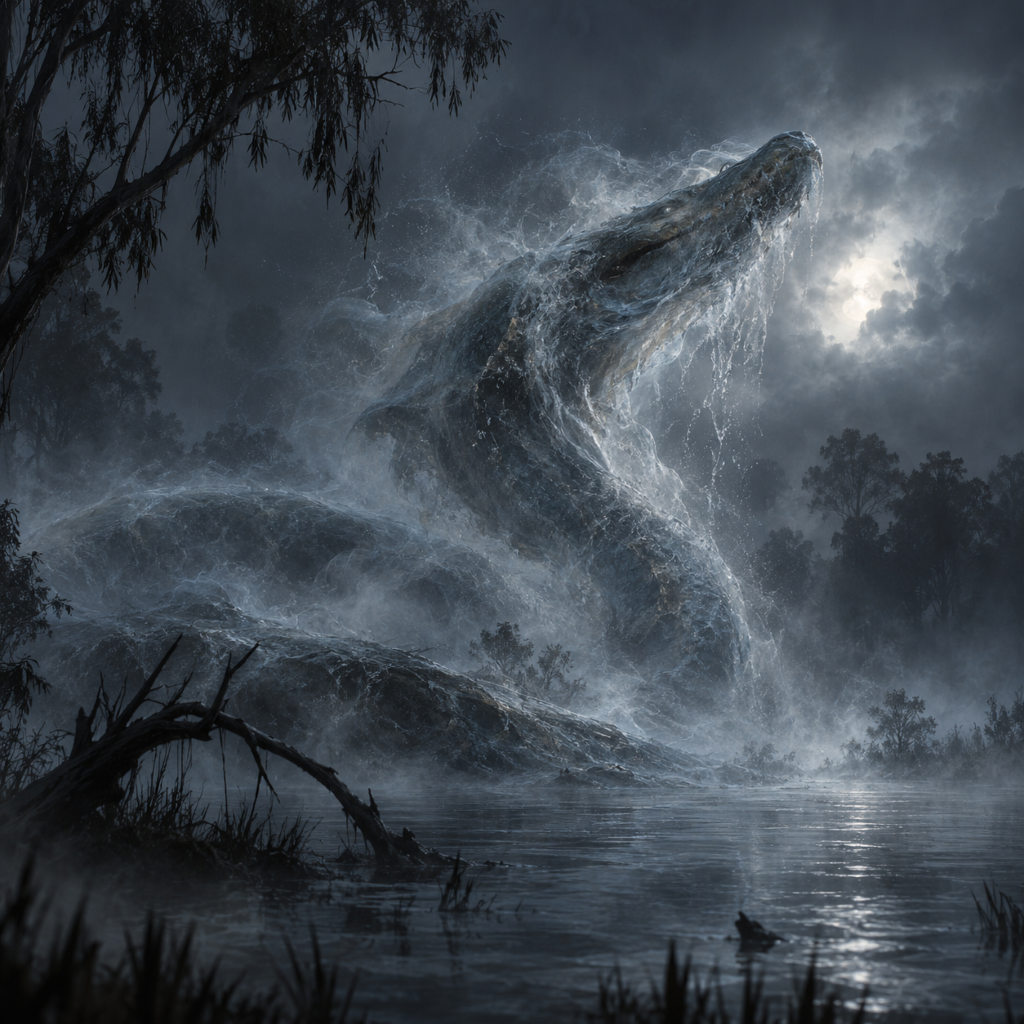
Kurrea is generally described as an enormous serpent or reptilian water creature. Its precise appearance varies between accounts, with some descriptions emphasising its elongated, snake-like body and others associating it with crocodilian characteristics. These differences reflect the variety of surviving descriptions rather than a single universally established physical form.
An important early reference comes from R. H. Mathews, whose account of Kurrea describes a legendary serpent-like creature associated with Boobera Lagoon. The same account records a ground carving representing the creature. The figure reportedly measured approximately 39 feet in length, illustrating the extraordinary scale attributed to Kurrea in the recorded tradition. This measurement describes the carving, not a verified measurement of the creature itself.
Water is central to Kurrea’s physical identity. The creature is associated with the deep waters of Boobera Lagoon, where it is said to dwell beneath the surface. Some retellings describe it as unable to travel freely across dry land, explaining how its movements through the landscape created channels connecting waterways.
These descriptions make Kurrea different from an ordinary reptile. Its enormous size, association with deep water, and ability to alter the landscape place it within the realm of supernatural beings. Nevertheless, details such as its exact colour, the number of limbs it possesses, and its complete anatomy are not consistently documented in the available historical accounts.
Family
Kurrea’s family relationships are not consistently documented, and the available sources do not establish a complete genealogy. Some recorded narratives, however, associate the creature with other important supernatural figures and provide insights into its place within regional storytelling traditions.
One of the best-known accounts concerns Baiame, a major ancestral creator figure in traditions of several Aboriginal peoples of New South Wales. In a narrative recorded by K. Langloh Parker, a creature identified as kurreah, translated as a crocodile, swallows Baiame’s wives, Birrahgnooloo and Cunnunbeillee, while they are near Narran Lake. Baiame subsequently kills the creature and frees them. The precise details vary between versions, and the creature in this account should not automatically be treated as identical to every manifestation of Kurrea associated with Boobera Lagoon.
Another narrative connects Kurrea with a warrior named Toolalla, who attempts to defeat the creature but discovers that his weapons cannot injure it. The story introduces an unusual relationship between Kurrea and the bumble tree, which is described as the serpent’s mother-in-law. This connection becomes significant when the warrior seeks refuge in the tree, beyond the creature’s reach. The narrative is preserved in later accounts of the Boobera Lagoon tradition.
Some modern retellings also identify the gowarke, extraordinary emu-like beings, as Kurrea’s descendants. However, this relationship is not sufficiently established across the available sources to be treated as a universal feature of Kurrea traditions.
Other names
Kurrea appears under several spellings in published sources. Kurreah is a notable variant recorded by K. Langloh Parker, who translated the term as meaning crocodile in her account of the Euahlayi people. The spelling reflects the historical recording of Aboriginal words by non-Indigenous writers, whose transcriptions did not always follow consistent conventions.
The creature is also associated with the name Rainbow Serpent in some accounts. A New South Wales government report identifies Garriya, or Kurrea, as a spiritual creature associated with Boobera Lagoon and describes it as also known as the Rainbow Serpent. Other historical interpretations have similarly connected Kurrea with broader traditions concerning ancestral water serpents.
However, the relationship between Kurrea and the Rainbow Serpent requires care. Aboriginal Australian traditions are diverse, and the Rainbow Serpent is not necessarily a single identical being across different peoples and regions. Similarities in appearance or association with waterways do not establish that all such figures share the same identity, stories, or responsibilities.
Powers and Abilities
Kurrea’s most prominent characteristic is its association with deep water and its formidable strength. In stories connected with Boobera Lagoon, the creature inhabits the water and poses a danger to those who enter its domain. Some accounts describe it attacking people who fish or otherwise venture into the lagoon, reinforcing its reputation as a powerful and dangerous being.
Another defining ability is its capacity to reshape the landscape. According to the narrative recorded by Mathews, Kurrea creates channels by tearing up the earth as it moves. These channels connect the creature’s movements with the physical formation of waterways, giving the story a strong connection to the landscape surrounding Boobera Lagoon.
Kurrea’s encounter with Toolalla demonstrates its apparent resistance to conventional weapons. The warrior attempts to kill the creature using his strongest weapons, but they fail to injure it. When Toolalla escapes, Kurrea pursues him, cutting through the ground as it moves. The episode portrays the creature as difficult to defeat and exceptionally powerful within its aquatic environment.
The same narrative reveals a limitation: Kurrea fears the bumble tree. Toolalla climbs into the tree to escape, and the creature retreats rather than approach him. This detail gives the story a resolution without requiring the warrior to overpower the serpent directly. Together, these abilities establish Kurrea as more than a predatory water creature. Its strength, relationship with waterways, resistance to weapons, and unusual vulnerability connect it to a landscape in which natural features carry cultural and spiritual significance.
Modern Day Influence
Kurrea remains present in contemporary discussions of Aboriginal Australian traditions, particularly those concerning sacred waterways, ancestral beings, and the cultural history of northern New South Wales. Historical publications, folklore collections, and modern reference works continue to preserve accounts of the creature and its connection to Boobera Lagoon.
The lagoon itself is especially significant. A 2022 report by the New South Wales Natural Resources Commission describes its cultural and spiritual importance to the Gomeroi, Gamilaraay, Kamilaroi, and Bigambul peoples. It also discusses the tradition identifying the lagoon as the resting place of Kurrea, illustrating how the creature remains connected to a particular cultural landscape rather than existing solely as a character in a detached legend.
Kurrea also appears in comparative discussions of Aboriginal water-serpent traditions. Researchers and writers have examined its similarities to the Rainbow Serpent and other supernatural beings associated with rivers, lagoons, and the shaping of the land. Such comparisons can help readers recognise recurring themes, but they should not erase the differences between individual cultural traditions.
Popular culture has adopted the name as well. Kurrea appears in Final Fantasy XIV as a powerful hunt target, reimagined as a fantasy creature for the game’s fictional world. This modern portrayal demonstrates how traditional names can travel into contemporary entertainment, although the game adaptation should be distinguished from Aboriginal cultural accounts.
Related Images

Source
Buchler, I. R., & Maddock, K. (Eds.). (1978). The rainbow serpent: A chromatic piece. Mouton Publishers.
Mathews, R. H. (1907). Notes on the Aborigines of New South Wales. W. A. Gullick, Government Printer. https://nla.gov.au/nla.obj-756755978
Norris, R. P., & Norris, C. M. (2014). The astronomy of the Kamilaroi people and their neighbours. Australian Aboriginal Studies. https://arxiv.org/pdf/1311.0076.pdf
Parker, K. L. (1905). The Euahlayi tribe: A study of Aboriginal life in Australia. Archibald Constable and Company.
Pathfinders NSW. (n.d.). Wiradjuri. https://pathfindersnsw.org.au/languages/wiradjuri/
Reed, A. W. (1982). Aboriginal myths, legends, and fables. Reed.
A Book of Creatures. (2021, February 15). Kurrea. https://abookofcreatures.com/2021/02/15/kurrea/
Final Fantasy XIV Hunt. (n.d.). A-Rank hunts ARR: Kurrea. https://ffxivhunt.com/hunt_a_arr.php
Frequently Asked Questions
Who is Kurrea in Aboriginal Australian traditions?
Kurrea is a giant water serpent associated with Aboriginal Australian traditions, particularly stories concerning Boobera Lagoon and other waterways in New South Wales.
Is Kurrea part of Wiradjuri tradition?
Kurrea appears in Wiradjuri reference material, but its best-known stories are associated with Boobera Lagoon and neighbouring Kamilaroi, Euahlayi, and Gomeroi cultural traditions.
What does Kurrea look like?
Kurrea is described as an enormous water-dwelling serpent with reptilian or crocodilian characteristics. Historical accounts emphasise its immense size and association with deep lagoons.
What are Kurrea's powers?
Kurrea is associated with great strength, resistance to weapons, dangerous aquatic habitats, and the ability to create channels by tearing through the earth as it moves.
Is Kurrea the Rainbow Serpent?
Some historical and contemporary accounts identify Kurrea with the Rainbow Serpent, but this association is not universal. Regional stories and cultural differences should be considered when comparing them.


