

Mande Burung : The Indian Forest Giant of Meghalaya
| Description | |
|---|---|
| Origin | Indian |
| Classification | Cryptid |
| Demeanour | Neutral, Shy |
| Habitat | Dense Forests of Meghalaya’s Garo Hills |
| Status | Not Proven |
Mythlok Perspective
In Mythlok’s Perspective, the Mande Burung is fascinating not because it has been proven, but because it sits at the intersection of wilderness, memory, and identity. Many cultures preserve stories of giant forest-dwelling humanoids that exist just beyond the boundaries of civilization. The Mande Burung fulfills this role for the Garo Hills, embodying the mystery of forests that remain largely untamed. Cross-culturally, it mirrors the Sasquatch of North America and the Yeti of the Himalayas. While the physical descriptions differ, all three represent humanity’s enduring belief that hidden corners of the natural world may still contain undiscovered wonders. Whether cryptid or cultural symbol, the Mande Burung remains a powerful reminder that some mysteries continue to thrive in the space between folklore and science.
Mande Burung
Introduction
nslates to “Forest Man” in the Garo language, a fitting description for a being that has remained hidden within some of the most remote jungles in Northeast India. For generations, stories of this elusive creature have been passed down through oral traditions among the Garo people, making it an enduring part of the region’s folklore.
Often described as India’s answer to Bigfoot or the Yeti, the Mande Burung occupies a unique place in both local culture and modern cryptozoology. While mainstream science has yet to verify its existence, reports of sightings, footprints, unusual sounds, and other unexplained evidence continue to attract researchers and adventurers. Whether viewed as a legendary forest spirit, a misidentified animal, or a potentially undiscovered species, the Mande Burung remains one of the most fascinating mysteries associated with India’s wilderness.
Physical Attributes
Descriptions of the Mande Burung remain remarkably consistent across many reported sightings. Witnesses commonly describe a large, upright hominoid standing between seven and ten feet tall. The creature is said to possess a broad chest, powerful limbs, and a body covered in thick black or dark brown hair.
One of its most distinctive features is its elongated head, which some observers claim gives the impression that the creature is wearing a pointed cap. Its face is generally described as ape-like yet unusually human in appearance. Witnesses frequently report a strong, unpleasant odor associated with the creature, a characteristic commonly mentioned in accounts of other alleged wild-man cryptids around the world.
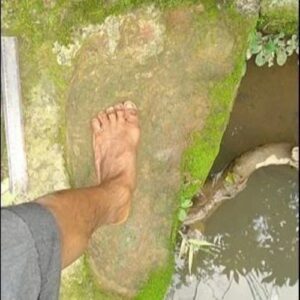
Large footprints are among the most frequently cited pieces of evidence. These tracks typically measure between thirteen and eighteen inches in length and often appear deeply impressed into the ground, suggesting a creature of considerable weight. Some investigators have estimated that a fully grown Mande Burung could weigh as much as 300 kilograms. Reports of overturned boulders and damaged vegetation have also contributed to its reputation as an exceptionally strong animal.
First Sighting/Reporting
Stories of the Mande Burung existed long before written records appeared. The Garo people have spoken of mysterious forest-dwelling beings for centuries, making it difficult to identify a true first sighting.
The first widely discussed modern report emerged in the late 1990s near Andol Chiring in South Garo Hills. Local researchers began documenting eyewitness accounts, footprints, and folklore surrounding the creature. Interest increased significantly in 2002 when forestry personnel conducting wildlife surveys in Balpakram National Park reported observing a large, upright figure in a remote area of the forest.
Further reports surfaced throughout the following years, particularly in villages located near heavily forested regions. Some witnesses claimed to have seen multiple individuals together, including smaller creatures that appeared to be juveniles. These reports strengthened local belief that the Mande Burung might represent a breeding population rather than a solitary animal.
Despite the growing number of accounts, no sighting has produced evidence capable of satisfying scientific standards. Nevertheless, these reports remain among the most frequently cited cases in Indian cryptozoology.
Other Names
The term Mande Burung itself means “Forest Man” and serves as the primary name used by the Garo people. However, local traditions describe several related beings that share similarities with the creature.
Among these is Matdngdng, which is often described as a faster-moving version of the Mande Burung. Another figure known as Ajaju appears in folklore as a strange humanoid lacking conventional elbow and knee joints. Garo traditions also mention Matmemang, an invisible supernatural being associated more closely with spirits than physical cryptids.
Outside India, the Mande Burung is frequently compared to other legendary wild-man figures. These include the Yeti of the Himalayas, the Yeren of China, the Yowie of Australia, the Orang Pendek of Indonesia, and the Sasquatch of North America. Such similarities have encouraged researchers to examine whether these legends might share common cultural origins or reflect recurring human experiences in remote wilderness environments.
Modus Operandi
Unlike many legendary creatures, the Mande Burung is generally portrayed as shy rather than aggressive. Most reported encounters involve brief observations before the creature retreats into the forest. There are very few stories describing direct attacks on humans.
According to local accounts, the creature primarily feeds on fruits, roots, tubers, berries, bark, and other plant material. Some reports suggest it also consumes freshwater crabs, which may explain the overturned rocks occasionally found near streams. Researchers investigating alleged Mande Burung activity have reported discovering crab remains in locations where unusual tracks were also present.
The creature is believed to inhabit isolated valleys, dense forests, and rugged terrain that receive minimal human activity. Witnesses often describe it as highly cautious and difficult to approach. Some reports suggest it constructs simple ground nests for resting, a behavior that distinguishes it from bears and other wildlife commonly found in the region.
Local folklore sometimes connects the Mande Burung to stories of giant brothers who once protected villages. Over time, these ancient narratives may have blended with sightings of unusual animals, helping shape the modern legend.
Pop Culture References
The mystery surrounding the Mande Burung has attracted attention from filmmakers, researchers, and cryptozoologists around the world. Numerous documentaries and television programs have explored the legend, often presenting it as India’s equivalent of Bigfoot.
One of the most notable advocates for investigating the creature has been documentary filmmaker Dipu Marak, who has spent years collecting eyewitness testimonies and supporting expeditions into the Garo Hills. International researchers have also visited the region in search of evidence.
Hair samples allegedly connected to the creature were subjected to DNA testing during one investigation. The results identified the samples as belonging to known animals rather than an unknown primate, though believers argue that the tested material may not have originated from the Mande Burung itself. Television programs, cryptozoology publications, and online communities continue to discuss the creature. Its reputation as the “Indian Bigfoot” has helped introduce the legend to audiences far beyond Meghalaya.
Current Status
Today, the Mande Burung remains an unverified cryptid. No confirmed photographs, biological samples, or physical remains have been produced that demonstrate the existence of an unknown large primate in the Garo Hills.
Various organizations and enthusiasts continue to investigate reports of footprints, hair samples, and eyewitness encounters. Camera traps have been installed in areas associated with sightings, but none have captured conclusive evidence.
Most scientists regard the Mande Burung as folklore, misidentification, or a product of local legend. Cryptozoologists, however, argue that the dense forests of Meghalaya remain insufficiently explored and could potentially conceal rare or undocumented species.
Regardless of whether the creature ultimately proves real or legendary, the Mande Burung continues to occupy an important place within Garo culture. It represents the enduring mystery of wilderness regions that still resist complete human understanding and serves as a reminder that folklore often thrives where nature remains largely unexplored.




Source
Achik Tourism Society. (2007). Mande Burung comprehensive report and descriptions. Retrieved from https://www.monstropedia.org/index.php?title=Mande_Burung
BBC. (2008). ‘Yeti hair’ to get DNA analysis. BBC News. Retrieved from https://en.wikipedia.org/wiki/Mande_Barung
Davies, A. (2010). Mande Burung Expedition Launch. CryptoZooNews. http://www.cryptozoonews.com/mande-burung-2/
Davies, A. (2010). Mande Burung Expedition Scheduled. The Paranormalist. https://paranormalist.com/mande-burung-expedition/
Kapur, A. (2008). India’s Mande Burung [Documentary]. History Channel. https://www.stage32.com/profile/102922/about
Marak, D. (2019). Will the Indian Army’s Yeti post boost interest in cryptozoology? Down to Earth. https://www.downtoearth.org.in/science-technology/will-the-indian-army-s-yeti-post-boost-interest-in-cryptozoology–64276
McGowan, J. (2024). Mande Burong in Meghalaya, India. The Natural Stuff. http://www.thenaturalstuff.co.uk/india/mande_burong/mande_burong.php
Wikipedia. (2008). Mande Barung. Wikipedia. Retrieved July 24, 2008, from https://en.wikipedia.org/wiki/Mande_Barung
Frequently Asked Questions
What is Mande Burung?
Mande Burung is a cryptid from Meghalaya’s Garo Hills, often described as India’s equivalent of Bigfoot or the Yeti.
What does Mande Burung mean?
The name translates to “Forest Man” in the Garo language, reflecting its alleged habitat in dense forests.
Has Mande Burung ever been proven to exist?
No. Despite sightings, footprints, and investigations, no scientific evidence has confirmed its existence.
Where is Mande Burung said to live?
It is primarily associated with the forests of the Garo Hills in Meghalaya, Northeast India.
Is Mande Burung dangerous to humans?
Most folklore and eyewitness reports describe it as shy and elusive rather than aggressive toward people.