

Kirtimukha : The Self-Devouring Guardian of Indian Legends
Listen
At a glance
| Description | |
|---|---|
| Origin | Indian Mythology |
| Classification | Spirits |
| Family Members | N/A |
| Region | India |
| Associated With | Protection, Devotion, Self-sacrifice, Destruction of ego, Sacred thresholds |
The Mythlok Perspective
In Mythlok’s Perspective, Kirtimukha is one of the most profound symbolic figures in Indian mythology because it transforms a terrifying monster into a lesson about spiritual growth. Rather than defeating enemies through violence, Kirtimukha achieves glory through obedience and self-sacrifice. Its story teaches that the greatest battle is often against one’s own ego. Similar themes appear in the Greek Ouroboros, which symbolizes cyclical renewal, and in Buddhist depictions of protective guardian faces that stand at sacred thresholds. Kirtimukha stands apart because its transformation is voluntary, making it a uniquely powerful emblem of humility, devotion, and inner mastery.
Kirtimukha
Introduction
Kirtimukha, meaning “Face of Glory” in Sanskrit, is one of the most recognizable symbols in Indian mythology and temple architecture. Although it is not worshipped as a deity, its image appears on countless temples, shrines, gateways, and sacred structures across India and Southeast Asia. With its fierce eyes, gaping jaws, and terrifying expression, Kirtimukha serves as a powerful guardian that protects holy spaces from harmful influences.
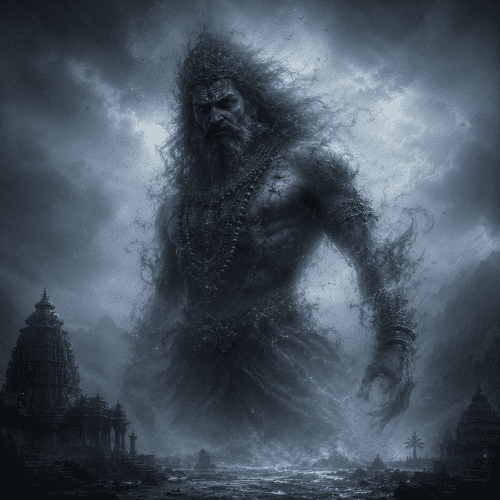
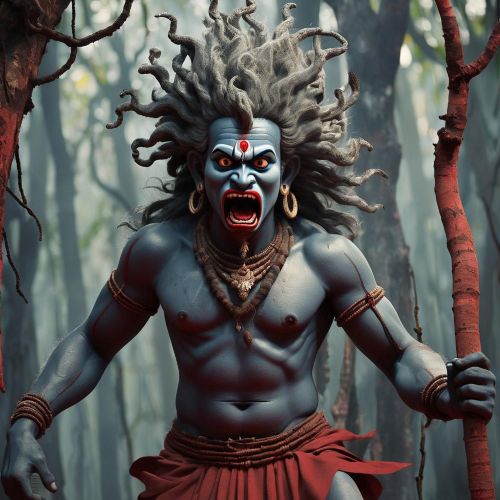
The story of Kirtimukha originates primarily from the Shiva Purana and Skanda Purana. According to the legend, the asura king Jalandhara became arrogant because of his growing power and sent the celestial being Rahu as a messenger to Lord Shiva. Rahu delivered an insulting demand that Shiva surrender Goddess Parvati. Angered by this audacity, Shiva created a monstrous being from the blazing energy of his third eye.
The creature was immense, terrifying, and consumed by an unbearable hunger. It immediately prepared to devour Rahu. Terrified, Rahu sought Shiva’s protection. Shiva granted mercy but was then faced with the problem of satisfying the creature’s endless appetite. He ordered it to feed upon itself. Without hesitation, the being obeyed and consumed its entire body until only its face remained.
Impressed by this extraordinary act of obedience and devotion, Shiva named the creature Kirtimukha, the Face of Glory, and declared that its image would forever adorn the entrances of temples and sacred places. Since then, Kirtimukha has symbolized humility, devotion, transformation, and divine protection.
Physical Traits
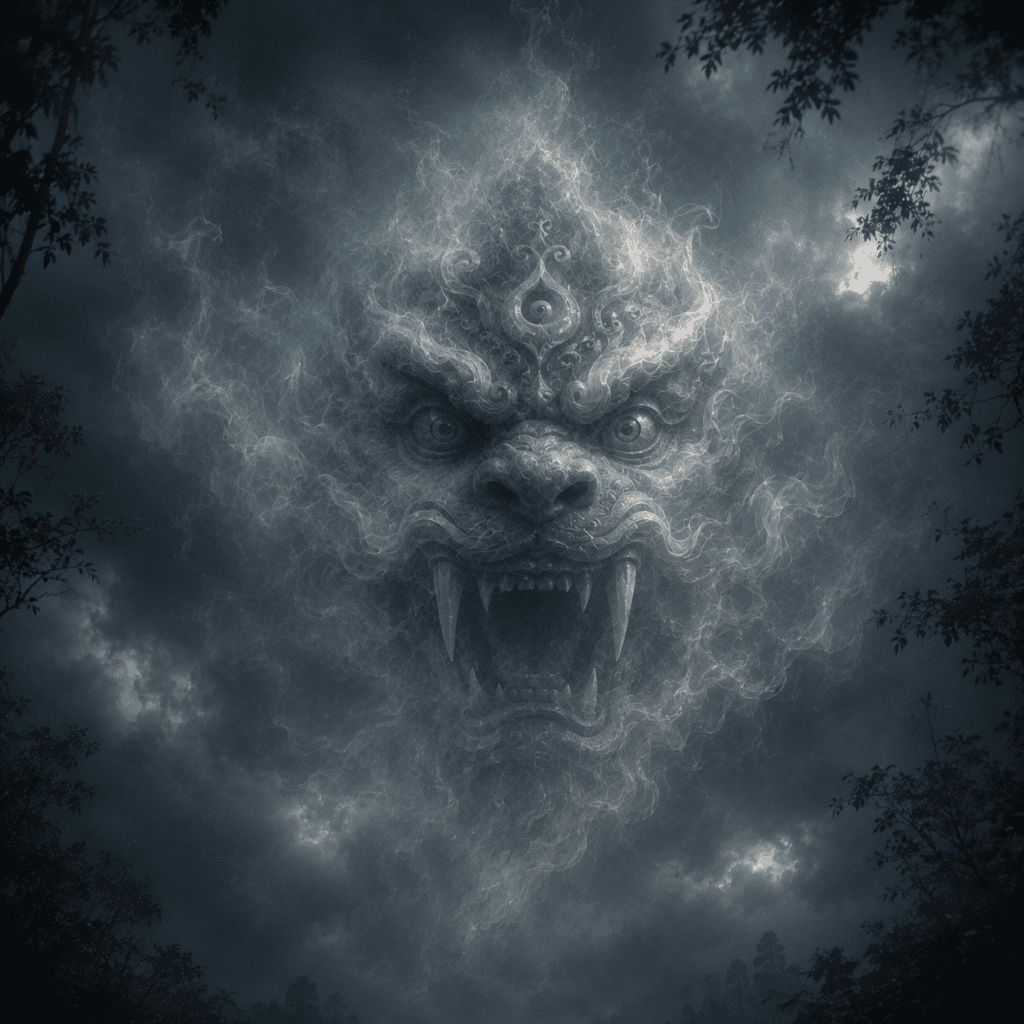
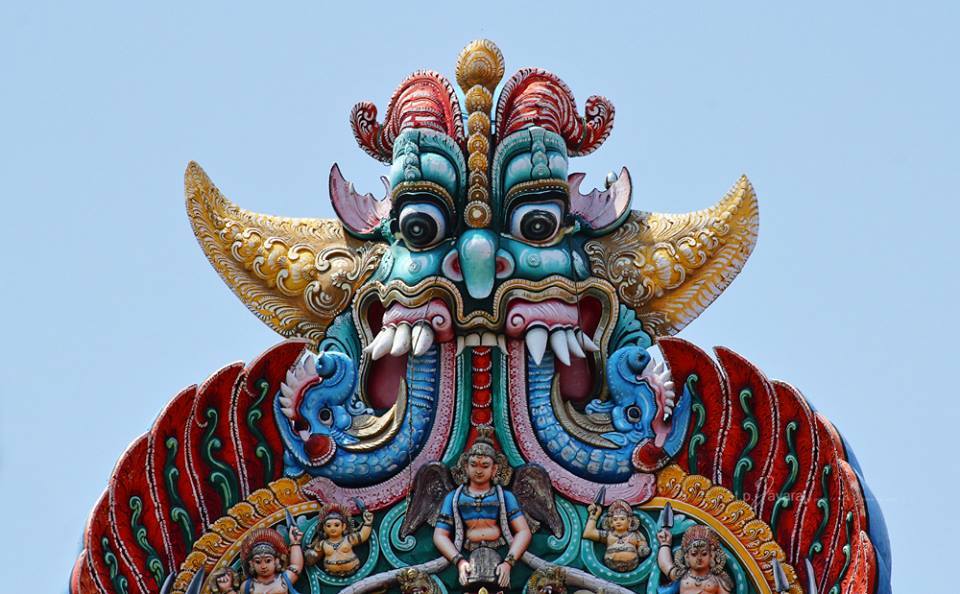
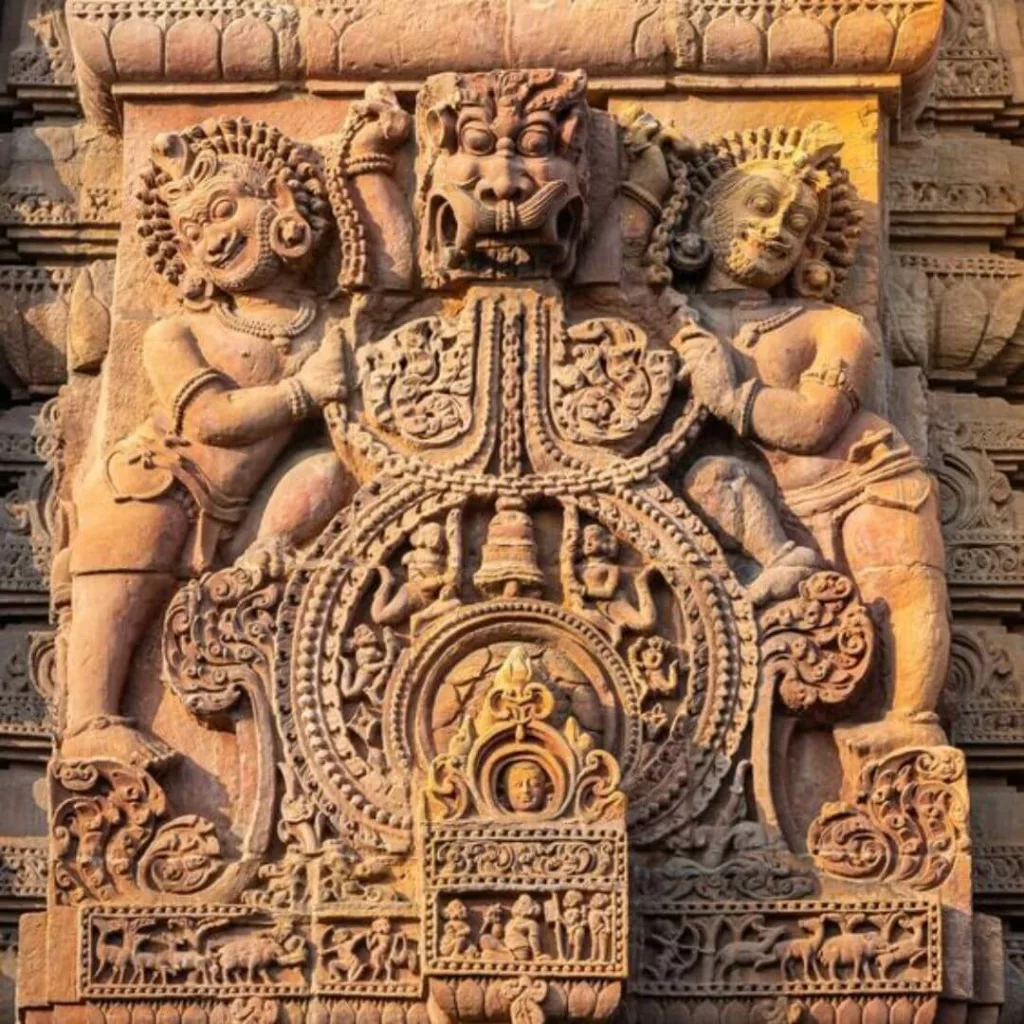
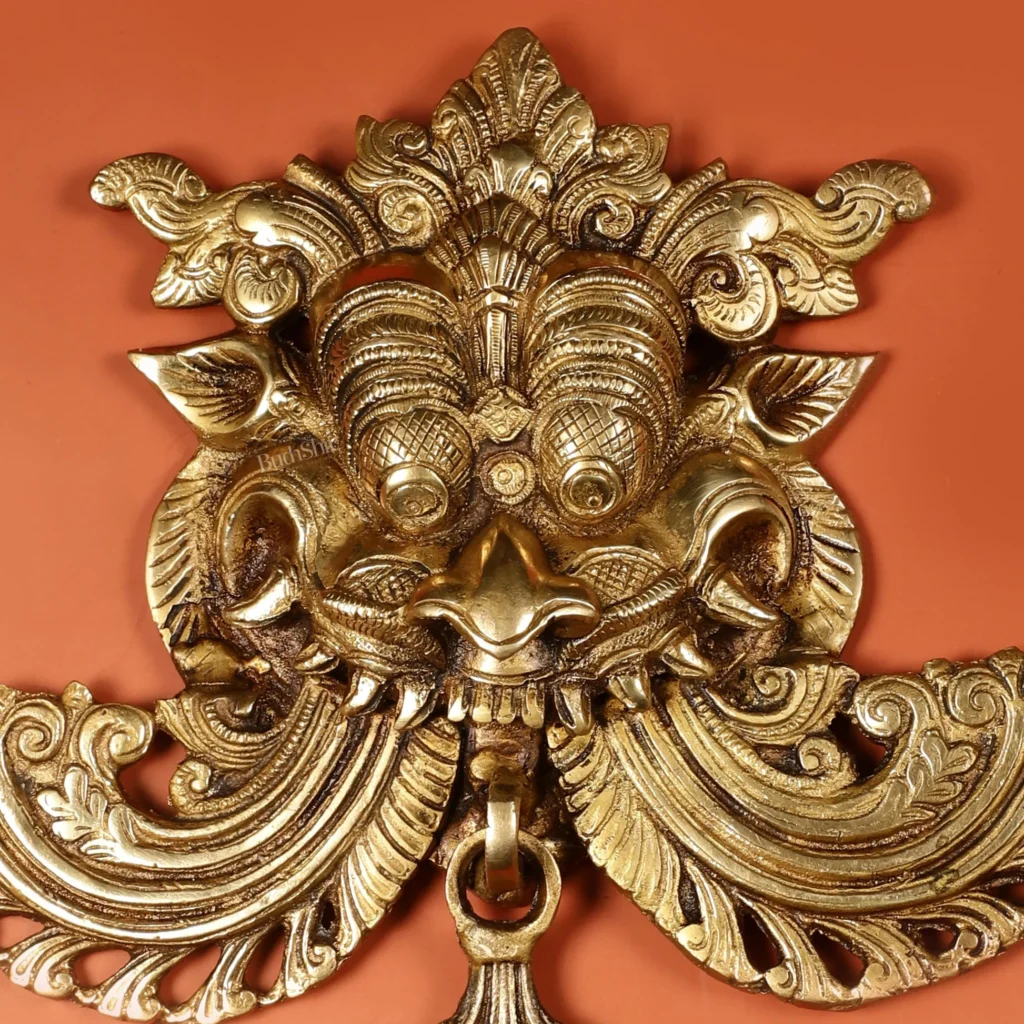
Kirtimukha is instantly recognizable because of its dramatic and fearsome appearance. It is usually depicted as a large face with bulging eyes, flared nostrils, sharp fangs, and an enormous open mouth. The expression appears both ferocious and powerful, designed to intimidate negative forces and evil influences.
One of the most distinctive aspects of Kirtimukha is the absence of a body. Since the creature consumed itself in obedience to Shiva’s command, artistic representations generally show only the head. In some rare depictions, small arms or decorative elements emerge from the face, but the primary focus remains the monstrous visage.
Temple sculptors often embellish the face with flowing foliage, pearl garlands, serpents, or decorative scrollwork extending from the mouth. This artistic treatment transforms the terrifying guardian into a symbol of life emerging from destruction.
Across different regions, Kirtimukha’s appearance evolved while retaining its core features. In South Indian temples, it frequently appears above gopurams and sanctum entrances. In North India, it is commonly carved on lintels and archways. Similar forms can also be found in the architectural traditions of Cambodia, Indonesia, Thailand, and Nepal, demonstrating its widespread influence throughout the Indian cultural sphere.
Family
Kirtimukha does not belong to a divine family in the traditional sense. Unlike many figures in Indian mythology, it has no parents, siblings, spouse, or offspring. Instead, Kirtimukha is considered a direct manifestation of Lord Shiva’s power. It emerged from the fiery energy of Shiva’s third eye and therefore represents an extension of Shiva’s divine will rather than an independent supernatural being.
Some traditions associate Kirtimukha with Shiva’s ganas, the attendants who serve him. However, even within these interpretations, Kirtimukha remains unique because it was created for a specific purpose and transformed into a sacred symbol through its unwavering obedience. Its true relationship is therefore not familial but spiritual. Kirtimukha exists as a living expression of Shiva’s authority, discipline, and transformative power.
Other names
The most widely used name is Kirtimukha, meaning “Face of Glory.” This title was bestowed by Shiva himself after the creature completed its act of self-sacrifice. In some traditions, it is also associated with the name Kalamukha, meaning “Face of Time.” This interpretation connects Kirtimukha with the inevitable power of time, which ultimately consumes all things.
Regional artistic traditions have produced additional names and interpretations. In parts of Southeast Asia, especially Indonesia and Bali, related forms became associated with figures such as Boma and Kala. Although these evolved into distinct cultural motifs, they retain clear connections to the original concept of Kirtimukha as a protective guardian.
Because of its lion-like features, Kirtimukha is sometimes confused with Simhamukha, or lion-faced figures. However, the two are not identical. Kirtimukha’s defining characteristic is its self-devouring origin and symbolic role as a sacred protector.
Powers and Abilities
The greatest power associated is protection. Its image functions as an apotropaic symbol, meaning it is intended to repel evil, misfortune, and harmful spiritual influences. This protective role explains why it is commonly positioned above temple entrances and sacred gateways.
Kirtimukha also represents the transformation of destructive energy into a force for good. It was born from divine wrath, yet through obedience and sacrifice, it became a guardian of holiness. This transformation reflects one of the central themes of Indian spiritual thought: even destructive forces can be redirected toward higher purposes.
Another important symbolic ability is the consumption of ego. By devouring itself, Kirtimukha demonstrates the surrender of pride, attachment, and selfish desires. Many spiritual interpretations view the story as a lesson in humility, encouraging devotees to overcome the ego before approaching the divine.
The motif is also associated with time and impermanence. Its endless hunger symbolizes the reality that all material things are eventually consumed by time. In this sense, Kirtimukha serves as a reminder of life’s transient nature and the importance of spiritual growth. Through these layered meanings, Kirtimukha becomes far more than a decorative face. It functions as a visual teaching about devotion, self-mastery, and the path toward spiritual transformation.
Modern Day Influence
Kirtimukha remains an important element of religious and cultural life throughout South Asia and Southeast Asia. Its image continues to appear on newly constructed temples, preserving a tradition that has endured for more than a thousand years. In India, versions of Kirtimukha are often used as protective symbols on homes, vehicles, and businesses. Many people view these images as safeguards against the evil eye and negative energies. This modern role closely parallels its ancient purpose as a guardian of sacred spaces.
The motif is also prominent in Buddhist and Jain architecture, demonstrating its broad appeal beyond a single religious tradition. Throughout Nepal, Cambodia, Thailand, Indonesia, and Bali, related forms continue to decorate temples and ceremonial structures. Artists and designers frequently draw inspiration from Kirtimukha in sculpture, jewelry, paintings, and tattoos. Its striking appearance and rich symbolism make it one of the most enduring visual icons of Indian mythology.
Scholars have occasionally compared Kirtimukha to the Ouroboros of Greek and Egyptian traditions because both involve self-consumption and transformation. While the symbolism differs, both figures express profound ideas about cycles, renewal, and the relationship between destruction and creation. Today, Kirtimukha remains a powerful reminder that true strength comes not from domination, but from mastering one’s own desires and ego.
Related Images





Source
Gayatri Heritage. (2024, December 6). Who was Kirtimukha? The story of the mythical guardian face. https://gayatriheritage.com/blogs/our-blogs/who-was-kirtimukha-the-story-of-the-mythical-guardian-face
Sadhguru. (2024, July 21). Kīrtimukha: The fierce protector who devoured himself on Shiva’s command. Sadhu – A Art of Living. http://www.sadhguru.org.in/2024/07/kirtimukha-fierce-protector-who.html
The Stone Studio. (2023, September 27). Story of Kirtimukha. https://www.thestonestudio.in/story-of-kirtimukha/
Wikipedia. (2007, February 24). Kirtimukha. In Wikipedia. https://en.wikipedia.org/wiki/Kirtimukha
IBI 24. (2025, November 6). Who is Kirtimukha: कीर्तिमुख कौन है, जिसने देवताओं से भी ऊंचा दर्जा हासिल किया? https://www.ibc24.in/religion/who-is-kirtimukha-who-is-kirtimukha-who-attained-a-status-higher-than-even-the-gods-he-devoured-hi
Kelvin M. K. (2008, May). Who is Kirtimukha? Kirtimukha-MKK Blogspot. http://kirtimukha-mkk.blogspot.com/2008/05/who-is-kirtimukha.html
Zimmer, H. (1946). Myths and Symbols in Indian Art and Civilization. Princeton University Press.
Michell, G. (1988). The Hindu Temple: An Introduction to Its Meaning and Forms. University of Chicago Press.
Kramrisch, S. (1946). The Hindu Temple. Motilal Banarsidass.
Brown, R. L. (1990). The Dvarapala in South and Southeast Asia: Guardians of the Sacred. Brill.
Agrawala, V. S. (1965). Indian Art. Prithivi Prakashan.
Frequently Asked Questions
Who is Kirtimukha in Indian mythology?
Kirtimukha is a protective guardian face created by Shiva’s third-eye energy and placed above temple entrances to ward off evil.
Why did Kirtimukha eat itself?
Kirtimukha obeyed Shiva’s command to satisfy its hunger by consuming its own body, leaving only its face behind.
What does Kirtimukha symbolize?
Kirtimukha symbolizes humility, self-sacrifice, protection, transformation, and the destruction of ego.
Where can Kirtimukha be found?
Kirtimukha appears on Hindu, Buddhist, and Jain temples across India, Nepal, Cambodia, Thailand, and Indonesia.
Is Kirtimukha a god?
No. Kirtimukha is not a deity but a divine manifestation of Shiva’s power that serves as a sacred guardian.