


Boon of Strength Absorption : Vali’s Gift of Invincible Combat
At a glance
Mythlok Perspective
From the Mythlok perspective, Vali’s Boon is less about supernatural invincibility and more about the burden of unequal power. Unlike Achilles‘ near invulnerability in Greek tradition or Cú Chulainn’s battle frenzy in Irish mythology, Vali’s strength depended on weakening others rather than simply empowering himself. His story suggests that power gained at another’s expense inevitably creates moral imbalance, reminding us that true greatness is measured not by invincibility but by the wisdom to use strength with restraint.
Boon of Strength Absorption
Introduction
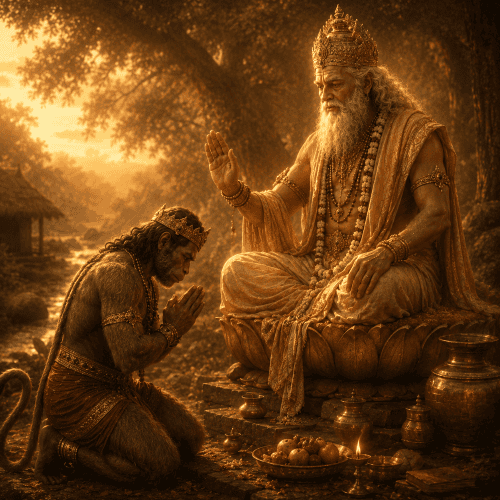
Vali, also known as Bali in several Indian traditions, is one of the most powerful warriors in the Ramayana. As the Vanara king of Kishkindha, he possessed extraordinary courage, unmatched physical strength, and a divine blessing that made him almost impossible to defeat in direct combat. This supernatural advantage, commonly known as Vali’s Boon, became one of the defining elements of his legend and shaped one of the epic’s most debated episodes.
The boon did far more than enhance Vali’s abilities. It transformed the balance of power within Kishkindha, forced Sugriva into exile, and ultimately influenced Lord Rama’s strategy during their confrontation. The story illustrates how divine gifts can elevate an individual while simultaneously creating the circumstances for their downfall when power is separated from righteousness.
Mythological Background
Vali was the elder brother of Sugriva and the ruler of Kishkindha, the kingdom of the Vanaras. Most versions of the Valmiki Ramayana describe him as the spiritual son of Indra, the king of the gods, while Sugriva is associated with Surya, the Sun God. From birth, Vali displayed exceptional strength and fearlessness, earning a reputation as one of the greatest warriors of his age.
His reign changed after an encounter with the demon Mayavi. Vali pursued the demon into a cave and instructed Sugriva to wait outside. After hearing terrifying sounds and seeing blood flow from the cave, Sugriva believed his brother had died. He sealed the entrance to prevent the demon from escaping and reluctantly accepted the throne.
However, Vali eventually emerged alive after defeating Mayavi. Believing Sugriva had intentionally betrayed him to seize the kingdom, Vali drove his younger brother into exile and took control of Sugriva’s wife, Ruma. This act was regarded as a serious violation of dharma and became the primary reason Rama later agreed to help Sugriva reclaim his kingdom.
Granting of the Boon/Blessing
The origin of Vali’s Boon varies slightly across regional traditions, although the central idea remains consistent. Many later Puranic and regional retellings attribute the boon to Lord Brahma, who rewarded Vali’s devotion and extraordinary penance. Some South Indian traditions, including Kamban’s Ramavataram, associate the blessing with Lord Shiva. Despite these differences, all versions describe Vali receiving a divine power that fundamentally changed the nature of combat.
Several traditions also mention that Indra presented Vali with a celestial golden garland after his birth. This divine ornament enhanced his vitality and symbolized his heavenly lineage. However, the famous ability to draw strength from an opponent is generally treated as a separate divine blessing rather than an inherent property of the garland. These variations reflect the richness of India’s storytelling traditions, but they all emphasize the same message: Vali’s extraordinary strength was not solely natural but reinforced by divine favor.
Nature of the Boon/Blessing
The defining feature of Vali’s Boon was its remarkable effect during battle. Whenever an opponent faced Vali in direct combat, half of that opponent’s strength was transferred to Vali. At the same time, the opponent was weakened by losing that same amount of power.
This meant that even warriors equal to Vali in strength became significantly weaker the moment they engaged him. Every battle increased Vali’s advantage, making victory through conventional combat virtually impossible. The blessing ensured that no enemy could overcome him through brute force alone.
This unique power explains why Sugriva repeatedly failed to defeat his brother despite his own considerable abilities. It also explains why Rama chose not to confront Vali directly. Instead, Rama struck him with an arrow while Vali was engaged in combat with Sugriva, avoiding the conditions under which the boon operated.
Recipients and Key Figures
Vali was the direct recipient of the divine blessing, but its influence extended to several important figures in the Ramayana. Lord Brahma is widely credited in many traditions with granting the boon, while Indra, Vali’s divine father, is associated with the celestial garland that enhanced his strength and vitality.
Sugriva became the greatest victim of the blessing. Unable to overcome his brother in battle, he lost both his kingdom and his family, forcing him into exile until he formed an alliance with Rama.
Lord Rama entered the story as the defender of dharma. Rather than attempting an impossible direct duel, he carefully assessed the nature of the boon before choosing a strategy that would restore justice without empowering Vali further.
Tara, Vali’s wise queen, also played a significant role. She warned Vali against fighting Sugriva after noticing Rama’s presence, but her advice was ignored. Their son Angada later became one of Rama’s loyal allies during the campaign against Ravana, ensuring that Vali’s legacy continued through service to righteousness.
Effects and Consequences
The immediate consequence of Vali’s Boon was complete military dominance. Few warriors dared challenge him because they knew any direct confrontation would strengthen rather than weaken the Vanara king. His victories established him as one of the greatest heroes of the age.
However, overwhelming power gradually contributed to moral decline. Vali’s treatment of Sugriva and his seizure of Ruma crossed accepted standards of dharma, transforming a once-respected ruler into a controversial figure. His strength became a source of fear rather than justice.
The boon also created one of the Ramayana’s most discussed ethical dilemmas. Rama’s decision to kill Vali from concealment has been debated for centuries. Vali questioned the fairness of Rama’s actions as he lay dying, while Rama defended his decision by arguing that Vali’s conduct had violated royal and moral duties. Since the boon only functioned in direct combat, Rama’s strategy effectively bypassed its supernatural protection.
Following Vali’s death, Sugriva regained the throne of Kishkindha, and the Vanara kingdom joined Rama’s campaign against Ravana. The episode became a turning point that ultimately led to Sita’s rescue and the defeat of Lanka’s ruler.
Symbolism and Spiritual Meaning
Vali’s Boon represents more than physical invincibility. It symbolizes how extraordinary power, when combined with pride, can cloud judgment and distance even great heroes from the principles of dharma. The story also demonstrates that divine blessings are not unconditional guarantees of success. In Hindu philosophy, power must remain aligned with righteousness. When strength is misused, destiny eventually restores balance through unexpected means.
Many traditional commentators further interpret Vali’s death at Rama’s hands as an act of spiritual liberation. Although his earthly life ended in conflict, dying at the hands of Vishnu’s incarnation is often viewed as a path toward moksha. From this perspective, Vali’s final moments represent both justice and divine grace. The episode ultimately teaches that wisdom, humility, and ethical conduct are greater safeguards than even the most extraordinary supernatural gifts.
Cultural Impact and Legacy
The story of Vali’s Boon has remained influential for centuries across literature, theatre, dance, television, and scholarly discussion. The episode of Vali Vadham is frequently explored because it raises enduring questions about justice, leadership, and the complexity of dharma.
Regional versions of the Ramayana often present different perspectives on Vali’s character. Some portray him primarily as a tragic hero whose strength became his weakness, while others emphasize his misuse of power and Rama’s duty to restore moral order. These differing interpretations have kept the story relevant across generations.
Today, Vali’s boon continues to serve as a powerful metaphor for the dangers of unchecked authority. It reminds readers that even the greatest advantages cannot protect someone who loses sight of righteousness, making the tale one of the most philosophically significant episodes in the Ramayana.


Source
Apam Napat. (2024, October 9). Vali – The King of Monkeys – Hindu Mythology. https://apam-napat.com/vali/
Indian Mythology Stories. (2024, February 13). Curse & boon untold stories: Monkey king Vali became the… https://www.indianmythologystories.com/2024/02/curse-boon-untold-stories-money-king.html
ISVARA.org. (2024, July 11). Vali. https://www.isvara.org/archive/vali/
Ritsin. (n.d.). Stories of boon in Indian mythology – Directory listings. https://ritsin.com/blog/boons-indian-mythology-mahabharat-the-ramayana/
Temple Yatri. (2024, July 27). Lord Hanuman and the tale of Vali. https://templeyatri.in/lord-hanuman-and-the-tale-of-vali/
WisdomLib. (2018, February 15). Vali. https://www.wisdomlib.org/hinduism/book/the-brahma-purana/d/doc57567.html
Tamil Manam. (2025, December 31). கம்பராமாயணத்தில் வாலி வரம் உண்மையா? Is the Vali Boon in Kambaramayanam True? https://tamilmanam.in/journal/index.php/issue/article/view/232
Frequently Asked Questions
What was Vali's Boon in the Ramayana?
Vali’s Boon allowed him to absorb half the strength of any opponent who faced him in direct combat, making him nearly impossible to defeat fairly.
Who granted Vali's Boon?
Why did Rama kill Vali from hiding?
Rama avoided a direct confrontation because Vali’s boon worked only during face-to-face combat. Striking from concealment prevented Vali from gaining Rama’s strength.
Did Vali's Boon make him completely invincible?
No. The boon made Vali virtually unbeatable in direct combat, but it did not protect him from attacks that bypassed the conditions of the blessing.
What lesson does Vali's Boon teach?
The story teaches that divine gifts must be guided by humility and dharma. Extraordinary power without moral responsibility eventually leads to downfall.


