


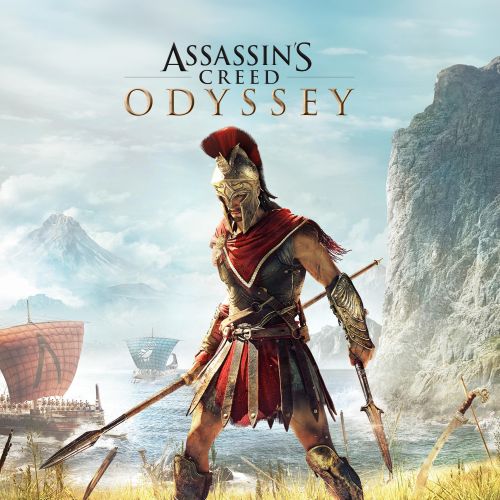
Assassin’s Creed Odyssey : Ancient Greece Between History and Legend
| Description | |
|---|---|
| Inspiration | Greek Mythology |
| Developer | Ubisoft Quebec |
| Type | Video Game |
| Release Year | 2018 |
| Storyline | Peloponnesian War, Family saga, Cult of Kosmos |
Mythlok Perspective
In Mythlok’s Perspective, Assassin’s Creed Odyssey represents a modern mythmaking experiment rather than a direct retelling of Greek legends. Its protagonist, Kassandra, embodies the archetype of the wandering hero whose journey combines personal discovery with encounters against legendary forces. Her adventures echo those of Odysseus, whose perilous travels tested his courage, intelligence, and resilience. A similar pattern appears in other cultures through figures such as the Mesopotamian Gilgamesh, whose quest for immortality transforms his understanding of mortality.
Assassin’s Creed Odyssey
Introduction
Released in October 2018, Assassin’s Creed Odyssey marked a significant evolution in Ubisoft’s long-running video game franchise by embracing role-playing mechanics, player choice, and a vast open world inspired by Ancient Greece. Set during the Peloponnesian War, the conflict between Athens and Sparta that began in 431 BCE, the game follows a mercenary whose personal journey becomes entangled with political conspiracies, family tragedy, and the mysteries of an ancient civilization. Players choose between Kassandra and Alexios, two fictional Spartan siblings whose lives unfold against a backdrop of historical events and legendary traditions.
What distinguishes Assassin’s Creed Odyssey from many historical adventure games is its integration of Greek mythology into an interactive experience. Legendary creatures, ancient sanctuaries, heroic traditions, and references to the Olympian gods exist alongside historical personalities such as Socrates and Pericles. Rather than presenting antiquity as a straightforward reconstruction of the past, the game combines historical research with imaginative storytelling and the franchise’s science-fiction narrative. This approach makes Assassin’s Creed Odyssey an interesting example of how contemporary entertainment reinterprets ancient cultural traditions for a global audience.
Game Overview
Developed by Ubisoft Quebec and published by Ubisoft, Assassin’s Creed Odyssey is an action role-playing game that combines exploration, combat, naval warfare, character progression, and branching dialogue. Its main story begins in 431 BCE, at the start of the Peloponnesian War, allowing players to explore a fictionalised version of Greece during one of the most politically turbulent periods of its classical history. The conflict between Athens and Sparta provides the historical framework for a much larger personal adventure.
Players travel across mainland Greece and numerous Aegean islands, visiting settlements, sanctuaries, battlefields, and archaeological landmarks. The Adrestia, the protagonist’s ship, enables naval exploration and combat, while the mercenary ranking system introduces competition with other warriors. Dialogue choices, romantic relationships, equipment upgrades, and decisions during quests give the game a stronger role-playing identity than earlier entries in the franchise.
The Cult of Kosmos serves as a central antagonist, manipulating political tensions and influencing events across Greece. Investigating its members connects the protagonist’s family history to the wider struggle for power. These fictional conspiracies unfold alongside real historical figures and events, creating a narrative in which documented history and invented drama constantly intersect.
Mythological Inspirations
Greek mythology is central to the identity of Assassin’s Creed Odyssey. The game introduces legendary creatures through dedicated quests, transforming familiar stories into challenging encounters that players must actively overcome. Medusa, the Minotaur, the Sphinx, and the Cyclops are among its most recognisable mythological adversaries. Their inclusion draws upon traditions that have shaped Greek literature, religious imagination, and artistic representation for centuries.
Medusa, traditionally associated with the Gorgons, turns a familiar legend of petrifying danger into a demanding combat encounter. The Minotaur recalls the story of the monstrous inhabitant of the Cretan Labyrinth, whose defeat by Theseus became one of the best-known heroic narratives in Greek tradition. The Sphinx introduces a different challenge by drawing upon the association between mythical guardians, riddles, and dangerous tests of intelligence. The Cyclops, meanwhile, evokes the one-eyed giants familiar from Greek epic, particularly Homer’s Odyssey.
These encounters are not literal reproductions of ancient religious beliefs. The game incorporates extraordinary beings into the Assassin’s Creed universe through its Isu, an advanced precursor civilization whose technology explains phenomena that might otherwise appear supernatural. This creative framework allows Ubisoft to combine legendary creatures with the franchise’s science-fiction narrative.
The downloadable expansion The Fate of Atlantis develops this relationship further by exploring Elysium, the Underworld, and Atlantis through the series’ distinctive interpretation of ancient mythology. Together, these experiences demonstrate how Assassin’s Creed Odyssey adapts traditional stories while giving players new ways to encounter their characters, settings, and symbolic themes.
Characters
Kassandra and Alexios are the two playable protagonists in Assassin’s Creed Odyssey. Both are fictional Spartan siblings whose lives are shaped by a devastating family tragedy and their subsequent separation. Although players can choose either character for the main campaign, Kassandra is the protagonist identified as canonical in the game’s established narrative continuity. Alexios instead serves as Deimos, a formidable figure associated with the Cult of Kosmos.
Their contrasting roles explore the consequences of manipulation, family loyalty, and personal choice. The protagonist’s journey involves uncovering the truth about the family’s past while confronting the political and ideological forces that have shaped its destruction. The Spear of Leonidas, an ancient artifact connected to the protagonist’s ancestry, also links the story to the franchise’s wider mythology.
Myrrine, the protagonist’s mother, is central to the family’s struggle for reconciliation. Barnabas, captain of the Adrestia, provides companionship and practical support throughout the voyage. Aspasia, a character inspired by the historical woman associated with Pericles, occupies an important position in the game’s political conspiracy. The narrative reveals her connection to the Ghost of Kosmos, although her role and motivations are more complicated than those of a conventional villain.
Historical figures further enrich the setting. Socrates introduces philosophical questioning into the player’s adventures, while Pericles represents Athenian political life. Hippocrates, traditionally associated with the development of Greek medicine, appears in quests that explore healing and medical practice. Herodotus also accompanies the broader narrative as a historian and observer. Their presence helps connect the protagonist’s fictional experiences to the intellectual and political culture of classical Greece.
Symbolism & Gameplay Mechanics
The gameplay systems in Assassin’s Creed Odyssey reinforce its themes of identity, power, and individual agency. Branching dialogue allows players to influence relationships and determine how particular conflicts unfold. These choices make the protagonist’s journey feel personal, although they operate within a narrative whose major historical framework remains largely fixed.
The faction-war system reflects the continuing struggle between Athens and Sparta. Players can weaken regional leaders, undermine military forces, and participate in battles that change local control. The mechanic captures the instability of the Peloponnesian War while simplifying the complex alliances, political institutions, and strategic calculations that shaped the actual conflict.
The Cult of Kosmos represents the destructive potential of secretive organisations that manipulate public uncertainty to consolidate power. Its members exploit political divisions for personal and collective advantage, creating a fictional parallel with the broader problem of corruption during wartime. However, the cult should not be treated as a direct historical equivalent of the later Templar Order; its relationship to that organisation belongs to the fictional mythology of the Assassin’s Creed series.
The Spear of Leonidas and the Staff of Hermes Trismegistus also connect gameplay progression with the burden of extraordinary power. The staff becomes particularly significant in The Fate of Atlantis, where its connection to immortality and the Isu expands the protagonist’s relationship with the ancient past. Meanwhile, exploration, naval combat, and encounters with mythical creatures transform Greece into a landscape where historical conflict and legendary adventure coexist.
Cultural Impact
Assassin’s Creed Odyssey has contributed to public engagement with Ancient Greece by presenting its landscapes, architecture, political conflicts, and cultural traditions through an interactive medium. Players can explore a reconstructed version of classical Athens, visit sanctuaries, travel between islands, and encounter interpretations of people who shaped Greek intellectual and political life. These experiences provide a visual introduction to antiquity, although the game’s historical representations require critical interpretation.
Its educational significance is especially apparent in Discovery Tour: Ancient Greece, a dedicated mode that allows players to explore the game’s environment without conventional combat. Guided tours introduce aspects of ancient architecture, everyday life, philosophy, warfare, and social organisation. By separating exploration from the main campaign’s violent objectives, this mode presents the reconstructed landscape as a resource for informal historical learning.
Academic research has examined how Assassin’s Creed Odyssey combines archaeology, historical representation, mythology, and modern popular culture. In a 2019 study published in Advances in Archaeological Practice, Aris Politopoulos and his co-authors explored the game’s relationship with authenticity and historical experience. Richard Cole’s 2022 article in Games and Culture further examined how the game combines cultural material and encourages players to participate in the interpretation of historical heritage.
The game has also generated fan-made videos, online discussions, memes, and other creative responses that extend its cultural presence beyond the original experience. Its importance therefore lies not only in entertainment but also in the questions it raises about how historical knowledge is communicated, adapted, and experienced through digital media.
Creative Liberties
Despite its detailed environments and historical references, Assassin’s Creed Odyssey should not be mistaken for an exact reconstruction of classical Greece. Its developers combine archaeological research and historical consultation with deliberate alterations designed to support exploration, combat, and cinematic storytelling. The result is a world that evokes antiquity without reproducing every aspect of its geography, architecture, politics, or social structure.
The game’s map compresses Greece and its islands into a navigable environment, reducing the distances between locations that would have required considerably more travel in the ancient world. Cities and landmarks are adapted for visual impact and gameplay, while architectural designs sometimes combine features from different periods or exaggerate their scale. Such decisions create an accessible and visually impressive environment, but they can also blur important historical distinctions.
The treatment of mythology involves a different kind of creative adaptation. Medusa, the Minotaur, and other legendary creatures are integrated into the Isu narrative, allowing the game to explain traditional supernatural stories through fictional advanced technology. This interpretation is specific to the Assassin’s Creed universe and should not be confused with the varied religious beliefs and literary traditions of ancient Greek communities.
Social representation also requires consideration. The game gives its protagonists considerable freedom to fight, lead, form relationships, and influence political events. These possibilities support modern role-playing conventions, but they do not always reflect the legal and social restrictions experienced by women in classical Greek society.
Ultimately, Assassin’s Creed Odyssey is best understood as a creative interpretation of antiquity rather than a historical record. Its greatest cultural value lies in bringing history and mythology into conversation, encouraging players to explore the ancient world while recognising the difference between archaeological evidence, traditional stories, and modern imagination.



Sources
Homer. (2018). The Odyssey (E. Wilson, Trans.). W. W. Norton & Company. https://wwnorton.com/books/9780393356250
Hesiod. (2006). Theogony and Works and Days (M. L. West, Trans.). Oxford University Press. https://global.oup.com/academic/product/theogony-and-works-and-days-9780199538317
Metacritic. (2018). Assassin’s Creed Odyssey reviews. https://www.metacritic.com/game/assassins-creed-odyssey/
McCall, J. (2019). Action and authenticity in Assassin’s Creed: Odyssey. Advances in Archaeological Practice, 7(3), 317–323. https://www.cambridge.org/core/journals/advances-in-archaeological-practice/article/history-is-our-playground-action-and-authenticity-in-assassins-creed-odyssey/25A64F3D388B99026A33DE932345252E
Ubisoft. (2018a). Assassin’s Creed Odyssey [Video game]. Ubisoft. https://www.ubisoft.com/en-us/game/assassins-creed/odyssey
Ubisoft. (2018b, June 28). Assassin’s Creed Odyssey – Reddit AMA with Jonathan Dumont.
https://www.ubisoft.com/en-us/game/assassins-creed/news/WG5OCDQ3oklQgoBNsFaCU/assassins-creed-odyssey-reddit-ama-with-jonathan-dumont
Ubisoft. (2018c, December 19). The mythical creatures of Assassin’s Creed Odyssey: Interview with the development team. https://www.ubisoft.com/en-us/game/assassins-creed/news/3B4dol6lFFZ9w9rnepcMph/the-mythical-creatures-of-assassins-creed-odyssey-interview-with-the-development-team
Ubisoft. (2018d, October 31). Assassin’s Creed Odyssey: The secrets of Ancient Greece uncovered video series. https://news.ubisoft.com/en-us/article/4FMb4TjIOvy3DB4WlLfLGE/assassins-creed-odyssey-the-secrets-of-ancient-greece-uncovered-video-series
Frequently Asked Questions
Is Assassin’s Creed Odyssey based on Greek mythology?
Yes. Assassin’s Creed Odyssey features Greek mythical creatures like Medusa, the Minotaur, the Sphinx, and the Cyclops, blending ancient legends with the franchise’s fictional Isu lore.
Is Kassandra or Alexios the canonical protagonist in Assassin’s Creed Odyssey?
Kassandra is the canonical protagonist of Assassin’s Creed Odyssey. Players can choose either sibling, but Alexios becomes Deimos, a powerful figure associated with the Cult of Kosmos.
Which historical period does Assassin’s Creed Odyssey take place in?
Assassin’s Creed Odyssey begins in 431 BCE, during the Peloponnesian War between Athens and Sparta, exploring ancient Greece through historical figures, political conflicts, and fictional adventures.
Are the monsters in Assassin’s Creed Odyssey real Greek mythological creatures?
Yes. Medusa, the Minotaur, the Sphinx, and the Cyclops originate in Greek mythology. However, the game reimagines them through its fictional Isu civilization and science-fiction lore.
Can Assassin’s Creed Odyssey help players learn about Ancient Greece?
Yes. Assassin’s Creed Odyssey offers historical exploration through its Discovery Tour mode, featuring guided educational experiences about ancient Greek architecture, society, culture, and everyday life.
