


Deimos : The Greek God of Dread and Terror in War
At a glance
The Mythlok Perspective
In Mythlok’s Perspective, Deimos is more compelling as an embodiment of psychological warfare than as a conventional god. Like the Norse Váli or other mythological figures tied to the consequences of conflict, he represents an aspect of violence rather than simply wielding it. His pairing with Phobos is especially effective: dread comes first, panic follows. Deimos reminds us that warfare can defeat the mind before it ever defeats the body.
Deimos
Introduction
Deimos is the personification of dread and terror in Greek mythology, a divine spirit whose presence represents one of the most unsettling aspects of warfare: the fear that takes hold before violence even begins. His name, Δεῖμος (Deimos), is generally translated as “dread” or “terror,” making his identity closely tied to the emotion he embodies. Unlike major Olympian gods such as Zeus, Athena, or Ares, Deimos does not possess an extensive mythology of his own. Instead, he appears primarily as a personified force within the violent world of battle.
Deimos is best known as the son of Ares, the Greek god of war, and Aphrodite, the goddess of love and beauty. His brother is Phobos, the personification of fear, panic, flight, and rout. Together, Deimos and Phobos accompany Ares into battle, transforming fear from an ordinary human response into a divine presence on the battlefield. Hesiod describes the brothers as forces that throw warriors and armies into disorder during war.
This makes Deimos particularly interesting within Greek mythology. He is not simply a god who causes fear; he represents fear itself as an active force. His mythology demonstrates how the Greeks could turn powerful emotions and experiences into supernatural beings with roles within the divine world.
Physical Traits
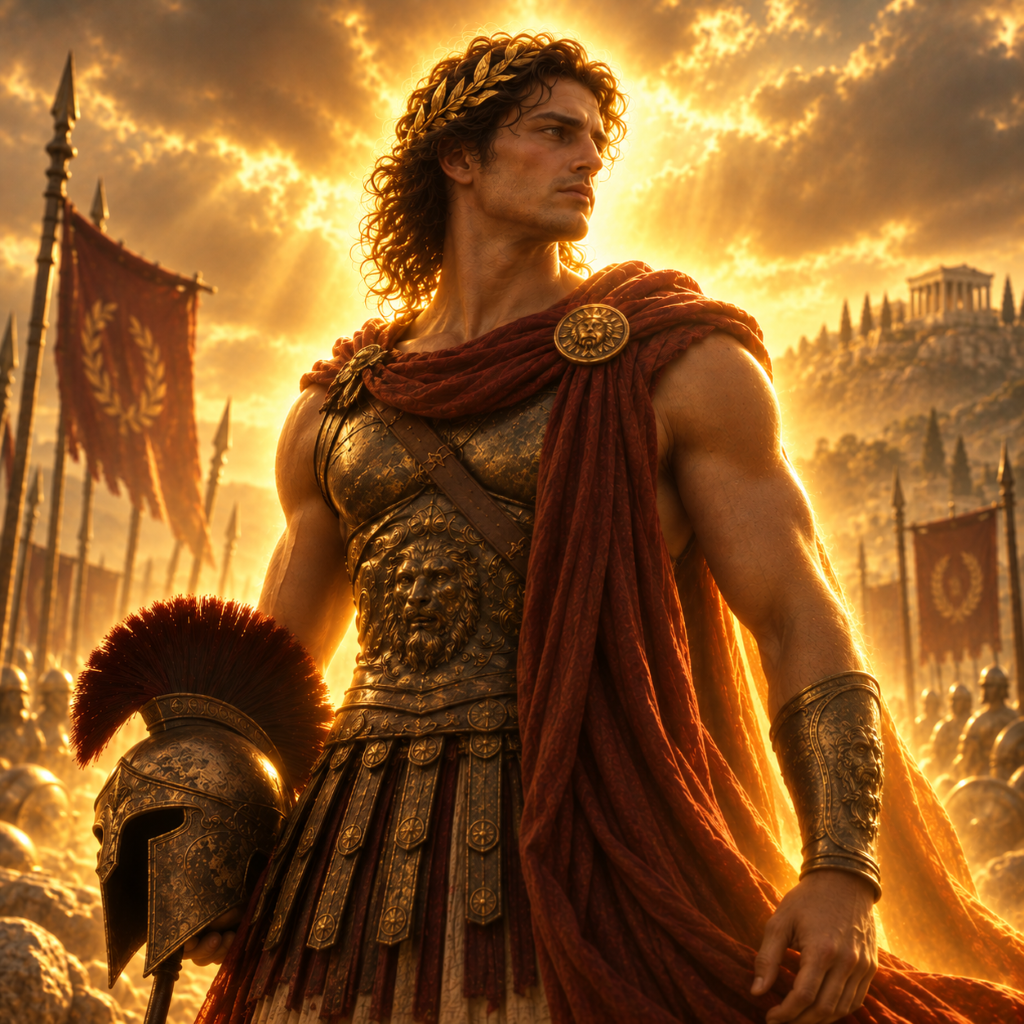
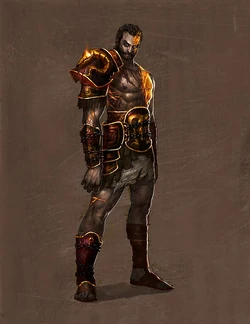
Ancient Greek sources do not provide a detailed or consistent physical description of Deimos. This is important because many modern portrayals give him elaborate armour, monstrous features, horns, weapons, or demonic characteristics that are largely products of later fantasy, games, comics, and other adaptations rather than classical Greek tradition.
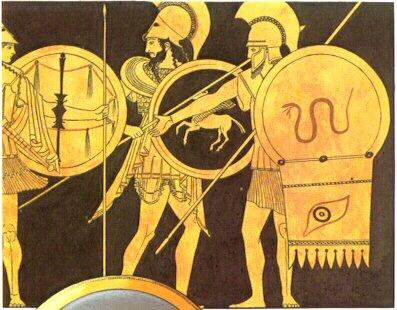
Deimos and Phobos were generally understood through their symbolic identities rather than distinctive physical appearances. Ancient artistic traditions could portray personified forces in human form, and the brothers were associated closely enough with Ares that their presence was understood through the atmosphere of warfare surrounding them. Phobos sometimes received more dramatic imagery, including leonine characteristics in descriptions of ancient artwork, but there is no equally consistent physical attribute that can confidently be assigned to Deimos.
The absence of a fixed appearance suits Deimos’s role. He is less a conventional warrior deity and more an embodiment of an emotion. His importance lies not in what he looks like, but in what his presence represents: the creeping certainty of terror that can overwhelm warriors before courage gives way to panic.
Family
Deimos belongs to the divine family created through the union of Ares and Aphrodite. Hesiod’s Theogony specifically names Phobos, Deimos, and Harmonia among the children associated with Ares and Aphrodite. This genealogy places Deimos between two contrasting aspects of the Greek divine world: Ares represents the violence of war, while Aphrodite represents love, beauty, and desire.
His closest mythological relationship is with his brother Phobos. The two are repeatedly presented together, although their functions are not identical. Deimos represents dread and terror, while Phobos is more closely associated with fear, panic, flight, and rout. In this sense, Greek mythology separates different stages of the psychological experience of battle. Deimos can be understood as the terrifying anticipation and overwhelming dread of violence, while Phobos represents the panic that can cause warriors to flee.
Harmonia is also identified as their sister in Hesiodic genealogy. Beyond these immediate relationships, traditions concerning the wider offspring of Ares and Aphrodite vary between ancient authors. Claims that Deimos fathered the monster Scylla belong to a later and much less prominent tradition and should not be treated as part of his core mythology.
Other names
The Greek name Deimos, written Δεῖμος, is closely connected to the idea of dread, terror, or fear. The meaning is particularly significant because Greek mythology frequently personified abstract emotions and forces as divine beings. Deimos therefore functions both as a name and as a description of the power he embodies.
In Latin and Roman contexts, related concepts of fear and dread were represented through figures such as Metus and Formido, while Pavor was associated with the fear and panic represented by Phobos. These Roman equivalents should not necessarily be understood as exact one-to-one translations of a single Greek deity, but they demonstrate the continuing Greco-Roman tendency to personify powerful emotional states.
Deimos is also sometimes written as Deimus in Latinized usage. His name became especially famous outside mythology after the discovery of one of Mars’s moons in 1877. Astronomer Asaph Hall named the two Martian moons Phobos and Deimos after the mythological companions of Ares, whose Roman counterpart was Mars. NASA confirms that Deimos means “dread.”
Powers and Abilities
Deimos does not have a conventional catalogue of magical abilities like many major gods in Greek mythology. His power is fundamentally psychological. As the personification of dread and terror, he represents the ability of fear to weaken courage, disturb judgment, and disrupt the cohesion of an army.
Homer places Deimos and Phobos within Ares’s battlefield retinue. In the Iliad, Ares orders the two figures to harness his horses before entering combat, establishing their close association with his warlike presence. Elsewhere, Deimos appears alongside Phobos and Eris, the personification of strife and discord, reinforcing the idea that warfare produces not only physical destruction but also psychological and social disorder.
The Shield of Heracles also places Deimos and Phobos beside Ares in battle. When Ares is wounded, the brothers drive his chariot and help remove him from the battlefield. This episode gives Deimos a more active role than simply being an abstract symbol: he participates in the machinery and movement of divine warfare while still functioning primarily as an embodiment of terror.
A later literary tradition, Nonnus’s Dionysiaca, gives Deimos and Phobos divine weapons during the conflict with Typhon, further expanding their role as agents of fear. However, this later account should be distinguished from the earlier Homeric and Hesiodic material rather than treated as evidence that Deimos traditionally possessed a permanent weapon or thunder-based power.
Ultimately, Deimos’s greatest “power” is the emotional force he represents. He embodies the moment when courage begins to collapse and the mind recognizes danger as overwhelming.
Modern Day Influence
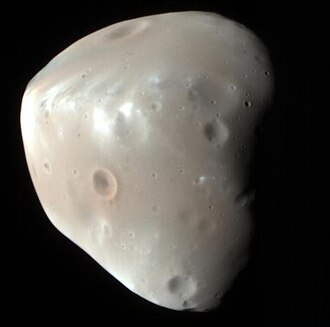
Deimos has achieved an unusual afterlife through astronomy. On August 11, 1877, American astronomer Asaph Hall discovered Deimos, the smaller and more distant of Mars’s two moons. He named it after the mythological son of Ares, following the naming tradition that also produced Phobos.
The astronomical Deimos is considerably different from its mythological namesake. NASA describes it as a small, irregular, heavily cratered body orbiting Mars approximately every 30 hours. It is smaller than Phobos and has a dark, reddish appearance. Scientists continue to study the Martian moons because their origins remain an important question in planetary science.
The mythological Deimos has also survived in modern literature, games, comics, and popular culture. However, many modern fictional versions dramatically expand his character, sometimes turning him into a conventional warrior, demon, or major antagonist. These portrayals should be separated from the ancient figure, whose surviving mythology is comparatively restrained.
The most enduring feature of Deimos is therefore not a particular story or physical image but the concept behind his name. Fear remains one of the most powerful forces in warfare, and the Greeks gave that force a divine identity. Through Deimos, Greek mythology recognized that battles are fought not only with weapons but also within the minds of those who face them.
Related Images
Source
Britannica. (n.d.). Deimos | Moon, Mars, God of War, Meaning, Greek mythology, satellite, orbit, size, gravity, composition, & facts. Encyclopædia Britannica. https://www.britannica.com/place/Deimos-moon-of-Mars
Gantz, T. (1996). Early Greek myth: A guide to literary and artistic sources (Vols. 1–2). Johns Hopkins University Press.
Hall, A. (1877). Discoveries of the satellites of Mars. Astronomical observations and researches made at the United States Naval Observatory.
Hesiod. (1914). Theogony (H. G. Evelyn-White, Trans.). Harvard University Press. (Original work composed circa 8th–7th century BCE).
Homer. (1924). The Iliad (A. T. Murray, Trans.). Harvard University Press. (Original work composed circa 8th century BCE).
Theoi Project. (n.d.). Deimos & Phobos: Greek gods of fear, panic & terror. https://www.theoi.com/Daimon/Deimos.html
Wikipedia. (2026). Deimos (deity). In Wikipedia. https://en.wikipedia.org/wiki/Deimos_(deity)
Cancik, H., & Schneider, H. (Eds.). (2004). Brill’s New Pauly: Encyclopaedia of the Ancient World. Leiden: Brill.
Gantz, T. (1996). Early Greek Myth: A Guide to Literary and Artistic Sources. Baltimore: Johns Hopkins University Press.
Frequently Asked Questions
Who is Deimos in Greek mythology?
Deimos is the Greek personification of dread and terror. He is the son of Ares and Aphrodite and accompanies his father into battle alongside his brother Phobos.
What is Deimos the god of?
Deimos is associated with dread, terror, and the fear produced by warfare. He represents the psychological terror that can overwhelm warriors during battle.
Is Deimos the brother of Phobos?
Yes. Deimos and Phobos are brothers in Greek mythology and are traditionally described as sons of Ares and Aphrodite. They accompany Ares during battles.
What does the name Deimos mean?
The ancient Greek name Deimos means “dread” or “terror.” The same name was later given to one of the two moons orbiting Mars.
Is Deimos a god or a demon?
Deimos is best described as a Greek daimon, or personified divine spirit. He is not a demon in the later Christian or modern fantasy sense of the word.


