
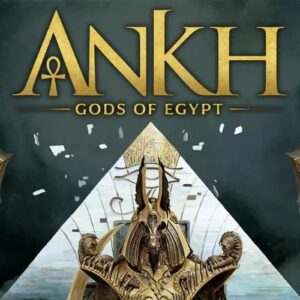
Ankh – Gods of Egypt : The Battle of Forgotten Gods
| Description | |
|---|---|
| Inspiration | Egyptian Mythology |
| Developer | CMON Global Limited (Designer: Eric M. Lang) |
| Type | Board Game |
| Release Year | 2021 |
| Storyline | Gods compete for worship as Egypt shifts from polytheism to monotheism |
Mythlok Perspective
In Mythlok’s Perspective, Ankh: Gods of Egypt succeeds because it understands that mythology is fundamentally about survival through belief. The game transforms worship into a strategic resource, which mirrors how ancient civilizations viewed divine power. Rather than treating Egyptian gods as distant symbols, it portrays them as competing forces shaped by human devotion and cultural change. The merge mechanic, while controversial, reflects an important truth about mythology: gods evolve, merge, and adapt as societies transform. Similar ideas appear in Roman religion where foreign deities were absorbed into local worship, and in Japanese Shinto-Buddhist syncretism where spiritual traditions blended over centuries. Ankh therefore feels less like a fantasy war game and more like a mythological meditation on memory, faith, and survival.
Ankh: Gods of Egypt
Introduction
CMON’s Ankh: Gods of Egypt is one of the most visually ambitious mythology-inspired board games released in recent years. Designed by Eric M. Lang and launched in 2021, the game places players in the role of ancient Egyptian gods struggling to survive during a period of religious transformation. Rather than focusing only on warfare, the game explores a deeper theme rooted in Egyptian history: what happens when people stop believing in their gods?
The title itself references the ancient Egyptian ankh symbol, a hieroglyph associated with life, immortality, and divine power. In the game, devotion becomes the lifeblood of the gods. The more followers a deity gains, the stronger they become. Without worshippers, however, even the mightiest god risks fading into oblivion.
What makes Ankh: Gods of Egypt stand apart from many strategy games is its blend of mythology, political maneuvering, and highly tactical gameplay. The game combines area control mechanics with asymmetric god powers, allowing every deity to feel distinct both mechanically and thematically. At the same time, it presents ancient Egypt not as a static historical setting, but as a living world where religion, monuments, monsters, and divine rivalries shape every conflict.
The game also became notable for its impressive production quality. Massive miniatures, detailed sculptures, and artwork inspired by ancient Egyptian iconography helped establish it as a centerpiece title among modern board game enthusiasts. Yet beneath the visual spectacle lies a surprisingly thoughtful interpretation of Egyptian mythology and religious history.
Game Overview
Ankh: Gods of Egypt is primarily an area-control strategy game designed for two to five players. Each player selects an Egyptian deity and competes to gain the greatest amount of devotion before the game ends. The board represents regions of ancient Egypt divided by the Nile River, deserts, and monuments. Players move armies, summon followers, recruit mythical guardians, and fight for territorial dominance.
The central resource in the game is devotion, which functions as both victory points and a reflection of divine relevance. Gods become more powerful as their worship spreads across Egypt. Battles, monuments, and strategic positioning all contribute to increasing devotion levels.
Unlike many traditional war games, Ankh uses a streamlined action system that creates constant tension. Players perform actions from a shared action track, including movement, summoning warriors, gaining followers, and unlocking divine powers. Because actions also trigger global events, every decision influences the pacing of the game for all players at the table.
One of the game’s most discussed mechanics is the “merge” system. During later stages of the match, the two players with the lowest devotion scores combine forces into a single alliance. This mechanic was inspired by the historical merging of Egyptian deities such as Amun-Ra and creates dramatic shifts in strategy. While controversial among competitive players, it remains one of the most original systems in modern board gaming.
Victory can occur in two ways. A player may reach the top of the devotion track immediately, or the game concludes after the final conflict event, with the highest devotion total determining the winner.
Mythological Inspirations
Egyptian mythology is deeply woven into nearly every aspect of Ankh: Gods of Egypt. The gods, monsters, monuments, and symbolism all draw from authentic ancient Egyptian beliefs and historical traditions. The game’s central premise reflects the religious upheaval associated with Pharaoh Akhenaten, who attempted to shift Egypt toward worship centered around Aten, the solar deity. Historically, this period challenged traditional Egyptian polytheism and altered the balance of religious power. The game transforms this historical tension into a struggle where gods compete to remain worshipped in an evolving society.
The designers also drew inspiration from the human qualities of Egyptian gods. Unlike distant cosmic beings, Egyptian deities often displayed jealousy, rivalry, affection, and betrayal. This makes them ideal for competitive gameplay because their myths already contain political and emotional conflict.
The world of the Duat, the Egyptian underworld, also influences the game’s tone and guardian creatures. Mythical beings such as Apep, giant scorpions, and sphinxes appear as recruitable allies, reinforcing the supernatural atmosphere of ancient Egypt.
Even smaller details echo authentic mythology. The use of monuments such as temples, obelisks, and pyramids reflects how religion shaped Egyptian architecture and public life. The game’s visual language consistently references symbols associated with divine authority, death, rebirth, and cosmic order.
Characters
Players can choose from several major Egyptian gods, each designed with abilities connected to their traditional mythological roles. Anubis specializes in death and the underworld. His powers allow him to manipulate fallen warriors and punish opponents through attrition. This reflects Anubis’ role as guardian of tombs and guide of souls.
Ra embodies divine radiance and kingship. His abilities focus on empowering units and increasing devotion through victorious conflicts, mirroring his status as the supreme solar deity. Isis uses protective and manipulative abilities inspired by her association with magic, healing, and motherhood. Her gameplay style rewards clever positioning and cooperation between units.
Osiris represents resurrection and the afterlife. His mechanics emphasize endurance and spiritual influence, connecting directly to myths surrounding death and rebirth. Amun reflects hidden authority and divine mystery. Historically associated with kingship and cosmic power, Amun’s in-game abilities support long-term strategic control.
The Pantheon expansion introduces additional deities including Horus, Set, Thoth, Bastet, and Hathor, greatly expanding gameplay variety. Guardians are equally important. Creatures such as Apep, the Androsphinx, and the Cat Mummy function as mythical allies with unique abilities. These beings are not merely decorative additions but major strategic elements capable of changing the course of battles.
Symbolism & Gameplay Mechanics
The ankh symbol lies at the heart of the game’s thematic identity. In ancient Egypt, the ankh represented life, immortality, and divine existence. Gods are frequently depicted carrying the symbol in temple carvings and funerary art, signifying their ability to grant eternal life. This symbolism is reflected mechanically through devotion. A god without followers effectively loses life and influence. The devotion track therefore becomes more than a score counter; it represents the survival of belief itself.
Combat in Ankh uses battle cards that introduce bluffing and psychological strategy. Players must predict opponents’ decisions while balancing aggression with long-term positioning. This creates a gameplay experience often compared to chess due to its emphasis on planning and timing. Monuments serve as both strategic objectives and symbolic anchors of religious power. Obelisks, pyramids, and temples generate devotion while visually reinforcing the sacred geography of ancient Egypt.
Another important element is the Ankh power system. Players unlock increasingly powerful divine abilities throughout the game, allowing gods to evolve over time. These powers encourage varied playstyles and ensure that no two matches unfold in exactly the same way.
Cultural Impact
Since its release, Ankh: Gods of Egypt has become one of the most recognized mythology-themed board games of the modern era. It is frequently compared to Blood Rage and Rising Sun, which were also designed by Eric M. Lang.
Many players praised the game for treating Egyptian mythology with respect while still making it accessible to modern audiences. Rather than presenting Egypt as a collection of stereotypes, the game embraces historical symbolism, religious themes, and authentic deity relationships.
The game’s Kickstarter campaign achieved major commercial success, demonstrating the continued popularity of mythology within tabletop gaming culture. Its detailed miniatures and artwork also helped push modern board game production standards toward increasingly cinematic experiences.
Beyond gaming, Ankh contributes to the wider revival of interest in Egyptian mythology seen across films, novels, video games, and streaming media. Ancient symbols such as the ankh continue to remain culturally recognizable thousands of years after their creation.
Creative Liberties
Although rooted in mythology, Ankh: Gods of Egypt intentionally adapts history for gameplay purposes. The merge mechanic is the clearest example. While Egyptian religion did historically combine deities into hybrid forms such as Amun-Ra, the game transforms this idea into a competitive balancing system where rival players temporarily unite.
Artist Adrian Smith also reinterprets Egyptian imagery through a darker and more cinematic visual style. Gods appear larger, more imposing, and more fantastical than traditional temple depictions. The guardians and monsters are similarly stylized for dramatic effect. Some creatures are exaggerated beyond their original mythological descriptions to create memorable gameplay moments and stronger battlefield presence.
Eric M. Lang has openly described the game as a modern interpretation rather than a historical simulation. The goal was not complete academic accuracy but an emotionally engaging experience that captures the grandeur, tension, and mysticism associated with ancient Egypt.


Sources
Above Board. (2022, July 8). Ankh: Gods of Egypt review. https://www.aboveboard.nz/blog/blog-ankh-gods-of-egypt-review
CMON. (n.d.). A guide to the gods. https://www.cmon.com/a-guide-to-the-gods/
CMON. (n.d.). Ankh: Gods of Egypt. https://www.cmon.com/products/ankh-gods-of-egypt/
Eggett, C. J. (2019, December). God Complex: Talking to Eric Lang about Ankh: Gods of Egypt. Tabletop Gaming. https://www.tabletopgaming.co.uk/features/god-complex-talking-to-eric-lang-about-ankh-gods-of-egypt/
Holmes, K. (n.d.). Ankh. Ancient Egypt Online. https://ancientegyptonline.co.uk/ankh/
Touregypt. (n.d.). The ancient ankh, symbol of life. http://www.tourecypt.net/featurestories/ankh.htm
Frequently Asked Questions
What is Ankh: Gods of Egypt about?
Ankh: Gods of Egypt is a mythology-inspired strategy board game where Egyptian gods battle for worshippers and divine dominance.
Is Ankh: Gods of Egypt based on real mythology?
Yes. The game draws heavily from authentic Egyptian mythology, history, gods, monsters, and religious symbolism.
What does the ankh symbol mean in Egypt?
The ankh symbol represents life, immortality, and divine power in ancient Egyptian culture.
Who designed Ankh: Gods of Egypt?
The game was designed by Eric M. Lang and published by CMON in 2021.
Why do gods merge in Ankh: Gods of Egypt?
The merge mechanic reflects historical Egyptian deity fusion traditions, such as the creation of Amun-Ra.