


Drilo Dadavanua : Malake’s Ancestral Spirit in Fijian Mythology
At a glance
| Description | |
|---|---|
| Origin | Fijian Mythology |
| Classification | Spirits |
| Family Members | Degei (Brother), Likumasei (Wife) |
| Region | Fiji |
| Associated With | Ancestral protection |
The Mythlok Perspective
In Mythlok’s Perspective, Drilo Dadavanua is best understood by comparing him with Manabozho of Anishinaabe mythology. Both figures connect mythology with the origins and identity of a community, but they occupy very different roles. Manabozho is an active culture hero whose stories centre on transformation, teaching and shaping the world, while Dadavanua is primarily an ancestral spirit whose importance comes from establishing the lineage and sacred identity of the Malake yavusa.
Drilo Dadavanua
Introduction
Drilo Dadavanua is an ancestral spirit associated with the Malake yavusa of Rakiraki in Fiji. In Fijian tradition, a yavusa is a community or social group whose identity is closely connected to ancestry, land, relationships and spiritual traditions. Dadavanua occupies an important place in the origin story of the Malake people, linking their ancestry to the sacred landscape of the Nakauvadra Mountains and to Degei, one of the major culture heroes of Fijian tradition.
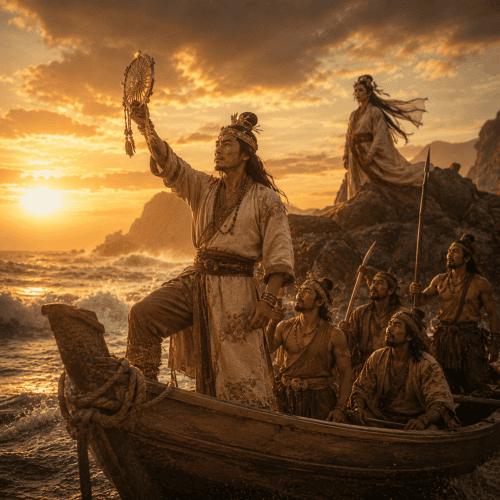
According to oral traditions recorded on Malake Island, Drilo Dadavanua was the original ancestral spirit of the Malake yavusa. These traditions state that Degei sent him from the Nakauvadra Mountains to establish himself among other ancestral spirits at Navatu. He subsequently married Likumasei, a woman from Cubu, an offshore islet associated with Navatu, before moving with her to Malake Island.
His story is therefore more than the biography of a supernatural figure. It explains the spiritual ancestry of a particular Fijian community and its traditional relationship with Degei. The Malake people became associated first with supplying crabs to Degei and later with turtle fishing, giving Dadavanua’s story a direct connection with livelihood, territory and ritual obligation.
Physical Traits
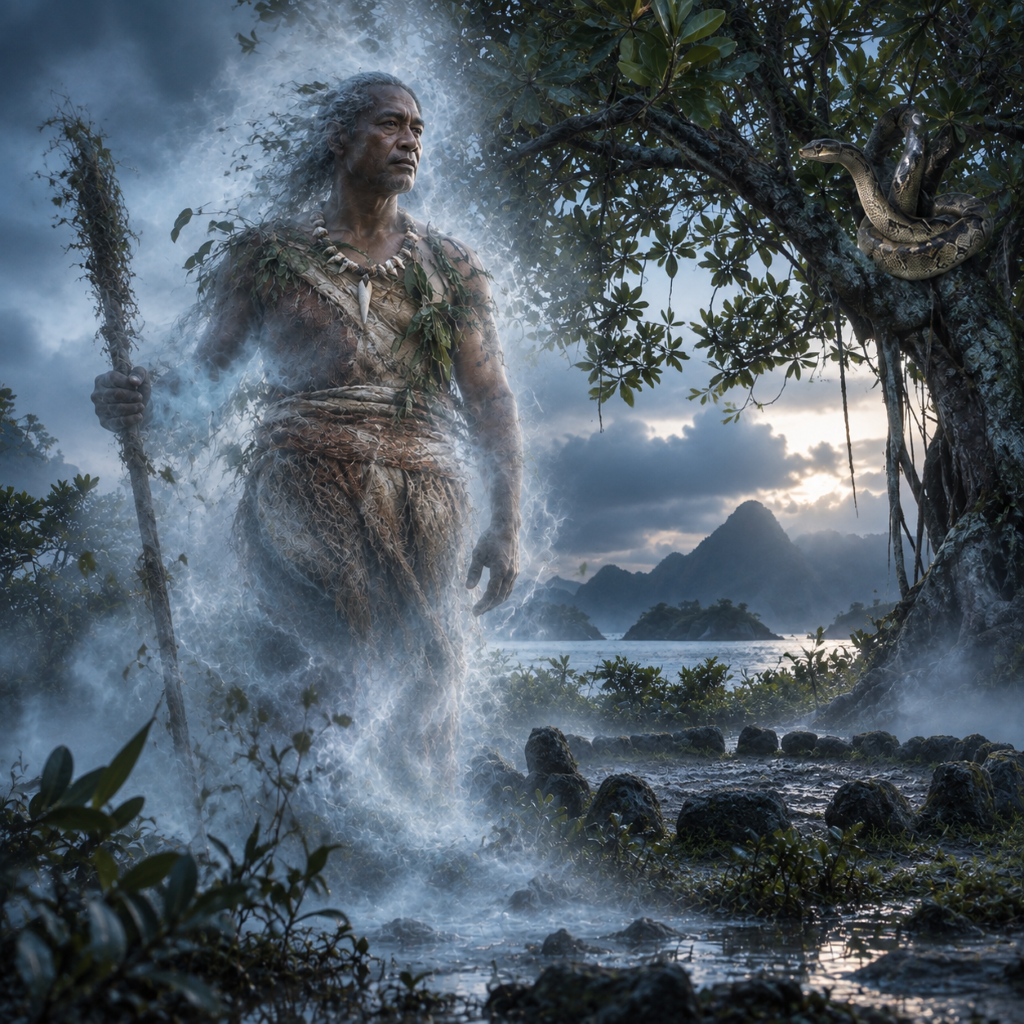
There is no reliable traditional description of Drilo Dadavanua as a fully formed human or animal figure. The available ethnographic record instead identifies a particular waqawaqa, or manifestation associated with the ancestral spirit. Dadavanua’s waqawaqa was a gata, or snake, said to live in a werewere tree at Navuniviavia on Malake Island.
This distinction is important. The snake should not be described as Dadavanua’s physical body or as evidence that he was a serpent deity. In the Fijian spiritual framework documented by ethnographers, a waqawaqa is a manifestation or object through which an ancestral spirit is represented or encountered. Dadavanua’s association with the snake therefore belongs to the spiritual geography of his cult rather than providing a conventional physical description.
His presence was also connected with particular locations. Dadavanua and Likumasei were associated first with Uluidrilo, a hilltop site marked by a ring of stones, before settling in the swampy coastal area of Lomalake at Navuniviavia. There, a rectangular earth mound marked the site of their house, while a nearby area was associated with presentations to the spirit. These places formed part of the material landscape through which the Malake community remembered its ancestral relationship with Dadavanua.
Family
Fijian oral traditions recorded on Malake identify Drilo Dadavanua as the younger brother of Degei, the principal culture hero of the Nakauvadra spiritual centre. According to this tradition, Degei instructed Dadavanua to leave Nakauvadra and go to the coastal region, eventually establishing the lineage that became the Malake yavusa.
After arriving at Navatu, Dadavanua married Likumasei, a woman from Cubu, an offshore islet associated with Navatu. Their relationship is significant because it connected the emerging Malake lineage with the ancestral communities already established around Navatu.
Dadavanua and Likumasei later moved to Malake Island. Their descendants became the Malake yavusa, traditionally associated with turtle fishing for Degei. The genealogical record preserved in the available sources does not provide a complete list of their children or later descendants by name. Instead, the important familial connection is the transition from Dadavanua and Likumasei to the collective Malake lineage.
Other names
The documented sources consistently identify the figure as Drilo Dadavanua or Dadavanua. No securely documented alternative personal name or major epithet is provided in the principal ethnographic sources.
His most important descriptive designation is his role as the ancestral spirit of the Malake yavusa. This is a functional and genealogical description rather than an alternative name. Within the broader Fijian spiritual system, such ancestral spirits were associated with particular communities, places of origin, locations of settlement, places where offerings or presentations were made, and manifestations through which their presence could be recognised.
It is therefore more accurate to identify Dadavanua through his relationship with the Malake yavusa than to invent additional titles or aliases. The name Drilo Dadavanua remains the principal documented name associated with the tradition.
Powers and Abilities
Drilo Dadavanua is not described in the available sources through a conventional catalogue of supernatural powers. His importance comes from his status as an ancestral spirit and from the role he occupies within the spiritual origin of the Malake yavusa.
His story connects him with Degei’s authority, the establishment of a new community and the traditional obligations of that community. The Malake people were first associated with supplying seka, or crabs, to Degei and later became known as Degei’s turtle fishers. This relationship placed the Malake within a wider network of spiritual, economic and political relationships centred on the Nakauvadra traditions.
Dadavanua was also associated with sacred places where communication and presentations took place. At Navuniviavia, the bete, or priest, communicated with the ancestral spirit at the site associated with his former dwelling. His waqawaqa, the snake in the werewere tree, provided another recognised manifestation of his spiritual presence.
Rather than claiming that Dadavanua controlled particular elements such as weather, healing or fertility, it is more accurate to understand his traditional power through ancestral guardianship, community identity, spiritual connection and lineage. His story gave the Malake people a sacred explanation for who they were, where their ancestral line came from and how their community related to Degei and neighbouring groups.
Modern Day Influence
Drilo Dadavanua does not appear to have a major documented presence in contemporary popular culture, film, commercial media or modern entertainment. His significance today is instead found in the preservation and study of Fijian oral traditions, ancestral histories and the relationship between people, spirits and places.
His story is particularly valuable because it demonstrates how the Fijian concept of community could be understood through an interconnected relationship between ancestral spirits, people and land. The history of the Malake yavusa is not simply a genealogy. It incorporates migration, marriage, settlement, economic responsibilities and sacred geography into a single origin tradition.
The sites associated with Dadavanua, including Uluidrilo and Navuniviavia, further demonstrate how mythology can become embedded in the physical landscape. Stones, earth mounds, trees and settlement locations become part of a community’s memory because they connect the present population with its ancestral past.
The wider Malake tradition also illustrates how spiritual relationships could influence social organisation. The community’s connection with Navatu was strengthened through Dadavanua’s marriage to Likumasei, while its relationship with Degei was expressed through the traditional provision of food and turtle fishing. In this sense, Drilo Dadavanua represents the meeting point of ancestry, territory and obligation.
Although Christianisation profoundly changed religious practice in Fiji, the recording of traditions such as Dadavanua’s preserves an important part of the country’s pre-Cession cultural history. His story remains particularly significant for understanding how Fijian communities used ancestral figures to explain their origins and establish relationships with the land and with neighbouring groups.
Related Images


Source
Deane, T. (1921). Fijian society; or, The sociology and psychology of the Fijians. Macmillan.
https://dn790000.ca.archive.org/0/items/fijiansocietyors00deanuoft/fijiansocietyors00deanuoft.pdf
Godchecker. (2023). Fijian mythology – The gods and spirits of Fiji. https://www.godchecker.com/fijian-mythology/
Godchecker. (2023). Explore Fijian mythology. https://www.godchecker.com/fijian-mythology/explore/
Hocart, A. M. (1895, September). Ancestor worship among the Fijians. Popular Science Monthly, 47.
https://en.wikisource.org/wiki/Popular_Science_Monthly/Volume_47/September_1895/Ancestor_Worship_Among_the_Fijians
Tianmu Anglican Church. (2026, September 19). Fijian religion — The way of the vanua. https://tianmu.org/good-work-library/ethnotheology/pacific/fijian-religion-the-way-of-the-vanua
Wikipedia. (2002, September 30). Degei. https://en.wikipedia.org/wiki/Degei
Wikipedia. (2007, May 24). Religion in Fiji. https://en.wikipedia.org/wiki/Religion_in_Fiji
Frequently Asked Questions
Who is Drilo Dadavanua in Fijian mythology?
Drilo Dadavanua is the ancestral spirit of the Malake yavusa in Fiji, whose origin story connects the community with Degei, Navatu, Malake Island and the Nakauvadra Mountains.
Who was Drilo Dadavanua married to?
Drilo Dadavanua was married to Likumasei, a woman from Cubu, an offshore islet associated with Navatu. They later moved to Malake Island and became ancestors of the Malake yavusa.
What animal is associated with Drilo Dadavanua?
Drilo Dadavanua is associated with a gata, or snake, living in a werewere tree at Navuniviavia. The snake was his waqawaqa, or spiritual manifestation.
Was Drilo Dadavanua the brother of Degei?
Malake oral traditions recorded by ethnographers identify Drilo Dadavanua as Degei’s younger brother and say that Degei sent him from Nakauvadra to establish his lineage.
What was Drilo Dadavanua associated with?
Drilo Dadavanua was associated with the ancestry of the Malake yavusa, sacred places on Malake Island and the community’s traditional relationship with Degei.


