


Chang Xi : The Chinese Lunar Mother Goddess of Twelve Moons
At a glance
| Description | |
|---|---|
| Origin | Chinese Mythology |
| Classification | Gods |
| Family Members | Di Jun (Husband) |
| Region | China |
| Associated With | 12 Moons |
Sources
In Mythlok’s Perspective, Chang Xi is distinctive because her mythology turns the moon into a cycle of divine motherhood, with twelve moons emerging as her celestial children. Her role invites comparison with Selene of Greek mythology, whose identity is more directly tied to the moon itself, while Chang Xi is defined through creation and nurture. Her pairing with Xi He, mother of the suns, further reveals how early Chinese mythology expressed celestial order through divine family relationships and recurring natural cycles.
Chang Xi
Introduction
Chang Xi (常羲) is an ancient Chinese lunar goddess whose story survives in the Shan Hai Jing, or Classic of Mountains and Seas, one of China’s earliest collections of mythology and cosmological traditions. She is described as the wife of Di Jun, a powerful celestial deity, and the mother of twelve moons. Her brief but remarkable appearance in ancient Chinese mythology places her among the earliest divine figures associated with the moon and the recurring rhythms of the heavens.
Chang Xi’s mythology is closely connected with the idea of celestial cycles. The twelve moons associated with her have traditionally been understood as reflecting the twelve months of the year, giving her story an important relationship with the measurement of time and the changing seasons. She is also described as bathing her lunar children, creating one of the most distinctive images associated with her mythology.
Unlike the later and more widely celebrated Chang’e, whose story centres on immortality and her ascent to the moon, Chang Xi belongs to a more ancient cosmological tradition. Her story is less concerned with personal drama and more with the organization of the celestial world. Through her, the moon becomes part of a divine family and a recurring pattern that connects the heavens with life on earth.
Physical Traits
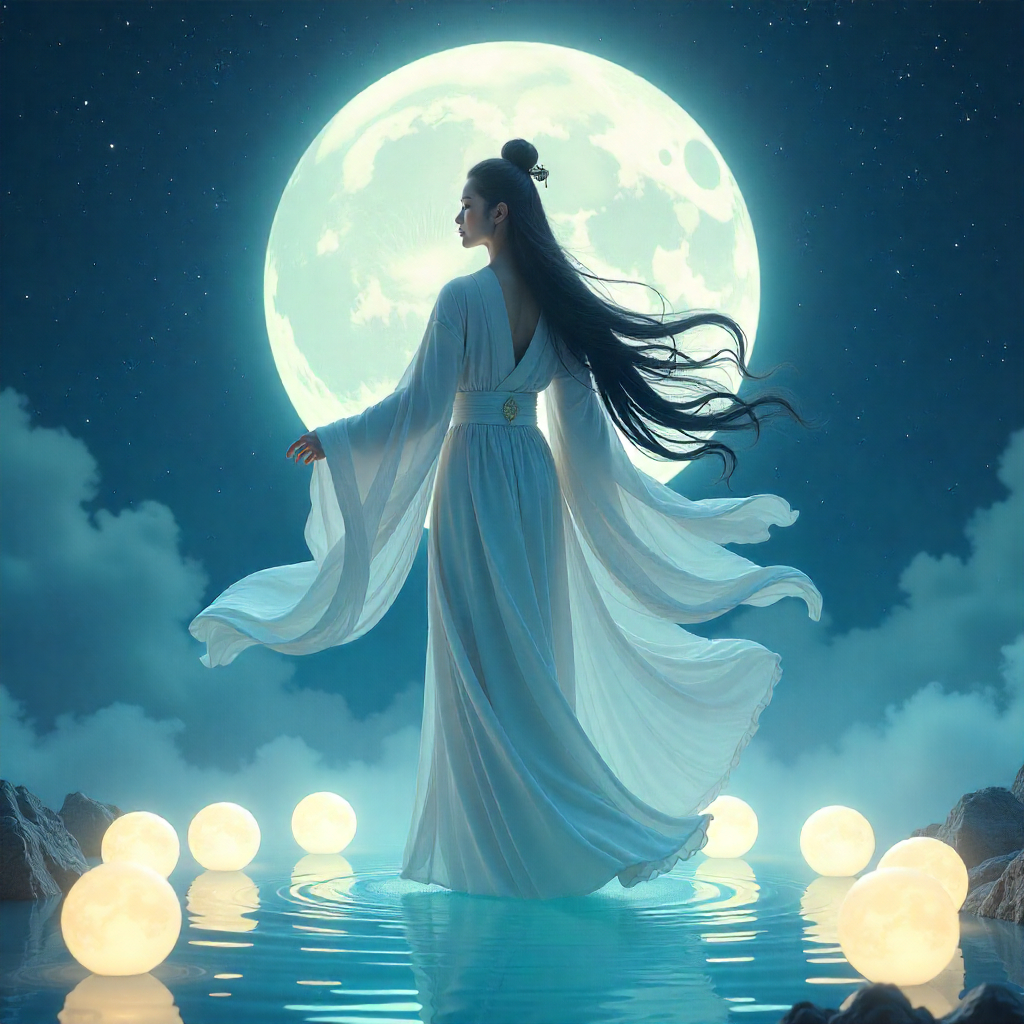
Ancient Chinese mythology provides only limited information about Chang Xi’s physical appearance. As a celestial goddess associated with the moon, she is nevertheless commonly imagined as a graceful and dignified woman whose appearance reflects the quiet beauty of the night sky.
Traditional-inspired artistic interpretations often portray Chang Xi wearing long flowing robes and standing beside celestial waters. Her connection with water comes particularly from the ancient image of her bathing the twelve moons. This scene gives artists an opportunity to present her as a serene maternal figure surrounded by moonlight, mist, and reflections.
Her appearance is therefore less about physical characteristics and more about the qualities traditionally associated with lunar divinity. Chang Xi can be envisioned with an elegant bearing, composed expression, and a quiet presence that reflects the moon’s recurring appearance in the night sky. For modern representations, her visual identity works best when the focus remains on her role as a celestial mother rather than on elaborate supernatural features. The twelve moons surrounding her provide the strongest visual expression of her mythology.
Family
Chang Xi’s family places her within one of the most intriguing celestial relationships in early Chinese mythology. She is the wife of Di Jun (帝俊), a prominent deity associated with the ancient Chinese mythological heavens. Her most important familial role is that of mother to twelve moons. These celestial children give Chang Xi a direct connection to the recurring divisions of the year. The number twelve has encouraged generations of interpreters to associate the moons with the twelve months, linking her mythology with calendars, seasonal change, and the observation of celestial movements.
Chang Xi is also closely connected through Di Jun to Xi He (羲和), another important female figure in early Chinese mythology. Xi He is associated with ten suns, while Chang Xi is associated with twelve moons. Their parallel roles create a striking celestial structure in which the sun and moon are represented through two divine mothers within the same mythological family.
This relationship makes Chang Xi more than simply a goddess of the moon. Her place within Di Jun’s celestial household connects her mythology with a larger conception of the heavens, where the movement of celestial bodies is expressed through divine ancestry and family relationships.
Other Names
Chang Xi is written as 常羲 in Chinese and is sometimes associated with the name Chang Yi (常儀) in early Chinese traditions. These names appear in discussions of ancient lunar mythology and reflect the variations found within early textual traditions. Chang Xi is distinct from Chang’e (嫦娥), another famous Chinese lunar figure. The two names have become closely associated in modern discussions because both women are connected with the moon, but their mythological stories are different.
Chang Xi belongs to the ancient cosmological traditions surrounding Di Jun and the twelve moons. Chang’e is best known from the later tradition involving Hou Yi and the elixir of immortality. The contrast between them illustrates the different ways Chinese mythology developed lunar figures over time. Chang Xi’s earlier mythological identity is especially valuable because it preserves an image of the moon not simply as a celestial location, but as a recurring group of heavenly bodies born from a divine mother.
Powers and Abilities
Chang Xi’s greatest power is expressed through her relationship with the twelve moons. She gives birth to them and is described as bathing them, establishing her as a nurturing figure responsible for these celestial bodies. The image of Chang Xi bathing the moons gives her mythology a strong association with renewal and celestial rhythm. The moon itself changes continually in appearance, moving through its familiar phases, while the twelve moons associated with Chang Xi suggest a larger recurring structure in the heavens.
Her twelve lunar children are also commonly connected with the twelve months of the year. Through this interpretation, Chang Xi becomes associated with the measurement and progression of time. Her mythology reflects the importance of observing the heavens to understand the passage of seasons and the rhythms of the natural world.
Her role can therefore be understood through three closely connected ideas: lunar cycles, motherhood, and time. Rather than functioning primarily as a warrior or ruler, Chang Xi’s power is expressed through the creation and care of celestial bodies. The bathing of the moons is particularly significant because it gives her mythology a distinctive ritual quality. Chang Xi does not merely give birth to the moons; she continues to care for them, reinforcing her identity as a maternal presence within the celestial order.
Modern Day Influences
Chang Xi remains a relatively lesser-known figure in comparison with Chang’e, but her importance has endured through the study and retelling of ancient Chinese mythology. Her story provides valuable insight into early Chinese ideas about the heavens and the personification of natural cycles.
Her connection with twelve moons has made Chang Xi particularly relevant to discussions of lunar calendars and ancient concepts of time. The moon was fundamental to the organization of traditional calendars, and mythological figures such as Chang Xi transformed these recurring celestial patterns into stories about divine beings and their families.
Her relationship with Xi He has also attracted attention in comparative studies of Chinese mythology. The two figures provide complementary images of celestial motherhood: Xi He is associated with the suns, while Chang Xi is associated with the moons. Together, their stories create one of the most memorable examples of celestial family mythology in early Chinese tradition.
Modern artists, writers, and creators continue to draw upon Chang Xi when exploring ancient Chinese cosmology. Her image as the mother of twelve moons offers a particularly evocative subject for visual art and contemporary mythology-inspired storytelling.
Chang Xi’s enduring appeal ultimately comes from the simplicity of her central myth. She stands at the intersection of motherhood, moonlight, and the passage of time, transforming the recurring movement of the heavens into a story of divine family and cosmic continuity. Her place in early Chinese mythology preserves an ancient attempt to understand the rhythms of the natural world through the language of gods, celestial bodies, and generations.
Related Images


Source
Classical Chinese text: The Classic of Mountains and Seas (Shan-hai Jing). (n.d.). Retrieved from ancient sources compiled in translations and academic anthologies.
Mythopedia. (2022). Changxi. Retrieved December 1, 2022, from https://mythopedia.com/changxi
Ancient Chinese Mythology. (n.d.). Changxi - 常羲. Retrieved from https://ancientchinesemythology.blogspot.com
Wikipedia contributors. (2003, November 16). Chang’e. Wikipedia. https://en.wikipedia.org/wiki/Chang%27e
Mythical Encyclopedia. (2023, December 29). Changxi: Overview, Etymology, Attributes, Family Tree, Mythology. https://mythicalencyclopedia.com/changxi
ChinaFetching. (2020, June 12). Chinese Goddesses in Creation Myths and Legends. https://chinafetching.com/chinese-goddesses
Wikipedia contributors. (2012, May 19). Changxi. Wikipedia. https://en.wikipedia.org/wiki/Changxi
Birrell, A. (1993). Chinese Mythology: An Introduction. Johns Hopkins University Press.
Yang, L., An, D., & Turner, J. (2005). Handbook of Chinese Mythology. Oxford University Press.
Wu, K. C. (1982). The Chinese Heritage. Crown Publishers.
Christie, A. (2010). Chinese Mythology: A Concise Guide. Oneworld Publications.
Loewe, M., & Shaughnessy, E. L. (Eds.). (1999). The Cambridge History of Ancient China. Cambridge University Press.
Frequently Asked Questions
Who is Chang Xi in Chinese mythology?
Chang Xi is an ancient Chinese lunar goddess, the wife of Di Jun, and the mother of twelve moons representing the twelve lunar months.
How is Chang Xi different from Chang’e?
While both are lunar goddesses, Chang Xi predates Chang’e and symbolizes lunar cycles and timekeeping, whereas Chang’e represents immortality and love.
What are Chang Xi’s powers?
Chang Xi governs the moon’s phases, fertility, tides, and time. She nurtures the twelve moons, symbolizing her control over the lunar calendar.
Is Chang Xi still worshipped today?
Direct worship of Chang Xi is rare, but her influence endures in lunar festivals, cosmological traditions, and mythological studies.
What does Chang Xi represent in modern culture?
Chang Xi represents balance, femininity, and the cyclical nature of time, serving as an early symbol of yin energy and cosmic renewal in Chinese mythology.


