


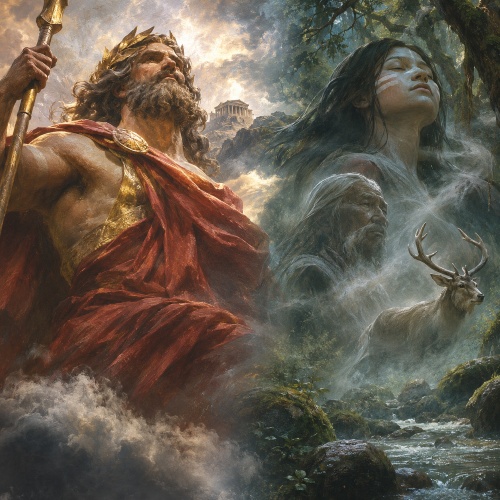
Why Understanding the Difference Between Spirits and Gods Matters
When exploring different cultures and their traditional belief systems, one of the most interesting questions concerns the distinction between spirits and gods. Both occupy the supernatural dimensions of human imagination and religious thought, often influencing how communities understand nature, death, creation and the unseen world. However, they are not necessarily the same. While gods are frequently associated with divine authority, cosmic responsibilities and extraordinary powers, spirits often have closer connections to particular places, natural elements, deceased individuals or specific aspects of everyday life.
Understanding the relationship between spirits and gods is important for anyone studying mythology, religion and folklore. The distinction helps explain why some supernatural beings receive elaborate temples and sacrifices, while others are remembered through household rituals, local traditions or protective offerings. Nevertheless, these categories are not universal, and different cultures have developed their own ways of understanding supernatural existence.
What Exactly Are Gods?
Gods are generally understood as supernatural beings possessing divine qualities, extraordinary powers or authority over particular aspects of existence. In many traditional belief systems, they are responsible for maintaining cosmic order, controlling natural forces, protecting communities or influencing human destiny. Their identities are usually established through stories, religious traditions and established systems of worship.
In Greek mythology, for example, Zeus occupies a position of authority among the Olympian gods and is associated with the sky, thunder and kingship. Poseidon governs the seas, while Athena represents wisdom and strategic warfare. Each deity has a recognisable identity, a collection of attributes and an established position within a larger divine hierarchy.
Similar arrangements appear elsewhere. In Norse mythology, Odin is associated with wisdom, knowledge and kingship, while Thor is connected with thunder and protection. In ancient Egyptian belief systems, Ra represents the sun and its life-giving power, while Osiris is associated with death, resurrection and the afterlife.
These examples demonstrate how gods frequently represent forces or principles that extend beyond ordinary human experience. Their influence may cover entire communities, natural systems or even the universe itself. However, not every god possesses unlimited power or authority. Some are restricted to particular responsibilities, while others depend on relationships with fellow deities and supernatural beings.
What Exactly Are Spirits?
Spirits represent a broader and considerably more varied category of supernatural beings. They may be associated with deceased humans, animals, natural environments, geographical locations or invisible forces believed to influence the physical world. Unlike gods, spirits do not always have clearly defined identities, established hierarchies or responsibilities extending across entire communities.
Ancestor spirits offer one of the clearest examples. In several African, Asian and Indigenous belief systems, deceased family members are believed to maintain connections with the living. They may provide protection, offer guidance or influence the fortunes of their descendants. Families consequently maintain traditions involving prayers, offerings and remembrance to honour these spiritual relationships.
Nature spirits represent another important category. Certain cultures recognise supernatural presences associated with forests, rivers, mountains, trees and other natural environments. These beings may protect particular locations, punish disrespectful behaviour or influence the wellbeing of people living nearby.
Ghosts and wandering spirits also occupy an important place in folklore. Unlike gods, these entities are frequently connected to particular events, unresolved experiences or the circumstances surrounding an individual’s death.
However, it would be incorrect to assume that all spirits were once humans or that they are necessarily less powerful than gods. Some traditions recognise powerful nature spirits and supernatural entities capable of influencing entire communities. Their classification depends on the cultural context in which they exist.
Five Important Differences Between Spirits and Gods
Although the boundaries can overlap, several characteristics help students understand how different traditions distinguish between these supernatural categories.
1. Origins and Existence
Gods are frequently believed to possess divine origins. They may be primordial beings, creators of the universe or members of an established supernatural order. Spirits, meanwhile, can have considerably more varied origins. Some emerge from deceased humans, while others are believed to have existed alongside nature or inhabit particular objects and locations.
2. Powers and Responsibilities
Gods often possess powers connected to major aspects of existence, such as weather, fertility, warfare, death and creation. Spirits generally have more specific associations, including protecting a family, guarding a forest or influencing a particular location. Nevertheless, powerful spirits can sometimes exercise authority comparable to that of gods.
3. Relationships with Humans
Human relationships with gods frequently involve worship, prayer, festivals and religious ceremonies. Spirits may receive offerings, remembrance rituals or protective ceremonies. Ancestor spirits, for example, can remain closely connected to family relationships, while nature spirits may demand respect for particular environments.
4. Hierarchy and Recognition
Many religious traditions establish recognisable pantheons in which gods occupy particular positions and possess defined relationships with one another. Spirits may exist within less structured supernatural systems. Some are individually named, while others are understood as collective or unidentified presences.
5. Cultural Significance
Gods frequently represent important cultural values, natural forces and explanations of existence. Spirits often help communities understand their immediate surroundings, relationships with ancestors and interactions with the natural world. Both categories, however, can play equally important roles in shaping cultural identity.
How Different Cultures Blur the Boundary
The distinction between spirits and gods becomes considerably more complicated when examining individual cultural traditions. Some supernatural beings cannot be comfortably placed into either category because their identities and responsibilities combine characteristics associated with both.
Japanese Shinto provides an interesting example through the concept of kami. These supernatural presences may be associated with natural phenomena, particular geographical locations, ancestral figures and powerful beings. A mountain, waterfall or ancient tree can be considered sacred because of the kami associated with it. Some kami are recognised as major deities, while others have more localised associations. This makes kami difficult to classify using a strict distinction between spirits and gods. Their nature depends considerably on the particular tradition and context in which they are understood.
Chinese traditional religious practices offer another interesting perspective. The spiritual world includes gods, ancestral spirits, local protective beings and supernatural entities that may occupy different positions within an interconnected cosmic order. Some historical figures can even become deified and receive recognition as protective gods following their deaths.
African traditional religious systems also demonstrate how complicated these categories can become. Among different communities, ancestral spirits, nature spirits and divinities may have distinct identities and responsibilities. In certain traditions, supernatural beings associated with rivers, forests and other natural features possess considerable authority and receive formal religious recognition.
These examples demonstrate that the distinction between spirits and gods is not always fixed. A supernatural being recognised as a spirit in one cultural context might perform functions associated with a deity in another.
Can Spirits Become Gods?
One particularly fascinating aspect of supernatural traditions is the possibility of spirits becoming gods. This transformation appears in several cultural belief systems, where deceased individuals, ancestors or historical figures gradually acquire divine status.
In Chinese religious traditions, for instance, certain historical personalities have become deified through popular devotion, religious recognition and the development of established cults. Guan Yu, a historical military general from the Three Kingdoms period, eventually became widely worshipped as a protective deity associated with loyalty, righteousness and martial strength.
Similar processes can be observed in other traditions, although the precise circumstances differ. Ancestors may become powerful protective figures, while exceptional individuals may acquire supernatural responsibilities following their deaths. However, this does not mean every spirit eventually becomes a god. Deification is a culturally specific process influenced by religious beliefs, historical circumstances and community practices. In some traditions, spirits and gods remain permanently separate categories, while others recognise a more fluid relationship between them.
Why Understanding the Difference Matters
For students exploring mythology and folklore, separating spirits from gods is more than an exercise in classification. It provides a better understanding of how different societies organise their supernatural worlds and explain their relationships with the environment, ancestors and the universe. It also prevents common misconceptions when studying different cultural traditions. Not every supernatural creature is a god, just as not every invisible being should automatically be classified as a spirit. A guardian associated with a forest, a deceased ancestor receiving offerings and a creator deity may all belong to the supernatural world, but their identities and cultural responsibilities can be fundamentally different.
The most important lesson is to examine each being within its original cultural context rather than imposing a universal classification. Religious traditions do not always follow the same definitions, and some deliberately maintain overlapping categories of supernatural existence. Ultimately, spirits and gods represent different ways through which human societies have understood the unseen dimensions of existence. Gods frequently provide explanations for cosmic forces and divine authority, while spirits help explain the presence of supernatural influences within everyday life. Their boundaries may sometimes overlap, but studying those differences reveals how diverse and interconnected human beliefs about the supernatural can be.
No posts were found.


