


Kapre : The Tree-Dwelling Giants of Philippine Folklore
At a glance
| Description | |
|---|---|
| Origin | Philippine Mythology |
| Classification | Hybrids |
| Family Members | N/A |
| Region | Philippines |
| Associated With | Gigantism, Strength, Invisibility |
Mythlok Perspective
In Mythlok’s View, the Kapre represents the uneasy boundary between human presence and the mysteries of nature. Like Japan’s kodama, it connects supernatural beliefs with trees, transforming familiar landscapes into places demanding respect. Yet the Kapre differs through its distinctly colonial-era associations and its image as a tobacco-smoking giant. Its enduring appeal lies in how Philippine folklore turns the ordinary act of passing beneath an old tree into an encounter with the unknown.
Kapre
Introduction
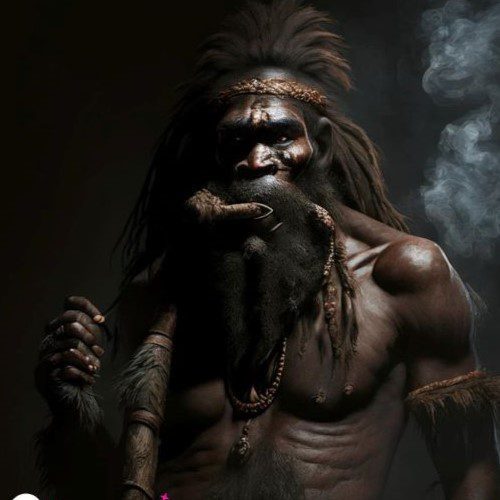
The Kapre is a supernatural being in Philippine folklore, commonly depicted as a towering, dark, hairy giant associated with ancient trees and the forests of the archipelago. Often imagined sitting among the branches of a balete or acacia tree, the Kapre is particularly recognisable for its habit of smoking an enormous cigar or tobacco pipe. Its presence is frequently announced through the smell of tobacco, mysterious laughter, or the unsettling feeling that someone is watching from above.
Unlike mythological figures known by individual names and defined biographies, the Kapre represents a category of supernatural beings encountered in folklore. Stories portray these creatures as mysterious inhabitants of places where the human and supernatural worlds intersect. Although their imposing appearance can frighten travellers, Kapres are not invariably portrayed as evil. Some accounts emphasise their mischievous behaviour, while others describe encounters in which they become threatening when people disturb their surroundings.
The Kapre occupies an enduring place in the Philippines’ supernatural traditions, reflecting the cultural significance of trees, forests, and unseen presences in everyday life. Its familiar modern appearance also reflects the historical development of Philippine folklore, where regional beliefs, colonial terminology, and popular storytelling have contributed to the creature recognised today.
Physical Description
The Kapre is commonly described as an exceptionally large humanoid with dark skin, thick body hair, and a powerful build. Its appearance varies between accounts, but its imposing size and hairy body are recurring characteristics. Some modern descriptions place its height between seven and nine feet, although this measurement should not be treated as a fixed feature shared by every tradition. Early written accounts describe the Kapre as gigantic without establishing a universally accepted height.
Its dark appearance and association with large trees contribute to its reputation as a mysterious woodland inhabitant. The creature is particularly associated with the balete, a type of fig tree, although acacias and mango trees also appear in descriptions of its habitat. These trees provide the setting for many reported encounters, especially after dark, when the Kapre is believed to remain concealed among the branches.
Tobacco smoking is among the creature’s most recognisable characteristics. Kapres are often depicted smoking large cigars, and the smell of tobacco may serve as a warning of their presence. Some accounts also associate them with unexplained laughter, strange sounds, or the sudden disorientation of people passing through their territory. These details vary across retellings and should not be understood as an identical set of physical or supernatural traits in every regional tradition.
Mythological Context
The Kapre belongs to the broad landscape of Philippine folk beliefs concerning supernatural beings that inhabit or interact with the human world. Such beings are frequently associated with particular environments, including forests, mountains, rivers, trees, and abandoned places. Within this landscape, the Kapre is especially connected with large trees and locations regarded as inhabited by unseen presences.
Stories about the Kapre often centre on encounters rather than elaborate creation narratives. A traveller might hear laughter from an apparently empty tree, smell tobacco smoke without seeing a smoker, or find that a familiar path has become confusing. These experiences are interpreted within folklore as possible signs of supernatural interference. The Kapre’s reputation consequently rests as much on its mysterious presence as on its physical appearance.
The creature’s temperament is not uniform across Philippine traditions. Some accounts portray it as relatively harmless or mischievous, while others suggest that it can become dangerous when disturbed. Its behaviour is often understood through the relationship between humans and the places it inhabits. Approaching an old tree without respect or damaging a place believed to shelter a supernatural being may be interpreted as inviting trouble.
The Kapre therefore represents more than a frightening giant in a tree. It forms part of a wider worldview in which familiar landscapes may contain unseen inhabitants and ordinary experiences can acquire supernatural explanations. However, beliefs about the Kapre should not be treated as identical throughout the Philippines, where different communities maintain distinct traditions and interpretations.
Origins
The origins of the Kapre involve both linguistic history and the development of Philippine supernatural folklore. The name is generally traced to the Arabic word kāfir, meaning a non-believer, through the Iberian colonial term cafre. The word acquired racialised meanings in colonial usage before becoming associated with the supernatural creature known as the Kapre.
Historical dictionaries and folklore collections provide important evidence for understanding this development. The nineteenth-century Tagalog-Spanish dictionary associated with Juan de Noceda and Pedro de Sanlucar records the older human and racial meanings of the term. In 1906, American teacher Fletcher Gardner published a description of the Kapre in the Journal of American Folklore, identifying it as a gigantic, dark-coloured being and describing it as benign. His account is significant because it provides an early printed description of the creature in Philippine folklore.
These historical records suggest that the Kapre’s familiar modern image developed over time rather than appearing fully formed in a single ancient narrative. The word’s colonial history and the evolution of its supernatural associations must be distinguished from the broader history of Philippine beliefs about spirits, trees, and giant-like beings.
The familiar cigar-smoking tree giant is particularly associated with later descriptions and popular representations. Tobacco itself became established in the Philippines during the Spanish colonial period, making the smoking motif historically distinct from any precolonial traditions concerning supernatural inhabitants of trees.
It is therefore more accurate to describe the Kapre as a figure whose recorded identity developed through historical and cultural processes than to assign it a single, demonstrable precolonial origin. Earlier regional traditions concerning large or tree-dwelling supernatural beings may provide relevant comparisons, but they do not establish that every modern characteristic of the Kapre existed in the same form before colonial contact.
Notable Members
Philippine folklore does not provide a universally recognised roster of named Kapres comparable to the individualised deities and heroes found in major mythological narratives. The Kapre is primarily understood as a category of supernatural beings, and stories generally focus on encounters with a Kapre rather than the biography of one specific individual.
Some accounts describe a Kapre encountered in a particular tree or location, while others attribute distinctive behaviour to an individual creature. Such figures can function as characters within their respective stories without establishing a standardised identity shared across the wider folklore tradition.
Ethnographic documentation also demonstrates that local descriptions do not always conform to the familiar image of a giant, hairy humanoid. A report documenting traditional knowledge among the Agta of Dipontian in Aurora, for example, records a Kapre described by one informant as a large, hairy being associated with trees and rocky places. Another reported encounter involved a being appearing as a large bird, which was understood within the account as a Kapre.
This variation illustrates why the Kapre should not be assigned a fixed physical form or a fabricated genealogy. Its defining identity rests on its place within a category of supernatural beings, while individual stories preserve local descriptions and encounters. Unless a named Kapre can be traced to a specific, documented tradition, it is more accurate to state that no universally established list of notable members exists.
Relationship with Other Beings
The Kapre shares the wider supernatural landscape of Philippine folklore with numerous other beings, including the Tikbalang and Nuno sa Punso. These creatures occupy distinct places within local traditions, and their coexistence in the same cultural landscape does not establish that they are members of one supernatural family.
The Tikbalang is commonly described as a humanoid creature with horse-like features and is associated with misleading travellers. The Nuno sa Punso, by contrast, is a small supernatural being associated with earthen mounds and places that people are expected to approach respectfully. The Kapre is distinguished by its association with large trees and its familiar image as a towering, tobacco-smoking figure.
Relationships between Kapres and humans are another recurring subject in some stories. Certain accounts describe supernatural beings becoming attached to people or interfering in their lives. However, such narratives should be attributed to the particular folklore tradition in which they occur rather than treated as universal features of Kapre behaviour.
The available traditions do not establish a single, standardised family structure for Kapres. Claims about a hierarchy of older and younger Kapres, a recognised class of female Kapres, or a formal alliance with other forest spirits require specific evidence from the relevant community or folklore collection. In the absence of such evidence, the Kapre is best understood as a distinct category of supernatural being rather than a member of a clearly defined mythological family.
Similar Beings
Several Philippine supernatural beings share characteristics with the Kapre, particularly their association with wilderness, unusual physical forms, and encounters that disrupt ordinary human experience. These similarities reflect overlapping folkloric themes rather than proof that the creatures are interchangeable.
The Pugot, associated particularly with Ilokano traditions, is an important comparison. Historical folklore records describe the Pugot as a giant or frightening supernatural being, with some accounts associating it with enormous cigars. These similarities have led researchers to consider how characteristics associated with regional figures may have influenced the broader image of the Kapre. However, the precise relationship between the traditions should not be reduced to the claim that every Pugot is a Kapre.
The Agta, or Agtà, is another important comparison, although the terminology requires care. Agta is also the name of Indigenous peoples in the Philippines, and it appears in particular regional traditions as a designation for supernatural beings. Some accounts describe an Agtà as a large, dark being associated with trees or other secluded places. In certain regional contexts, the descriptions overlap with those of the Kapre, but the names should not automatically be treated as synonyms.
The Tikbalang offers a further comparison because both beings may mislead travellers. Its horse-like features, however, distinguish it from the familiar tree-dwelling Kapre. Similarly, the Nuno sa Punso is associated with earthen mounds rather than the towering trees most commonly linked with Kapres.
These comparisons demonstrate the diversity of Philippine folklore. Similar motifs can emerge in neighbouring communities, but each being retains its own regional associations, terminology, and narrative traditions.
Symbolism and Interpretations
The Kapre’s association with old trees makes it a useful figure for understanding how folklore gives supernatural significance to familiar landscapes. Trees are not merely background settings in Kapre stories; they are places where the creature is believed to dwell and where human encounters with the unseen may occur. The presence of a Kapre consequently transforms an ordinary tree into a location that calls for caution and respect.
The creature’s tendency to mislead travellers can be interpreted as an expression of the uncertainty associated with unfamiliar or secluded environments. In stories where people lose their way or encounter inexplicable disturbances, the Kapre gives a supernatural explanation to experiences that challenge ordinary expectations. Its role as a trickster also allows folklore to explore the limits of human control over the natural world.
The Kapre’s dark appearance and colonial-era name carry a more complicated historical dimension. The word’s association with racialised terminology shows how colonial language could become incorporated into local supernatural traditions. This history does not mean that all beliefs about tree-dwelling beings originated in colonial rule. Rather, it suggests that the familiar Kapre emerged through a combination of local beliefs, changing terminology, and the circulation of stories.
A contemporary environmental interpretation is also possible. Because the Kapre is closely associated with old trees, the creature can be used today as a symbol of the value of protecting established trees and respecting the places that communities consider significant. This is a modern interpretation of its folkloric associations, rather than a claim that environmental conservation was the original purpose of the tradition.
Taken together, these interpretations show how the Kapre can represent mystery, the limits of human knowledge, respect for particular places, and the historical transformation of folklore. Its meaning is not fixed, and interpretations differ according to the stories, communities, and historical contexts in which the creature appears.
Modern Influence
The Kapre remains a recognisable figure in contemporary representations of Philippine folklore. Its distinctive appearance and association with old trees make it particularly suited to visual storytelling, including illustrations, comics, films, television, and digital media. Creators can draw on its familiar characteristics while adapting its behaviour and appearance to suit different narratives.
The creature also features in efforts to document and present Philippine supernatural traditions to wider audiences. The 2015 documentary web series The Creatures of Philippine Mythology, associated with The Aswang Project, explored the histories and changing representations of several supernatural beings, including the Kapre. Such projects help bring regional folklore into contemporary discussions about cultural identity and storytelling.
In modern fiction, the Kapre can serve several narrative purposes. It may appear as a frightening presence in a forest, a mischievous figure that disrupts a traveller’s journey, or a supernatural character whose actions challenge the assumptions of human protagonists. Its ambiguous temperament makes it more flexible than a creature defined exclusively as good or evil.
The Kapre’s association with old trees also gives contemporary storytellers an opportunity to explore changing relationships with the natural world. A story featuring a Kapre may encourage audiences to consider why particular places are treated with respect, how traditional beliefs shape behaviour, or what happens when development transforms a familiar landscape.
Although its modern appearance is widely recognisable, the Kapre should not be treated as a single, unchanging figure whose characteristics are identical throughout Philippine history. Its development illustrates how folklore evolves through oral storytelling, written documentation, cultural exchange, and popular media. As long as these stories continue to be retold, the Kapre will remain an important example of the Philippines’ diverse supernatural traditions.
Related Images




Sources
Bacdayan, A. S. (1963). Philippine mythology and folklore. University of the Philippines Press.
Demetrio, F. R. (1992). Encyclopedia of Philippine Folk Beliefs and Customs. Giraffe Books.
Jocano, F. L. (1969). Outline of Philippine Mythology. Centro Escolar University Research and Development Center.
Lynch, F. (2004). Philippine Mythology and Folklore: An Introduction. Ateneo de Manila University Press.
Rafael, V. (2014). Kapre and Other Myths: Folklore and National Identity in the Philippines. Philippine Studies, 62(2), 145–172. https://www.jstor.org/stable/42721549
Scott, W. H. (1994). Barangay: Sixteenth-Century Philippine Culture and Society. Ateneo de Manila University Press.
Tan, M. L. (2008). Kapre, Tikbalang, Manananggal: The politics of folklore in the Philippines. Philippine Studies, 56(3), 389–418. https://journals.ateneo.edu/ps/article/view/1211
Philippine Folklore Stories. (2020). The Kapre. Philippine Folklore. Retrieved from https://www.philippinefolklore.com/kapre
The Aswang Project. (2017). The Kapre: A Philippine tree-dwelling giant. Retrieved from https://www.aswangproject.com/kapre/
Frequently Asked Questions
What does kapre do?
The Kapre, a treetop trickster in Philippine myth, loves to mislead travelers with illusions and spooky sounds. While mischievous, they might offer good luck or get grumpy if you harm their forest home. Watch out for their immense strength and invisibility tricks!
What happens if a kapre falls in love?
A lovesick Kapre gets fixated, following their human crush endlessly. Gifts and protection might be offered, but societal disapproval and communication gaps loom large. Unrequited love can make the Kapre mischievous or even dangerous.
How to avoid kapre?
Kapres dislike noise, swearing, and disrespect for the forest. To avoid their tricks, be polite, wear your shirt inside out, or travel with a group. Strong smells like vinegar or garlic might also help keep them at bay. Be polite in the forest, say “Tabi po” to big trees.
What does a kapre smell like?
A Kapre’s stench isn’t for the faint of heart. Imagine a mix of rotting leaves and the strongest tobacco you can think of. Their giant pipes constantly pump out this pungent smoke, a way to both attract attention and clear a path. Not exactly a perfume commercial.
Is Kapre good or bad?
The Kapre are tricksters, not villains. They enjoy playful pranks, leading travelers astray. Respect the forest and you might get a lucky charm! But anger them by harming trees, and they might get grumpy. More mischievous than mean, their mood depends on you.



Pingback: Halloween Reads 2023! – The Write Attitude