

Altamaha-ha : The Mysterious River Creature of Georgia
| Description | |
|---|---|
| Origin | United States of America |
| Classification | Cryptid |
| Demeanour | Neutral |
| Habitat | Marshes |
| Status | Not Proven |
Mythlok Perspective
In Mythlok’s View, the Altamaha-ha represents the archetype of the “river guardian,” a presence shaped as much by environment as imagination. Unlike oceanic monsters, it is bound to a specific ecosystem, making it deeply local yet universally recognizable. Similar figures appear in global traditions, from the Bunyip to the Ogopogo, each tied to water bodies that resist full human control. The Altamaha-ha reflects how uncertainty in nature evolves into narrative, turning geography into myth.
Altamaha-ha
Introduction
The Altamaha-ha is one of North America’s lesser-known yet enduring cryptid legends, rooted in the waterways of southeastern Georgia. Centered around the Altamaha River and the coastal town of Darien, the story blends Indigenous memory, colonial-era reporting, and modern cryptozoology.
Long before written accounts, oral traditions from the Muscogee (Creek) Nation described a powerful aquatic presence inhabiting the river’s marshes and estuaries. Later European settlers and sailors expanded these narratives, turning the creature into a regional mystery often compared to Loch Ness Monster.
Today, the Altamaha-ha is not just a creature story. It reflects how landscapes shape belief systems. The river’s shifting tides, murky waters, and dense marshes create an environment where sightings feel plausible, even inevitable. As a result, the legend continues to live at the intersection of folklore, ecology, and curiosity.
Physical Attributes
Descriptions of the Altamaha-ha remain surprisingly consistent across decades, though details vary depending on the witness. Most accounts portray a long, serpentine creature ranging anywhere from 20 to 70 feet in length.
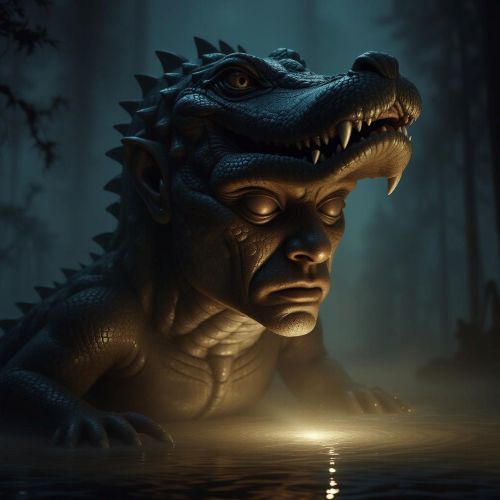
Its body is often compared to that of a prehistoric fish, especially a sturgeon, with a distinct ridge running along its back. Witnesses frequently describe a crocodile-like head with pronounced eyes and visible teeth, giving it a predatory appearance. Unlike traditional sea serpents, the Altamaha-ha is said to have front flippers but no rear limbs, allowing it to move through water with a smooth, undulating motion similar to dolphins.
Coloration tends to fall within gray or green tones, likely influenced by the river’s muddy, light-filtered waters. A lighter underside is sometimes noted, which aligns with countershading seen in real aquatic animals. Skeptics often point to known species such as the Alligator gar or the West Indian manatee as possible explanations. However, neither fully matches the composite features reported, which keeps the mystery alive.
First Sighting/Reporting
The earliest layer of the Altamaha-ha legend comes from Indigenous oral history, where the creature was not merely an animal but a presence tied to the river’s identity. These stories predate European arrival, placing the creature firmly within a cultural rather than purely observational framework.
The first widely recognized written account appeared on April 18, 1830, in the Savannah Georgian. A ship captain named Delano and his crew reported encountering a massive creature near St. Simons Island. According to the report, the animal measured around 70 feet and had features resembling an alligator. Multiple witnesses supported the claim, which gave the story unusual credibility for its time.
Through the late 19th and early 20th centuries, sightings continued sporadically. Interest peaked in the 1920s, when increased river activity and local reporting led to a surge in public fascination. Since then, sightings have never fully stopped, though they remain anecdotal.
Other Names
The Altamaha-ha is most commonly referred to as “Altie,” a nickname that reflects local familiarity rather than fear. The name itself originates from the Altamaha River, tying the creature directly to its environment.
Over time, comparisons to global cryptids have led to labels like “Georgia’s Loch Ness Monster” or the “Altamaha River Monster.” While these names help outsiders understand the concept, they often oversimplify a legend that is deeply tied to a specific cultural and ecological context. Earlier accounts occasionally used terms like “sea serpent” or “river serpent,” especially in colonial writings, showing how European frameworks influenced the way the creature was described.
Modus Operandi
The Altamaha-ha is typically described as elusive rather than aggressive. Most sightings involve brief appearances at the water’s surface, often accompanied by a wake similar to that of a fast-moving boat.
Witnesses frequently report hissing or bellowing sounds, followed by sudden dives into deeper channels. The creature is said to move between tidal marshes, abandoned rice fields, and narrow tributaries, using the complex geography of the Altamaha basin to remain hidden.
Encounters are most often reported during dawn or dusk, when visibility is low and wildlife activity increases. While some stories mention the creature thrashing or disturbing boats, there are no verified reports of attacks on humans. This behavior suggests a territorial but non-predatory presence, which aligns with many real aquatic animals that avoid confrontation while defending their habitat.
Pop Culture References
In recent years, the Altamaha-ha has transitioned from local folklore into wider media representation. It appears in documentaries such as Monsters and Mysteries in America, where it is featured as part of the broader American cryptid tradition.
The creature also gained attention through the video game South of Midnight, where it is reimagined as a supernatural swamp entity with a tragic backstory. This reinterpretation reflects a growing trend of blending folklore with narrative-driven gaming.
Local tourism has embraced the legend as well. Sculptures and exhibits in Darien celebrate the creature, turning it into both a cultural icon and an economic asset. Books by researchers like Linda Godfrey further place the Altamaha-ha within the wider study of unexplained creatures.
Current Status
Despite nearly two centuries of written reports, there is no scientific evidence confirming the existence of the Altamaha-ha. Most explanations point toward misidentification, environmental distortion, or folklore amplification.
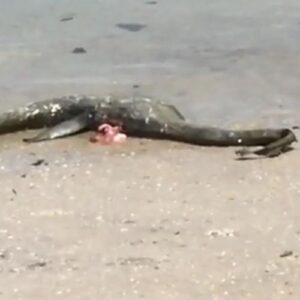
A notable incident occurred in 2018 when a strange carcass washed ashore on Wolf Island. Initial speculation linked it to the Altamaha-ha, but it was later revealed to be an art hoax created by Zardulu using fabricated materials.
Even so, sightings continue to be reported by fishermen and boaters. The lack of definitive proof has not diminished interest. Instead, it has reinforced the creature’s status as a living legend. As of 2026, the Altamaha-ha remains unverified but culturally significant. It contributes to regional tourism, supports conservation awareness, and continues to inspire curiosity about what may exist in the unexplored corners of natural ecosystems.



Source
Cox, D. (2019, October). Legend of Georgia’s “Loch Ness Monster. Two Egg Civil War Round Table. https://twoegg.blogspot.com/2019/10/altamahaha.html
Brown, T. (2018, April 22). The South’s own Loch Ness Monster? Garden & Gun. https://gardenandgun.com/souths-loch-ness-monster/
Wikipedia contributors. (2024). Altamaha-ha. Wikipedia. https://en.wikipedia.org/wiki/Altamaha-ha
Cryptid Wiki. (2007). Altamaha-ha. Fandom. https://cryptidz.fandom.com/wiki/Altamaha-ha
Hangar1 Publishing. (2024, March 14). The mysterious legends of Georgia’s cryptids. https://hangar1publishing.com/blogs/cryptids/georgia-cryptids
Statesboro Herald. (2021, April 22). The ‘Altamaha-ha’ creature earns legendary status. https://www.statesboroherald.com/life/altamaha-ha-creature-earns-legendary-status/
Southern Style Sweet Tees. (2025, August 27). Georgia’s Altamaha-ha: River monster meets Bigfoot. https://www.southernstylesweettees.com/blog/1c4d49wyhjky1q8q35fa1jdwk6xnbc
Frequently Asked Questions
What is the Altamaha-ha?
A legendary aquatic cryptid said to inhabit Georgia’s Altamaha River, often compared to a sea serpent or lake monster.
Where is the Altamaha-ha usually seen?
Sightings occur near Darien, Georgia, especially in marshes, estuaries, and tidal waterways.
Is there proof of the Altamaha-ha?
No scientific evidence exists; sightings remain anecdotal and unverified.
What animals could explain Altamaha-ha sightings?
Misidentified alligator gars or manatees are the most common scientific explanations.
Why is the Altamaha-ha important?
It supports local culture, tourism, and reflects Indigenous and regional storytelling traditions.