


Gorgon : The Fearsome Sisters of Greek Mythology
Mythlok Perspective
From the Mythlok lens, the Gorgons represent a fascinating contradiction in ancient Greek mythology: creatures feared for their destructive power became symbols of protection. Unlike the Harpies or Sirens, whose identities centred on threatening humanity, the Gorgons transformed fear itself into a defence against danger. Their story also reveals how Medusa evolved from a monstrous antagonist into a symbol of female resistance. Mythlok sees the Gorgons as an example of how mythology rarely assigns a single meaning to power.
Gorgon
Introduction
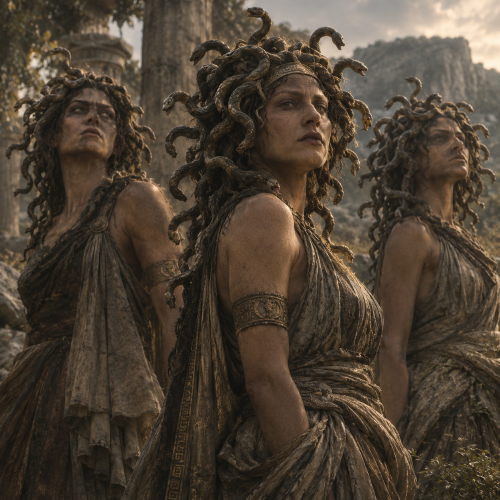
The Gorgons are among the most recognisable and feared creatures in Greek mythology. Known for their terrifying faces, serpentine hair, and supernatural powers, these monstrous sisters could inspire such fear that their gaze was associated with turning living beings into stone. Although Medusa is often used interchangeably with the word Gorgon, she was actually one of three sisters: Medusa, Stheno, and Euryale.
Their stories occupy an unusual position in Greek mythology, combining monstrous appearances, divine ancestry, heroic adventures, and protective symbolism. Medusa became particularly famous through her encounter with Perseus, who was tasked with bringing back her severed head. Yet the Gorgons were more than obstacles for ancient heroes. Their frightening faces became protective symbols known as gorgoneia, appearing on temples, shields, armour, pottery, and personal ornaments.
Understanding the Gorgons means looking beyond Medusa’s famous defeat to explore the mythology, artistic traditions, and cultural beliefs that made these figures enduring symbols of fear and protection.
Physical Description
Ancient Greek representations of the Gorgons varied considerably, but their appearance was generally designed to inspire terror. Early artistic depictions commonly showed them as female creatures with broad faces, enormous staring eyes, protruding tongues, sharp teeth, and sometimes tusks. Some representations also gave them wings, claws, and other animal-like characteristics.
Their most recognisable feature became their snake-covered hair. However, the familiar image of Medusa with living serpents replacing her hair developed gradually and became particularly prominent in later artistic and literary traditions. The Gorgons were also associated with a terrifying supernatural ability: petrification. Their gaze could turn living creatures into stone, making a direct encounter potentially fatal. This explains why Perseus approached Medusa without looking directly at her, using the reflective surface of Athena’s shield to guide his attack.
Their appearance evolved alongside Greek artistic conventions. During the Archaic period, Gorgons were frequently represented as grotesque, exaggerated monsters. Classical artists increasingly portrayed Medusa with more human and sometimes beautiful features while retaining the unsettling qualities that distinguished her from ordinary women. This transformation demonstrates how Greek artists explored the relationship between beauty, monstrosity, and fear.
Mythological Context
The Gorgons belonged to an ancient family of supernatural beings associated with the primordial forces of the natural world. According to Hesiod’s Theogony, they were daughters of Phorcys and Ceto, two ancient sea deities whose descendants included several dangerous and unusual creatures. Hesiod placed the sisters beyond Oceanus, near the distant western boundaries of the known world. Such locations frequently appeared in Greek mythology as homes for extraordinary beings existing beyond familiar human territories.
Their most famous myth concerns Perseus, the son of Zeus and Danaë. King Polydectes sent the young hero to retrieve Medusa’s head, believing the task would be impossible. Perseus received assistance from Athena and Hermes, along with magical equipment that helped him reach the Gorgons. Finding the sisters asleep, Perseus approached Medusa while looking at her reflection in Athena’s polished shield. He then severed her head without meeting her deadly gaze. The encounter did not end Medusa’s influence. Her severed head retained its supernatural power, allowing Perseus to turn enemies into stone. He eventually presented it to Athena, who placed the Gorgon’s image upon her protective aegis.
Origins
The origins of the Gorgons developed through several stages of Greek literary and artistic tradition. Homer’s Iliad already refers to the terrifying Gorgon head displayed on Zeus’s aegis. The Odyssey also mentions a Gorgon in connection with the underworld, although Homer does not provide the familiar story of Medusa and Perseus. Hesiod’s Theogony offers one of the earliest surviving accounts of the three sisters. It identifies Stheno, Euryale, and Medusa as daughters of Phorcys and Ceto, establishing their place within the genealogy of Greek primordial beings.
Their representation in ancient art provides another important perspective. Gorgon imagery became particularly prominent during the Archaic period, appearing on architectural decorations, pottery, armour, and other objects. Some scholars have also investigated possible connections between Gorgon imagery and earlier Near Eastern protective figures, although the precise origins of these visual traditions remain debated. The Gorgon therefore emerged through an evolving combination of literary mythology, religious symbolism, and artistic imagination rather than from a single definitive origin story.
Notable Members
Greek mythology identifies three principal Gorgons, each with a distinct place in the family. Medusa is the most famous and the only mortal sister. Her encounter with Perseus established her central position in Greek heroic mythology. Following her beheading, the winged horse Pegasus and the warrior Chrysaor emerged from her body. Both were fathered by Poseidon, according to Hesiod’s account. Stheno was one of the immortal sisters. Her name is commonly associated with strength, and she is generally presented as a formidable figure who survived Medusa’s death.
Euryale was the other immortal sister. Her name is associated with ideas of wide movement or expansiveness, although its precise interpretation is debated. Later traditions describe her anguished cries following Medusa’s death, particularly in connection with the hero’s escape. The distinction between mortality and immortality is important. Perseus could defeat Medusa because she was mortal, but Stheno and Euryale remained beyond the reach of ordinary human violence.
Relationship with Other Beings
The Gorgons were connected to a much wider family of extraordinary creatures through their parents, Phorcys and Ceto. Their mythological relatives included the Graeae, three sisters who shared a single eye and tooth, and other monstrous beings whose genealogies vary between ancient sources.
The Graeae are particularly important because they appear in Perseus’s quest. The hero sought information from the sisters and obtained knowledge that helped him locate Medusa. Medusa’s relationship with Poseidon also connects the Gorgons to the wider divine world. According to Hesiod, Poseidon lay with Medusa in a meadow, and Pegasus and Chrysaor emerged when Perseus severed her head.
Athena and Hermes played equally important roles in the story by assisting Perseus. Athena’s connection continued after Medusa’s death when the goddess incorporated the Gorgon head into her aegis. These relationships show that the Gorgons were not isolated monsters but participants in an interconnected mythological world of gods, heroes, primordial beings, and supernatural creatures.
Similar Beings
Greek mythology contains several female monsters that share characteristics with the Gorgons. The Graeae, their mythological relatives, are perhaps the closest comparison because they also appear as a supernatural group of sisters associated with the distant boundaries of the world. The Harpies combine female and bird-like characteristics, while the Sirens use their enchanting songs to lure sailors towards destruction. The Sphinx, another hybrid creature, guards knowledge through riddles and presents a dangerous challenge to those who encounter her.
Echidna is another interesting comparison. Described as a creature combining female and serpentine features, she occupies a similar position among the monstrous beings of Greek mythology. Despite these similarities, the Gorgons possess a distinctive characteristic: their terrifying power is associated with sight. While other creatures threaten humans through physical attacks, deception, or supernatural influence, the Gorgons represent the danger of confronting something whose very appearance can destroy the observer.
Symbolism and Interpretations
The Gorgons represent one of the most interesting contradictions in Greek mythology. Although their appearance and supernatural abilities inspired terror, their images were frequently used to provide protection. The severed head of Medusa, known as the gorgoneion, became an important apotropaic symbol. The term describes an image intended to ward off evil or repel harmful influences. Ancient Greeks placed Gorgon faces on shields, temples, pottery, jewellery, and architectural decorations. The frightening image was believed to confront danger with an equally terrifying force.
The Gorgons also symbolised the boundary between life and death. Their petrifying gaze transformed living beings into lifeless stone, representing the destructive consequences of encountering supernatural power. Medusa’s story has acquired additional interpretations over time. In Ovid’s Metamorphoses, a Roman literary retelling, Medusa is described as a beautiful maiden whose encounter with Neptune in Minerva’s temple leads to her transformation, with Minerva changing her hair into snakes. This account differs from earlier Greek traditions and should not be treated as the original version of her story.
Modern interpretations frequently examine Medusa through themes of female power, victimisation, injustice, and resistance. Her transformation from a vulnerable woman into a feared monster has made her an especially significant figure in contemporary discussions of gender and power.
Modern Influence
The Gorgons continue to influence literature, cinema, television, video games, fashion, and contemporary art. Medusa, in particular, has become one of the most recognisable figures from Greek mythology, with interpretations ranging from terrifying antagonist to misunderstood survivor. Her image has also entered commercial culture. The fashion house Versace famously adopted the Medusa head as its emblem, drawing upon its associations with beauty, fascination, power, and recognition.
Contemporary writers and artists have increasingly revisited Medusa’s story from perspectives that challenge traditional portrayals of her as a simple monster. Feminist interpretations often present her as a symbol of female agency, resistance, and the reclamation of identity. The wider Gorgon tradition also remains important in the study of ancient Greek art. The gorgoneion demonstrates how an image associated with fear could become an instrument of protection, revealing the complex relationship between mythology, religious belief, and visual culture.
More than two millennia after their appearance in surviving Greek literature, the Gorgons remain powerful cultural figures. Their mythology demonstrates that a creature feared as a monster could also become a guardian, and that the story of Medusa was never simply about a hero defeating a terrifying enemy.

Sources
Encyclopaedia Britannica, “Gorgon.” https://www.britannica.com/topic/Gorgon
Theoi Project, “Gorgones & Medousa.” https://www.theoi.com/Pontios/Gorgones.html
Encyclopaedia Britannica, “Medusa.” https://www.britannica.com/topic/Medusa-Greek-mythology
Journal of Ancient History and Archaeology, “Gorgoneion and Gorgon-Medusa: A Critical Research Review.” https://jaha.org.ro/index.php/JAHA/article/view/741
Hesiod, Theogony, translated by Hugh G. Evelyn-White, Loeb Classical Library, Harvard University Press, 1914.
Ovid, Metamorphoses, translated by Frank Justus Miller, Loeb Classical Library, Harvard University Press, 1916.
Apollodorus, The Library of Greek Mythology, translated by Robin Hard, Oxford University Press, 1997.
Kathryn Topper, “Perseus, the Maiden Medusa, and the Imagery of Abduction,” Hesperia 76, no. 1 (2007): 73–105. https://www.ascsa.edu.gr/index.php/publications/hesperia/article/76/1/73-105
Frequently Asked Questions
Who were the three Gorgons in Greek mythology?
The three Gorgons were Medusa, Stheno, and Euryale. They were daughters of Phorcys and Ceto, with Medusa being mortal and her two sisters immortal.
What powers did the Gorgons possess?
The Gorgons were associated with supernatural abilities, particularly a terrifying gaze that could turn living creatures into stone. Medusa was the most famous bearer of this power.
Why was Medusa different from the other Gorgons?
Medusa was the only mortal Gorgon. Her sisters, Stheno and Euryale, were immortal, making her uniquely vulnerable to Perseus, who eventually beheaded her.
What happened to Medusa after Perseus killed her?
Pegasus and Chrysaor emerged from Medusa’s body after her beheading. Perseus retained her powerful head, which could still turn enemies into stone.
What did the Gorgon symbol represent in ancient Greece?
The Gorgon head, known as the gorgoneion, was a protective symbol believed to ward off evil. It appeared on ancient Greek shields, temples, pottery, armour, and jewellery.


