


Arsay : The Mysterious Earth Goddess of Ugaritic Traditions
Listen
At a glance
| Description | |
|---|---|
| Origin | Ugaritic Mythology |
| Classification | Gods |
| Family Members | Baal (Father), Pidray, Tallay (Siblings) |
| Region | Syria |
| Associated With | Earth, Fertility, Agricultural renewal |
The Mythlok Perspective
In Mythlok’s Perspective, Arsay is fascinating precisely because she refuses to fit neatly into modern mythology categories. Unlike famous earth goddesses such as Gaia or Prithvi, Arsay is never fully explained in the surviving texts, making her one of mythology’s greatest puzzles. Her quiet presence beneath the grandeur of Baal’s legends reminds us that ancient civilizations also revered the unseen forces that sustained life. Rather than celebrating dramatic battles or heroic victories, Arsay represents the hidden foundations of existence, the fertile earth, concealed waters, and mysterious powers that make renewal possible. Sometimes, the most enduring myths are those that leave us with questions instead of answers.
Arsay
Introduction
Among the many deities of Ugaritic mythology, Arsay remains one of the most intriguing and least understood. Unlike famous gods such as Baal, Anat, or El, she rarely takes centre stage in surviving myths. Yet the few references to her reveal a goddess who occupied an important place within the divine world of ancient Ugarit. Her name appears in the Baal Cycle, a collection of mythological poems discovered at Ras Shamra in modern-day Syria, where she is consistently associated with Baal and his daughters.
What makes Arsay fascinating is the mystery surrounding her. Ancient texts never provide a detailed account of her personality or deeds, leaving scholars to reconstruct her role from scattered references in myths, ritual texts, and divine lists. Most researchers agree that her name is connected to the Ugaritic word for “earth” or “underworld,” suggesting a close relationship with the fertile ground beneath the surface. Others propose that she may have represented subterranean waters that nourished crops during dry seasons, while some interpret her as a chthonic goddess connected to the hidden forces of nature.
Rather than being remembered for heroic battles or dramatic adventures, Arsay represents one of the quieter but equally essential aspects of the ancient cosmos. She embodies the unseen world beneath human feet, reminding us that life depends not only on storms and sunlight but also on the mysterious powers hidden within the earth itself. Although much about her remains uncertain, her presence offers a valuable glimpse into how the people of Ugarit understood fertility, renewal, and the natural balance that sustained their civilization.
Physical Traits
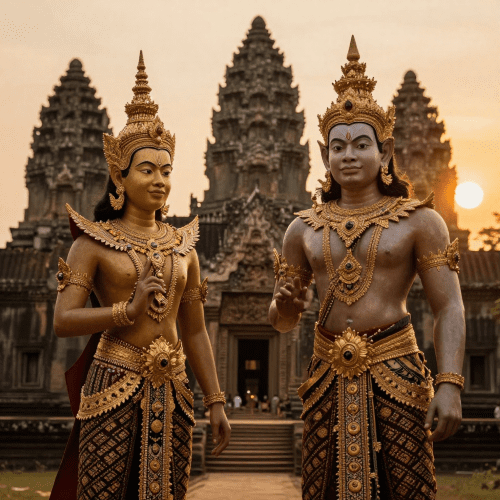
No surviving text or archaeological discovery tells us what Arsay looked like. Unlike Baal, whose images appear on stelae and reliefs, Arsay has never been identified in Ugaritic art with certainty. The literary texts are equally silent, describing neither her clothing nor her appearance.
This absence is not unusual in ancient Near Eastern mythology. Many Ugaritic gods are characterised through their actions, titles, and relationships rather than detailed physical descriptions. As a result, any modern illustration showing Arsay as a beautiful maiden, an earth mother, or an underworld queen is an artistic interpretation rather than a reconstruction based on historical evidence.
Even without visual descriptions, her name provides an important clue to her symbolic identity. Derived from the Ugaritic word ‘arṣ, meaning “earth” and sometimes “underworld,” it suggests that she represented the hidden, fertile, and life-sustaining qualities of the land. Instead of being defined by physical beauty, Arsay’s identity seems rooted in the natural world itself.
Modern depictions often portray her standing among mist-covered landscapes, emerging from rocky terrain, or surrounded by springs and underground waters. While these images are imaginative rather than historical, they capture the scholarly view that Arsay belonged to the mysterious spaces where earth, moisture, and renewal met beneath the surface.
Family
Arsay is generally recognised as one of the daughters of Baal, the powerful storm and fertility god of Ugaritic mythology. In the Baal Cycle, she appears alongside Pidray and Tallay, two sisters whose names are commonly translated as “Misty” and “Dewy.” Together, the three form a closely connected group within Baal’s divine household.
The surviving texts never identify Arsay’s mother. Although Baal is associated elsewhere with goddesses such as Anat and Ashtart, no Ugaritic source explicitly names either of them as Arsay’s parent. Because of this silence, modern scholars avoid assigning her a mother based on speculation.
The three sisters appear together in several passages of the Baal Cycle, suggesting that they represented complementary aspects of the natural world. Tallay is associated with dew, Pidray with mist or clouds, while Arsay appears linked to the earth or hidden moisture beneath it. Although the texts never explain this relationship in detail, the grouping reflects how the ancient Ugaritians viewed different elements of nature as interconnected expressions of divine power.
Arsay also appears in ritual offering lists, demonstrating that she was more than simply a literary character. She received worship alongside other members of the Ugaritic pantheon, indicating that devotees regarded her as an active participant in their religious life rather than a minor figure mentioned only in mythological poetry.
Other names
Arsay’s name is written in Ugaritic as ʾarṣy, a word most scholars connect with ʾarṣ, meaning “earth.” Depending on the context, the same root can also refer to the underworld, giving her name multiple layers of meaning. For this reason, modern researchers sometimes translate Arsay as “Earthy” or “She of the Earth,” though these remain scholarly interpretations rather than official ancient titles.
She also bears the epithet bt yʿbdr, traditionally translated as “daughter of yʿbdr.” The meaning of yʿbdr is one of the most debated aspects of her mythology. Some scholars interpret it as referring to abundant or flowing waters, while others associate it with broad earth or rain-bearing forces. Because the ancient language remains imperfectly understood, no single translation has achieved universal acceptance.
Some comparative studies have noted similarities between Arsay and the Mesopotamian underworld goddess Allatum. However, this comparison reflects modern scholarship rather than evidence that ancient Ugaritians identified the two goddesses as the same deity. It is therefore best understood as an interpretive tool rather than an alternative name for Arsay.
These uncertain titles reflect a broader truth about Arsay herself. Rather than presenting a clearly defined goddess with a long list of attributes, the surviving evidence leaves room for interpretation, making her one of the most enigmatic members of the Ugaritic pantheon.
Powers and Abilities
Unlike many mythological gods, Arsay is never described performing dramatic feats or wielding supernatural weapons. The surviving texts instead hint at her importance through symbolism and association, allowing scholars to infer her possible domains of influence.
Her strongest connection is with the earth itself. Since her name derives from the Ugaritic word for earth, researchers generally believe she represented the fertile ground that sustained agriculture. This interpretation fits well within Ugarit’s farming society, where the health of the soil determined the prosperity of entire communities.
Some scholars also associate Arsay with underground springs and hidden waters. In this interpretation, she complements her sisters Tallay and Pidray by representing moisture stored beneath the earth rather than rain, mist, or dew. Although no surviving myth explicitly states this function, it provides a coherent explanation for her place within Baal’s family and the agricultural symbolism of the Baal Cycle.
Another widely discussed theory links Arsay with the underworld. This idea is based largely on the meaning of her name and later comparisons with other Near Eastern deities rather than direct statements in Ugaritic texts. Consequently, most modern scholars treat her underworld role as a possibility rather than an established fact.
Arsay also appears in ritual contexts, suggesting she played a recognised role in religious ceremonies. While the texts never explain the specific blessings she granted, her inclusion in offerings indicates that worshippers believed she possessed divine influence worthy of honour and devotion.
Taken together, these fragments portray Arsay as a goddess whose power lay not in warfare or spectacle but in the unseen processes that sustained life. She represents the hidden earth, nourishing moisture, and quiet forces that allowed crops to grow and civilizations to flourish.
Modern Day Influence
Although Arsay never achieved the modern popularity of gods like Baal or Anat, she continues to attract the attention of historians, archaeologists, and comparative mythologists. Every new study of the Baal Cycle contributes to a deeper understanding of her place within the religious landscape of Late Bronze Age Ugarit.
Her greatest modern significance lies in academic research. Because so little is known about her, Arsay serves as an important example of how scholars reconstruct ancient religions using fragmentary evidence. Discussions surrounding her identity often explore the relationship between earth, fertility, underground water, and the underworld across the wider ancient Near East.
Arsay also appears in reference books, mythology databases, and educational websites that document lesser-known deities from world mythology. Although she rarely features in mainstream novels, films, or television, her mysterious nature has inspired occasional appearances in fantasy settings and independent creative works that draw upon ancient Near Eastern traditions.
For enthusiasts of mythology, Arsay represents something increasingly valuable: a reminder that not every ancient deity fits neatly into modern categories. Her story demonstrates that many gods were deeply connected to local landscapes, seasonal cycles, and regional religious practices that cannot always be fully reconstructed thousands of years later.
In many ways, Arsay’s greatest legacy is the mystery she preserves. She stands as a symbol of how much has survived from the ancient world—and how much has been lost—encouraging continued exploration of one of humanity’s oldest mythological traditions.
Related Images





Source
Day, J. (2002). Pidray, Tallay and Arsay in the Baal Cycle. Journal of Northwest Semitic Languages. https://journals.co.za/doi/abs/10.10520/EJC101278
Rahmouni, A. (2008). Divine epithets in the Ugaritic alphabetic texts. Brill. https://brill.com/display/book/9789004275256/B9789004275256-s005.xml
Smith, M. S. (2008). The Ugaritic Baal Cycle (Vols. 1–2). Brill.
Tugendhaft, A. (2017). Baal and the Politics of Poetry. Oxford University Press.
Walls, N. H. (1992). The Goddess Anat in Ugaritic Myth. Society of Biblical Literature.
Britannica. (2025). Ugarit summary. https://www.britannica.com/summary/Ugarit
Britannica. (1998). Ugarit: Syria, map, history, & tablets. https://www.britannica.com/place/Ugarit
Wikipedia contributors. (2026). Arsay. Wikipedia. https://en.wikipedia.org/wiki/Arsay
Frequently Asked Questions
Who is Arsay in Ugaritic mythology?
Arsay is a goddess from Ugaritic mythology who appears in the Baal Cycle. She is generally regarded as one of Baal’s daughters and is associated with the earth, hidden moisture, and possibly the underworld.
What is Arsay the goddess of?
The ancient texts never explicitly define Arsay’s domain. Most scholars believe she was connected with the earth and subterranean waters, while others suggest she may have had associations with fertility
Who are Arsay's parents?
Arsay is identified in the Baal Cycle as a daughter of Baal. The surviving Ugaritic texts do not name her mother, making her maternal lineage unknown.
Is Arsay an underworld goddess?
Possibly, but it is not certain. Her name can be interpreted as relating to the earth or underworld, leading some scholars to propose that she had chthonic associations.
Why is Arsay important in Ugaritic mythology?
Although she plays a relatively small role in surviving myths, Arsay provides valuable insight into how the people of ancient Ugarit understood fertility, the earth, and the hidden natural forces that supported agriculture.


