


Prithvi : The Divine Mother Earth of Indian Tradition
At a glance
| Description | |
|---|---|
| Origin | Indian Mythology |
| Classification | Gods |
| Family Members | Dyaus Pita (Husband) |
| Region | India |
| Associated With | Earth, Fertility, Nature, Nourishment, Agriculture |
The Mythlok Perspective
In Mythlok’s Perspective, Prithvi is one of the most profound deities in Hindu mythology because she represents a truth that every civilization depends upon yet often overlooks. Unlike warrior gods who demonstrate power through conquest, Prithvi embodies a quieter form of strength—the ability to nurture, endure, and sustain life despite endless demands. Her myths remind us that the Earth is not merely a resource to be consumed but a living force deserving gratitude and protection. In many ways, Prithvi serves as the moral foundation of Hindu cosmology, teaching that prosperity and survival are only possible when humanity remains in harmony with the world that supports it.
Prithvi
Introduction
Prithvi (Sanskrit: पृथ्वी, Pṛthvī) is the personification of Earth in Hindu mythology and one of the oldest deities mentioned in the Vedas. Revered as Mother Earth, she represents fertility, nourishment, stability, and the physical foundation upon which all life exists. Her name is often interpreted as “the Broad One” or “the Vast One,” reflecting the immense and life-supporting nature of the Earth itself.
In the Rigveda, Prithvi frequently appears alongside Dyaus Pita, the Sky Father, forming the divine pair known as Dyava-Prithivi—Heaven and Earth. Together, they symbolize the cosmic balance that sustains creation. While early Vedic hymns celebrate her as a nurturing mother who supports all living beings, later Puranic traditions expand her role and identify her with Bhudevi, one of the principal consorts of Lord Vishnu.
Prithvi occupies a unique place in Hindu thought because she is both a goddess and the living world itself. Mountains, forests, rivers, fields, and every form of terrestrial life are considered manifestations of her divine presence. Through countless myths and religious traditions, she remains a powerful symbol of patience, generosity, and endurance.
Physical Traits
Unlike many Hindu deities who possess elaborate iconography from the earliest scriptures, Prithvi was initially described in broad cosmic terms. Vedic texts portray her as vast, expansive, and capable of supporting all creatures, emphasizing her role as the ground of existence rather than focusing on a specific physical appearance.
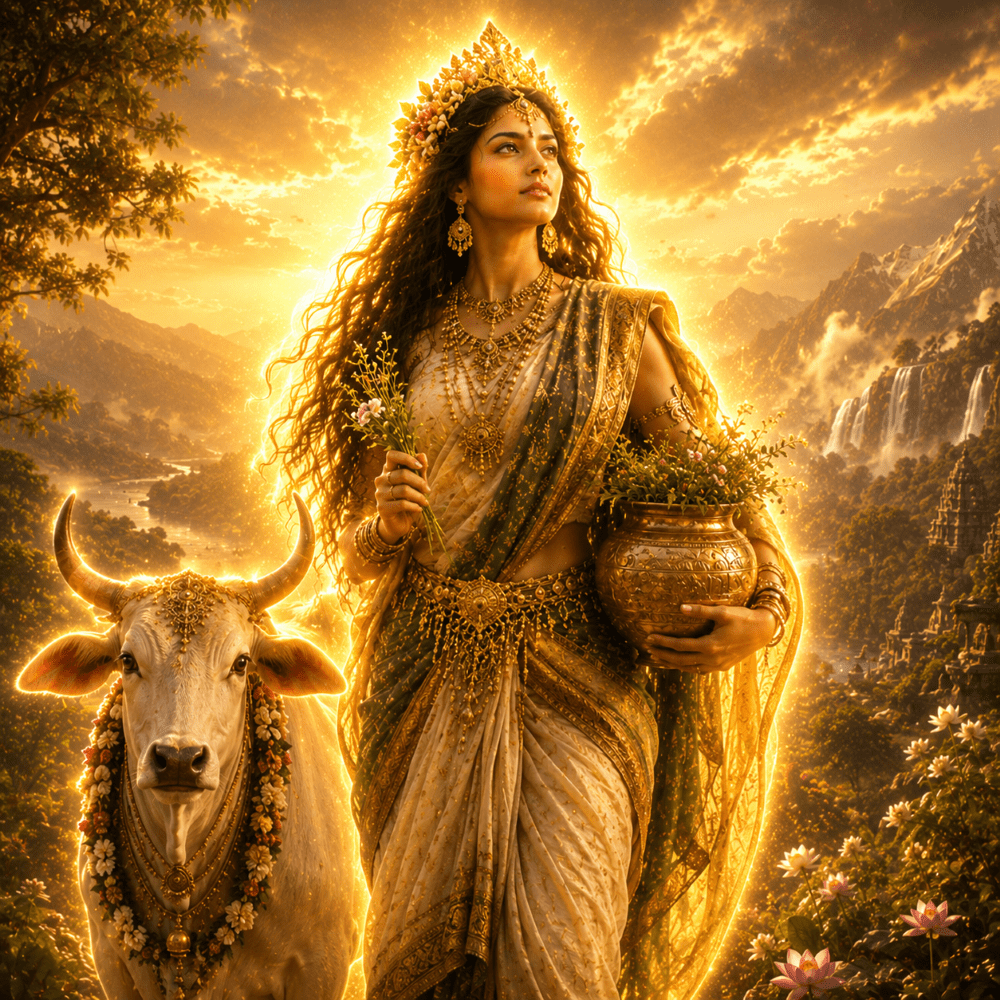
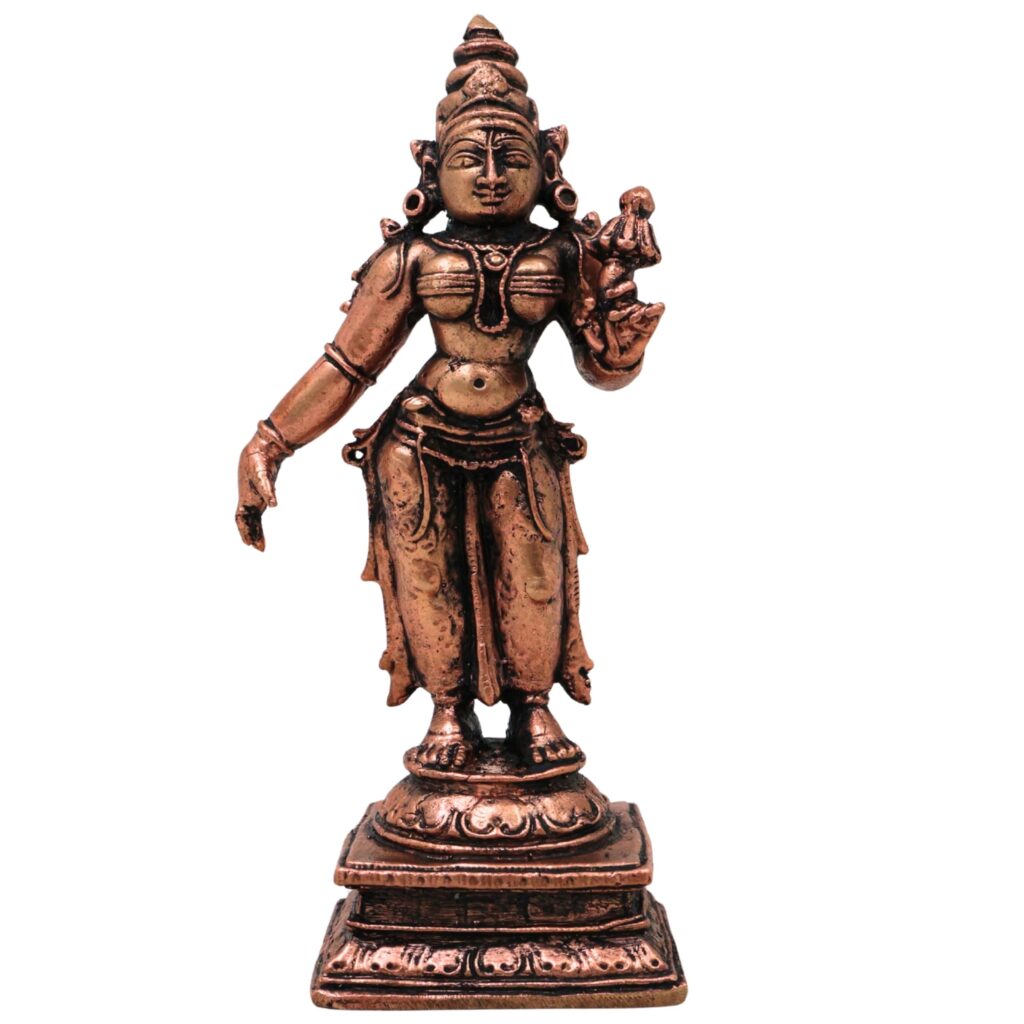
In later Hindu art and temple traditions, Prithvi is often depicted as a beautiful goddess dressed in green, brown, or golden garments that symbolize vegetation, soil, and prosperity. She may hold a lotus, a vessel of abundance, or gestures of blessing that reflect her nurturing nature.
One of her most enduring symbols is the sacred cow. Several myths describe the Earth taking the form of a cow, particularly in stories involving King Prithu. In these narratives, the cow represents fertility, nourishment, and the Earth’s ability to provide resources for humanity. This imagery reinforces the idea that the Earth continuously sustains life through her generosity. As Bhudevi, she is commonly portrayed standing beside Lord Vishnu, emphasizing her role as the divine embodiment of the earthly realm.
Family
Prithvi belongs to the oldest layer of Hindu cosmology and is closely associated with the primordial forces that shaped the universe. In Vedic tradition, her counterpart is Dyaus Pita, the Sky Father. Together they form the cosmic parents from whom many divine beings emerge. Ancient hymns regard Heaven and Earth as the foundational forces that gave rise to life and order.
Various Vedic sources associate several deities with this celestial pair, including Agni, the god of fire; Indra, king of the gods; Ushas, goddess of dawn; and other divine beings connected to natural phenomena. However, genealogies vary across different texts and traditions.
In later Hindu mythology, Prithvi becomes identified with Bhudevi, one of the consorts of Lord Vishnu alongside Sridevi. This association becomes particularly important in Vaishnavism, where Vishnu repeatedly protects and restores the Earth whenever cosmic balance is threatened.
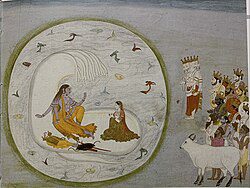
A significant myth links her to King Prithu, a legendary ruler regarded as an avatar or empowered king associated with Vishnu. According to the Puranas, Prithu pursued the Earth when she withheld her resources from humanity. After convincing her to nourish the world again, he established order and prosperity. The Earth subsequently became known as Prithvi in his honor.
Other names
Throughout Hindu literature, Prithvi is known by several names that emphasize different aspects of her divine nature. Bhumi and Bhudevi are among the most common names, referring to her as the sacred Earth goddess and the earthly manifestation of divine power.
Dharani means “the bearer” or “the supporter,” highlighting her role in sustaining all forms of existence. Vasudha translates to “the giver of wealth,” recognizing the Earth’s ability to provide minerals, crops, and resources essential for life.
Medini refers to fertile land and agricultural abundance, reflecting her connection with prosperity and growth. Prithvi Mata, meaning “Mother Earth,” remains one of the most widely used devotional titles. It expresses the enduring belief that all living beings are children of the Earth and depend upon her generosity. These names collectively reveal the many dimensions of Prithvi’s identity, from cosmic mother and divine sustainer to provider of wealth and fertility.
Powers and Abilities
Prithvi’s powers are fundamentally tied to her role as the living Earth. Rather than wielding weapons or engaging in dramatic battles, her strength lies in sustaining creation and maintaining stability throughout the cosmos. Her most important ability is nourishment. Every crop, forest, river, and ecosystem is considered an expression of her life-giving energy. Through this power, she supports both humanity and the gods.
Prithvi is also associated with fertility and abundance. Agricultural prosperity, healthy harvests, and the renewal of life are traditionally viewed as blessings that arise from her presence. This connection made her especially important in ancient agrarian societies. Another significant aspect of her power is endurance. Hindu texts frequently portray her as patient and compassionate, capable of bearing immense burdens while continuing to sustain life. This quality makes her a symbol of resilience and selfless service.
In Puranic mythology, she possesses the ability to assume different forms, most famously transforming into a cow. This shape-shifting ability allows her to protect herself and communicate her needs to gods and humans alike. As the embodiment of the earth element among the Panchamahabhutas (Five Great Elements), Prithvi also represents solidity, structure, and permanence. Every physical form depends upon her elemental essence.
Modern Day Influence
Prithvi continues to hold deep cultural and spiritual significance in modern India. Her influence extends beyond religion into environmental awareness, national identity, and contemporary symbolism. Many Hindu rituals begin with prayers seeking forgiveness from Mother Earth before stepping on the ground. This practice reflects the enduring belief that the Earth is sacred and worthy of respect.
Environmental movements frequently invoke Prithvi as a symbol of ecological responsibility. Her image serves as a reminder that humanity’s well-being is inseparable from the health of the natural world. Scholars often point to Vedic hymns dedicated to Earth as early examples of environmental consciousness.
Her legacy also appears in modern science and defense. India’s Prithvi missile series, among the country’s earliest indigenous ballistic missile programs, was named after the Earth goddess, reflecting concepts of strength, stability, and territorial protection. In literature, education, and public discourse, Prithvi remains a powerful representation of sustainability, balance, and humanity’s connection to nature. Thousands of years after her first appearance in the Vedas, she continues to inspire reverence for the planet that sustains all life.
Related Images





Source
Akhilesh Sabharwal. (2013, February 10). Dyaus and Prithvi – Sky and Earth. Retrieved June 16, 2026, from https://asabharwal.com/dyaus-and-prthivi-sky-and-earth/
Dyaus. (n.d.). Wikipedia. Retrieved June 16, 2026, from https://en.wikipedia.org/wiki/Dyaus
Jansankalp Foundation. (n.d.). Prithvi. Jansankalp. Retrieved June 16, 2026, from https://jansankalp.org/docs/trinity/origins-of-gods/prithvi/
Prithvi. (n.d.). Wikipedia (French edition). Retrieved June 16, 2026, from https://fr.wikipedia.org/wiki/Prithvi
Prithvi (पृथ्वि). (2018, September 30). Vedic Science Blog. Retrieved June 16, 2026, from https://vedic.science.blog/prithvi/
Prithvi (missile). (n.d.). Wikipedia. Retrieved June 16, 2026, from https://en.wikipedia.org/wiki/Prithvi_(missile)
Kinsley, D. (1988). Hindu Goddesses: Vision of the Divine Feminine in the Hindu Religious Tradition. University of California Press.
O’Flaherty, W. D. (1975). Hindu Myths: A Sourcebook Translated from the Sanskrit. Penguin Classics.
Bhattacharyya, N. N. (1999). History of the Sakta Religion. Munshiram Manoharlal Publishers.
Frequently Asked Questions
Who is Prithvi in Hindu mythology?
Prithvi is the Hindu goddess who personifies Earth. She is one of the oldest deities mentioned in the Vedas and is revered as Mother Earth, the sustainer of all life.
Is Prithvi the same as Bhudevi?
Yes. In later Hindu traditions, especially Vaishnavism, Prithvi is commonly identified with Bhudevi, one of the consorts of Lord Vishnu.
Why is Prithvi associated with a cow?
The cow symbolizes fertility, nourishment, and abundance. Several myths describe Prithvi taking the form of a cow to provide resources and sustain humanity.
What are the powers of Prithvi?
Prithvi governs fertility, nourishment, stability, endurance, and prosperity. She sustains all living beings and represents the earth element in Hindu cosmology.
What is the significance of Prithvi today?
Prithvi remains a symbol of environmental stewardship, ecological balance, and humanity’s connection to nature. Her influence is visible in religious traditions, conservation efforts, and modern Indian culture.
