


Arianrhod : The Welsh Mother Whose Curses Shaped Her Son’s Destiny
At a glance
| Description | |
|---|---|
| Origin | Welsh Mythology |
| Classification | Gods |
| Family Members | Dôn (Father), Math fab Mathonwy (Uncle), Gwydion, Gilfaethwy (Brothers); Dylan ail Don, Lleu Llaw Gyffes (Sons) |
| Region | Wales |
| Associated With | Magical prohibitions, Childbirth, Motherhood, Family conflict, The Silver Wheel |
The Mythlok Perspective
In Mythlok’s Perspective, Arianrhod represents the complicated relationship between personal authority and the freedom of others to shape their own identities. Like Hera in Greek mythology, whose conflicts with members of her family influence the destinies of other figures, Arianrhod demonstrates how powerful women can become both agents of authority and sources of conflict. However, while Hera’s influence frequently emerges through divine status and vengeance, Arianrhod’s significance lies in the magical restrictions she places upon her son. Her story challenges the idea that power necessarily guarantees control, revealing how attempts to determine another person’s future can become obstacles that person must overcome.
Arianrhod
Introduction
Arianrhod is a prominent female figure in Welsh mythology, best known for her role in the Fourth Branch of the Mabinogi, a collection of medieval Welsh tales preserved in manuscripts such as the White Book of Rhydderch and the Red Book of Hergest. Daughter of Dôn and sister of the magician Gwydion, she becomes central to a story of unexpected childbirth, family conflict, magical prohibitions, and the struggle for identity.
Arianrhod is particularly remembered as the mother of Dylan ail Don and Lleu Llaw Gyffes. Although both children are born through extraordinary circumstances, their lives follow very different paths. Dylan becomes associated with the sea, while Lleu grows into a significant figure whose identity and future are repeatedly challenged by his mother.
Her name is commonly interpreted as meaning Silver Wheel, derived from the Welsh words arian, meaning silver, and rhod, meaning wheel. However, the earliest recorded forms of the name include Aranrhod and Aranrot, making this etymology uncertain. The interpretation has nevertheless become an important part of her modern identity, inspiring associations with celestial cycles, the moon, and the turning of time.
Arianrhod is sometimes described as a Welsh goddess of the moon, stars, or fate. These descriptions are popular in contemporary Pagan spirituality, but the medieval narrative does not explicitly assign her these divine domains. What the surviving story establishes more clearly is her magical influence, her complicated family relationships, and her ability to impose powerful restrictions on her son.
Physical Traits
The medieval account of Arianrhod provides little information about her physical appearance. Unlike some mythological figures whose defining features include extraordinary beauty, distinctive clothing, or supernatural transformations, Arianrhod is primarily characterised through her actions, ancestry, and relationships.
Her introduction occurs when Math fab Mathonwy, the ruler of Gwynedd, needs a new woman to serve as his footholder. Following the events involving Goewin, Gwydion recommends his sister Arianrhod for the position. Math then subjects her to a test involving his magical wand, an encounter that unexpectedly results in the birth of two children.
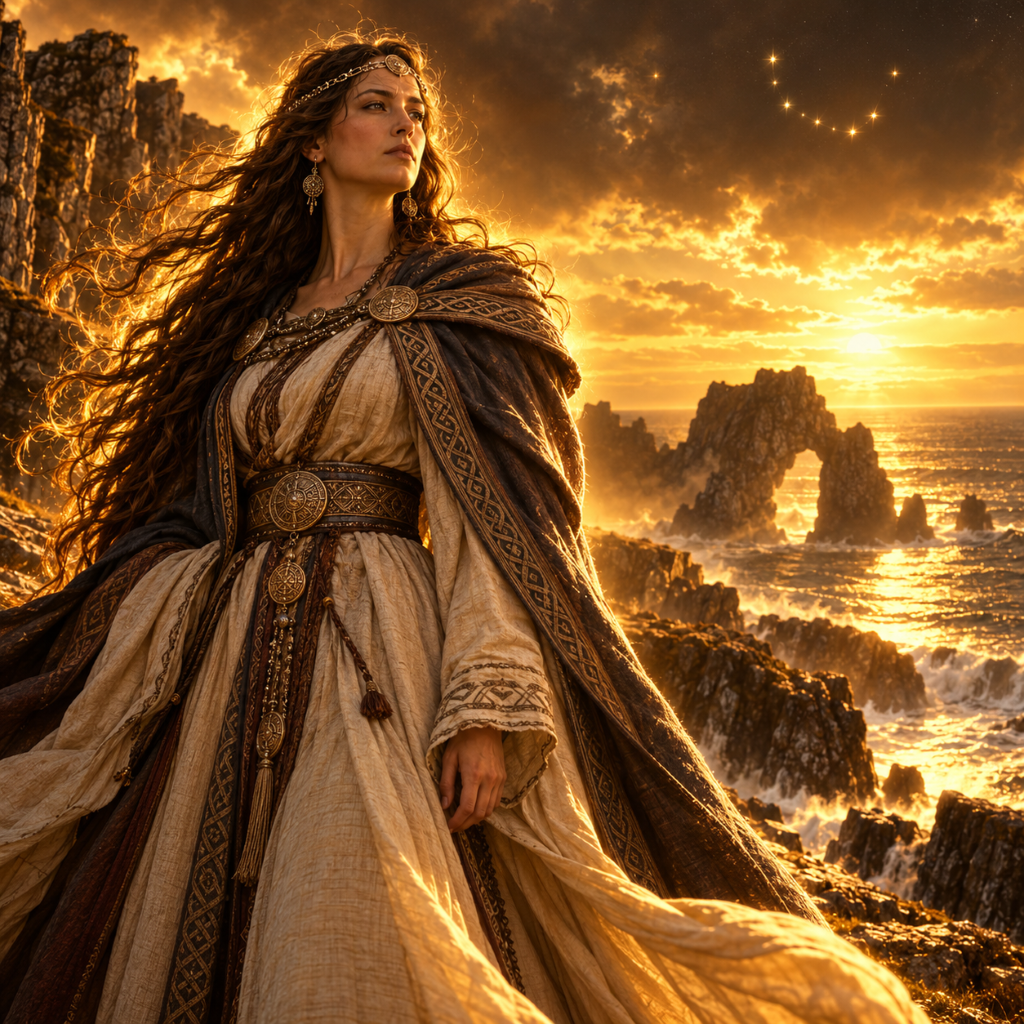
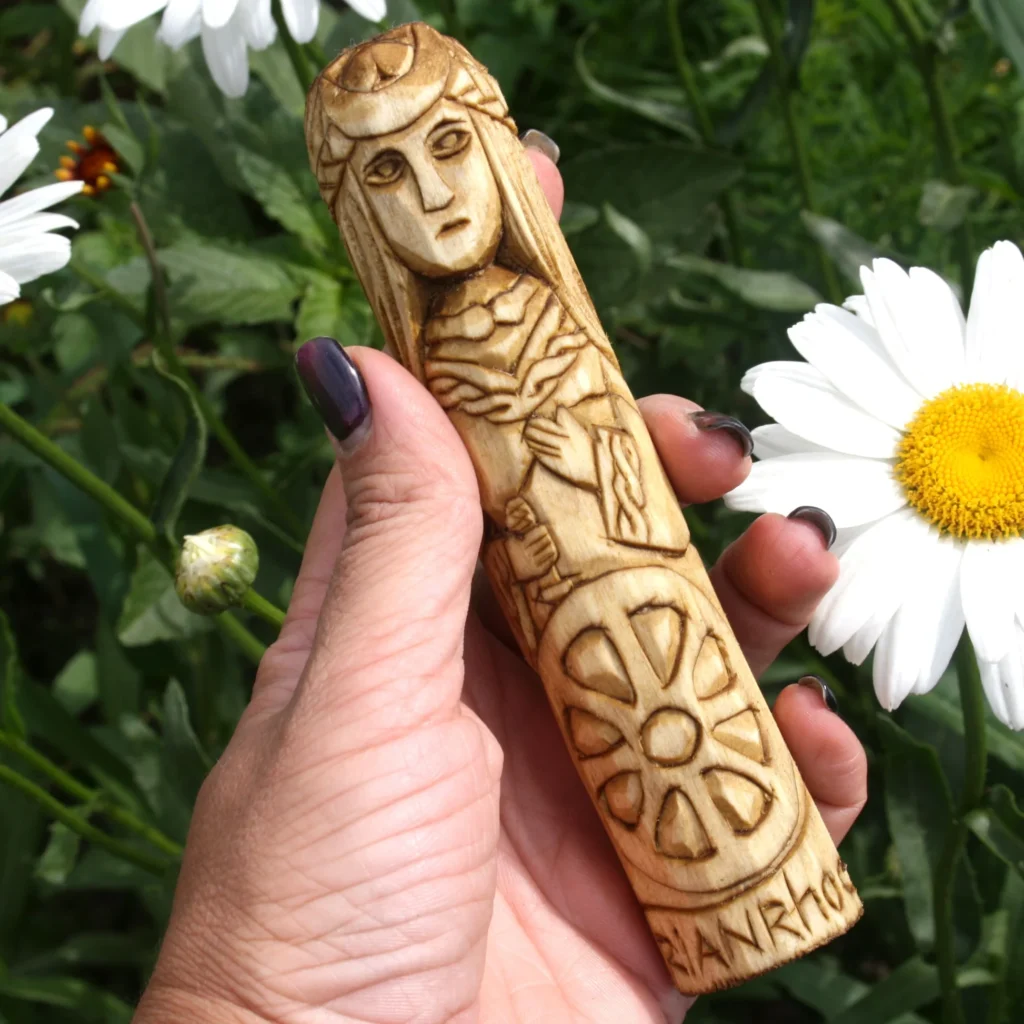
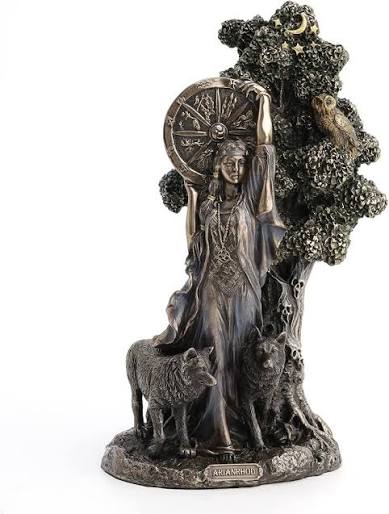
The narrative does not establish specific details about Arianrhod’s height, hair colour, eye colour, clothing, or other distinguishing physical features. Descriptions of her as a radiant, silver-haired woman surrounded by moonlight belong primarily to later artistic and spiritual interpretations. Her popular association with the Silver Wheel has nevertheless influenced how contemporary artists portray her. She is frequently imagined against star-filled skies, with silver garments and celestial symbols suggesting mystery, authority, and an otherworldly presence.
Family
Arianrhod belongs to the family of Dôn, a prominent ancestral figure in Welsh mythology. In the Fourth Branch of the Mabinogi, she is identified as Dôn’s daughter, Gwydion’s sister, and Math fab Mathonwy’s niece. Her family connections are particularly important because the conflict surrounding her children drives much of her role in the narrative.
Dôn is identified as Arianrhod’s parent in the Mabinogi. However, Welsh mythological traditions are not entirely consistent about her ancestry. Welsh Triad 35 associates Arianrhod with Beli Mawr instead, demonstrating that different strands of medieval Welsh tradition preserved alternative genealogies. The surviving evidence does not justify treating every version as part of one definitive family tree.
Gwydion, her brother, is a powerful magician whose decisions repeatedly influence the lives of Arianrhod and her children. He raises Lleu and uses his magical abilities to overcome the restrictions Arianrhod places upon him. Her two best-known children are Dylan ail Don and Lleu Llaw Gyffes. Dylan is born first during the incident involving Math’s wand. After receiving baptism, he immediately moves towards the sea, becoming closely associated with its waters. His story eventually ends when he is killed by his uncle Gofannon.
Lleu is the second child, initially concealed by Gwydion and subsequently raised by him. Unlike Dylan, Lleu’s story revolves around his struggle to obtain a name, weapons, and a wife despite his mother’s opposition. Arianrhod’s relationship with Lleu is especially significant because her magical prohibitions become obstacles that he must overcome before he can establish his identity and place in the world.
Other names
Arianrhod appears in Welsh mythological discussions under several spelling variations, including Aranrhod and Arianrod. Aranrot and Aryanrot are also recorded forms associated with the transmission of the name through medieval Welsh textual traditions. The variation between Arianrhod and Aranrhod is important when considering the popular translation Silver Wheel. Although the elements of the later form appear to support this interpretation, the earliest forms make the name’s original meaning uncertain.
The Silver Wheel remains the most familiar modern interpretation. It has become a powerful symbolic expression associated with Arianrhod’s perceived connections to celestial cycles, transformation, and the passage of time. Another prominent association is Caer Arianrhod, traditionally understood as Arianrhod’s fortress. The name is also associated with the constellation Corona Borealis, or the Northern Crown, in Welsh tradition.
Modern spiritual sources sometimes call Arianrhod a star goddess or lunar goddess. These descriptions reflect later interpretations of her mythological significance rather than explicit titles established in the Fourth Branch of the Mabinogi.
Powers and Abilities
Arianrhod’s supernatural influence in the Fourth Branch of the Mabinogi centres on extraordinary childbirth and her ability to impose binding magical prohibitions. Her powers are not presented as a systematic collection of abilities, but they become evident through the events surrounding her children. Her first extraordinary act occurs when she steps over Math’s magical wand. The encounter results in the immediate birth of Dylan and the emergence of a second child, who is taken away by Gwydion and later grows into Lleu.
Her most consequential actions involve the three tyngedau, or binding pronouncements, that she places upon Lleu. These declarations prevent him from receiving the privileges ordinarily associated with his identity and status unless they are fulfilled through her. First, she declares that Lleu will not receive a name unless she gives it to him. Gwydion eventually disguises himself and arranges circumstances in which Arianrhod unknowingly names her son. Second, she refuses to provide Lleu with weapons. Gwydion again uses disguise and deception to bring about a situation in which she arms her son without recognising him.
Third, Arianrhod declares that Lleu will never have a wife from any race then living on Earth. In response, Gwydion and Math use magic to create Blodeuedd from flowers, providing Lleu with a wife who does not originate from an existing earthly race. These episodes reveal Arianrhod’s capacity to shape the course of events through magical speech. However, her restrictions do not ultimately secure permanent control over Lleu’s future.
Her powers should not automatically be expanded to include every ability attributed to her in contemporary spiritual literature. The medieval narrative does not explicitly establish that she controls the moon, commands the stars, governs fate universally, or presides over the changing seasons.
Modern Day Influence
Arianrhod continues to inspire contemporary literature, fantasy, feminist criticism, and modern Pagan spirituality. Her story offers a complex character whose actions can be interpreted through questions of authority, motherhood, reputation, and personal autonomy. In some contemporary spiritual traditions, she is honoured as a goddess associated with the moon, stars, transformation, and the cycles of life. The Silver Wheel provides a particularly effective symbol for these interpretations, suggesting movement, continuity, and the relationship between individual lives and larger cosmic patterns.
These associations should be understood as part of her modern reception rather than as definitive evidence of an ancient Welsh religious tradition dedicated specifically to her. The surviving medieval narrative does not establish a historical cult centred on Arianrhod.
Her character has also attracted attention from writers who revisit Welsh mythology through feminist perspectives. Evangeline Walton’s The Island of the Mighty, part of her Mabinogi-inspired tetralogy, reimagines the traditional stories and develops characters whose motivations can be more complex than their medieval portrayals initially suggest. Academic discussions of Walton’s work examine how such adaptations reshape Arianrhod’s character and challenge conventional interpretations of her actions.
Arianrhod’s story is particularly relevant to contemporary discussions of women in mythology because it resists a simple division between benevolent mother figures and antagonists. She can be understood as a woman whose pride and refusal to acknowledge her son become central to his journey, while her actions also expose the social pressures surrounding sexuality, reputation, and family expectations.
Her name also survives in Welsh geographical and cultural associations. Caer Arianrhod refers to a coastal rock formation in north-west Wales that becomes visible under particular tidal conditions. The name is additionally associated with Corona Borealis in Welsh tradition, reinforcing the celestial imagery that surrounds her modern identity.
Related Images
Source
Bromwich, R. (2006). Trioedd Ynys Prydein: The Welsh Triads (3rd ed.). University of Wales Press. https://www.uwp.co.uk/book/trioedd-ynys-prydein/
Davies, S. (Trans.). (2007). The Mabinogion. Oxford University Press. https://global.oup.com/academic/product/the-mabinogion-9780192832429
Fran Wen. (2024, August 23). Pwy yw Arianrhod? [Who is Arianrhod?].
https://franwen.com/en/news/pwy-yw-arianrhod
Koch, J. T. (Ed.). (2006). Celtic culture: A historical encyclopedia. ABC-CLIO. https://www.abc-clio.com/products/a2404c/
Mysterious Britain & Ireland. (2008, September 15). Arianrhod. https://www.mysteriousbritain.co.uk/pantheons/arianrhod/
Parker, W. (2003). The Four Branches of the Mabinogi: Celtic myth and medieval reality. Bardic Press. https://www.bardicpress.com/
Wikipedia. (2026). Arianrhod. https://en.wikipedia.org/wiki/Arianrhod
Frequently Asked Questions
Who is Arianrhod in Welsh mythology?
Arianrhod is a prominent female figure in Welsh mythology who appears in the Fourth Branch of the Mabinogi. She is the mother of Dylan ail Don and Lleu Llaw Gyffes, whose destinies are shaped by her actions.
What does the name Arianrhod mean?
Arianrhod is traditionally interpreted as meaning Silver Wheel, combining Welsh elements associated with silver and a wheel. However, earlier spellings of her name make this etymology uncertain.
Who are Arianrhod's children?
Arianrhod’s best-known children are Dylan ail Don, associated with the sea, and Lleu Llaw Gyffes, a prominent figure in Welsh mythology. Both are born during the extraordinary incident involving Math’s magical wand.
What powers does Arianrhod have in Welsh mythology?
Arianrhod demonstrates magical influence through extraordinary childbirth and three binding prohibitions imposed on Lleu. These prevent him from receiving a name, weapons, or a wife without her involvement.
Is Arianrhod a moon goddess?
Arianrhod is often interpreted as a moon or star goddess in modern spiritual traditions. However, the medieval Mabinogi does not explicitly identify her as a lunar deity or establish her as the ruler of celestial cycles.


