


Amanozako : The Rebellious Goddess of Japanese Folklore
At a glance
| Description | |
|---|---|
| Origin | Japanese Mythology |
| Classification | Gods |
| Family Members | Susanoo (Parent), Amano-o/Amanosaku (Son) |
| Region | Japan |
| Associated With | Rebellion, Destruction, Uncontrollable rage, Strength |
The Mythlok Perspective
In Mythlok’s Perspective, Amanozako represents the disruptive side of divine power, where rebellion becomes an intrinsic part of one’s nature rather than a response to injustice. She shares an interesting parallel with Eris, the Greek goddess of discord, who could turn harmony into conflict through a single act of provocation. However, while Eris thrives on creating strife between others, Amanozako embodies defiance itself, making her a more personal expression of chaos and resistance to authority.
Amanozako
Introduction
Amanozako (天逆毎) is a formidable female supernatural being in Japanese folklore, associated with defiance, uncontrollable anger and opposition to divine authority. Unlike the better-known deities of Japanese tradition, whose stories often explore creation, harmony and the balance of the natural world, Amanozako represents the disruptive force that refuses to follow established rules. Her unusual birth, monstrous appearance and rebellious temperament make her one of the more distinctive figures in Japan’s supernatural traditions.
Amanozako is traditionally connected to Susanoo, the storm god, from whose violent spiritual energy she is said to have emerged. Her story appears in the Wakan Sansai Zue, an encyclopaedic work published around 1712, and she was subsequently illustrated by Toriyama Sekien in his 1779 collection, Konjaku Gazu Zoku Hyakki. Some accounts also associate her with the tengu and amanojaku, although these relationships developed through later interpretations rather than a universally accepted ancient tradition.
Amanozako is particularly interesting because her mythology does not present rebellion as an occasional response to injustice. Opposition is fundamental to her nature. She embodies a supernatural personality that instinctively challenges whatever others expect of her, making her a striking representation of disorder within Japanese folklore.
Physical Traits
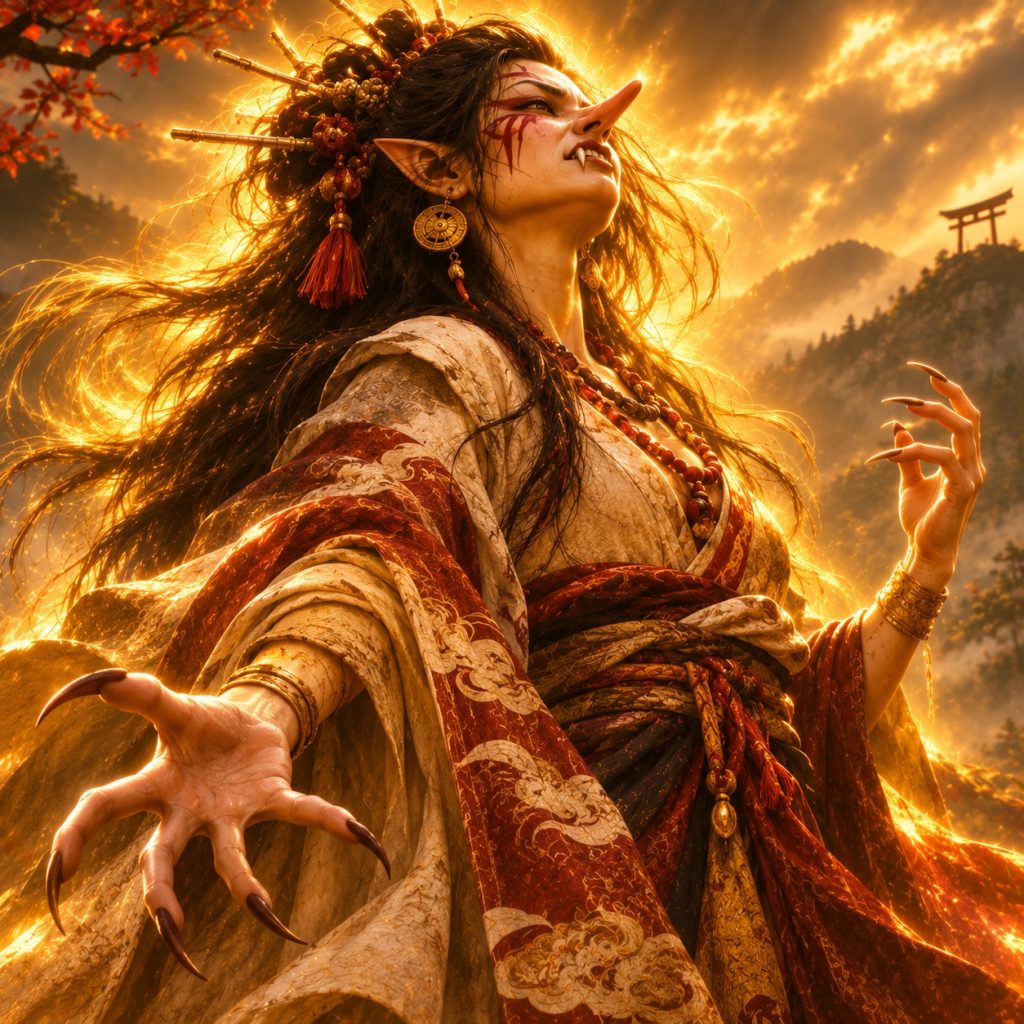
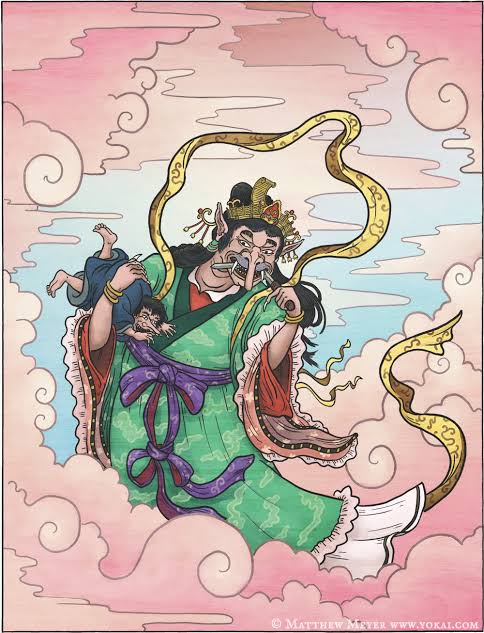
Amanozako is described as a monstrous female being with a combination of human and animal characteristics. Traditional descriptions give her a human-like body and a beast-like head, accompanied by a prominent nose, unusually long ears and formidable fangs. These features distinguish her from conventional depictions of Japanese goddesses and place her visually within the wider world of supernatural creatures.
Her elongated nose and unusual facial features are particularly significant because they resemble characteristics associated with tengu, the supernatural beings traditionally connected with mountains, forests and the spiritual world. However, Amanozako should not simply be considered a female tengu. Her identity as a distinct supernatural figure predates the later interpretations connecting her to that group.
Her fangs are among her most remarkable physical characteristics. Folklore describes them as exceptionally powerful, capable of biting through metal weapons, including swords. This detail reinforces the idea that ordinary physical defences offer little protection against her. Toriyama Sekien’s illustration in Konjaku Gazu Zoku Hyakki helped preserve her appearance for later generations. His work remains an important visual reference for understanding how supernatural beings were represented in Edo-period Japanese artistic traditions.
Family
Amanozako’s unusual family history begins with Susanoo, the Shinto deity associated with storms, seas and destructive natural forces. According to the traditional account, Susanoo accumulated an extraordinary amount of violent spiritual energy within himself. Unable to contain this force, he expelled it from his body, and the resulting substance took form as Amanozako. This origin is different from ordinary divine parentage. Rather than being born through a conventional relationship between two deities, Amanozako emerges from the destructive spiritual essence of Susanoo. Her connection to the storm god therefore explains her association with uncontrollable aggression and supernatural power.
Amanozako is also associated with a son, although his name and story vary between accounts. One tradition identifies him as Amano-o, whom she reportedly bore without a partner. He subsequently became ruler of the Nine Heavens. Other modern references use the name Amanosaku when discussing this rebellious offspring. The relationship between Amanozako and her son is also important in later traditions connecting the pair with the origins of the tengu. The eighteenth-century text Tengu Meigi Kō presents them as ancestral figures associated with these supernatural beings. However, this proposed genealogy is not consistently supported across Japanese folklore sources.
Other names
Amanozako’s Japanese name is written as 天逆毎. Its meaning is commonly interpreted in connection with opposition to heaven or resistance to everything, reflecting the rebellious nature attributed to her. The precise linguistic interpretation varies, and the popular translation should be understood as an explanation of her character rather than a definitive literal translation.
Several alternative names and titles appear in folklore references. These include Amanozako-hime, Onna Tengu, Metengu and Tengu Kami. The latter titles are particularly interesting because they connect her with the tengu traditions of Japan. Onna Tengu can be understood as female tengu, while Tengu Kami identifies her with a divine or supernatural aspect of the tengu. These associations reflect attempts by later writers to connect Amanozako’s unusual appearance and origins with the broader tengu tradition.
Amanozako is also sometimes associated with Amanojaku, a mischievous supernatural being known for contradiction, stubbornness and deliberately opposing others. Although their characteristics overlap, the two should not be treated as identical figures. Amanozako is generally described as a powerful female deity, whereas Amanojaku belongs to a different category of Japanese supernatural folklore.
Powers and Abilities
Amanozako’s supernatural abilities reflect her extraordinary temperament. Her most distinctive characteristic is an uncontrollable rage that manifests as immense physical strength. Traditional descriptions suggest that she becomes violently aggressive when contradicted or prevented from getting her way. Her strength is particularly remarkable because she is capable of overpowering beings far greater than ordinary humans. Folklore describes her as able to send even powerful gods flying enormous distances with a forceful movement of her body or nose. Some accounts use a distance of a thousand ri to communicate the extraordinary scale of this ability.
Flight is another ability associated with Amanozako. Her capacity to travel through the air over vast distances strengthens the connection later traditions establish between her and the tengu. It also distinguishes her from supernatural beings whose influence remains confined to particular locations. Her powerful fangs provide another expression of her supernatural strength. The ability to bite through metal swords suggests that conventional weapons cannot easily harm her. This characteristic reinforces her portrayal as a dangerous opponent who exists beyond ordinary physical limitations.
Beyond her physical abilities, Amanozako is fundamentally associated with contradiction and disorder. She represents a supernatural force that resists expectations, challenges authority and refuses to conform. Later interpretations connect this temperament with the behaviour of the amanojaku, although the extent of their historical relationship remains uncertain.
Modern Day Influence
Amanozako remains a relatively obscure figure compared with prominent Japanese deities such as Amaterasu and Susanoo. Nevertheless, she continues to attract attention among enthusiasts of Japanese folklore, supernatural traditions and yōkai studies. One of her most important historical representations is Toriyama Sekien’s illustration in Konjaku Gazu Zoku Hyakki. His illustrated collections helped preserve numerous supernatural figures and introduced their appearances to generations of readers. Amanozako’s inclusion in this work ensured that her unusual story and visual identity remained part of Japan’s illustrated folklore tradition.
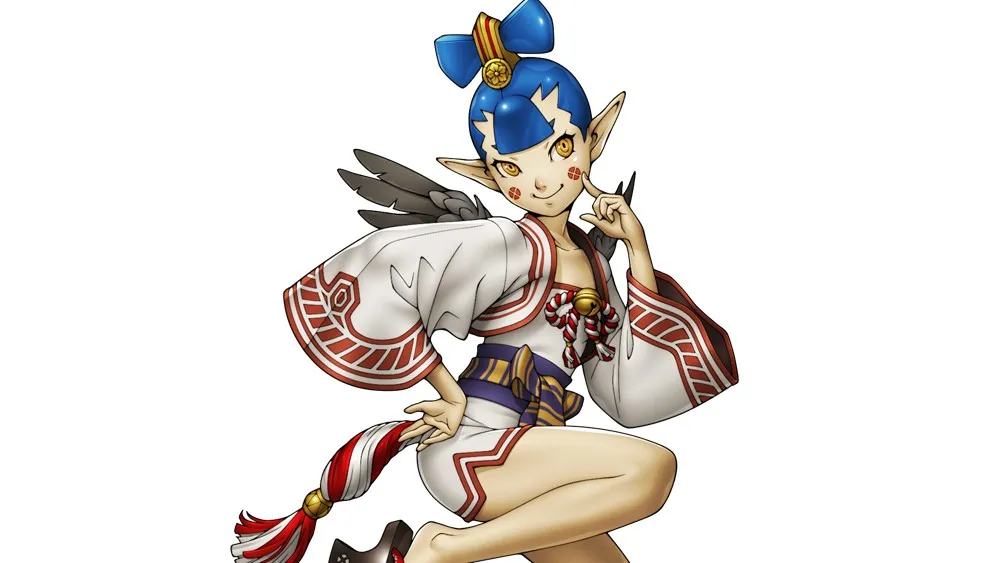
She has also entered contemporary popular culture through Japanese fantasy entertainment. One notable appearance is in the Megami Tensei video game franchise, particularly Shin Megami Tensei V, where she is reimagined as a supernatural character inspired by her traditional identity. Such adaptations introduce lesser-known mythological figures to audiences who might otherwise encounter only the more familiar Japanese deities.
Modern discussions frequently revisit her proposed relationship with the tengu and amanojaku. However, these connections should be understood within their historical context rather than treated as established facts about the origins of all Japanese yōkai. Amanozako’s enduring appeal comes from her unusual place in Japanese supernatural traditions. She is neither a conventional guardian deity nor simply a mischievous spirit. Instead, she represents the destructive potential of unchecked defiance. Her mythology preserves an alternative perspective on divine power, one in which opposition and disorder become defining characteristics rather than qualities that must always be overcome.
Related Images



Source
Foster, M. D. (2015). The book of yokai: Mysterious creatures of Japanese folklore. University of California Press.
Toriyama, S. (1779). Konjaku gazu zoku hyakki [The illustrated one hundred demons from the present and past]. Self-published woodblock-printed book. Available through the Library of Congress collection: https://www.loc.gov/resource/gdcwdl.wdl_20185_001/?sp=18
Terajima, R. (1712). Wakan sansai zue [Illustrated Sino-Japanese encyclopedia of the three realms]. Osaka.
Sendai kuji hongi [Kujiki]. (n.d.). Early Japanese historical text; Amanozako account as summarized in later scholarship and reference works.
Tengu meigi kō [Inquiry into the meaning of tengu]. (1754). Edo-period text discussing Amanozako’s connection to tengu.
Yokai Encyclopedia. (2025, September 5). Amano-zako (Heaven-contrary deity). https://yokai.jp/en/yokai/amanozako
Yokai Lore. (2026, October 6). Amanozako: The goddess born from a god’s fury. https://www.yokailore.com/yokai/amanozako
Crunchyroll. (2021, July 30). Feature: Japanese myths and how they’re depicted in horror anime.
https://www.crunchyroll.com/pl/news/features/2021/7/30/feature-japanese-myths-and-how-theyre-depicted-in-horror-anime
Library of Congress. (2021, July 23). Yokai: The strange and supernatural beings of Japanese folklore and history. https://www.loc.gov/resource/gdcwdl.wdl_20185_001/?sp=18
Frequently Asked Questions
Who is Amanozako in Japanese mythology?
Amanozako is a rebellious female supernatural deity in Japanese folklore, associated with uncontrollable rage, defiance and immense supernatural strength.
How was Amanozako born?
According to Japanese folklore, Amanozako emerged from the violent spiritual energy expelled by Susanoo, the Japanese god of storms.
Is Amanozako related to Susanoo?
Yes. Traditional accounts describe Amanozako as emerging from Susanoo’s expelled spiritual fury rather than being born through conventional divine parentage.
Is Amanozako the ancestor of the tengu?
An eighteenth-century Japanese text connects Amanozako to the origins of the tengu, although this proposed ancestry is not universally accepted.
What are Amanozako's powers?
Amanozako possesses extraordinary strength, can fly, has fangs capable of biting through swords and is associated with uncontrollable rage.


