


Erebus : The Primordial Darkness of Ancient Greece
At a glance
| Description | |
|---|---|
| Origin | Greek Mythology |
| Classification | Gods |
| Family Members | Chaos (Parent), Nyx (Wife), Aether, Hemera (Children) |
| Region | Greece |
| Associated With | Primordial darkness, Gloom, Shadow, Underworld |
The Mythlok Perspective
In Mythlok’s Perspective, Erebus is fascinating because he is not darkness as evil, but darkness as existence. Unlike later gods who command specific forces, Erebus embodies one of the conditions from which the cosmos takes shape. Compared with Hades, who governs the dead, Erebus represents the obscurity surrounding that realm. His power is therefore less about action and more about presence—the ancient darkness that exists before anyone can see the light.
Erebus
Introduction
Erebus (Ἔρεβος, Erebos) is the primordial personification of darkness in Greek mythology and one of the earliest beings in the Greek creation tradition. In Hesiod’s Theogony, written in the Archaic period, Chaos appears first, followed by Gaia, Tartarus, Eros, and the emergence of Erebus and Nyx, the personification of Night. Erebus then joins with Nyx to produce Aether, the bright upper air, and Hemera, the personification of Day.
This makes Erebus different from the better-known Olympian gods. He does not belong to the later divine order ruled by Zeus, nor is he remembered through a collection of adventures, battles, or temples. Instead, Erebus represents one of the fundamental conditions of the cosmos: darkness.
The name Erebus also developed a geographical meaning within Greek literature. It could refer to the dark regions of the underworld or the shadowy realm associated with the dead. Ancient authors therefore use Erebus both as a divine personification and as a place or condition of darkness. This dual meaning is important because Erebus is not simply another name for Hades, the god who rules the dead. Rather, the terms could overlap when ancient writers described the underworld.
Physical Traits
Ancient Greek sources do not give Erebus a standardized physical appearance. There is no reliable classical description establishing a particular face, body, clothing, weapon, or animal associated with him. Hesiod simply introduces Erebus as one of the primordial beings emerging from Chaos. For this reason, Erebus is better understood as a personified cosmic force than as an anthropomorphic god like Zeus, Apollo, or Ares. Later descriptions imagine his presence as darkness or dark mist occupying the deep spaces of the world and the regions beneath the earth.
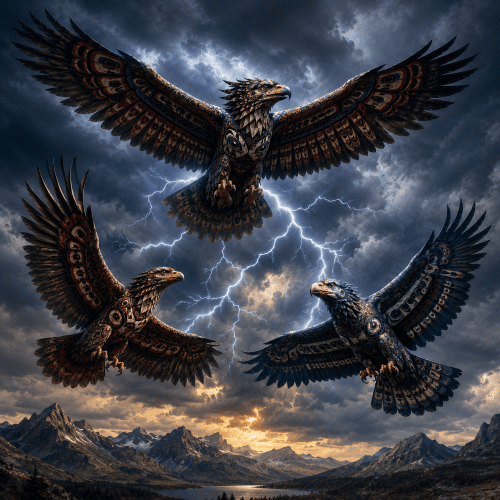
This distinction is particularly useful when interpreting Erebus visually. Rather than depicting him as a conventional warrior deity dressed in elaborate armor, a representation closer to the surviving mythology would emphasize an almost elemental presence. His form can be human enough to communicate personification, while darkness, shadow, and atmospheric obscurity remain integral to his appearance. Erebus therefore represents darkness given identity rather than a god who merely possesses the ability to create darkness.
Family
Erebus has a particularly important place in the earliest layers of Greek divine genealogy. In Hesiod’s Theogony, he emerges from Chaos together with Nyx. Erebus and Nyx subsequently become partners, and their union produces Aether and Hemera. Aether represents the bright, upper air, while Hemera represents Day. Their parentage creates a striking cosmological relationship: darkness and night give rise to the forces associated with brightness and daytime. This does not mean that Erebus and Nyx are simply equivalent to modern concepts of night and darkness. Greek cosmology frequently transformed natural and abstract phenomena into divine beings with genealogical relationships.
Later writers expanded this family considerably. Hyginus, for example, gives Night and Erebus a large number of offspring representing concepts such as Fate, Old Age, Death, Sleep, Dreams, Discord, Nemesis, the Fates, and the Hesperides. Cicero similarly preserves a genealogy in which numerous abstract forces are described as children of Erebus and Night. These later genealogies should not be treated as though they were all part of Hesiod’s original account. The surviving traditions developed across different periods and authors, so Erebus’s family tree changes depending on the source.
Other names
Erebus is the Latinized form commonly used in English, while Erebos is a transliteration closer to the Ancient Greek Ἔρεβος. The name is associated with darkness, gloom, and the shadowy regions beneath the earth. The word also acquired a geographical or cosmological meaning. In ancient literature, Erebus could designate a dark region of the underworld, particularly the realm through which the dead were imagined to pass. Homeric usage helped establish this broader association between Erebus and the world of the dead.
This creates an important distinction between Erebus as a primordial being and Erebus as a place. Modern summaries sometimes blur the two, but they represent related uses of the same ancient term. Erebus should also not simply be equated with Tartarus. Tartarus is presented by Hesiod as a distinct primordial region and cosmic depth, while Erebus is associated with darkness and the shadowy underworld.
Powers and Abilities
Erebus’s powers are best understood through his nature rather than through individual feats. Unlike Zeus, whose mythology is filled with battles and displays of divine authority, Erebus does not have a substantial body of surviving myths in which he actively intervenes in human affairs. His defining attribute is primordial darkness. Erebus embodies the deep gloom that forms part of the earliest Greek conception of the cosmos. Later descriptions portray his darkness as an extensive presence associated with the spaces beneath the earth and the underworld.
His relationship with Nyx also gives him an important cosmological role. Together they produce Aether and Hemera, connecting darkness and night with the emergence of brightness and day. In this sense, Erebus participates in the ordering of opposites that characterize Greek cosmological thought. His association with the underworld adds another dimension. Erebus can represent the darkness surrounding the realm of the dead, making his name closely connected with death and the passage into the underworld. However, surviving sources do not establish him as a ruler of the dead. That role belongs primarily to Hades.
The extensive list of darker personifications associated with Erebus in later Roman genealogies should likewise be treated as evidence of later mythographic development rather than as a catalogue of powers directly exercised by Erebus himself.
Modern Day Influence
Erebus has remained remarkably durable because darkness is one of the most adaptable concepts in storytelling. Modern literature, fantasy, games, comics, and mythology-inspired fiction frequently use the name Erebus for characters, locations, realms, or forces associated with darkness and the unknown.
His influence also extends beyond fiction. Mount Erebus, an active volcano in Antarctica, ultimately received its name through HMS Erebus, one of the ships used during James Clark Ross’s Antarctic expedition. The ship itself had been named after the mythological figure. Thus, one of the world’s most remote volcanic landscapes carries a name originating in an ancient Greek conception of darkness.
In literature and popular culture, Erebus is often transformed into a more conventional dark god or antagonist. Such portrayals can be effective creatively, but they differ from the ancient evidence. The original Erebus is much less like a villain and much more like a cosmic principle.
That distinction is what makes Erebus particularly interesting. He belongs to a generation of Greek divine beings in which natural forces, places, and fundamental conditions of existence could be personified. Before the stories of Olympian gods dominated Greek mythology, the cosmos itself was already being imagined through beings such as Chaos, Gaia, Tartarus, Nyx, and Erebus. Erebus ultimately represents something more fundamental than evil. He is darkness itself: ancient, impersonal, and woven into the structure of creation.
Related Images




Source
Britannica. (2025, October 7). Erebus | God, Hades, Gaea, & story. Encyclopedia Britannica. https://www.britannica.com/topic/Erebus
Cicero, M. T. (1967). De natura deorum (H. Rackham, Trans.). Harvard University Press. (Original work published 1st century BCE)
Hesiod. (1914). Theogony (H. G. Evelyn-White, Trans.). Harvard University Press. (Original work composed circa 8th–7th century BCE)
History Cooperative. (n.d.). Erebus: The primordial Greek god of darkness. https://historycooperative.org/erebus-god-of-darkness/
Mythopedia. (2023, March 9). Erebus. https://mythopedia.com/topics/erebus/
The Theoi Project. (n.d.). Erebos (Erebus). https://www.theoi.com/Protogenos/Erebos.html
Wikipedia. (2002, September 5). Erebus. In Wikipedia. https://en.wikipedia.org/wiki/Erebus
Greek Legends and Myths. (n.d.). Erebus. https://www.greeklegendsandmyths.com/erebus.html
Frequently Asked Questions
Who is Erebus in Greek mythology?
Erebus is the primordial personification of darkness who emerges from Chaos and becomes the consort of Nyx in Hesiod’s Theogony.
What is Erebus the god of?
Erebus represents primordial darkness, gloom, and the shadowy regions associated with the Greek underworld.
Who are the parents of Erebus?
In Hesiod’s Theogony, Erebus emerges from Chaos. He is one of the earliest beings in the Greek creation tradition.
Who are the children of Erebus?
Hesiod names Aether and Hemera as children of Erebus and Nyx. Later Roman writers attribute additional abstract beings to the pair.
Is Erebus the same as Hades?
No. Hades is the god and ruler of the dead, while Erebus is a primordial personification of darkness also used for a region of the underworld.


