


Zamolxe : The Thracian God Who Promised Immortality
At a glance
| Description | |
|---|---|
| Origin | Thracian Mythology |
| Classification | Gods |
| Family Members | N/A |
| Region | Romania, Bulgaria |
| Associated With | Immortality, Afterlife, Prophecy, Healing |
The Mythlok Perspective
In Mythlok’s Perspective, Zamolxe is distinctive because his mythology is built around the uncertainty between god, teacher and deified human. His promise of immortality invites comparison with Osiris, whose mythology similarly transforms death into continued existence, but Zamolxe lacks Osiris’s elaborate divine genealogy. The fragmentary evidence also makes him valuable as an example of how Greek observers reconstructed unfamiliar Thracian beliefs through their own religious framework.
Zamolxe
Introduction
Zamolxe, more commonly known in ancient sources as Zalmoxis, Zamolxis or Salmoxis, is one of the most mysterious religious figures of ancient Thrace. He was associated particularly with the Getae, a Thracian population living around the Lower Danube, in territories corresponding broadly to parts of modern Romania and Bulgaria. Unlike many ancient gods whose stories survive through extensive myths, Zamolxe is known mainly through Greek and Roman writers, leaving much about his original worship uncertain.
The earliest substantial account comes from Herodotus in the Histories. He describes the Getae as believing that they did not truly die but went instead to Salmoxis, whom Herodotus identifies as a deity. He also records a story that Salmoxis had once been a slave of the philosopher Pythagoras in Samos before returning to the Getae. Importantly, Herodotus himself questions this explanation, suggesting that Salmoxis may have lived much earlier than Pythagoras and leaving open the possibility that he was an indigenous Getic god rather than a historical man.
This uncertainty is central to Zamolxe’s mythology. He can appear as a god, religious teacher, priest, prophet or possibly a deified human depending on the ancient source. What remains consistent is his connection with the Getic belief in an existence beyond death.
Physical Traits
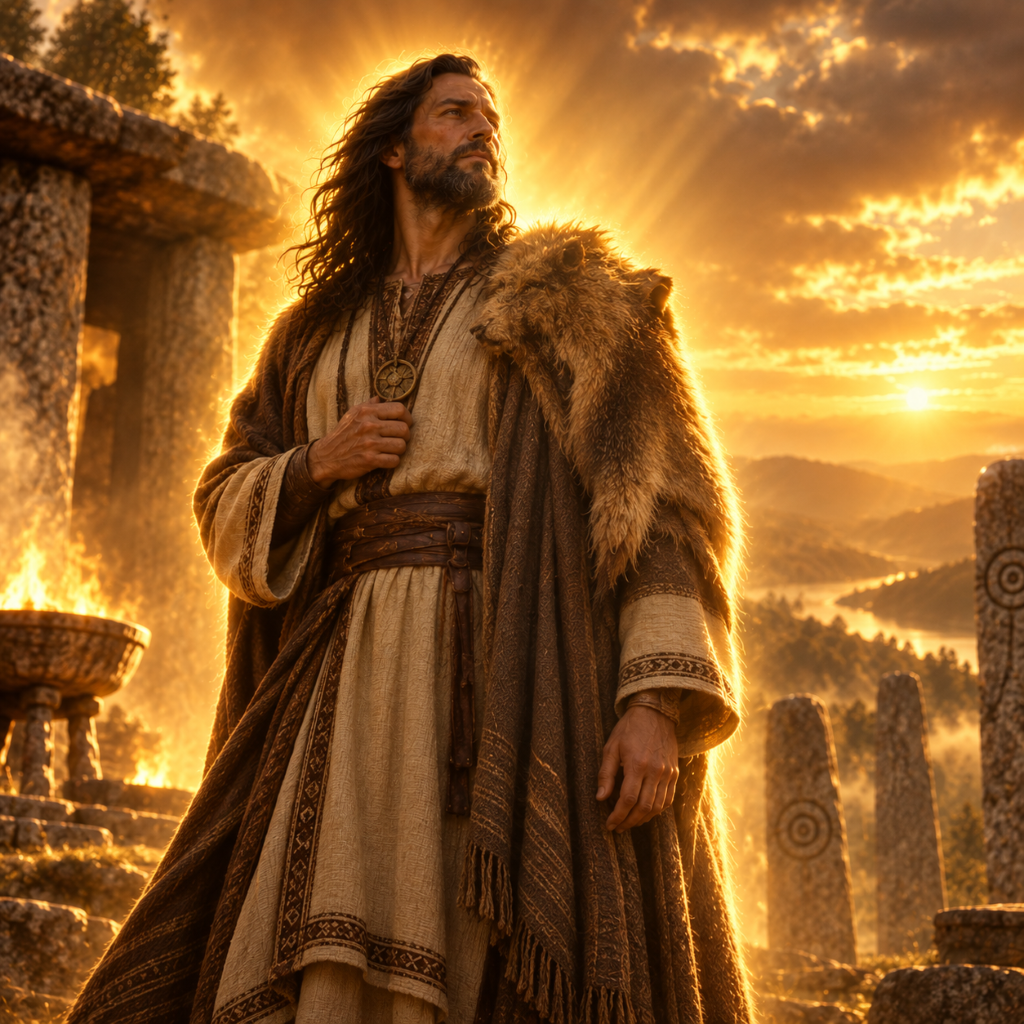
There is no reliable ancient description of Zamolxe’s physical appearance. No securely identified statue, relief, coin or other contemporary image can be confidently recognised as representing him. This makes it impossible to establish details such as his age, height, facial features or typical clothing.
A later tradition provides one striking physical association. Porphyry, writing centuries after Herodotus, says that Zamolxe received his name because he had been wrapped in a bear’s skin at birth. Porphyry connects this story with the Thracian word zalmos, which he understood as meaning a skin or hide. The account is interesting, but it should not be treated as proof that Zamolxe traditionally appeared as a bear-skinned deity.
The lack of established iconography is significant. Much of what is said about Zamolxe comes from literary descriptions rather than surviving Getic religious images. Consequently, modern artistic portrayals of him—with a bear pelt, priestly clothing or an imposing warrior’s appearance—are interpretations rather than confirmed ancient representations.
Family
Zamolxe has no known mythological family tree. Ancient writers do not provide the names of his parents, spouse, children or siblings, and there is no established genealogy comparable to those of the Greek or Norse gods. The most famous relationship associated with him is with Pythagoras, but this is not a family connection. Herodotus reports a Greek story that Zamolxe was once Pythagoras’s slave in Samos and later became wealthy and returned to his homeland. Herodotus does not accept the story without reservation and even suggests that Zamolxe may have existed before Pythagoras.
Strabo preserves another version in which Zamolxe is connected with Pythagorean learning and Egyptian travel before becoming a religious authority among the Getae. These accounts show how Greek writers attempted to explain an unfamiliar Thracian religious figure through concepts they already understood.
Decaeneus, the religious adviser of the Getic ruler Burebista, is sometimes presented in modern accounts as a successor to Zamolxe. Ancient evidence does connect Decaeneus with the religious authority of the Getae, but it does not establish him as Zamolxe’s direct disciple or biological successor. The two figures should therefore be treated as separate religious personalities.
Other names
Zamolxe appears under several forms because ancient authors and manuscript traditions recorded his name differently. Zalmoxis, Zamolxis, Salmoxis and Samolxis are the principal variants encountered in classical literature. Herodotus uses the form Salmoxis in the surviving textual tradition, while later writers including Strabo commonly use Zamolxis. These variations do not necessarily represent different gods. They are generally understood as different forms of the same Thracian or Getic name, although the exact etymology remains disputed.
Herodotus also says that some Getae called their deity Gebeleizis. This has sometimes led modern writers to equate Zamolxe with a separate Thracian thunder or sky god. That identification, however, is not certain. Herodotus’s wording and later scholarship leave room for different interpretations, so Gebeleizis is better presented as an associated or possibly alternative divine name rather than an unquestionably identical figure.
Powers and Abilities
Zamolxe’s defining power was his association with immortality. According to Herodotus, the Getae believed that those who died went to Salmoxis rather than simply ceasing to exist. This belief gave death a different meaning: it represented a passage into another state of existence.
Herodotus describes a remarkable ritual in which the Getae selected a messenger every five years and sent him to Zamolxe with their requests. The messenger was thrown onto sharpened spears, and his death was interpreted as a favourable sign that Zamolxe had received their message. If he survived, the community considered him unworthy and another messenger was selected. This account comes from Herodotus and reflects his description of Getic practice, rather than independent evidence confirming the ritual archaeologically.
Zamolxe was also associated with a dramatic disappearance and return. Herodotus says that he built an underground chamber and concealed himself there for three years before appearing again in the fourth year. His followers interpreted this return as confirmation of his teaching about existence beyond death. Whether this was an actual ritual, a symbolic story or a Greek interpretation of a Getic religious practice remains uncertain.
Later traditions expanded his role into that of a teacher, lawgiver and religious authority. Plato provides another important association in Charmides, where a Thracian physician describes the teachings of Zalmoxis as emphasising the relationship between the soul and the body. The passage presents Zalmoxis as a king and god whose approach to healing begins with the soul rather than treating the body in isolation.
Strabo later describes Zamolxe as a religious figure who gained authority among the Getae and connects him with sacred knowledge, prophecy and practices associated with abstaining from animal food. These later accounts demonstrate the growing complexity of his image, but they should not be treated as a single, historically certain biography.
Modern Day Influence
Zamolxe has survived far beyond the ancient world, particularly as a symbol of the pre-Roman heritage of the Lower Danube. His importance increased during the development of modern Romanian historical and national narratives, when ancient Dacian and Getic figures were increasingly used to explore the origins of Romanian identity.
Modern interpretations have sometimes presented Zamolxe as the supreme god of a sophisticated monotheistic religion, a shaman, a mystery-god, a solar deity or a chthonic god of the underworld. These interpretations are influential, but none can be established with certainty from the surviving ancient evidence. Modern scholarship generally stresses that the evidence is fragmentary and comes largely through Greek and Roman observers rather than surviving indigenous Getic religious texts.
The Romanian historian of religion Mircea Eliade played a major role in shaping modern discussions of Zamolxe, particularly through his interpretation of the god’s disappearance and return as a pattern of divine occultation and manifestation. His work helped make Zalmoxis an important subject in comparative history of religions.
Zamolxe has also entered modern literature, historical imagination and reconstructionist religious movements inspired by ancient Dacian and Thracian traditions. Even the prehistoric past has carried his name: the dinosaur genus Zalmoxes, discovered from fossils in Romania, was named in honour of the ancient Getic deity.
His modern significance therefore rests less on a complete surviving mythology and more on the enduring mystery surrounding him. Zamolxe represents one of the rare ancient religious figures whose central idea—the possibility of life beyond death—survives even though the original tradition that produced it has largely disappeared.
Related Images





Source
Dana, D. (2008). Zalmoxis de la Herodot la Mircea Eliade. Istorii despre un zeu al pretextului. Polirom. https://www.polirom.ro
Eliade, M. (1972). Zalmoxis, the vanishing god (W. R. Trask, Trans.). University of Chicago Press. https://press.uchicago.edu/ucp/books/book/chicago/Z/bo3785632.html
Encyclopedia.com. (n.d.). Zalmoxis. Encyclopedia of Religion. https://www.encyclopedia.com/environment/encyclopedias-almanacs-transcripts-and-maps/zalmoxis
Herodotus. (n.d.). The Histories, Book IV, 93–96. https://www.perseus.tufts.edu/hopper/text?doc=Perseus%3Atext%3A1999.01.0126
Oxford Classical Dictionary. (2015). Zalmoxis. Oxford University Press. https://academic.oup.com/edited-volume/61673/chapter-abstract/548203867
Pantheon.org. (n.d.). Zalmoxis. https://pantheon.org/articles/z/zalmoxis.html
Wikipedia. (n.d.). Zalmoxis. https://en.wikipedia.org/wiki/Zalmoxis
Wikisource. (2010). 1911 Encyclopædia Britannica/Zalmoxis. https://en.wikisource.org/wiki/1911_Encyclop%C3%A6dia_Britannica/Zalmoxis
Frequently Asked Questions
Who was Zamolxe in Thracian mythology?
Zamolxe, or Zalmoxis, was a religious figure worshipped by the Getae, associated with immortality, the soul and life after death in ancient Thrace.
What was Zamolxe the god of?
Zamolxe was primarily associated with immortality and the afterlife. Ancient sources also connect him with religious teaching, sacred knowledge, prophecy and healing.
Was Zamolxe a god or a human?
Ancient sources disagree. Herodotus leaves open whether Zamolxe was an indigenous Getic god or a historical man later regarded as divine.
Was Zamolxe a student of Pythagoras?
Herodotus records a Greek story claiming Zamolxe had been Pythagoras’s slave, but he questions the story and says Zamolxe may have lived earlier.
What happened to Zamolxe after he disappeared?
Herodotus says Zamolxe hid in an underground chamber for three years before returning. His reappearance strengthened the Getic belief in his promise of immortality.


