Tragic Jungle (2020) : Where the Xtabay Haunts the Jungle
| Description | |
|---|---|
| Country of Origin | Mexico |
| Language | Spanish |
| Genre | Adventure |
| Cast | Indira Rubie Andrewin, Gilberto Barraza, Mariano Tun Xool |
| Directed by | Yulene Olaizola |
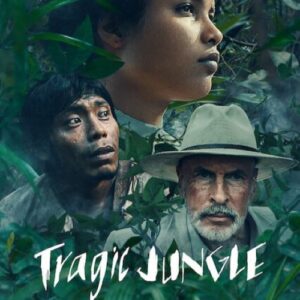
Tragic Jungle
Yulene Olaizola’s Tragic Jungle (2020), also known as Selva Trágica, is less a conventional supernatural thriller than a modern retelling of a Mayan myth in which the boundaries between woman, spirit and jungle gradually disappear. Set in the 1920s along the border between Mexico and British Honduras, the film follows Agnes, a young Belizean woman who escapes an English landowner and enters the rainforest, only to be taken in by a group of Mexican chicle workers. As the men become increasingly fascinated by her, a series of mysterious deaths suggests that Agnes may be something far more dangerous than she appears.
The mythological heart of Tragic Jungle is the Xtabay, a female supernatural figure from Yucatec Maya tradition. In one widely circulated version of the legend, the Xtabay appears as an extraordinarily beautiful woman who lives in or near the forest, seducing men and leading them to destruction. Her mythology is closely associated with ideas of sexuality, moral judgement, death and the dangerous mystery of the wilderness. Academic research also notes that the Xtabay tradition has multiple versions and has evolved considerably across time, making it more complicated than the simple image of a “female demon” often used to describe her.
Olaizola uses that ambiguity extremely well. Agnes is never given a definitive supernatural identity. She could be a traumatised woman whose circumstances are interpreted through superstition, or she could genuinely be the Xtabay taking physical form. The film deliberately refuses to settle the question. As the men around her begin to die, myth becomes a way of explaining what they cannot understand. Their fear transforms Agnes from a vulnerable woman into a supernatural threat, while the jungle itself increasingly feels like a living mythological presence.
This transformation is particularly significant because Tragic Jungle changes the moral function of the Xtabay. Rather than presenting her simply as a monster who punishes male desire, the film connects her mythology to exploitation. The men are harvesting chicle from the rainforest, stripping trees of their valuable sap for commercial gain, while Agnes has already been treated as property by a colonial landowner. Woman and jungle therefore become parallel victims of possession and extraction. When the supernatural begins to strike back, the mythology becomes a form of ecological and feminist revenge.
The film’s most compelling mythological idea is consequently not that Agnes is the Xtabay, but that she gradually becomes indistinguishable from her. Her white clothing, her silence, her sexuality and her increasingly uncanny behaviour echo the traditional imagery surrounding the forest spirit. The jungle seems to absorb her identity, while the men project their fears and desires onto her. The result is a deliberately unstable mythology in which the supernatural may exist independently—or may emerge from the collision between human greed, sexual violence and an environment that refuses to remain passive.
Nature itself functions almost as a mythological character. The rainforest is not merely a backdrop for the story; it possesses an atmosphere of sentience, concealment and danger. The workers believe they understand the landscape because they depend upon it for their livelihood, yet the deeper they travel, the less control they appear to have. The film’s soundscape, mist, vegetation and distorted imagery reinforce the sense that ordinary reality is gradually being replaced by a supernatural world.
This makes Tragic Jungle especially interesting as a piece of modern mythmaking. Instead of reproducing the Xtabay story literally, Olaizola uses its central archetype to question why women who resist male control are so often turned into monsters in folklore. At the same time, the film reverses the familiar colonial adventure narrative: the jungle is not an empty wilderness waiting to be conquered, and its mysterious female presence is not simply an obstacle to male exploration. The supposed “civilised” outsiders are the ones behaving destructively, while the supposedly monstrous jungle may be defending itself.
The film can be frustrating because it deliberately withholds explanations. Viewers unfamiliar with the Xtabay tradition may struggle to understand what Agnes represents, and some of the mythology is communicated through cryptic narration rather than clearly explained. Critics have consequently differed sharply on whether the ambiguity enriches or weakens the story. Yet from a mythological perspective, that uncertainty is also part of the film’s appeal. Folklore rarely functions like a modern fantasy franchise with fixed rules; legends change according to the communities, storytellers and fears that carry them forward.
Ultimately, Tragic Jungle works best when understood as a reinterpretation of the Xtabay rather than a straightforward monster movie. Agnes becomes a contemporary incarnation of the forest woman: victim, seductress, spirit and avenger at once. The film takes an old Mayan legend about a dangerous woman in the wilderness and connects it to colonialism, sexual violence and environmental exploitation. Its greatest achievement is making the viewer question whether the jungle is haunted by a demon—or whether the real horror is what human beings bring into it.