


Xuánlóng : The Mysterious Black Dragon of Chinese Legend
At a glance
| Description | |
|---|---|
| Origin | Chinese Mythology |
| Classification | Animals |
| Family Members | N/A |
| Region | China |
| Associated With | Darkness, Mystery, Water, Rainfall |
The Mythlok Perspective
In Mythlok’s Perspective, Xuánlóng represents an interesting distinction between mythological identity and cosmological symbolism. While celebrated dragons such as Yinglong possess recognisable narratives, Xuánlóng derives much of its significance from the cultural meanings attached to darkness, water and mystery. Its limited documentation makes it important to distinguish historical traditions from modern interpretations. Unlike the Azure Dragon, whose position within Chinese cosmology is firmly established, the Black Dragon occupies a less clearly defined space. Yet both demonstrate how Chinese traditions transformed natural forces into powerful supernatural symbols.
Xuánlóng
Introduction
Xuánlóng (玄龍), translated as the Black Dragon, Dark Dragon or Mysterious Dragon, is a dragon figure associated with Chinese mythological and cosmological traditions. Its name combines xuán (玄), a character expressing darkness, depth and mystery, with lóng (龍), meaning dragon. Together, the name evokes a powerful supernatural being connected with the hidden forces of nature.
Unlike celebrated Chinese dragons such as Yinglong and the Azure Dragon, Xuánlóng does not have an extensive collection of surviving mythological narratives. Its identity is better understood through the symbolism surrounding black dragons, particularly their associations with water, darkness and the northern direction. Some modern accounts also identify Xuánlóng with Hēilóng (黑龍), meaning Black Dragon, although the historical relationship between these names is not consistently established.
Chinese dragons traditionally represent forces that sustain and regulate the natural world. They are associated with rainfall, rivers, lakes, oceans and the movement of clouds. Rather than representing evil, they generally embody supernatural authority, prosperity and harmony. Xuánlóng belongs to this wider tradition, representing the mysterious and powerful aspects of the natural world.
Physical Traits
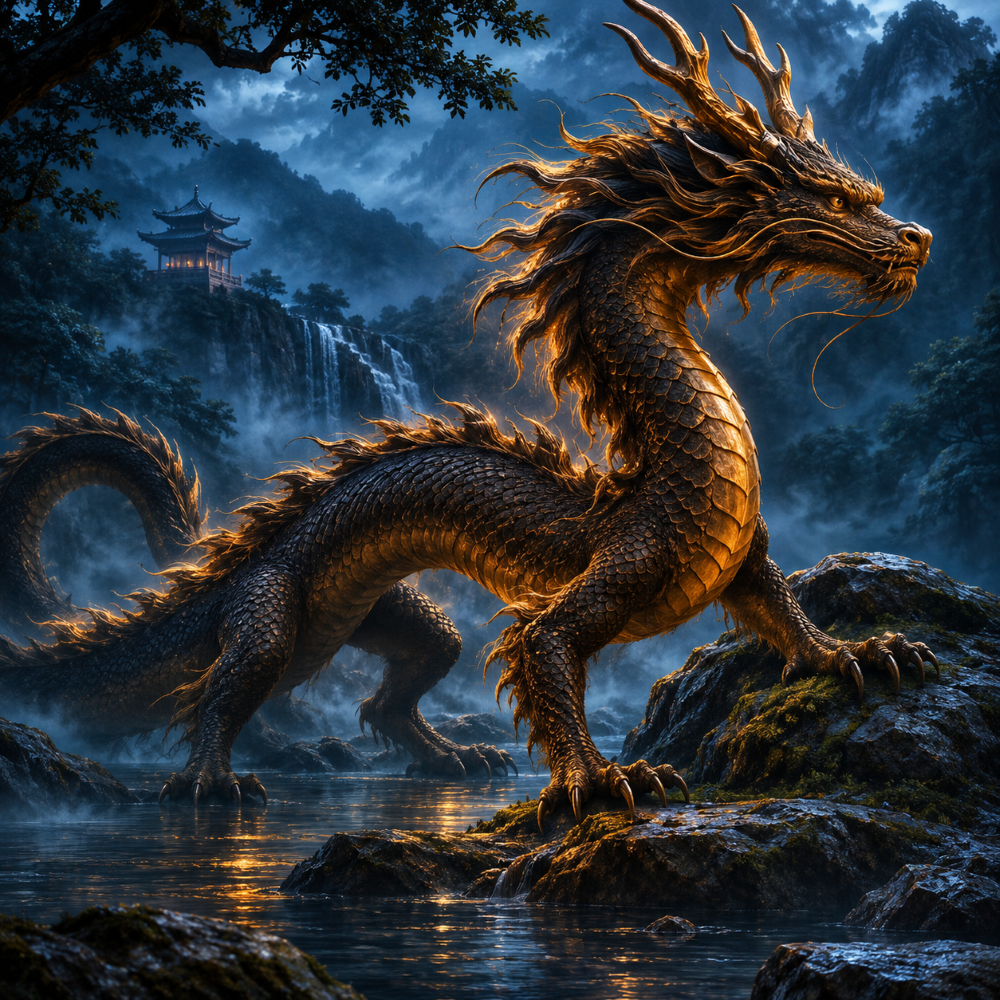
Xuánlóng is generally imagined as a dark or black Chinese dragon. Its defining characteristic is its colour, which carries considerable symbolic meaning in traditional Chinese thought. Black represents more than physical darkness; it can suggest depth, mystery and the concealed forces operating beneath the visible world. There is no surviving, widely accepted physical description that establishes a unique appearance for Xuánlóng. Its imagined form therefore draws upon the traditional representation of the Chinese lóng.
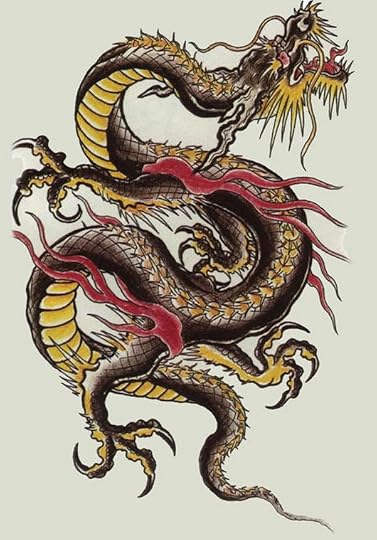
Chinese dragons are commonly depicted with elongated, serpentine bodies covered in scales, four powerful legs, sharp claws, horns, whiskers and expressive eyes. Their appearance combines characteristics associated with several animals, creating a creature that is neither entirely terrestrial nor aquatic. They are frequently portrayed moving through clouds, rivers and the open sky.
For Xuánlóng, these traditional characteristics are complemented by dark scales and an imposing presence. Its appearance reflects its association with deep waters and the mysterious northern regions. It is important, however, to distinguish traditional Chinese dragon imagery from a confirmed individual description of Xuánlóng. The familiar dragon anatomy provides an appropriate visual reference rather than a definitive ancient portrait.
Family
Xuánlóng has no reliably documented family tree in the surviving mythological material. There are no established accounts identifying its parents, siblings, spouse or offspring. Consequently, assigning it a specific place within a divine genealogy would be speculative. Its broader mythological connections lie within the extensive tradition of Chinese dragons. Chinese folklore and religious traditions recognise several categories of dragons associated with different aspects of existence. Tianlong represents the celestial dragon, Fuzanglong is associated with hidden treasures, Dilong is connected with the earth, and Shenlong is associated with spiritual and meteorological forces.
Another important group consists of the Dragon Kings, known as Longwang. These supernatural rulers are associated with the seas, rivers and rainfall. Their influence reflects the importance of water in traditional Chinese religious life. Although Xuánlóng shares symbolic characteristics with these dragon beings, there is no established evidence that it belongs to their family or serves under a particular Dragon King. Its identity is therefore better understood through shared cultural and cosmological traditions than through biological relationships.
Other names
Xuánlóng is written as 玄龍 in traditional Chinese characters and 玄龙 in simplified Chinese. Its English interpretations include Black Dragon, Dark Dragon and Mysterious Dragon. Another name frequently associated with the black dragon is Hēilóng (黑龍), which translates directly as Black Dragon. Although modern descriptions sometimes use Hēilóng and Xuánlóng interchangeably, the terms should not automatically be considered identical across every historical or religious tradition.
The word xuán is particularly interesting because its meaning extends beyond colour. In classical Chinese thought, it can express profound mystery, depth and the unfathomable nature of existence. This gives Xuánlóng a symbolic dimension that goes beyond its physical appearance. Black dragon imagery also appears in Chinese geographical and cultural references. Heilongjiang, for example, translates as Black Dragon River and is the Chinese name for the Amur River. This demonstrates the enduring cultural importance of black dragon symbolism, although it does not establish that Xuánlóng personally created or governed the river.
Powers and Abilities
Xuánlóng’s individual supernatural abilities are not extensively documented. Its commonly attributed powers are largely drawn from the broader traditions surrounding Chinese dragons and their relationship with natural forces.
Water is one of the strongest symbolic associations of the black dragon. In the Five Phases system, known as Wuxing, black corresponds with water. This connection makes Xuánlóng an appropriate representation of rivers, lakes, rainfall and the mysterious depths of aquatic environments. Chinese dragons have traditionally been regarded as supernatural beings capable of influencing water and maintaining the balance of natural forces.
Rainmaking is an important part of the wider Chinese dragon tradition. Historical evidence from the Shang dynasty demonstrates that dragons were already connected with rituals intended to secure rainfall. Archaeological and textual research discusses the creation of dragon images as part of ancient rain-seeking practices. These associations reflect the dependence of early agricultural communities on seasonal rainfall. While this tradition does not establish a unique rainmaking narrative for Xuánlóng, it provides the cultural context for its connection with water and weather.
Black is associated with the north and winter in traditional Chinese cosmology. Through this colour symbolism, Xuánlóng is frequently interpreted as a northern dragon. An important distinction must be made here. The established northern guardian among the Four Celestial Symbols is Xuánwǔ (玄武), the Dark Warrior, traditionally represented through a tortoise and snake. Xuánlóng should not be confused with this figure, even though their names share the character xuán and their symbolism overlaps.
The character xuán also conveys the idea of something profound and difficult to comprehend. Xuánlóng consequently represents the mysterious dimensions of nature, particularly the unseen forces associated with darkness, water and the natural world. These associations provide a meaningful symbolic interpretation, although they should not be mistaken for a documented catalogue of individual supernatural abilities.
Modern Day Influence
Xuánlóng’s modern cultural presence is closely connected with the continuing popularity of Chinese dragon imagery. Although the figure itself is relatively obscure, black dragons remain popular subjects in contemporary art, literature, games and visual storytelling. Chinese dragons continue to occupy an important position in traditional celebrations. Dragon dances, particularly during Lunar New Year festivities, preserve the cultural relationship between dragons, prosperity and communal good fortune. Historically, dragon imagery has also been connected with rituals seeking rainfall and agricultural abundance.
Black dragon symbolism also survives through geographical names, traditional artwork and decorative motifs. Heilongjiang, or Black Dragon River, is a particularly recognisable example of how dragon imagery has become embedded in Chinese cultural geography. Modern fantasy games and fictional universes frequently draw inspiration from Chinese dragons, incorporating their associations with elemental forces, ancient power and supernatural authority. These adaptations sometimes use the concept of the black dragon without necessarily reproducing a historically established Xuánlóng tradition.
The dragon’s broader cultural significance also extends into imperial history. Chinese emperors adopted dragon imagery as a symbol of authority and celestial legitimacy. Over time, the dragon developed into one of the most recognisable representations of Chinese cultural identity. Xuánlóng therefore represents an interesting aspect of Chinese dragon symbolism. Its importance lies less in a collection of individual adventures and more in the ideas expressed through its identity: darkness, water, mystery and the powerful forces that shape the natural world.
Related Images


Source
Britannica Editors. (2026, November 19). Long. Encyclopaedia Britannica. https://www.britannica.com/topic/long
Ren, A. L., & Zhu, M. (2024, February 7). The dragon and the fate of China. The China Story. https://www.thechinastory.org/the-dragon-and-the-fate-of-china/
de Visser, M. W. (1913). The dragon in China and Japan. J. Müller.
Strassberg, R. E. (2002). A Chinese bestiary: Strange creatures from the Guideways through mountains and seas. University of California Press.
Pankenier, D. W. (2015). Astrology and cosmology in early China: Conforming earth to heaven. Cambridge University Press.
Thorbjarnarson, J., & Wang, X. (2010). The Chinese alligator: Ecology, behavior, conservation, and culture. Johns Hopkins University Press.
The Chinese dragon: Cultural contextualization of a recent archaeological discovery. (2023).
https://dn760104.eu.archive.org/0/items/2023-chinese-dragon-final-version/2023_CHINESE%20DRAGON_Final%20Version.pdf
Mythsterhood. (2020, September 22). Chinese dragon mythology, part 1.
https://mythsterhood.com/chinese-dragon-mythology-pt-1/
Frequently Asked Questions
Who is Xuánlóng in Chinese mythology?
Xuánlóng is the Mysterious or Black Dragon associated with Chinese dragon traditions, particularly symbolism surrounding darkness, water and the northern direction.
What does Xuánlóng mean?
Xuánlóng combines xuán, meaning dark or mysterious, and lóng, meaning dragon. The name is commonly translated as Black Dragon or Mysterious Dragon.
What powers does Xuánlóng possess?
Xuánlóng is associated with water, rainfall and natural forces through broader Chinese dragon traditions. Its individual supernatural abilities are not extensively documented.
Is Xuánlóng the same as Xuánwǔ?
No. Xuánwǔ is the Dark Warrior, a celestial guardian represented by a tortoise and snake. Xuánlóng is a black dragon figure.
Is Xuánlóng related to other Chinese dragons?
Xuánlóng belongs to the wider Chinese dragon tradition, but no reliable classical genealogy establishes its relationship with other named dragons.


