


Xihe : The Solar Goddess and Mother of Ten Suns in Chinese Lore
At a glance
The Mythlok Perspective
In Mythlok’s Perspective, Xihe offers an interesting contrast to Amaterasu, the Japanese sun goddess. While Amaterasu represents the Sun as a source of divine authority, light and political legitimacy, Xihe embodies its movement, nurturing and celestial order through her motherhood of the ten suns. Both figures connect solar power with the stability of the world, but their stories approach this responsibility differently. Amaterasu’s withdrawal plunges the world into darkness, while Xihe’s mythology explores the dangers of excessive sunlight.
Xihe
Introduction
Xihe (羲和), also known as Xi He or Hsi-ho, is a prominent solar figure in Chinese mythology associated with the birth of the ten suns and the movement of the sun across the heavens. Her mythology connects celestial power with the natural rhythms of the world, particularly the passage of days and the maintenance of cosmic order. She is traditionally identified as the wife of the celestial deity Di Jun and the mother of ten solar beings.
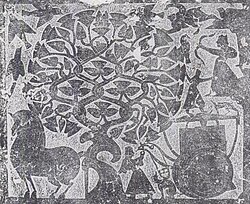
One of the earliest accounts of Xihe appears in the Shanhaijing (Classic of Mountains and Seas), a collection of ancient Chinese geographical descriptions, legends and supernatural traditions compiled over several centuries. The text describes Xihe as a woman who gave birth to ten suns and regularly bathed them in Gan Yuan, also translated as the Sweet Abyss. Her story connects her to the mythical landscape of the eastern seas, where the suns were associated with the sacred Fusang tree.
Xihe’s identity becomes more complex when other classical sources are considered. The Chuci (Songs of Chu) associates her with the sun’s journey, while the Huainanzi describes the daily movement of the sun through different celestial locations. The Shangshu (Book of Documents), meanwhile, refers to Xi and He in connection with astronomical observation and calendar regulation.
These accounts do not necessarily describe one identical mythological character. Instead, they reveal how Xihe’s identity developed across different Chinese traditions, becoming associated with solar birth, celestial travel and the measurement of time.
Physical Traits
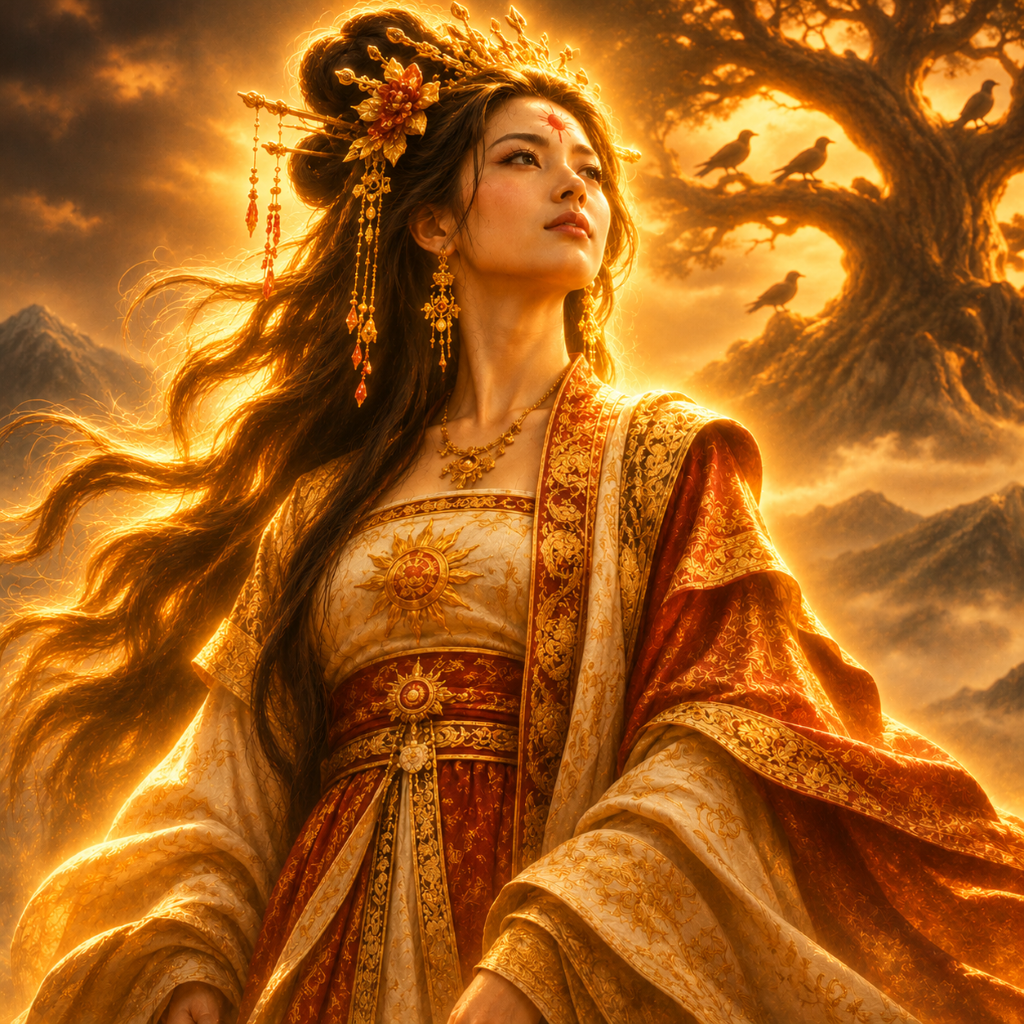
Ancient Chinese mythology provides no detailed physical description of Xihe. The Shanhaijing identifies her as a woman and establishes her divine identity through her relationship with the ten suns. It does not describe her facial features, clothing, height or other distinctive physical characteristics.
Consequently, her appearance in modern illustrations and traditional artistic interpretations is largely symbolic. She is commonly imagined as a celestial woman whose presence reflects the radiance and authority of the sun. Solar motifs, flowing garments and warm golden colours are natural artistic choices, although they should not be mistaken for descriptions preserved in the earliest texts. Her association with the Fusang tree and the eastern seas also provides an important visual foundation for depicting her. The mythical tree was believed to be connected with the resting and bathing place of the ten suns.
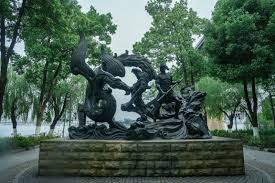
Later interpretations of Xihe as the sun’s charioteer offer another possible artistic representation. She can be portrayed guiding a celestial vehicle through the heavens, although the familiar image of a chariot drawn by six dragons belongs to developed traditional interpretations rather than an explicit physical description in the Shanhaijing.
Family
Xihe’s most important family relationship is with Di Jun (帝俊), a major celestial deity in ancient Chinese mythology. The Shanhaijing identifies her as his wife and describes her as the mother of ten suns. Their relationship places Xihe within a divine family associated with the organisation of the heavens and the natural world.
Her ten sons are central to her mythology. They are described as solar beings who inhabited the Fusang tree, a gigantic mythical mulberry tree situated in the eastern regions beyond the sea. According to the tradition, the suns followed an organised cycle in which they took turns appearing in the sky. This arrangement allowed the world to receive sunlight without being overwhelmed by excessive heat.
The wider mythology also connects Di Jun with Changxi (常羲), another of his wives. Changxi is traditionally described as the mother of twelve moons. Together, these two maternal figures establish an interesting relationship between solar and lunar traditions in Chinese mythology.
Xihe’s sons also feature in the famous legend of Hou Yi, the divine archer. According to the Huainanzi, ten suns once appeared together during the reign of Emperor Yao. Their combined heat scorched vegetation and threatened life on Earth. Hou Yi was ordered to shoot at the suns, destroying nine and leaving one to continue illuminating the world. Although the Huainanzi recounts this disaster, it does not directly identify Xihe in the episode. Her connection comes from the separate genealogical tradition establishing her as the mother of the ten suns.
Other names
Xihe is written as 羲和 in Chinese characters and is commonly romanised as Xīhé in modern Mandarin pinyin. Older English-language publications frequently use Xi He or Hsi-ho, reflecting different historical systems of Chinese romanisation.
She is often described as the Mother of the Ten Suns, the Solar Goddess or the Goddess of the Sun. These are descriptive titles rather than independently established alternative personal names. Her association with celestial movement also connects her with the title of solar charioteer. In later literary interpretations, Xihe became the figure responsible for guiding the sun through its daily journey across the heavens.
Another important distinction concerns the name Xi He in the Shangshu. There, Xi and He are associated with astronomical officials who observe celestial movements and regulate the calendar under Emperor Yao. This tradition should not automatically be treated as identical to the female solar deity described in the Shanhaijing. The different uses of the name demonstrate how ancient Chinese traditions combined mythology, astronomy and historical interpretations of celestial knowledge.
Powers and Abilities
Xihe’s most recognised mythological role is her motherhood of the ten suns, making her an important figure in Chinese solar mythology. Unlike ordinary celestial objects, these suns were regarded as living supernatural beings with their own place in the cosmic order. The Shanhaijing describes Xihe bathing her ten children in Gan Yuan, a mythical body of water associated with the eastern seas and the beginning of the solar journey. This ritual establishes her as a nurturing divine figure responsible for the care of the solar beings.
In later Chinese literary traditions, Xihe became associated with guiding the sun across the heavens. The Chuci, particularly the poem Li Sao, invokes her in connection with the sun’s celestial journey, while subsequent commentaries developed her identity as the divine charioteer. Some later interpretations describe her solar vehicle as being drawn by six dragons. Xihe also became associated with astronomy and timekeeping through traditions connecting her name with the observation of the sun, moon and stars. The Shangshu refers to Xi and He as astronomical officials responsible for regulating the calendar, although this account does not necessarily describe the same mythological goddess.
Xihe’s mythology also reflects the importance of maintaining cosmic balance. The story of the ten suns illustrates the consequences of celestial disorder when all ten appear together, exposing the Earth to unbearable heat. The intervention of the archer Hou Yi, who shoots down nine suns, restores the natural cycle. Although Xihe is not directly identified as controlling this event, her connection to the ten suns makes her mythology central to its larger meaning. Her divine role therefore extends beyond solar motherhood, representing the relationship between celestial power, natural rhythms and the balance necessary for life to flourish.
Modern Day Influence
Xihe continues to hold cultural significance in contemporary China, particularly through the relationship between ancient mythology and modern astronomy. One of the most prominent examples is China’s solar observation satellite named Xihe. Launched on October 14, 2021, the spacecraft became China’s first space-based solar telescope. Its name was selected through a public naming initiative, drawing inspiration from the ancient solar goddess. The satellite studies the Sun through observations in the H-alpha spectral band, extending the association between Xihe and solar observation into modern scientific research.
Her name also has an established place in international astronomy. In December 2019, the International Astronomical Union approved Xihe as the official name of the star HD 173416 in the constellation Lyra. The naming formed part of the IAU100 NameExoWorlds initiative, which celebrated astronomical heritage from different cultures. Beyond science, Xihe continues to appear in contemporary interpretations of Chinese mythology, literature, animation and popular culture. Her connection with the ten suns and Hou Yi provides a particularly compelling narrative for modern adaptations exploring the relationship between divine beings and humanity.
Xihe remains an important figure because her mythology brings together several ancient Chinese ideas: the power of the Sun, the organisation of celestial cycles and the relationship between the heavens and life on Earth. Her enduring presence in both cultural storytelling and scientific naming demonstrates how ancient mythological figures can continue to influence modern understandings of the natural world.
Related Images



Source
Birrell, A. (1993). Chinese mythology: An introduction. Johns Hopkins University Press.
Major, J. S., Queen, S. L., Meyer, A. S., & Roth, H. D. (Eds.). (2010). The Huainanzi: A guide to the theory and practice of government in early Han China. Columbia University Press.
Mythopedia. (n.d.). Xihe. https://mythopedia.com/topics/xihe
Qu, Y. (2011). The songs of Chu: An anthology of ancient Chinese poetry (G. Chao & Q. Su, Trans.). Columbia University Press.
Theobald, U. (2012, July 12). Xi He 羲和. ChinaKnowledge.de. http://www.chinaknowledge.de/History/Myth/personsxihe.html
World History Encyclopedia. (2025, February 4). Yin and yang. https://www.worldhistory.org/Yin_and_Yang/
Yuan, K. (Ed.). (1985). Zhongguo shenhua chuanshuo cidian [Dictionary of Chinese myths and legends]. Shanghai Cishu Chubanshe.
The classic of mountains and seas. (2001). (A. Birrell, Trans.). Penguin Books.
Frequently Asked Questions
Who is Xihe in Chinese mythology?
Xihe is a solar goddess in Chinese mythology, best known as the wife of Di Jun and the mother of ten suns. She is also associated with the sun’s celestial journey.
Who is Xihe's husband in Chinese mythology?
Xihe is traditionally described as the wife of Di Jun, an important celestial deity in ancient Chinese mythology and the father of her ten solar children.
Why did Xihe have ten suns?
According to the Shanhaijing, Xihe gave birth to ten suns and bathed them in Gan Yuan. They were associated with the mythical Fusang tree in the eastern sea.
What happened to Xihe's ten suns?
According to the legend, all ten suns appeared together and scorched the Earth. The archer Hou Yi shot down nine, leaving one sun to illuminate the world.
Is Xihe the Chinese goddess of the Sun?
Yes. Xihe is traditionally recognised as a solar goddess associated with the ten suns, celestial movement and the regulation of time in ancient Chinese mythology.


