Vesna : Slavic Goddess of Spring and Renewal
At a glance
| Description | |
|---|---|
| Origin | Slavic Mythology |
| Classification | Gods |
| Family Members | N/A |
| Region | Serbia, Croatia, Slovenia |
| Associated With | Spring, Renewal, Fertility, Rebirth, Agriculture, Youth |
The Mythlok Perspective
In Mythlok’s Perspective, Vesna represents one of humanity’s most universal ideas: the certainty that life returns after hardship. While surviving myths about her are fragmented, her symbolism remains remarkably powerful. She embodies the moment when winter loosens its grip and the world begins again. Similar figures appear across cultures, from the Greek goddess Persephone to the Germanic goddess Ostara. What makes Vesna unique is her close connection to seasonal rituals and agricultural life. Rather than ruling from a distant realm, she is felt in every blossom, birdsong, and warming breeze, making her one of the most relatable deities in Slavic tradition.
Vesna
Introduction
Vesna is one of the most recognizable figures associated with spring in Slavic tradition. Her name literally means “spring” in several Slavic languages, making her one of the clearest examples of a seasonal deity whose identity is inseparable from the natural world she represents. Among the South Slavs, particularly in areas that are now Croatia, Serbia, and Slovenia, Vesna became a symbol of renewal, fertility, and the return of life after the hardships of winter.
Unlike some deities whose stories survive in extensive mythological texts, Vesna’s image has largely been preserved through folklore, seasonal customs, songs, and later cultural traditions. As a result, scholars continue to debate whether she was worshipped as a major goddess across the Slavic world or whether she began as a personification of spring that gradually evolved into a divine figure. Regardless of her exact historical status, her importance in Slavic culture is undeniable.
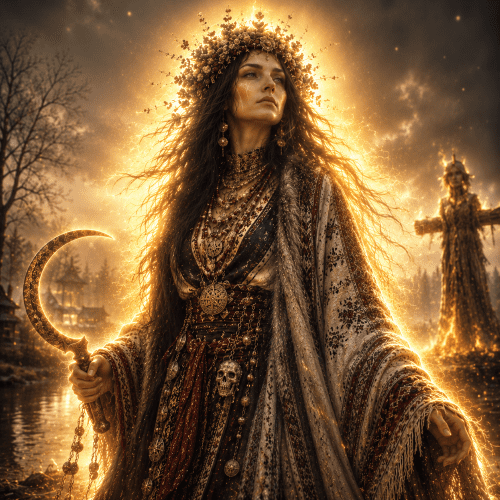
Vesna represents the annual awakening of nature. Her arrival signals the melting of snow, the return of birds, the blooming of flowers, and the beginning of the agricultural season. In many folk traditions, her coming is linked to the symbolic defeat of winter, often represented by the goddess Morana or Marzanna. Through this seasonal cycle, Vesna became a powerful symbol of hope, rebirth, and the enduring triumph of life over dormancy.
Physical Traits
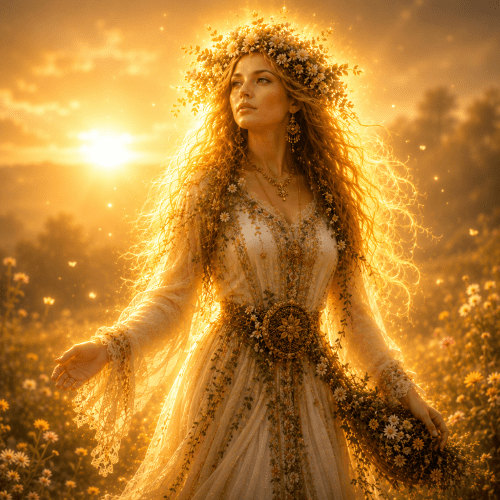
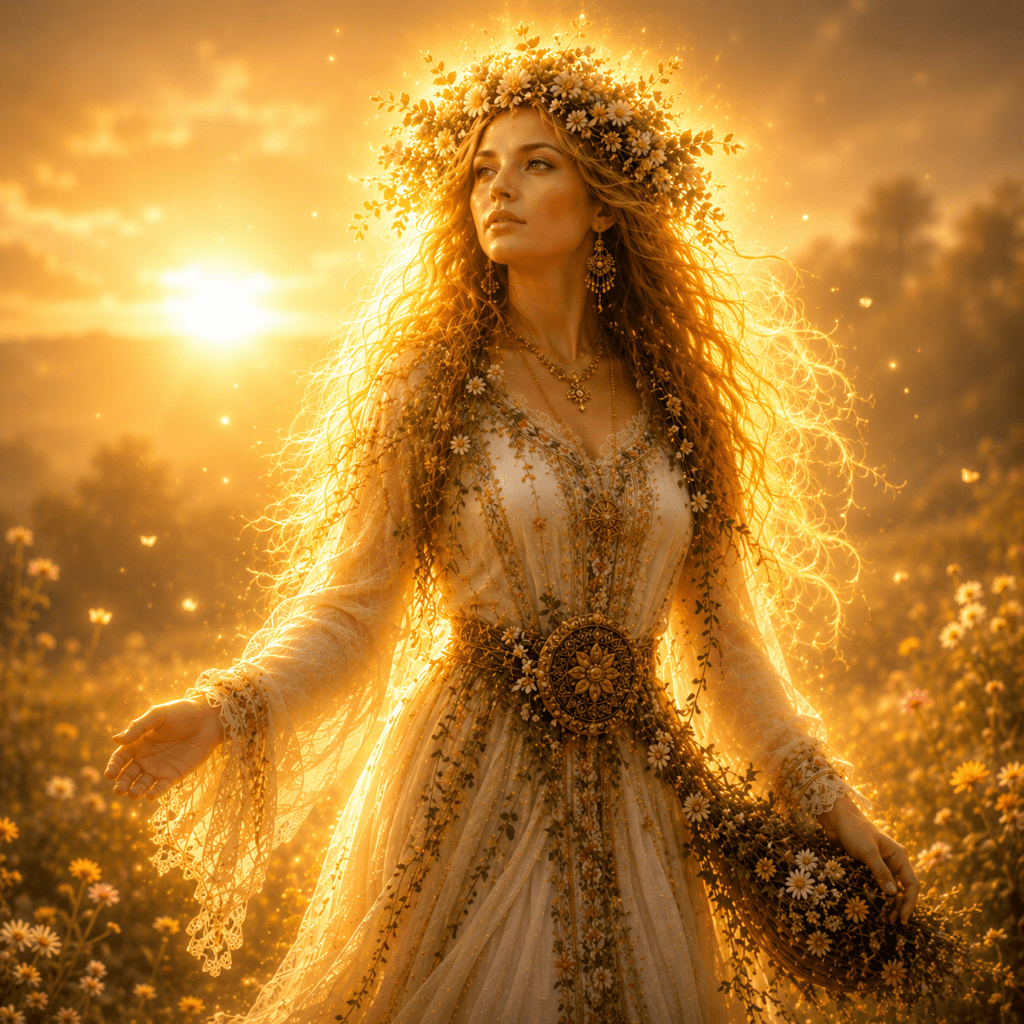
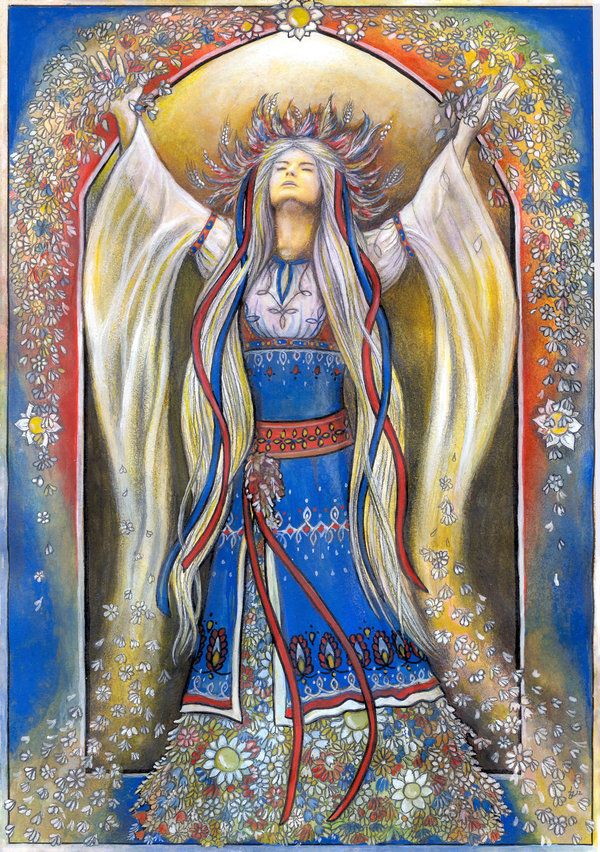
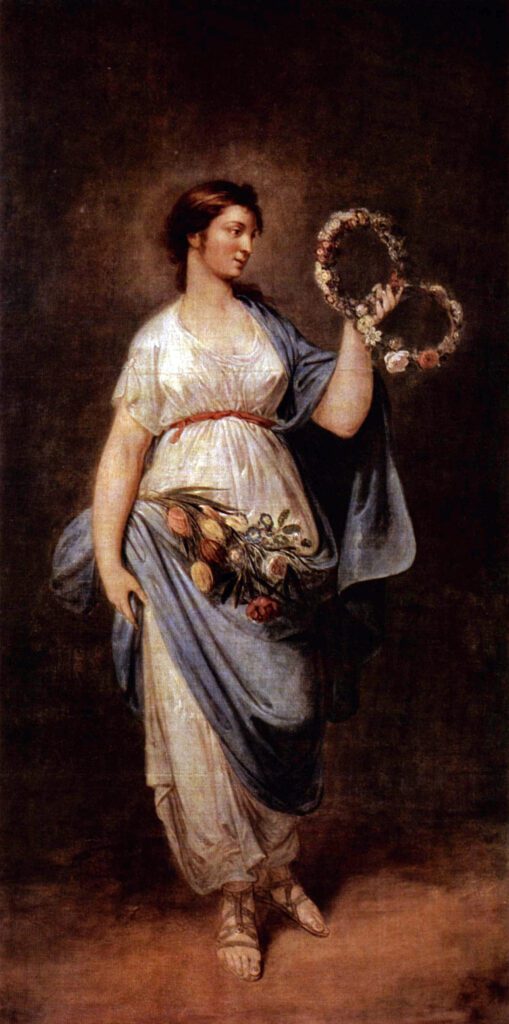
Vesna is traditionally imagined as a young and radiant woman whose appearance reflects the beauty of spring itself. Although no ancient source provides a definitive description of her appearance, Slavic folklore and later artistic interpretations have created a remarkably consistent image.
She is usually portrayed as youthful, healthy, and full of vitality. Her clothing is commonly depicted in white or light green shades, colors associated with purity, growth, and new beginnings. Flowers often adorn her hair, while floral wreaths symbolize the blossoming fields and forests that accompany her arrival. In many illustrations, she is shown walking barefoot across meadows, emphasizing her close connection to the earth and the natural world.
Birds frequently accompany Vesna in folklore. The cuckoo, a traditional herald of spring in many Slavic cultures, is particularly associated with her. Warm sunlight, flowering trees, and lush greenery often surround her, reinforcing her role as the living embodiment of the season. Rather than appearing as a warrior or ruler, Vesna’s beauty reflects harmony, abundance, and the gentle power of nature’s renewal.
Family
The family relationships of Vesna are among the most debated aspects of her mythology. Unlike deities such as Perun or Veles, whose positions within Slavic belief systems are more clearly defined, Vesna’s familial connections vary significantly depending on the source and regional tradition.
The most common association places Vesna in opposition to Morana, the goddess linked with winter, death, and seasonal decline. Some modern interpretations describe them as sisters or twin counterparts, representing the eternal cycle between life and death, warmth and cold, growth and decay. However, this relationship is largely derived from folklore and symbolic interpretation rather than surviving ancient myths.
Certain reconstructed Slavic pantheons connect Vesna to larger divine families. Some traditions associate her with Lada, a goddess linked to beauty, love, and fertility, while others place her among the descendants of the primordial creator Rod. These family trees remain speculative because reliable historical evidence is limited.
Vesna is also occasionally paired with Vesnik, a male spring figure who appears in certain South Slavic folk traditions. Rather than a husband or consort in the strict mythological sense, Vesnik functions more as a companion who heralds the arrival of spring. Despite these various interpretations, no universally accepted genealogy exists for Vesna, making her one of the more mysterious figures in Slavic mythology.
Other names
Because Slavic mythology developed across a vast geographic region, many deities acquired local names and overlapping identities. Vesna is no exception. In some traditions, she is associated with Živa or Zhiva, a goddess connected with life, fertility, and abundance. The similarities between the two figures have led some scholars and modern practitioners to view them as related deities or different regional expressions of the same divine force.
Certain folk traditions also connect Vesna with Devana or Dziewanna, although these figures are more commonly associated with forests, wilderness, and hunting. Such connections likely emerged through centuries of cultural blending and regional adaptation rather than from a single unified mythology.
The title “Vesna-Krasna,” meaning “Beautiful Vesna,” appears in folk songs and seasonal celebrations. The term “Vesnyanka” is also linked to springtime ritual songs performed throughout parts of Eastern Europe to welcome the changing season. Even today, Vesna remains a popular female given name throughout Slavic countries, preserving the goddess’s association with youth, beauty, and renewal.
Powers and Abilities
As the goddess of spring, Vesna’s powers revolve around growth, fertility, and the restoration of life. Her influence extends across both nature and human prosperity, making her one of the most positive and life-affirming figures in Slavic tradition.
Her most important ability is the renewal of the natural world. With her arrival, winter’s grip loosens, plants begin to grow, and animals emerge from seasonal dormancy. This transformation symbolizes the return of life to the earth and the continuation of the natural cycle.
Vesna is closely associated with fertility. Farmers traditionally viewed the coming of spring as essential for successful planting and future harvests. Through this connection, she became a guardian of agricultural abundance and the fertility of the land. Healthy crops, blossoming orchards, and productive fields all fell within her sphere of influence.
She is also linked with youth, beauty, and vitality. In folklore, her presence brings joy, optimism, and fresh beginnings. Some traditions describe her as spreading warmth and light wherever she travels, causing flowers to bloom and forests to awaken. These abilities are often symbolic rather than supernatural in a dramatic sense, reflecting nature’s seasonal transformation.
Another important aspect of Vesna’s power is her role in overcoming winter. Seasonal rituals frequently involved the symbolic banishment of Morana, representing the end of death and stagnation. Through this annual victory, Vesna became a powerful symbol of resilience, hope, and renewal.
Modern Day Influence
Although ancient Slavic paganism largely disappeared following Christianization, Vesna remains an influential cultural figure throughout the Slavic world. Her legacy survives in language, folklore, literature, art, and modern spiritual movements.
One of the most visible reminders of her influence is linguistic. The word “vesna” continues to mean “spring” in several Slavic languages, ensuring that her name remains part of everyday life. It is also widely used as a feminine given name, carrying associations of beauty, youth, and optimism.
Traditional spring celebrations across Eastern and Southern Europe still preserve elements of older seasonal customs. In some communities, festivals marking the end of winter and the arrival of spring echo ancient beliefs connected to Vesna and Morana. Folk songs known as Vesnyanky remain part of cultural heritage in regions such as Ukraine and Belarus.
Vesna has also become a popular figure in modern literature, fantasy fiction, and contemporary pagan spirituality. Artists frequently depict her as a radiant spring goddess surrounded by flowers and birds, while cultural organizations use her image to celebrate Slavic heritage and identity.
In Slovenia, the prestigious Vesna Awards, the country’s highest film honors, further demonstrate how deeply the name remains woven into modern culture. Whether viewed as a goddess, a personification of spring, or a cultural symbol, Vesna continues to embody renewal, hope, and the enduring cycle of life.
Related Images


Source
Meet the Slavs. (2022, May 13). 15 Slavic goddesses you should know about. Meet the Slavs. https://meettheslavs.com/slavic-goddesses/
Suzanne Corbie. (2022, March 21). Vesna, Slavic goddess of spring. Suzanne Corbie. https://suzannecorbie.co.uk/vesna-slavic-goddess-of-spring/
Trident Myth. (2023, November 11). Vesna: Embracing the rejuvenation of spring in Slavic mythology. Trident Myth. https://www.tridentmyth.com/vesna/
Vesna (mythology). (2024, November 15). In Wikipedia. https://en.wikipedia.org/wiki/Vesna_(mythology)
Vesna. (2021, December 31). In Wiktionary. https://en.wiktionary.org/wiki/Vesna
Lastavica Cruising. (2021, May 14). Vesna – the goddess of spring, love and harmony. Lastavica Cruising. https://lastavica.hr/en/croatian-culture-and-history/vesna-the-goddess-of-spring-love-and-harmony
Abbott, G. F. (1903). Macedonian Folk-Lore. Cambridge University Press.
Afanasyev, A. N. (1869). Poetic Views of the Slavs on Nature (Vol. 3). Moscow.
Bogataj, J. (2005). Slovenska mitologija – Vesna. Poštne znamke, 56.
Derksen, R. (2008). Etymological Dictionary of the Slavic Inherited Lexicon. Brill
Slavorum. (n.d.). Czech female band “Vesna” turning music into a Slavic fairy‑tale. Slavorum. https://www.slavorum.org/czech-female-band-vesna-turning-music-into-a-slavic-fairy-tale/
Frequently Asked Questions
Who is Vesna in Slavic mythology?
Vesna is the Slavic goddess or personification of spring, associated with fertility, renewal, growth, and the return of life after winter.
What does the name Vesna mean?
The name Vesna means “spring” in several Slavic languages and symbolizes rebirth, youth, and seasonal renewal.
Is Vesna connected to Morana?
Yes. Vesna is often portrayed as the seasonal counterpart of Morana, representing spring’s victory over winter and death.
What are Vesna's powers?
Vesna governs spring, fertility, agricultural prosperity, natural renewal, and the awakening of plants, animals, and human vitality.
Is Vesna still important today?
Yes. Vesna remains a cultural symbol throughout Slavic countries and continues to inspire festivals, literature, art, personal names, and modern spiritual traditions.