The Dragon Heroes : A Chinese Fantasy of Dragons, Love and Betrayal
| Description | |
|---|---|
| Origin | Chinese Mythology |
| Language | Mandarin |
| Type | Reimagination |
| Seasons | 1 (40 episodes) |
| Cast | Ren Quan, Li Xiaolu, Christopher Lee, Cui Peng, Eddy Ko, Felix Wong |
| OTT Platform / TV Channel | BTV (China) and MediaCorp Channel 8 (Singapore) |
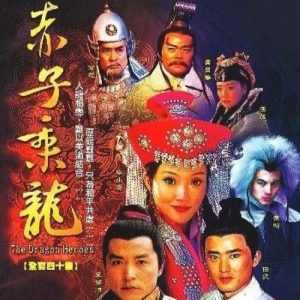
The Dragon Heroes
Introduction
The Dragon Heroes (赤子乘龙), also known as Chi Zi Cheng Long, is a Chinese fantasy television series released in 2005. Combining costume drama, martial arts, romance and supernatural adventure, the series explores a world where humans and dragons share a troubled history. Directed by Zheng Weiwen (Steve Cheng Wai-Man), Li Hantao and other collaborators, the production features Ren Quan as Li Bin, Li Xiaolu as Shui Linglong and Fei Cui, Christopher Lee as Yan Cheng, and Cui Peng as Yao Lie, also known as the Little White Dragon. The series is listed as having 40 episodes by MediaCorp, although some streaming catalogues list 44.
At its heart, The Dragon Heroes is a story about power, prejudice and the consequences of betrayal. Its dragons are not simply monstrous creatures threatening human civilisation. They are a community with their own rulers, relationships, loyalties and grievances. When a human emperor turns against the very beings who helped secure his power, an uneasy relationship between the two peoples becomes a struggle for survival.
The series draws inspiration from the cultural significance of dragons in Chinese mythology, where these beings are traditionally associated with water, rain, prosperity and authority. However, its characters, romantic conflicts and central political narrative belong to a fictional television universe rather than a direct retelling of one classical Chinese legend. This combination of familiar mythological symbolism and original storytelling gives The Dragon Heroes its distinctive place within Chinese fantasy television.
Plot
The story of The Dragon Heroes begins with a betrayal that changes the relationship between humans and dragons. The Dragon King has helped the human ruler overcome his enemies, but the emperor eventually becomes suspicious of the dragon clan’s power. Fearing that the Dragon King could threaten his authority, he turns against his former ally and sets out to eliminate the dragons. The Dragon King is imprisoned, while his youngest daughter, Shui Linglong, becomes separated from the world she once knew.
Years later, Yuan Bao, an orphan raised among travelling performers, accidentally releases the dragon princess from her enchanted prison. Her return to the human world begins a journey to discover what happened to her father and her people. Initially unfamiliar with human society, Shui Linglong gradually learns to navigate a world shaped by political ambition, personal loyalties and competing interests.
Her journey brings her into contact with Li Bin, the crown prince. Unlike his father, Li Bin believes that a ruler should protect his people rather than govern through fear. Their growing affection becomes complicated by the involvement of Yao Lie, a white dragon who shares a history with Shui Linglong. His loyalty to the dragon clan and his feelings for the princess introduce another dimension to the conflict.
The story also explores Shui Linglong’s relationship with Fei Cui, a kind-hearted young woman whose body becomes connected with the princess’s fate. Shui Linglong eventually inhabits Fei Cui’s body, allowing the drama to explore questions of identity and sacrifice alongside its supernatural adventures.
As the princess searches for her father and attempts to restore the dragon clan, alliances shift and betrayals deepen. The Dragon King’s eventual rescue does not bring lasting peace, as the emperor’s hostility continues to threaten both communities. The resulting struggle forces the characters to confront a difficult question: can humans and dragons overcome the hatred created by those who seek to control them?
Mythological Basis
The mythology behind The Dragon Heroes begins with the Chinese dragon, known as long (龙). Unlike the predominantly hostile dragons found in many European legends, Chinese dragons have traditionally been associated with auspicious power, rainfall, waterways, agricultural prosperity and protection. Their symbolism developed across religious traditions, folklore, imperial culture and popular storytelling.
One particularly relevant figure is the Dragon King, or Longwang (龙王). In Chinese religious traditions and folklore, Dragon Kings are supernatural rulers associated with bodies of water and the creatures inhabiting them. They are frequently connected with rainfall and the well-being of communities that depend on water. Their powers can be beneficial, although the relationship between divine authority and human society is not always straightforward.
The Dragon King in The Dragon Heroes draws upon this recognisable cultural tradition, but the series adapts it to serve its own dramatic narrative. Rather than focusing primarily on rainfall or the administration of the natural world, it presents the Dragon King as a ruler caught in a political struggle with a human emperor. His imprisonment becomes a symbol of the persecution suffered by his people.
The Dragon Pearl also contributes to the series’ supernatural framework. It functions as an important element of the fictional conflict, connecting the characters’ destinies with the struggle over dragon power. However, the pearl’s specific role in the series should not be treated as a universal feature of Chinese dragon mythology.
Transformation provides another connection with traditional supernatural storytelling. Chinese folklore includes accounts of dragons, spirits and other extraordinary beings assuming different forms. Yao Lie’s human disguise and Shui Linglong’s connection with Fei Cui draw on this broader imaginative tradition, while their precise circumstances belong to the drama’s own fictional world.
These elements allow The Dragon Heroes to use Chinese dragon symbolism without claiming to reproduce a single ancient myth. Its mythology is best understood as a modern creative adaptation of established cultural motifs.
Characters & Archetypes
The characters in The Dragon Heroes represent different responses to power, loyalty and the divisions between humans and dragons. Their relationships drive the plot while giving the series familiar mythic archetypes.
Shui Linglong, the Dragon Princess, is the displaced royal and questing heroine. Separated from her family and community, she must discover the truth about her past while deciding how to respond to the suffering inflicted upon her people. Her relationship with Li Bin complicates her responsibilities, placing personal affection alongside her duty to the dragon clan. Her connection with Fei Cui also makes identity and sacrifice central to her character.
Li Bin represents the benevolent prince. As the emperor’s son, he occupies a position of privilege, yet his understanding of leadership differs from his father’s. His willingness to question the hostility directed towards dragons makes him a potential bridge between the two communities. Rather than relying exclusively on royal authority, he must learn to navigate competing loyalties and the consequences of his choices.
Yuan Bao is the innocent helper whose actions set the main adventure in motion. His accidental release of Shui Linglong demonstrates how seemingly insignificant individuals can influence events far beyond their understanding. Although he lacks the supernatural abilities and political influence possessed by the principal characters, his kindness and resourcefulness make him an important part of the story.
Yao Lie, also known as the Little White Dragon, embodies the conflicted guardian. His identity connects him to the dragon clan, while his relationship with Shui Linglong introduces emotional complications into his mission. His character explores the tension between loyalty to a community and the desire to control the choices of someone he loves.
The emperor represents the tyrant whose fear of losing power turns former allies into enemies. His betrayal of the Dragon King demonstrates how political insecurity can transform cooperation into persecution. The Dragon King, meanwhile, represents the wounded sovereign whose imprisonment threatens the survival and future of his people.
Together, these characters create a conflict in which the distinction between hero and villain depends less on species than on individual choices. The drama repeatedly questions whether authority is justified by power alone or must be earned through responsibility and compassion.
Creative Liberties
The Dragon Heroes takes considerable creative liberties with Chinese mythology, combining familiar supernatural figures with an original story of political betrayal and forbidden love. Its central conflict between the human emperor and the dragon clan is a dramatic construction rather than a direct adaptation of a single classical legend.
The series also reshapes the traditional image of the Dragon King. In Chinese religious traditions, Dragon Kings are associated with aquatic realms, rainfall and supernatural authority. The drama retains the ruler’s extraordinary status but places him within a dynastic struggle, making his captivity and the persecution of his people the emotional centre of the narrative.
Its treatment of dragon-human relationships is another creative choice. The romance between Shui Linglong and Li Bin turns a conflict between two communities into a personal struggle involving affection, loyalty and political responsibility. Yao Lie’s involvement adds emotional tension, allowing the series to combine mythological adventure with the conventions of romantic melodrama.
The connection between Shui Linglong and Fei Cui further expands the fantasy framework. By incorporating the transfer of identity and the inhabiting of another person’s body, the series introduces supernatural complications that serve its characters and plot. Although transformation has precedents in Chinese folklore, this particular storyline should be understood as part of the show’s original narrative rather than a universal mythological motif.
Most importantly, the series presents dragons as a persecuted community rather than simply supernatural threats. They experience loss, maintain family relationships and struggle to protect their future. This approach shifts the familiar conflict between humans and dragons towards questions of prejudice, political domination and reconciliation.
Ultimately, The Dragon Heroes demonstrates how Chinese fantasy television can reinterpret traditional cultural symbols for modern audiences. Its dragons retain associations with extraordinary power and authority, but their story also becomes one of belonging, betrayal and the possibility of peace. By combining mythological inspiration with romance and political intrigue, the series creates a fictional world in which the struggle between humans and dragons reflects a broader conflict over how power should be used.