


Nan Madol : The Ancient Stone City of Pohnpei
At a glance
| Description | |
|---|---|
| Mythology | Pohnpeian Mythology |
| Country | Federated States of Micronesia |
| Closest airport | Pohnpei International Airport (PNI) |
| Type | Constructed |
| Accessibility | 04/10 |
Mythlok Perspective
In Mythlok’s Perspective, Nan Madol represents how architecture can become an expression of sacred authority, collective identity and political power. Its construction shares an interesting parallel with the megalithic monuments of ancient Egypt, where monumental stone structures reflected the relationship between rulers, religious beliefs and organised labour. However, while Egyptian monuments primarily celebrated divine kingship and the afterlife, Nan Madol’s artificial islets and interconnected waterways reflect a distinctly Pohnpeian understanding of sacred geography, chiefly authority and the relationship between land and sea.
Nan Madol
Introduction
Off the southeastern coast of Pohnpei in the Federated States of Micronesia lies Nan Madol, one of the most extraordinary archaeological sites in the Pacific. Built across a coastal lagoon near Temwen Island, this ancient city consists of more than 100 artificial islets separated by narrow waterways and enclosed by massive walls of columnar basalt and coral boulders. Its unusual architecture has earned it the nickname “Venice of the Pacific”, although its history and purpose are very different from those of its European namesake.
Nan Madol served as the ceremonial, political and mortuary centre of the Saudeleur Dynasty, which established control over much of Pohnpei. Its monumental structures include royal residences, temples, burial complexes and spaces associated with the island’s chiefly hierarchy. The construction of these buildings required enormous quantities of stone, considerable labour and an organised system capable of coordinating resources across the island.
The site covers approximately 76.7 hectares as a UNESCO World Heritage property, with a surrounding buffer zone of 664 hectares. Its archaeological significance lies not only in its architecture but also in what it reveals about the development of complex societies in the Pacific.
For the Pohnpeian people, however, Nan Madol is more than an abandoned settlement. Oral traditions connect its construction with supernatural brothers, sacred rituals and legendary rulers. These stories give the ruins a cultural dimension that extends beyond archaeology, making Nan Madol a remarkable meeting point between ancestral memory, history and mythology.
Connection with Mythology
Pohnpeian oral traditions associate the creation of Nan Madol with two brothers, Olosihpa and Olosohpa, who arrived from a mythical western land known as Katau or Kanamwayso. Described in traditional accounts as powerful sorcerers, the brothers travelled to Pohnpei searching for a suitable location to establish a sacred centre dedicated to Nahnisohn Sahpw, the god associated with agriculture.
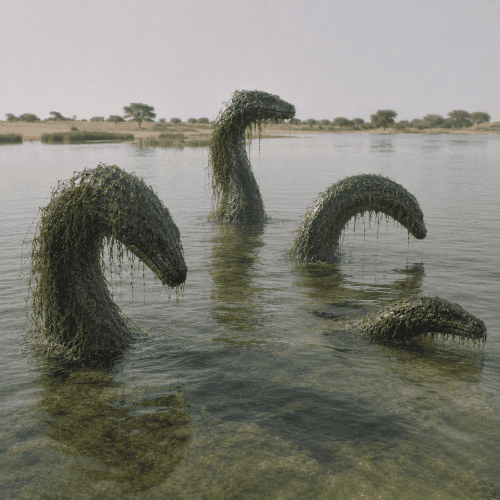
After several unsuccessful attempts to establish their religious centre, they eventually settled near Temwen Island. Here, they began constructing an altar and the foundations of what would become Nan Madol. The most extraordinary element of their story concerns the transportation of the enormous basalt stones. According to local traditions, the brothers used supernatural abilities to lift and move the massive columns into position. Some versions describe a flying dragon assisting them, carrying the stones through the air and placing them where the builders needed them. Other accounts attribute the achievement to powerful birds or supernatural beings.
These stories offer a traditional explanation for an engineering achievement that continues to attract archaeological interest. Scientific investigations have established that the basalt originated from different locations across Pohnpei, demonstrating that the builders organised the movement of heavy materials over considerable distances.
According to the legend, Olosihpa died after the settlement was established, leaving Olosohpa as its first ruler. Olosohpa married a local woman and became the founder of the Saudeleur Dynasty. His descendants governed Pohnpei for generations before their authority was eventually challenged by Isokelekel, a legendary warrior whose arrival marked the end of Saudeleur rule. The mythology surrounding Nan Madol therefore connects the physical landscape with divine authority, ancestral power and the legitimacy of traditional leadership. These narratives remain an important part of Pohnpeian cultural heritage and help explain why the ancient city continues to hold such significance for local communities.
Ways to Get There
Reaching Nan Madol requires travelling to Pohnpei, one of the islands of the Federated States of Micronesia. The principal international gateway is Pohnpei International Airport (PNI), located near Kolonia, the state’s main urban centre. International connections generally involve transit through regional Pacific hubs, particularly Guam or Honolulu, depending on the airline and available schedules. Travellers should check flight availability carefully because services to Pohnpei are relatively limited compared with major international destinations.
From Kolonia, visitors travel southeast towards the Madolenihmw municipality, where Nan Madol is situated near Temwen Island. Road transport can be arranged through accommodation providers or local tour operators. The final approach depends on the access route and prevailing conditions. Visitors may reach parts of the archaeological complex by following local trails and crossing shallow tidal areas. Alternatively, guided boat trips provide access through the historic waterways, allowing travellers to explore the artificial islets from the lagoon.
Boat excursions are particularly useful for understanding the city’s original design, as the canals were an essential part of its organisation. However, tides, weather and local access arrangements can affect the available routes. Arranging a visit with a knowledgeable local guide is strongly recommended. Nan Madol includes areas under customary ownership, and access arrangements should be confirmed before travelling. A guide also provides valuable context about the ruins, traditional place names and the cultural protocols associated with this sacred landscape.
What to Look For
Nan Madol’s most distinctive feature is its extraordinary stone architecture. The builders used massive columnar basalt blocks, coral boulders and smaller stones to construct walls, platforms and enclosures across the lagoon. The basalt columns were arranged using a distinctive header-and-stretcher technique, creating structures that resemble enormous pieces of interlocking timber. Among the most important structures is Nandauwas, a monumental mortuary complex associated with the Saudeleur rulers. Its imposing basalt walls enclose burial and ceremonial spaces, making it one of the most recognisable features of the entire archaeological site. The scale of its construction reflects the importance of chiefly authority and ancestral traditions in ancient Pohnpeian society.
The network of canals is another essential feature. These waterways separate the artificial islets and connect different sections of the city. Their arrangement demonstrates that Nan Madol was deliberately designed as a water-based settlement rather than simply a collection of buildings constructed along the coast. Visitors should also pay attention to the remains of ceremonial platforms, elite residences and administrative spaces. Together, these structures suggest that different islets served specialised purposes within the political and religious organisation of the Saudeleur Dynasty.
The surrounding environment adds another dimension to the experience. Mangroves, tropical vegetation and shallow coastal waters have gradually reclaimed parts of the ancient complex. The contrast between dark basalt walls, green vegetation and turquoise water makes Nan Madol visually distinctive. However, visitors should avoid climbing on fragile structures, removing stones or disturbing vegetation. Respecting restricted areas and local guidance is essential to protecting this vulnerable archaeological landscape.
Importance in cultural history
Nan Madol represents one of the most significant examples of monumental architecture in the Pacific Islands. Its construction demonstrates that ancient Pohnpeian society possessed the organisational capabilities necessary to coordinate large-scale building projects without modern machinery. The city was closely associated with the Saudeleur Dynasty, which established a centralised system of chiefly authority across Pohnpei. Its political and ceremonial importance is reflected in the distribution of royal residences, mortuary structures, temples and other specialised spaces throughout the artificial islets.
Archaeological research has helped establish a more detailed chronology of the site. Earlier interpretations generally placed its major development between 1200 and 1500 CE. However, research published in 2024, using uranium-thorium dating of coral building materials alongside radiocarbon evidence, identified two major construction phases extending from the 10th to the 15th centuries. This research has added important detail to the understanding of Nan Madol’s development and the changing political organisation of Pohnpei.
The Saudeleur Dynasty is traditionally believed to have ended around 1628 following the arrival of Isokelekel. Although the precise historical chronology remains connected to oral traditions, the transition marked a significant change in Pohnpei’s political organisation. In 2016, UNESCO recognised Nan Madol as a World Heritage Site under four cultural criteria. Its inscription acknowledged its monumental architecture, evidence of complex chiefly societies, ceremonial significance and continuing connections with traditional systems of governance.
However, Nan Madol was also placed on UNESCO’s List of World Heritage in Danger in the same year. Waterway siltation, invasive vegetation, storm surges and deterioration of stone structures threaten the archaeological remains. Today, Nan Madol remains deeply connected to Pohnpeian identity. Its significance extends beyond the achievements of an ancient dynasty, preserving connections between the island’s people, ancestral traditions, traditional leadership and the surrounding natural environment.
Best time to travel
Pohnpei has a warm tropical climate throughout the year, with frequent rainfall and high humidity. Unlike destinations with clearly defined seasonal weather, even the comparatively drier months can experience substantial precipitation. The relatively drier period generally falls between November and April, with January and February typically recording lower rainfall. These months are often more suitable for outdoor exploration, although weather conditions can change quickly.
The wetter months, particularly April and May, can bring heavier rainfall. This may affect walking routes, water crossings and boat excursions around the archaeological complex. Visitors travelling during this period should allow flexibility in their schedules. Early morning is generally a good time to explore Nan Madol. Temperatures are more comfortable, and the softer natural light highlights the distinctive basalt walls and surrounding waterways.
Tide conditions are particularly important when planning a visit. Some walking approaches become easier around lower tides, while boat excursions depend on suitable water levels and local navigation conditions. Visitors should confirm the day’s arrangements with their guides rather than relying on a general seasonal recommendation. Comfortable footwear, drinking water, insect protection and rain gear are useful throughout the year. With appropriate preparation and respect for local customs, a visit to Nan Madol offers an extraordinary opportunity to experience one of the Pacific’s most remarkable cultural landscapes.



Source
National Park Service. (n.d.). Nan Madol. https://www.nps.gov/places/nan-madol.htm
UNESCO World Heritage Centre. (2016). Nan Madol: Ceremonial Centre of Eastern Micronesia. https://whc.unesco.org/en/list/1503/
UNESCO World Heritage Centre. (2016). Nan Madol: Ceremonial Centre of Eastern Micronesia—Map of inscribed property. https://whc.unesco.org/en/documents/141610
UNESCO World Heritage Centre. (2016). Four sites inscribed on UNESCO’s World Heritage List. https://whc.unesco.org/en/news/1524
UNESCO World Heritage Centre. (2016). Decision 40 COM 8B.22. https://whc.unesco.org/en/decisions/6800/
UNESCO World Heritage Centre. (2023). State of conservation: Nan Madol: Ceremonial Centre of Eastern Micronesia. https://whc.unesco.org/en/soc/3768/
National Historic Preservation Office, Federated States of Micronesia. (n.d.). Nan Madol, East Site of Temwen Island, Temwen Island. https://nach.gov.fm/nan-madol-east-site-of-temwen-island-temwen-island/
SmartHistory. (2022). Nan Madol: “In the space between things.” https://human.libretexts.org/Bookshelves/Art/Art_History_and_Theory/SmartHistory_of_Art_2e/SmartHistory_of_Art_X_-Oceania/05%3A_Micronesia/5.04%3A_Nan_Madol-_In_the_space_between_things
CruiseAlert. (2026). Pohnpei, Micronesia cruise port guide. https://www.cruisealert.com/content/port-guide/pohnpei-micronesia
Cultural Heritage Online. (2026). Nan Madol UNESCO heritage site Micronesia. https://culturalheritageonline.com/magazine/unesco-world-heritage-sites-near-nan-madol/
Frequently Asked Questions
Who built Nan Madol?
Nan Madol was built by the ancient Pohnpeian people and served as the ceremonial and political centre of the Saudeleur Dynasty. Pohnpeian oral traditions attribute its construction to two supernatural brothers, Olosihpa and Olosohpa.
Where is Nan Madol located?
Nan Madol is located off the southeastern coast of Pohnpei Island in the Federated States of Micronesia. The ancient complex lies near Temwen Island, within the Madolenihmw municipality.
Why is Nan Madol called the Venice of the Pacific?
Nan Madol is called the Venice of the Pacific because its more than 100 artificial islets are separated by a network of canals and waterways. These channels connected different sections of the ancient city.
What is the mythology behind Nan Madol?
Pohnpeian mythology tells of two brothers, Olosihpa and Olosohpa, who used supernatural powers to construct the ancient city. Some versions describe a flying dragon helping them transport the enormous basalt stones used in its construction.
Is Nan Madol a UNESCO World Heritage Site?
Yes. UNESCO inscribed Nan Madol on the World Heritage List in 2016, recognising its monumental architecture and importance to Pacific Island history. It was also placed on the List of World Heritage in Danger because of environmental deterioration and conservation challenges.


