
Ogun’s Machete : The Sacred Iron Blade in Yoruba Tradition
At a glance
| Description | |
|---|---|
| Mythology | Indian Mythology |
| Type | Carried |
| Power | 08/10 |
Mythlok Perspective
In Mythlok Perspective, Ogun’s Machete is not simply a weapon of iron but a symbol of civilization’s decisive breakthrough. It represents the moment humanity chose to cut through fear, wilderness, and limitation. Iron becomes more than metal; it becomes intention shaped by fire. Unlike the refined craftsmanship of Hephaestus in Greek tradition or the sacred swordsmith kami of Japan, Ogun’s force feels raw and untamed. His blade does not polish reality. It carves a path through it.
Ogun’s Machete
Introduction
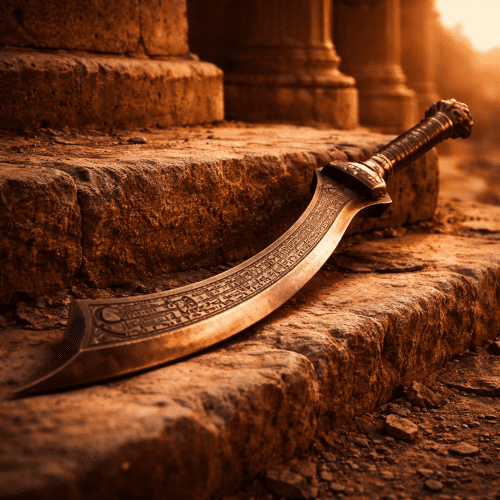
Ogun’s Machete is one of the most powerful ritual symbols in Yoruba spiritual tradition. More than a blade of iron, it represents the force that clears paths, enforces justice, protects communities, and fuels technological progress. Ogun, the Orisha of iron, war, labor, and innovation, is inseparable from this weapon. Wherever metal exists, his presence is acknowledged, and wherever iron cuts through resistance, Ogun’s authority is felt.
In Yoruba belief, Ogun is not simply a warrior. He is the divine blacksmith, the patron of hunters, the guardian of roads, and the protector of those who work with metal. His machete embodies this dual nature. It creates and destroys. It protects and punishes. It opens new beginnings and enforces sacred oaths. Across West Africa and throughout the diaspora in Santería, Candomblé, and Haitian Vodou, Ogun’s Machete remains a living symbol of resilience, courage, and transformation.
Origins
The origins of Ogun’s Machete are rooted in Yoruba cosmology and the rise of iron technology in West Africa. Archaeological evidence confirms that parts of West Africa transitioned directly from the Stone Age into the Iron Age without a Bronze Age phase, with iron smelting documented as early as the first millennium BCE. Within Yoruba tradition, this technological leap is spiritually attributed to Ogun.
In sacred narratives, Ogun was the first Orisha to descend from the heavens to prepare the earth for habitation. Armed with an iron blade and accompanied by a loyal dog, he hacked through dense primordial forest so that other divine beings could descend safely. Wooden and stone tools had failed. Only iron succeeded. This moment established Ogun as the divine pathfinder and culture hero.
The machete specifically reflects the agricultural and practical environment of Yoruba society. It was not a ceremonial sword of royalty but a working blade used to clear brush, cultivate land, and defend settlements. Its symbolism therefore reflects daily life. Ogun’s Machete became the spiritual embodiment of iron itself. In Yoruba language, the root “gún” carries meanings associated with striking, piercing, or overcoming, reinforcing the blade’s identity as an instrument of decisive action.
Over centuries, blacksmith guilds in regions such as Ile-Ife and Ondo preserved Ogun’s legacy. Every forge became a sacred space. Every spark of iron carried divine significance. The machete thus evolved from tool to sacred emblem.
Powers
Ogun’s Machete is believed to possess the supernatural ability to cut through both physical and spiritual barriers. It does not merely clear forests. It clears destiny. Devotees pray to Ogun when they seek to remove obstacles from their lives, whether those obstacles are enemies, injustice, stagnation, or misfortune.
The blade enforces truth. In traditional Yoruba courts, individuals swore oaths upon iron associated with Ogun. To lie under his witness invited severe consequences, often believed to manifest through accidents involving metal or iron-related harm. This reputation made Ogun’s Machete a divine instrument of justice.
At the same time, the blade represents constructive power. Iron tools made farming efficient. Weapons defended communities. Metal instruments built cities. The machete therefore symbolizes progress, industry, and endurance. Ogun governs blacksmiths, mechanics, surgeons, drivers, soldiers, and engineers. From ancient iron blades to modern machinery, all fall under his influence.
There is also a volatile aspect. Ogun’s energy is intense and uncompromising. When angered, he becomes destructive. This duality is central to understanding Ogun’s Machete. It is neither purely violent nor purely creative. It is raw power shaped by intention.
Owners/Users
Ogun himself is the primary owner of the machete. In shrines, his presence is represented through iron implements placed inside metal vessels filled with tools such as chains, spikes, and hammers. The machete is often positioned prominently as his defining symbol.
However, Ogun’s Machete is symbolically wielded by many professions. Hunters invoke him before entering forests. Soldiers pray for courage. Blacksmiths dedicate their forges to him. Mechanics and drivers seek protection from metal-related accidents. Surgeons, who cut to heal, also operate within his symbolic domain.
Within diaspora traditions, Ogun is known by related names. In Santería, he is called Oggún and remains associated with iron tools. In Brazilian Candomblé, he maintains strong warrior attributes and is often linked with Saint George through Catholic syncretism. In Haitian Vodou, Ogou embodies similar characteristics of strength, military power, and technological mastery. Across these traditions, the machete continues to function as a ritual object, oath instrument, and protective symbol.
Instances used
One of the most famous narratives involving Ogun’s Machete describes the clearing of the primordial forest. When other Orishas attempted to descend to Earth, they were blocked by thick wilderness. Ogun stepped forward and cut a road through the chaos, earning titles that identify him as the opener of pathways. This myth explains why he is invoked before major endeavors, journeys, and new ventures.
Another legend recounts Ogun’s tragic rage at Ire-Ekiti. After helping establish kingship and civilization, he became angered by betrayal and conflict. In fury, he wielded his blade destructively before withdrawing into the earth. This story highlights the danger of uncontrolled power and reinforces the need for discipline when invoking Ogun’s energy.
In festivals such as the Olọ́jọ́ celebration in Ile-Ife, iron symbolism plays a central role in honoring Ogun’s contribution to civilization. Ritual clashes of metal objects may be performed to invoke his presence. Offerings often include palm wine, roasted yam, and dogs, animals closely associated with him. In the diaspora, Ogun’s machete became symbolically tied to revolutionary strength. During periods of resistance and liberation movements in the Caribbean, his spirit was invoked as a force of resilience and military determination.

Source
Abiodun, R., Drewal, H. J., & Pemberton, J., III (Eds.). (1994). The Yoruba artist: New theoretical perspectives on African arts. Smithsonian Institution Press.
Idowu, E. B. (1962). Olódùmarè: God in Yoruba belief. Longmans.
Olusegun, O. O. (2017). A study of Ogun festival in Ondoland. International Journal on Studies in English Language and Literature, 5(5), 1-8. https://www.arcjournals.org/pdfs/ijsell/v5-i5/1.pdf
Santería Guide. (2025, April 1). Ogun: The warrior Orisha of iron, war, and protection. https://santeriaguide.com/blogs/santeria-guide-english/ogun-the-warrior-orisha-of-iron-war-and-protection
Wikipedia contributors. (2026). Ogun. Wikipedia, The Free Encyclopedia. https://en.wikipedia.org/wiki/Ogun
Ayoola, O. (2025, November 15). Ọgún: Yoruba Orisa of Iron, War, and the Open Road. Retrieved from https://oyebodeayoola.com
Frequently Asked Questions
What does Ogun's Machete symbolize?
Ogun’s Machete symbolizes iron, justice, protection, and the power to remove obstacles. It represents both creative and destructive force.
Is Ogun's Machete only a weapon of war?
No. While it is used in battle myths, it also represents agriculture, craftsmanship, and technological progress.
Why is iron sacred to Ogun?
Iron marks the beginning of advanced civilization in West Africa. Ogun is regarded as the divine force behind metallurgy and all metal tools.
How is Ogun's Machete used in rituals?
It is used in oath-taking, protection rites, and ceremonies that seek to open paths or remove spiritual blockages.
Is Ogun worshipped outside Nigeria?
Yes. Through the African diaspora, Ogun is venerated in Cuba, Brazil, Haiti, and other regions under related names.