


Te Wheke-o-Muturangi : The Giant Octopus of Māori Tradition
At a glance
| Description | |
|---|---|
| Origin | Maori Mythology |
| Classification | Animals |
| Family Members | N/A |
| Region | New Zealand |
| Associated With | Giant octopus, Ccean travel, Fishing, Extraordinary strength |
The Mythlok Perspective
In Mythlok’s Perspective, Te Wheke-o-Muturangi demonstrates how a dangerous creature can become an unexpected agent of discovery. Unlike the Kraken of Norse tradition, whose immense power threatens ships and sailors, this Māori giant octopus drives a pursuit that connects ancestral memory with the geography of Aotearoa. While the Kraken embodies the ocean’s destructive unpredictability, Te Wheke-o-Muturangi becomes part of a voyaging narrative that links people to new lands. The contrast reveals how different cultures transform the dangers of the sea into stories that explain not only its mysteries but also humanity’s relationship with exploration, identity and place.
Te Wheke-o-Muturangi
Introduction
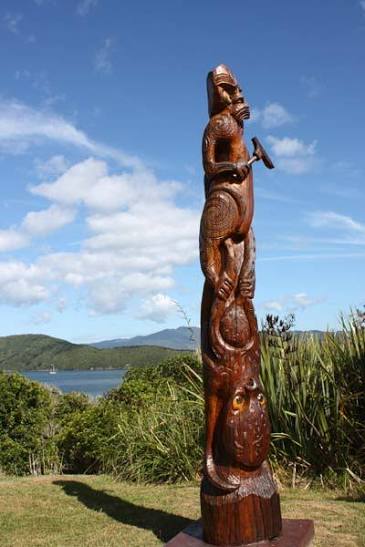
Te Wheke-o-Muturangi, also known as Te Wheke-a-Muturangi, is a legendary giant octopus in Māori tradition whose story is closely associated with Kupe, the ancestral Polynesian navigator linked to the discovery of Aotearoa, now known as New Zealand. The creature belongs to one of the best-known narratives surrounding Kupe’s voyages, in which a pursuit across the Pacific leads to encounters with unfamiliar coastlines and the eventual defeat of a formidable marine adversary. Although the details differ between accounts, Te Wheke remains an important figure connecting ocean navigation, ancestral memory and the cultural significance of particular places.
The story commonly begins in Hawaiki, the ancestral homeland from which Kupe and other Polynesian voyagers are said to have travelled. Te Wheke was the pet of Muturangi, a tohunga, or ritual expert, whose refusal to restrain the creature brought him into conflict with Kupe. According to a widely recorded version, the giant octopus repeatedly interfered with fishing, taking bait and disrupting the efforts of Kupe’s people. When the problem continued, Kupe set out to pursue the creature across the ocean. The journey brought him to Aotearoa, where the chase continued through coastal waters before culminating in a fierce battle.
Māori traditions are not a single, universally fixed narrative, and different iwi preserve variations of the story. The locations associated with the pursuit and the details of the final confrontation can differ. These differences are significant because the narrative is connected to local histories, place names and ancestral relationships. Te Wheke-o-Muturangi should therefore be understood not simply as a legendary sea monster but as a figure within a wider body of Māori knowledge about voyaging, the ocean and the ancestral discovery of Aotearoa.
Physical Traits
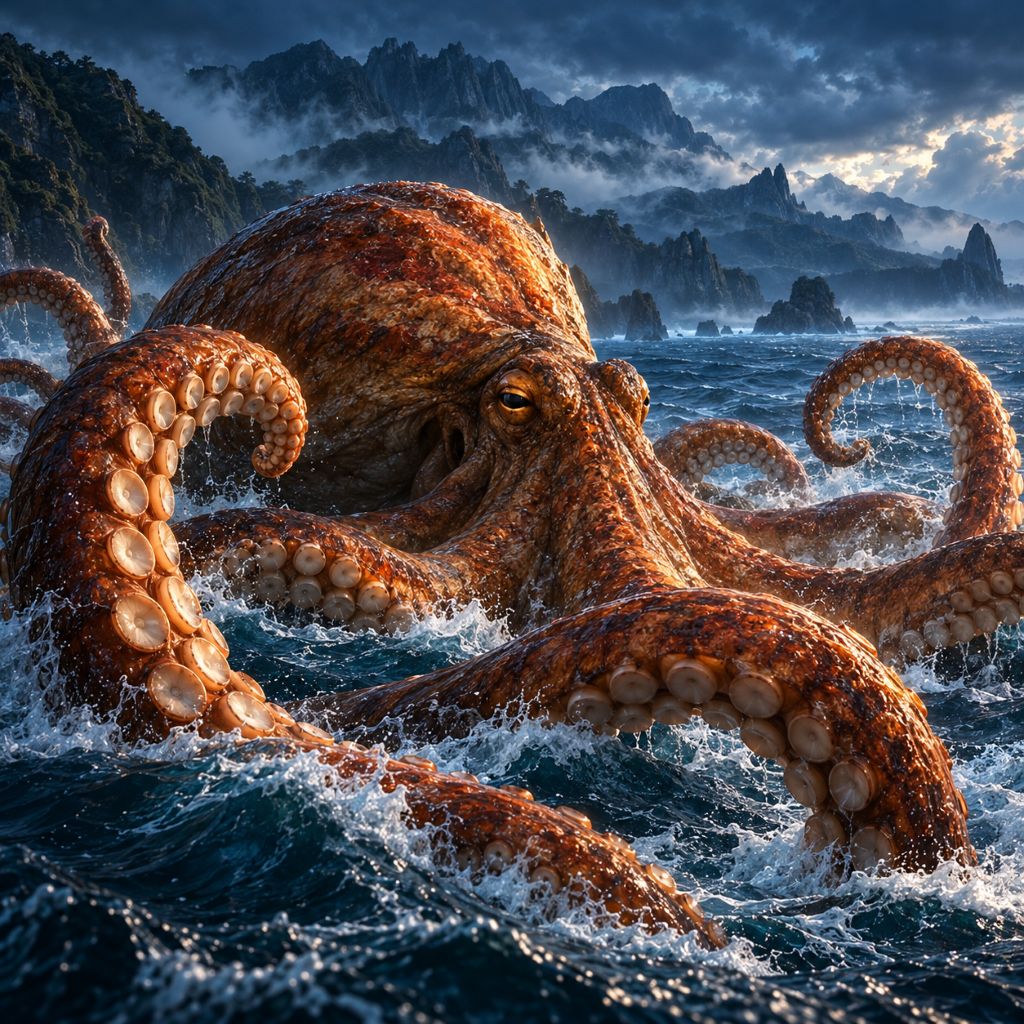
Te Wheke-o-Muturangi is described as an enormous wheke, the Māori word for an octopus. Its defining feature is its extraordinary size, which distinguishes it from ordinary marine animals and makes it a formidable opponent for Kupe and his crew. In a widely circulated educational retelling, its tentacles extend above the water and are described as much longer than Kupe’s ocean-going waka. One tentacle even grips the vessel, threatening to overturn it as the crew struggles to defend themselves.
The creature’s appearance is primarily defined by its enormous arms, powerful suckers and imposing head. In the climactic confrontation, Kupe attacks the octopus directly, eventually striking its head to defeat it. These details give the creature a physical presence that is central to the story without requiring additional supernatural features that the traditional accounts do not establish.
Descriptions of Te Wheke-o-Muturangi should not be confused with scientific descriptions of actual octopus species found in New Zealand waters. The legendary creature’s extraordinary scale belongs to the narrative, where its size communicates the danger of the encounter and the difficulty of pursuing it across the Pacific. The available accounts do not establish a precise length, weight, colour or biological species for the mythological octopus.
Family
Te Wheke-o-Muturangi’s principal relationship is with Muturangi, who is identified in many accounts as its owner. Muturangi is described as a tohunga associated with Hawaiki, although details concerning his background and location vary between traditions. The octopus is generally presented as his pet or possession rather than as a member of a divine genealogy. Its connection with Muturangi establishes the relationship that drives the initial conflict with Kupe.
Kupe is Te Wheke’s principal adversary in the best-known version of the narrative. Their relationship is defined by the pursuit and eventual confrontation rather than kinship. Kupe’s wife, Hine-te-Aparangi, and members of his wider whānau accompany him on the voyage in some accounts, while warriors and fishermen form part of the expedition. Their presence establishes that the encounter involves a travelling community rather than a solitary hero fighting an isolated monster.
The story does not provide an established genealogy for Te Wheke-o-Muturangi. No widely documented account identifies its parents, offspring or siblings. Its association with Muturangi is therefore best understood as a relationship of ownership and service, with its conflict with Kupe forming the central narrative connection.
Other names
The creature is known by several closely related names, including Te Wheke-o-Muturangi and Te Wheke-a-Muturangi. Both forms refer to the giant octopus associated with Muturangi and the story of Kupe’s voyage. The name is also shortened to Te Wheke when the context makes its identity clear. The National Library of New Zealand records a 2007 graphic novel titled Te Wheke-a-Muturangi, which retells the story of the octopus leading Kupe and his companions from Hawaiki to Aotearoa.
The differences between the names should not automatically be treated as evidence of separate creatures. Both principal forms appear in accounts of the same traditional figure, although spelling and wording vary across publications and retellings. The name associates the wheke with Muturangi, distinguishing this particular legendary octopus from octopuses in general.
Some modern interpretations explore the octopus as a metaphor for the interconnectedness of Pacific voyaging routes. Although such readings can offer interesting perspectives on navigation and cultural exchange, they should be distinguished from the established narrative identifying Te Wheke as Muturangi’s giant octopus pursued by Kupe. Claims that the creature had particular names in other Polynesian traditions, or that its tentacles originally represented specific navigational routes, require independent evidence before being presented as historical facts.
Powers and Abilities
Te Wheke-o-Muturangi’s principal abilities are its immense physical strength, extraordinary reach and capacity to survive a prolonged pursuit across the ocean. Its tentacles allow it to seize fishing bait, interfere with fishing activities and threaten Kupe’s waka. During the final confrontation in a widely recorded version, the octopus attacks the vessel with enough force to endanger the entire crew. Its strength makes it a serious adversary, while its movement through the ocean keeps Kupe’s expedition in pursuit.
The creature’s role in the voyage is equally important. By fleeing across the Pacific and around the coastlines of Aotearoa, Te Wheke becomes the focus of a journey associated with discovery. Its pursuit connects the ancestral homeland of Hawaiki with places across New Zealand, including areas around Wairarapa, Te Whanganui-a-Tara and the waters of Raukawa Moana, commonly known as Cook Strait. Different traditions associate particular episodes with different locations.
Kupe eventually defeats the creature through a combination of strength and strategy. In one educational account, he throws calabashes into the water to distract the octopus before delivering a fatal blow to its head. The story does not establish that Te Wheke is immortal, nor does it consistently attribute abilities such as flight, shape-shifting or speech to the creature. Its extraordinary power comes from its size, strength and place in the narrative rather than an extensive catalogue of magical abilities.
Modern Day Influence
Te Wheke-o-Muturangi continues to appear in educational materials, literature, public art and contemporary interpretations of Māori traditions. Its story is particularly important in accounts of Kupe’s voyages because it connects ancestral narratives with identifiable coastal landscapes and place names. The New Zealand Ministry of Education’s Mātauranga Māori resources include retellings of Kupe’s pursuit of the giant wheke, helping introduce the narrative to students through Māori cultural and historical perspectives.
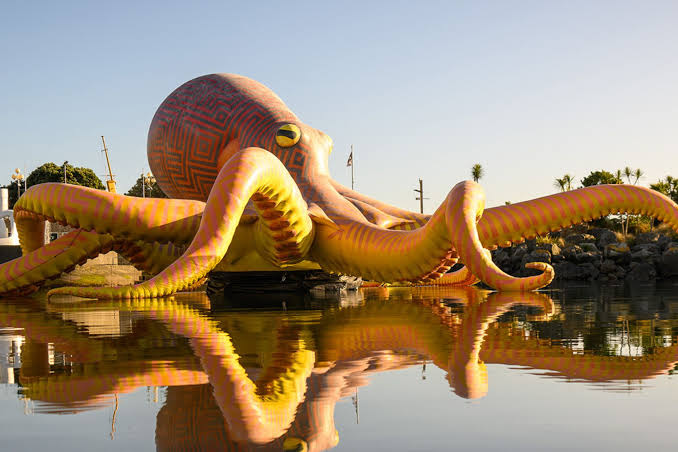
The story has also inspired contemporary artists. In January 2024, Māori artist Lisa Reihana presented Te Wheke-a-Muturangi: The Adversary at Sydney Festival. The large floating octopus sculpture brought the traditional narrative into a contemporary public setting, inviting audiences to encounter the story beyond the pages of a book or the classroom. Its presentation demonstrated how ancestral narratives can be reinterpreted through modern artistic practice while retaining their cultural connections.
Te Wheke’s association with specific places remains another important aspect of its legacy. Accounts of Kupe’s journey connect the creature with coastal features, waterways and islands around Aotearoa. These geographical associations help preserve the relationship between oral traditions and the landscapes in which communities remember them.
The creature’s continuing presence in education and art demonstrates that Te Wheke-o-Muturangi is more than a monster in a heroic adventure. Its story brings together the risks of ocean travel, the importance of fishing to communities, the courage required to navigate unfamiliar waters and the ways ancestral narratives give meaning to place. Preserving the different versions of the legend also recognises that Māori traditions belong to living communities whose histories and interpretations deserve to be represented accurately.
Related Images
Source
Himiona, K. (1957). The story of Kupe. The Journal of the Polynesian Society, 66(3), 232–248. http://www.jps.auckland.ac.nz/document//Volume_66_1957/Volume_66%2C_No._3/The_story_of_Kupe%2C_by_Himiona_Kaamira%2C_p_232-248/p1
Hiroa, T. R. (1950). The coming of the Maori. Whitcombe and Tombs. https://nzetc.victoria.ac.nz/tm/scholarly/tei-BucComi-t1-g1-t1.html
Kawaharada, D., & Henry, T. (1995). Voyaging chiefs of Havai‘i. Kalamakū Press. http://www2.hawaii.edu/~dennisk/books/voyaging_chiefs.html
Mātauranga Māori. (n.d.). Kupe and the giant wheke. New Zealand Ministry of Education.
https://eng.mataurangamaori.tki.org.nz/Support-materials/Te-Reo-Maori/Maori-Myths-Legends-and-Contemporary-Stories/Kupe-and-the-Giant-Wheke
Museum of New Zealand Te Papa Tongarewa. (n.d.). Kupe. https://collections.tepapa.govt.nz/topic/10732
Royal, T. A. C. (2005). First peoples in Māori tradition: Kupe. Te Ara—The Encyclopedia of New Zealand. https://teara.govt.nz/en/first-peoples-in-maori-tradition/page-6
Te Ara—The Encyclopedia of New Zealand. (2004). Octopus and squid. Manatū Taonga Ministry for Culture and Heritage. https://teara.govt.nz/en/octopus-and-squid/page-4
Wellington City Libraries. (2024, July 3). Pūrākau—Legends: Te Wheke of Muturangi.
https://www.wcl.govt.nz/maori/te-whanganui-a-tara/local-resources/legends/
Frequently Asked Questions
Who is Te Wheke-o-Muturangi in Māori mythology?
Te Wheke-o-Muturangi is a legendary giant octopus associated with Muturangi and pursued across the Pacific by Kupe in Māori traditions about the discovery of Aotearoa.
Why did Kupe chase Te Wheke-o-Muturangi?
In a widely recorded version, Kupe pursued the giant octopus because it repeatedly interfered with his people’s fishing by taking bait and disrupting their efforts.
How was Te Wheke-o-Muturangi defeated?
In a popular retelling, Kupe distracted the giant octopus with calabashes before attacking its head and delivering the fatal blow during their final battle.
What is the relationship between Te Wheke-o-Muturangi and Muturangi?
Muturangi is traditionally described as the giant octopus’s owner or master. He is identified in many accounts as a tohunga, or Māori ritual expert, associated with Hawaiki.
Is Te Wheke-o-Muturangi a god or a sea monster?
Te Wheke-o-Muturangi is a legendary giant octopus, not generally classified as a god. Its extraordinary size and strength make it a formidable creature in Māori traditions.


