


Ramogi Ajwang’ : Founder and Ancestral Hero of the Luo People
At a glance
| Description | |
|---|---|
| Origin | Luo Mythology |
| Classification | Mortals |
| Family Members | Nyar Nam (Wife) |
| Region | Kenya |
| Associated With | Migration, Leadership, Healing |
The Mythlok Perspective
In Mythlok’s Perspective, Ramogi Ajwang’ represents a type of ancestral hero found in cultures around the world: the leader who transforms migration into identity. His importance lies less in supernatural power and more in his role as a bridge between people, land, and memory. The sacred connection between Ramogi and Got Ramogi Hill echoes how many societies attach founding ancestors to specific landscapes. Comparable figures can be found across cultures. Ramogi’s role among the Luo resembles that of Aeneas in Roman tradition, who guided survivors to a future homeland, or Manco Cápac in Inca tradition, who established the foundations of a civilization. Like these culture heroes, Ramogi embodies the idea that a people’s history begins with a journey, a leader, and a place that becomes sacred through memory.
Ramogi Ajwang’
Introduction
Ramogi Ajwang’ is one of the most important ancestral figures in Luo tradition. Revered as the founding father of the Kenyan Luo people, he occupies a unique place where history, memory, and mythology intersect. Unlike many legendary figures who are remembered primarily for supernatural exploits, Ramogi is celebrated for leadership, migration, and the establishment of a homeland that continues to shape Luo identity today.
According to Luo oral traditions, Ramogi led his people during a major migration that eventually brought them to the eastern shores of Lake Victoria in present-day Kenya. These stories describe a long journey from regions associated with the Upper Nile and parts of modern Uganda. Upon reaching the area now known as Luo Nyanza, Ramogi and his followers established settlements that became the foundation of many Luo communities.
Because Luo history was traditionally preserved through oral storytelling rather than written records, different versions of Ramogi’s story exist. Some portray him as a historical chief and clan leader, while others elevate him to the status of a culture hero chosen by Nyasaye, the supreme deity in Luo belief. Regardless of the variation, Ramogi remains a symbol of unity, resilience, and shared ancestry for millions of Luo people.
Physical Traits
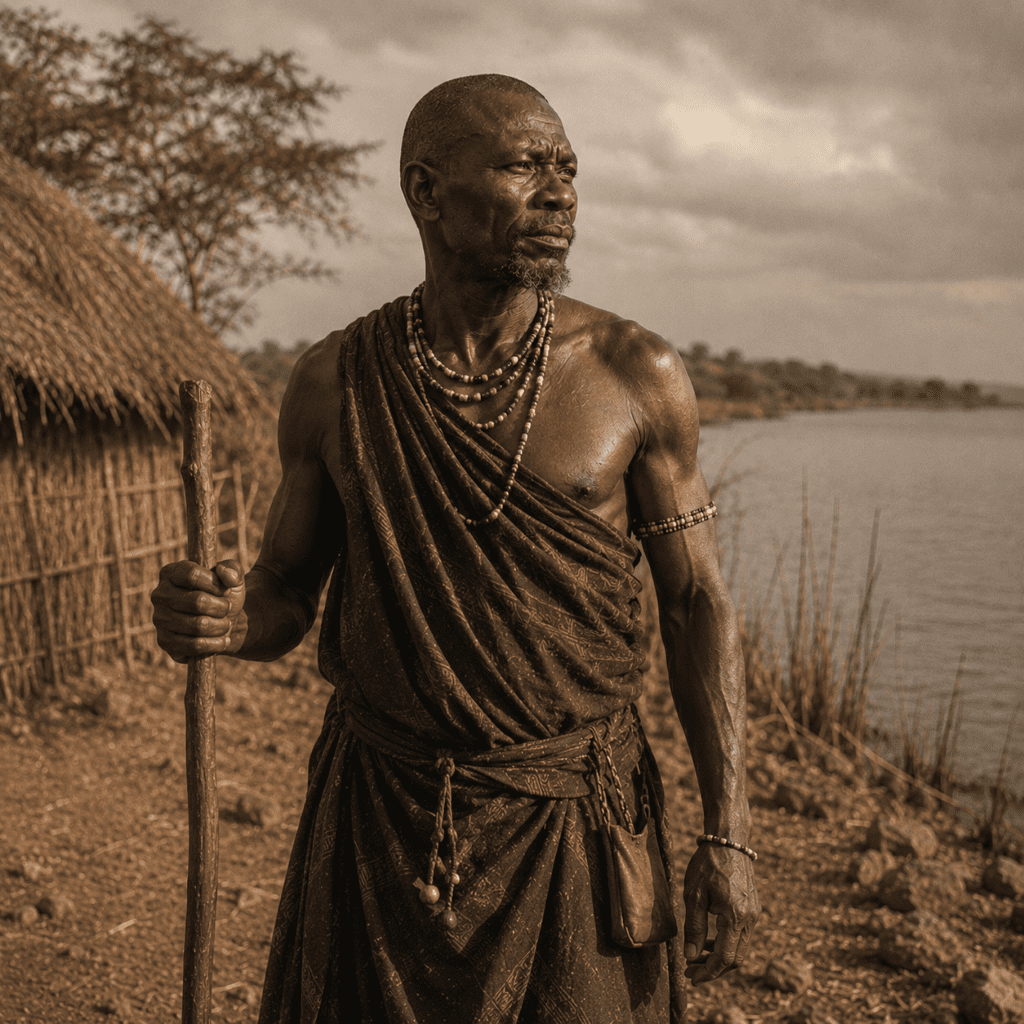
Unlike gods and spirits who are often described with extraordinary appearances, Ramogi Ajwang’ is remembered as a human ancestor. Oral traditions focus far more on his achievements and character than on specific physical features. As a result, there are no consistent descriptions of his height, facial appearance, or other distinguishing characteristics.
Instead, stories portray him as a strong and capable leader who possessed the endurance necessary to guide a migrating people through unfamiliar territory. He is commonly imagined as a warrior elder, a figure who combined physical strength with wisdom and authority.
The absence of a fixed physical description has allowed different generations to envision Ramogi in ways that reflect their own understanding of leadership. What remains constant across traditions is his image as a commanding presence whose influence came from courage, experience, and spiritual insight rather than appearance alone.
Family
Family and lineage are central themes in Luo tradition, making Ramogi Ajwang’ an important ancestral figure within numerous genealogical narratives. Many Luo clans trace their origins to him, viewing him as the patriarch from whom major community lineages emerged.
Some oral traditions describe Ramogi’s wife as Nyar Nam, a figure associated with Lake Victoria and the spiritual significance of the region. Through this ancestral union, various clans and regional groups are said to have descended from their household.
Traditional genealogies frequently include names that later became associated with important Luo regions and communities, including Sakwa, Gem, Uyoma, Ugenya, Yimbo, Asembo, Nyakach, Seme, and Rachuonyo. While these genealogies vary between traditions, their purpose is not merely historical. They help explain relationships between communities, reinforce a shared sense of identity, and connect modern Luo populations to a common ancestral heritage. Even today, references to Ramogi’s descendants remain an important part of cultural identity, emphasizing kinship and collective belonging.
Other names
Ramogi Ajwang’ is known by several names and titles across different traditions. The most common variation is simply “Ramogi,” a name that has become synonymous with Luo ancestry and heritage.
The surname or epithet “Ajwang'” is sometimes interpreted as a way to distinguish him from earlier ancestors bearing the same name. Oral accounts provide different explanations for this designation, reflecting the fluid nature of traditional storytelling.
He is also remembered through honorific titles that emphasize his status and achievements. Some traditions refer to him as a chief or king, while others highlight his role as a healer, spiritual guide, or founding father. These titles reflect the many dimensions of his legacy rather than identifying separate individuals.
The enduring importance of his name can be seen throughout Luo society, where “Ramogi” remains a powerful cultural symbol. Expressions such as “Nyikwa Ramogi” or “children of Ramogi” continue to be used to express shared ancestry and collective identity.
Powers and Abilities
Ramogi Ajwang’ is generally remembered as a human leader rather than a supernatural deity. Nevertheless, oral traditions often attribute extraordinary abilities to him, reflecting the deep respect he commanded among his people.
Many stories portray him as a gifted spiritual practitioner and healer. He is frequently described as an ajuoga, a person knowledgeable in traditional medicine, ritual practices, and communication with spiritual forces. This reputation contributed to his status as both a political and spiritual leader.
Some traditions also credit him with prophetic insight and exceptional wisdom. These qualities allowed him to guide his people through difficult migrations and make decisions that ensured their survival. Folklore occasionally expands these abilities further, suggesting that he possessed powers connected to weather, protection, or spiritual influence.
A significant aspect of his legacy is tied to Got Ramogi, the hill where he is believed to have first settled in Kenya. Sacred sites within this area, including Rapogi Rock, are associated with his spiritual presence. Visitors have long regarded these locations as places of prayer, reflection, and ancestral connection. Rather than being remembered for magical feats alone, Ramogi’s greatest power lies in his enduring role as a source of wisdom, guidance, and cultural continuity.
Modern Day Influence
The influence of Ramogi Ajwang’ extends far beyond oral tradition. His legacy remains deeply woven into Luo culture, identity, and public life throughout Kenya. One of the most important symbols associated with him is Got Ramogi in Siaya County. This sacred hill is widely regarded as the ancestral homeland of the Luo people in Kenya. It serves as a cultural landmark, a historical site, and a place of spiritual significance. Religious groups, community leaders, and cultural organizations continue to visit the area for ceremonies and commemorative events.
Ramogi’s name also plays a powerful role in cultural identity. Many Luo people proudly identify themselves as descendants of Ramogi, reinforcing a sense of unity across diverse clans and regions. The phrase “Nyikwa Ramogi” remains a common expression of shared heritage.
His influence can also be seen in politics, education, and public discourse. Prominent leaders have invoked his legacy when discussing community development, leadership, and cultural pride. The name Ramogi appears in institutions, media organizations, and cultural initiatives that seek to preserve and promote Luo heritage.
Modern documentaries, books, and educational programs continue to retell his story, introducing new generations to the traditions surrounding their ancestral founder. Through these retellings, Ramogi Ajwang’ remains not only a figure of the past but also a continuing source of inspiration for the future.
Related Images


Source
Paukwa. (2024, July 15). The Luo myth of creation and the search for home. Paukwa. https://www.paukwa.or.ke/story-series/creationmyths/the-luo-myth-of-creation-and-the-search-for-home/
Hivisasa. (2018, July 21). Meet the first Luo to live in Nyanza. Hivisasa. https://hivisasa.com/posts/984-meet-the-first-luo-to-live-in-nyanza
Hivisasa. (2019, January 7). The most respected man in Luo land will surprise you. Hivisasa. https://hivisasa.com/posts/1058-meet-the-grandfather-of-all-luos
Travel Oltepesi. (2023, October 23). Got Ramogi “The Cradle of Luo Dispersion”. Travel Oltepesi. https://traveloltepesi.co.ke/got-ramogi-the-cradle-of-luo-dispersion/
Kenya Forestry Working Group. (n.d.). The case of Ramogi Hill Forest Reserve, Kenya (CBD case study). Convention on Biological Diversity. https://www.cbd.int/doc/case-studies/for/cs-ecofor-ke-01-en.pdf
Franklin, P. J. L., & Omar, Y. A. (1995). The Word for God in Kiswahili: Further Considerations. Journal of Religion in Africa, 25(2), 202–211. https://doi.org/10.2307/1581274
Frequently Asked Questions
Who was Ramogi Ajwang'?
Ramogi Ajwang’ is the legendary founding ancestor of the Luo people in Kenya, remembered for leading migrations and establishing settlements near Lake Victoria.
Is Ramogi Ajwang' a god?
No. Ramogi Ajwang’ is traditionally regarded as a human ancestor and culture hero rather than a deity.
What is Got Ramogi?
Got Ramogi is a sacred hill in Siaya County, Kenya, believed to be the first settlement established by Ramogi Ajwang’ and his followers.
Why is Ramogi Ajwang' important to the Luo people?
He symbolizes shared ancestry, cultural identity, leadership, migration history, and the origins of many Luo communities.
Did Ramogi Ajwang' have supernatural powers?
Some oral traditions attribute spiritual abilities and healing knowledge to him, but he is primarily remembered as a wise leader, healer, and ancestral patriarch.
