


Mir-Susne-Khum : The Heavenly Rider of the Khanty and Mansi
At a glance
| Description | |
|---|---|
| Origin | Khanty Mythology |
| Classification | Gods |
| Family Members | Numi-Torum (Father), Kaltash-Ekva (Mother) |
| Region | Russia |
| Associated With | Celestial riding, Mediation, Protection, |
The Mythlok Perspective
In Mythlok’s Perspective, Mir-Susne-Khum represents one of the most fascinating “watcher” figures in northern Eurasian tradition. Unlike distant creator gods who remain detached from humanity, he constantly travels between worlds, making him feel deeply connected to ordinary human life. His imagery as a winged horseman crossing the sky gives him a mythic grandeur similar to solar riders found in Indo-Iranian and Central Asian traditions. At the same time, his trickster qualities keep him grounded in older animistic storytelling where heroes are unpredictable and morally complex. His mythology also reflects the harsh cycles of Siberian nature, especially the constant movement between winter darkness and returning light. Comparatively, he shares similarities with Sleipnir and the wandering sky riders associated with Mithra, yet his role as a mediator between spirits and humans makes him uniquely Ob-Ugrian in identity.
Mir-Susne-Khum
Introduction
Mir-Susne-Khum stands among the most important figures in the spiritual traditions of the Khanty and Mansi peoples of western Siberia. Revered as a celestial rider, cultural hero, and divine mediator, he occupies a unique place between the heavenly realm and the human world. In many oral traditions, he is portrayed as the seventh son of the sky god Numi-Torum, entrusted with observing humanity and maintaining balance across the cosmos.
Unlike distant creator deities who rarely interact with mortals, Mir-Susne-Khum is deeply involved in the lives of people. He acts as a protector, messenger, and traveler between worlds. Scholars studying Ob-Ugrian religion often compare him to heroic riders and solar guardians found across Eurasian mythology because of his connection to horses, light, and seasonal cycles.
His mythology also reflects layers of cultural evolution. Researchers have identified possible Indo-Iranian influences in his imagery, especially in stories that describe him as a mounted warrior crossing the skies. Yet despite these outside parallels, Mir-Susne-Khum remains distinctly rooted in the spiritual worldview of the Khanty and Mansi peoples, where the natural world, ancestor traditions, and cosmic balance are deeply intertwined.
Today, he survives not only through folklore but also through ethnographic studies, museum collections, and cultural revival projects that preserve the ancient traditions of Siberia’s indigenous communities.
Physical Traits
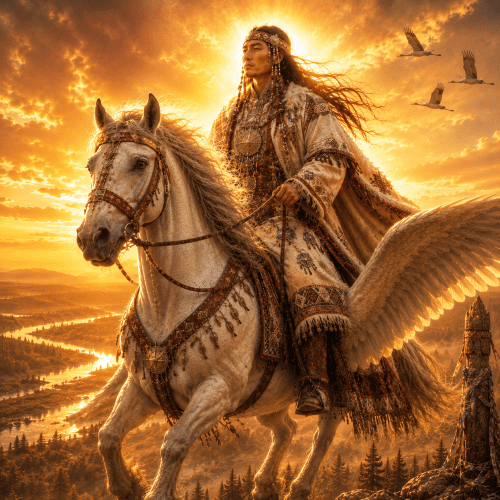
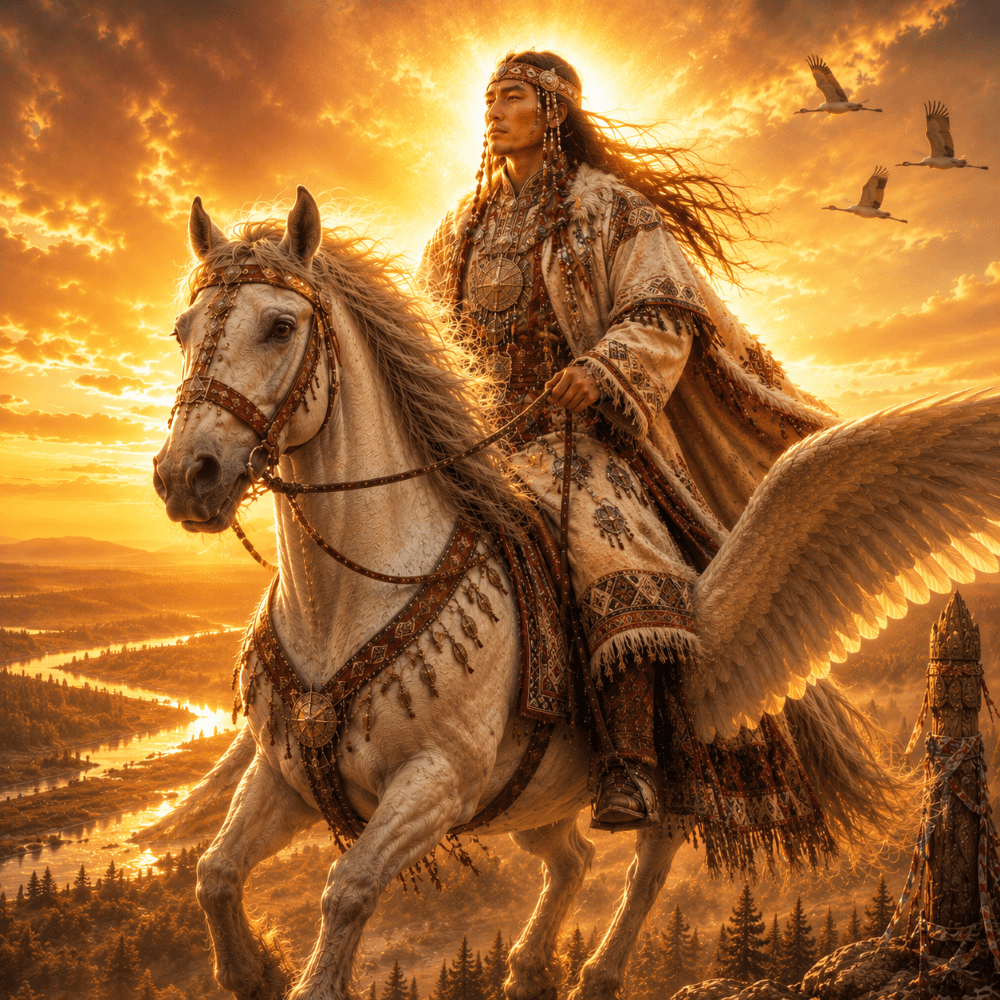
Mir-Susne-Khum is most commonly imagined as a heavenly horseman traveling across the skies. Rather than having one fixed appearance, his image changes depending on the story or ritual context. In many traditions, he appears as a powerful rider wearing ceremonial clothing associated with warriors and nobles. Sacred textiles and ritual coverings from the Khanty and Mansi regions sometimes depict mounted figures believed to represent him.
One of his most famous features is his supernatural horse. Folklore describes the animal as fiery, golden, or made of iron, emphasizing both divine strength and otherworldly speed. Some myths claim the horse possessed eight wings, allowing Mir-Susne-Khum to travel around the world in a single journey. This imagery reinforces his role as a cosmic observer who constantly watches over humanity.
His symbolism also includes bird-like characteristics. Scholars studying Ob-Ugrian mythology have connected him with migratory birds such as cranes, geese, and wagtails. These associations likely relate to seasonal movement, solar cycles, and the arrival of spring after long Siberian winters. Because of this, Mir-Susne-Khum is sometimes viewed not only as a warrior figure but also as a spirit of renewal and transition.
In ritual art, he may appear as an anthropomorphic figure riding above other beings or positioned at the center of ceremonial objects. These depictions highlight his elevated status among the divine figures of Khanty and Mansi belief systems.
Family
Mir-Susne-Khum belongs to the divine family of the upper world in Ob-Ugrian mythology. He is traditionally identified as the youngest or seventh son of Numi-Torum, the supreme sky god who rules the heavens. His mother is usually named Kaltash-Ekva, an important maternal and fertility figure associated with destiny and birth.
Stories surrounding his birth differ across regions, but many portray him as a child connected to both heavenly and earthly realms. This dual connection helps explain why he serves as an intermediary between gods and humans. While his father remains distant in the sky world, Mir-Susne-Khum actively travels among mortals and listens to their prayers.
Some traditions describe him as having numerous wives and descendants. Folklore occasionally claims he fathered a hundred sons, many of whom became ancestors of shamans and spiritual lineages. His wives are at times linked with celestial or natural forces such as dawn and twilight, further strengthening his association with cosmic cycles.
A recurring rival in his stories is Jelping-Ja-Oyka, a hostile figure who opposes him in mythic narratives. Their rivalry reflects broader themes of balance between order and chaos that appear throughout Siberian mythology.
Other names
Because Khanty and Mansi traditions developed across vast territories, Mir-Susne-Khum is known by several regional names and titles. Variations in pronunciation and dialect have produced multiple forms that appear in folklore collections and academic studies.
Among the Mansi, he is sometimes called Mir-Setivi-Kho or Kan-Iki. Khanty groups use names such as Otr-Iki, Ar Mig-Khui, Kale-Khui, and Pairaxta. English-language scholarship often translates his title as “The World Surveyor” or “The Man Watching the World,” emphasizing his role as a divine observer.
Another name connected to him in certain legends is Eekva-Pygris. These alternative identities reveal how widespread and adaptable his worship became among different Ob-Ugrian communities. Even with these regional differences, the core image remains consistent. Whether called Mir-Susne-Hum, Kan-Iki, or Otr-Iki, he continues to represent the celestial rider who moves between the heavens and the human world.
Powers and Abilities
Mir-Susne-Khum possesses abilities that make him one of the most active divine beings in Khanty and Mansi mythology. His most important role is mediation. He carries prayers from humans to the higher gods and ensures communication between earthly life and the celestial realm.
His supernatural horse allows him to travel rapidly across the cosmos. Myths describe him circling the world while observing human actions, making him a guardian figure who maintains moral and cosmic balance. This constant movement across the skies also connects him with solar symbolism and seasonal cycles.
Unlike purely benevolent heroes, Mir-Susne-Khum displays elements of the trickster archetype. Some early stories portray him as unpredictable, clever, and occasionally aggressive. These traits reflect ancient mythological traditions where heroes were not entirely good or evil but embodied the complexity of nature itself.
He is also remembered as a cultural hero who shaped the lives of the Ob-Ugrian peoples. In various stories, he protects communities, defeats dangerous beings, and establishes sacred traditions. Certain scholars believe his mythology evolved over time from darker and more chaotic origins into the heroic guardian figure known today.
His association with horses, birds, and celestial movement places him within a broader Eurasian tradition of sky riders and wandering heroes. Yet his identity remains deeply tied to Siberian cosmology, where spiritual forces move constantly between visible and invisible worlds.
Modern Day Influence
Although traditional Khanty and Mansi religious practices changed significantly during the modern era, Mir-Susne-Khum remains an important cultural symbol. Ethnographers studying Siberian spirituality continue to document stories, ritual objects, and ceremonial traditions connected to him.
Sacrificial textiles, ritual coverings, and ceremonial artifacts associated with his cult survived into the twentieth century and are now preserved in museums and academic collections. These objects provide valuable insight into indigenous Siberian religious practices and artistic traditions. Modern cultural organizations in the Yugra region also use imagery connected to Mir-Susne-Khum when celebrating Khanty and Mansi heritage. Festivals, exhibitions, and educational programs frequently present him as a symbol of ancient identity and spiritual continuity.
Academic interest in the deity has also grown because of his possible Indo-Iranian connections and his role within Eurasian mythological traditions. Researchers continue exploring how his stories combine indigenous Siberian beliefs with wider themes found across Central Asia and northern Eurasia. For many people today, Mir-Susne-Khum represents more than mythology. He symbolizes cultural survival, ancestral memory, and the enduring spiritual traditions of the Khanty and Mansi peoples.
Related Images
Source
Baulo, A. V. (2016). Sacrificial site to venerate Mir-Susne-Khum of Ob-River Mansi. Tomsk Journal of Linguistics and Anthropology, 2(12), 65–72.
Baulo, A. V. (n.d.). [Article on Mir-Susne-Khum cult attributes]. Archaeology, Ethnology & Anthropology of Eurasia.
Mir-Susne-Hum. (n.d.). In Wikipedia. Retrieved May 15, 2026, from https://en.wikipedia.org/wiki/Mir-Susne-Hum
The Mansi. Spiritual Culture (Mythologies, Traditional Beliefs, and Rituals). (n.d.). O KMNS.
Celestial bodies on the Ob Ugrian ritual artifacts (based on…). (n.d.). Archaeology, Ethnology & Anthropology of Eurasia.
The Hero of the Yellow Wagtail: roots of the image. (n.d.). Ob-Ugric Studies / Vestnik Ugrovedenia.
Kaltas-Ekwa. (n.d.). In Wikipedia. Retrieved May 15, 2026, from https://en.wikipedia.org/wiki/Kaltas-Ekwa
Frequently Asked Questions
Who is Mir-Susne-Khum?
Mir-Susne-Khum is a celestial rider and cultural hero in Khanty and Mansi mythology who acts as a mediator between gods and humans.
What is Mir-Susne-Khum associated with?
He is associated with horses, solar symbolism, protection, cosmic balance, and communication between worlds.
Who are the parents of Mir-Susne-Khum?
He is traditionally described as the son of the sky god Numi-Torum and the goddess Kaltash-Ekva.
Why is Mir-Susne-Khum important in Siberian mythology?
He is one of the central heroic figures of Ob-Ugrian belief systems and symbolizes divine guidance and cultural identity.
What does the eight-winged horse of Mir-Susne-Khum represent?
The horse symbolizes supernatural speed, celestial travel, and his ability to observe the entire world.
