
Mahishasura : The Powerful Buffalo Asura of Indian Tradition
At a glance
| Description | |
|---|---|
| Origin | Indian Mythology |
| Classification | Hybrids |
| Family Members | Rambha (Father), Mahish ((Mother) |
| Region | India |
| Associated With | Strength, Shapeshifting, Conquest, Arrogance, Buffalo |
The Mythlok Perspective
In Mythlok’s Perspective, Mahishasura is more than a defeated demon. He represents the recurring mythological theme of power becoming unbalanced when it is separated from wisdom and humility. His buffalo form symbolizes primal strength and earthly dominance, while Durga embodies disciplined divine force. Their conflict is not simply a battle between good and evil but a clash between unchecked ambition and cosmic harmony. Across cultures, similar figures appear in myths where powerful beings challenge divine order. Mahishasura shares thematic similarities with the Greek monster Typhon, who fought the Olympian gods, and the Norse giant Surtr, whose destructive power threatens the cosmos. Like these figures, Mahishasura serves as a reminder that strength alone cannot sustain lasting authority. Mythology repeatedly teaches that true power must remain balanced by responsibility, wisdom, and respect for the greater order of existence.
Mahishasura
Introduction
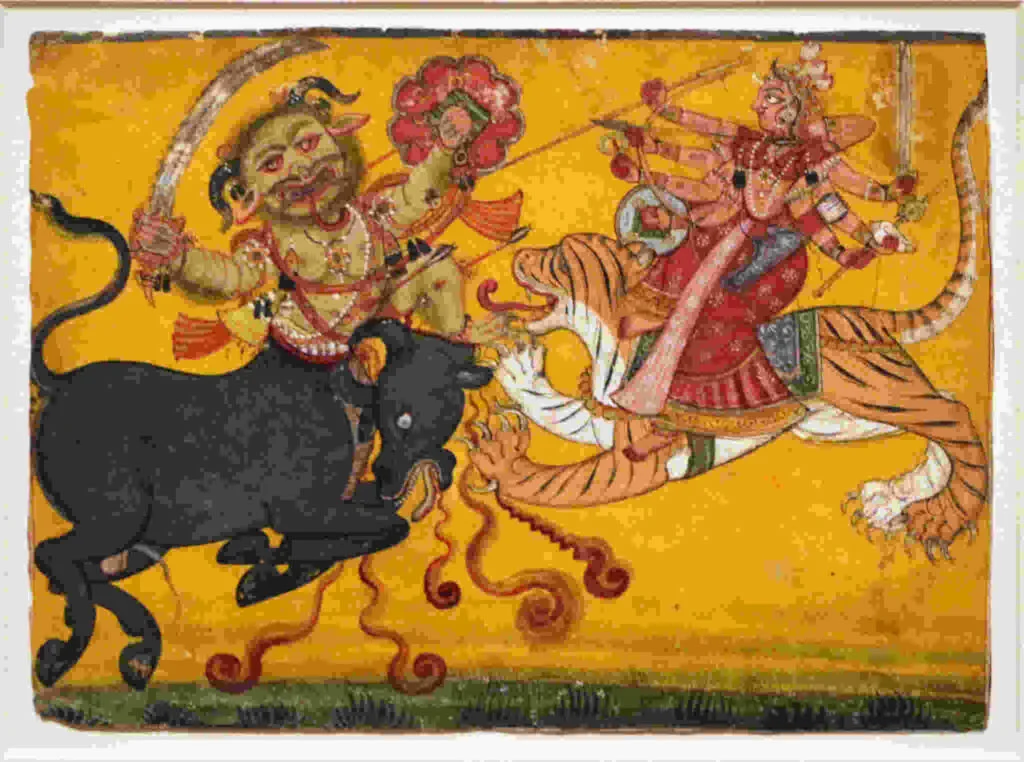
Mahishasura is one of the most famous asuras in Indian tradition and serves as the primary antagonist in the celebrated tale of Goddess Durga’s victory over evil. His story is preserved in the Devi Mahatmya, a sacred text within the Markandeya Purana, where he is portrayed as a mighty warrior who conquered heaven and defeated the gods through the power of a divine boon.
The name Mahishasura combines two Sanskrit words: mahisha, meaning buffalo, and asura, meaning a powerful supernatural being often opposed to the devas. This connection to the buffalo became central to both his appearance and symbolism. Empowered by extraordinary strength and near invulnerability, he challenged the established cosmic order and seized control of the three worlds.
His eventual defeat at the hands of Goddess Durga remains one of the most important episodes in Indian religious literature. The story symbolizes the triumph of divine justice over tyranny and highlights the supreme power of Shakti, the divine feminine force. Even today, Mahishasura remains a significant figure in religion, art, folklore, festivals, and contemporary cultural discussions.
Physical Traits
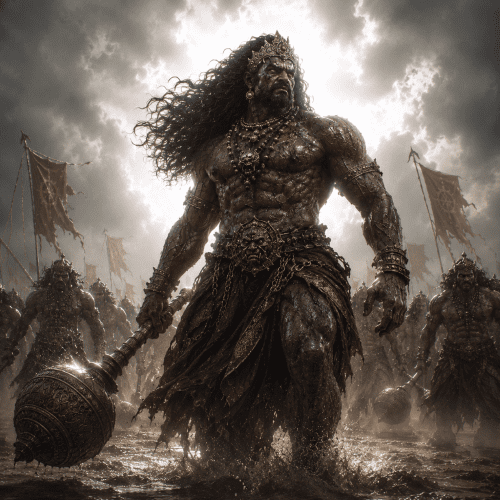
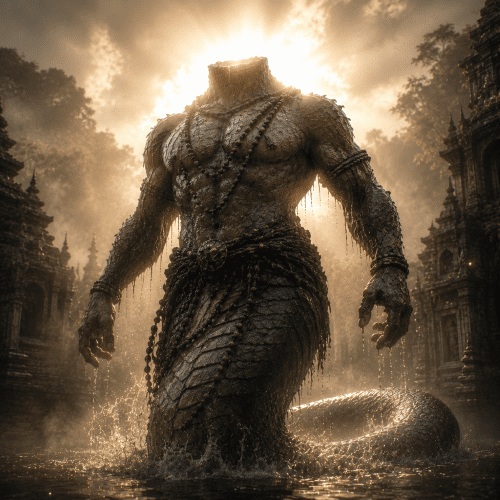
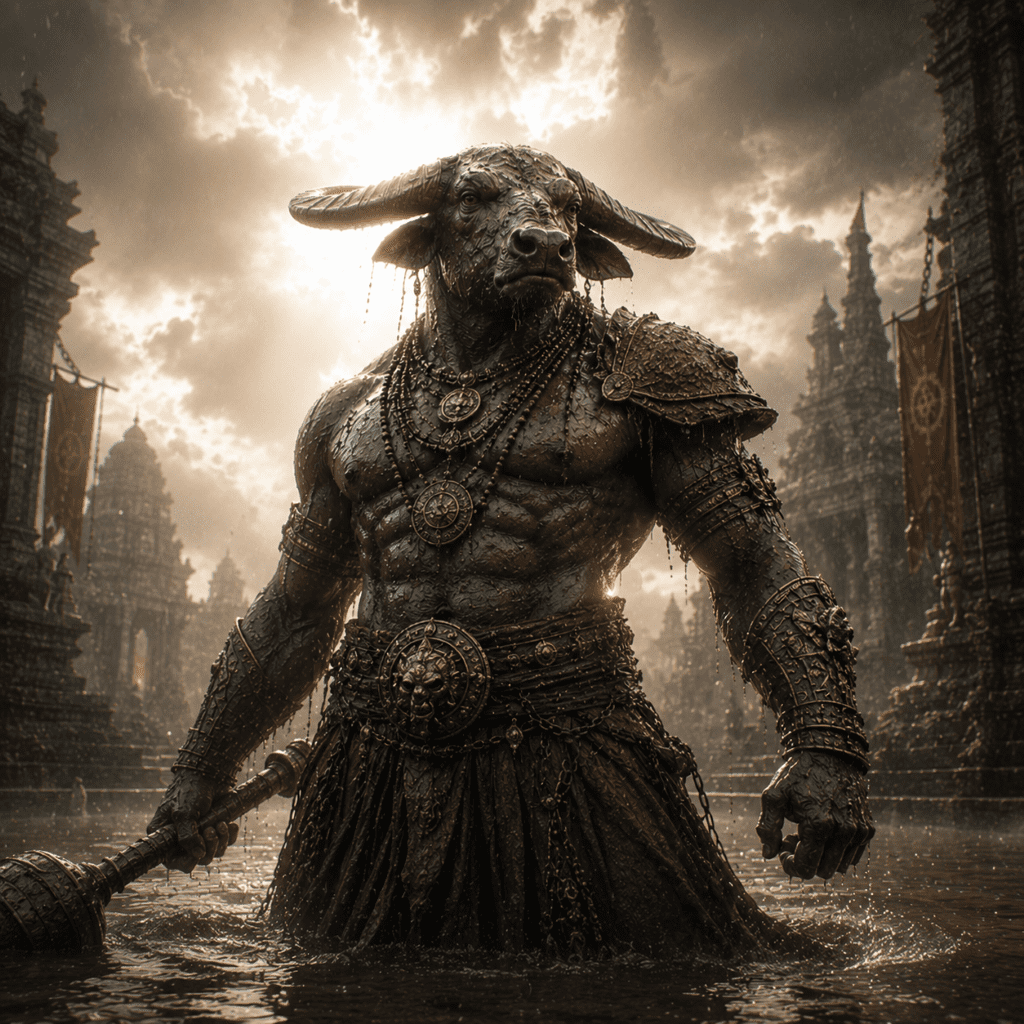
Mahishasura is most commonly depicted as a hybrid being possessing both human and buffalo characteristics. Ancient texts and artistic traditions describe him as a shape-shifter capable of assuming multiple forms during battle, though his buffalo form is his most recognizable manifestation.
In sculptures, temple carvings, and paintings, he often appears as a muscular warrior emerging from the body of a buffalo or bearing a buffalo’s head atop a human body. Large curved horns, powerful limbs, and an imposing stature emphasize his immense physical strength. These features distinguish him from other asuras and reinforce his association with raw power and untamed force.
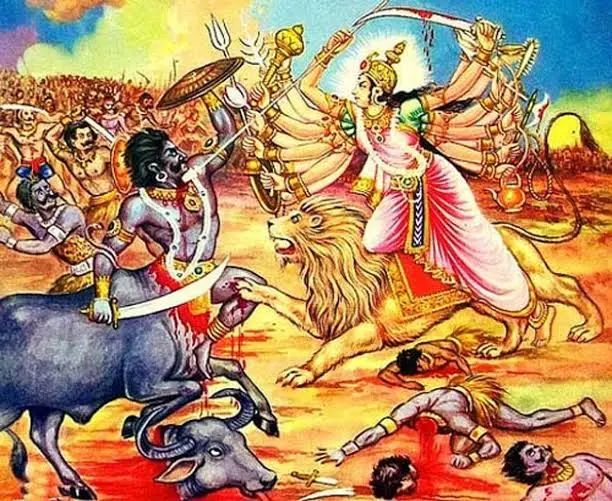
The buffalo itself carries symbolic meaning within the story. It represents stubbornness, aggression, and earthly strength, qualities that Mahishasura embodies throughout his campaign against the gods. Artistic depictions of Durga standing over the fallen buffalo demon have become some of the most recognizable images in Indian religious iconography.
Family
Mahishasura’s origins are explained through later Puranic and regional traditions. He is generally identified as the son of Rambha, a powerful asura king. According to popular accounts, Rambha fell in love with a buffalo woman, often called Mahishi, and from their union Mahishasura was born.
This unusual parentage helps explain his ability to shift between human and buffalo forms. It also places him within the larger lineage of the asuras, supernatural beings frequently portrayed as rivals of the devas in Indian cosmology.
Some regional traditions mention additional relatives, including a sister named Mahishi. However, such details vary considerably between sources and are not emphasized in the Devi Mahatmya. The primary focus of the classical narrative remains Mahishasura’s rise to power and his confrontation with Durga rather than his family relationships.
Other names
Unlike many mythological figures who possess numerous epithets, Mahishasura is primarily known by a single name throughout most major texts. The name itself is descriptive enough to convey both his nature and identity as the buffalo asura.
Regional folklore, however, preserves several local variations. In parts of Maharashtra he is remembered as Mhasoba, while some communities in central India refer to him through names such as Bhainsasura or Karas Dev. These alternative identities often reflect local traditions that portray him differently from mainstream religious narratives.
Perhaps the most enduring connection to his name appears through Goddess Durga’s title, Mahishasuramardini, meaning “Destroyer of Mahishasura.” This title became so influential that it appears in countless hymns, artworks, temple sculptures, and devotional traditions across India. Through the goddess’s epithet, Mahishasura’s memory remains permanently embedded within the religious landscape.
Powers and Abilities
Mahishasura’s greatest advantage came from a boon granted by Brahma. Through intense austerities and penance, he earned protection from death at the hands of any man or male deity. Believing no woman could ever defeat him, he considered himself effectively immortal.
With this confidence, he launched a massive campaign against the gods. His armies overwhelmed the celestial forces, and he succeeded in driving Indra and the devas from heaven. For a time, he ruled the three worlds and exercised authority that even the gods could not challenge directly.
His physical strength was legendary. Ancient accounts describe him as capable of crushing armies and battling divine warriors without fear. Equally dangerous was his ability to transform his shape during combat. He could shift between buffalo, human, and other forms, making him an unpredictable opponent.
The Devi Mahatmya vividly describes how Mahishasura repeatedly altered his appearance while fighting Durga. Despite these transformations, the goddess ultimately overcame every strategy he employed. His defeat demonstrated that even the greatest power becomes vulnerable when corrupted by pride and tyranny.
Modern Day Influence
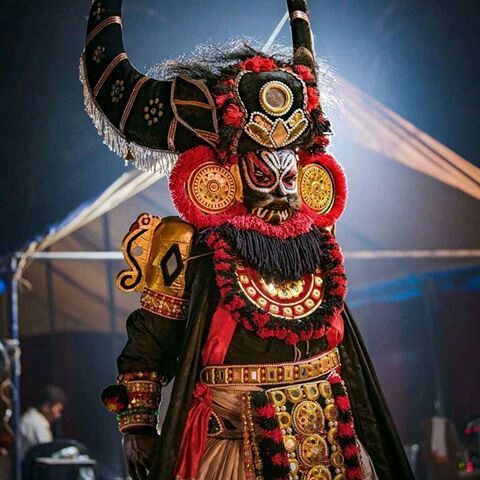
Mahishasura continues to play an important role in modern Indian culture. His story forms the foundation of many Navaratri and Durga Puja celebrations, where the victory of Durga over the buffalo demon symbolizes the triumph of good over evil. Images of the goddess slaying Mahishasura are among the most widespread religious representations in India and are displayed prominently during annual festivals.
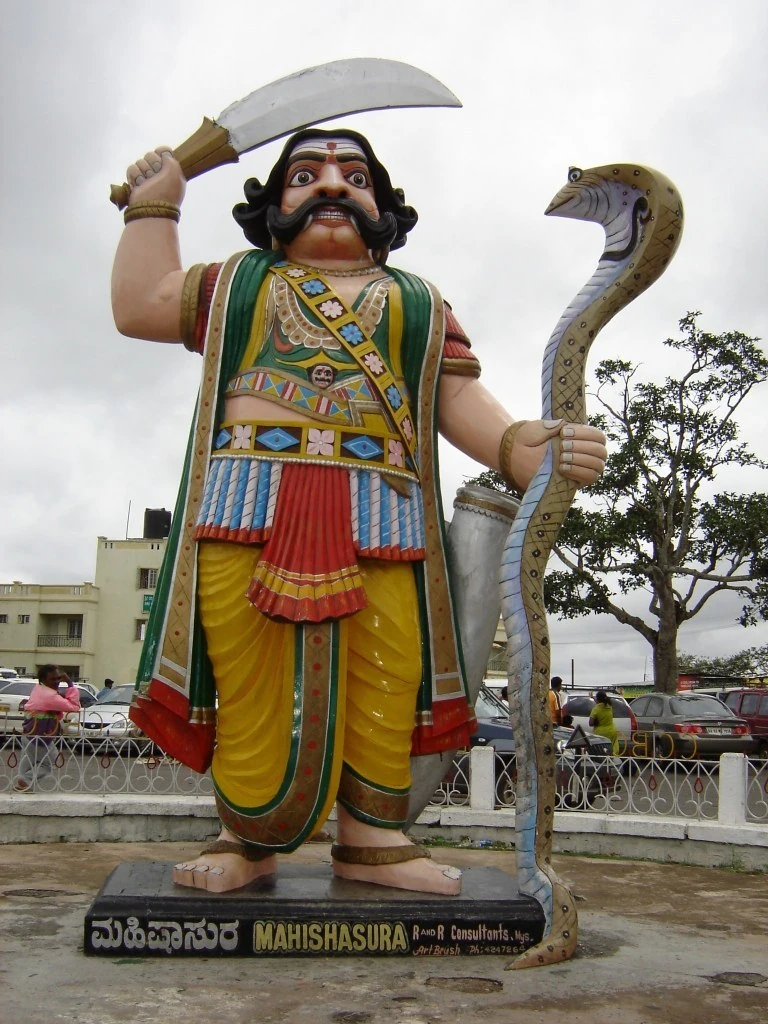
The city of Mysuru in Karnataka maintains a particularly strong connection to the legend. Many scholars believe the city’s name evolved from Mahishuru, meaning “the city of Mahisha.” A well-known statue of Mahishasura stands on Chamundi Hills, commemorating the location traditionally associated with his final battle against the goddess.
Beyond religious celebrations, Mahishasura has become a subject of historical and cultural reinterpretation. Some Dalit, Bahujan, and Adivasi communities view him not as a villain but as a heroic ancestor or indigenous ruler who resisted dominant social forces. These alternative interpretations have generated significant academic discussion about mythology, identity, and cultural memory.
His presence can also be seen in literature, theatre, television, comics, and contemporary art. Whether portrayed as a fearsome demon, a tragic ruler, or a symbol of resistance, Mahishasura remains a living figure whose story continues to evolve within modern Indian society.
Related Images

Source
Charactorium. (n.d.). Mahishasura. Retrieved June 8, 2026, from https://charactorium.com/en/character/mahishasura
Mahishasura – Wikipedia. (2013, March 20). In Wikipedia. Retrieved June 8, 2026, from https://de.wikipedia.org/wiki/Mahishasura
Round Table India. (2025, September 13). Mahishasura: The demonized hero of the Dalits. Retrieved June 8, 2026, from https://www.roundtableindia.co.in/mahishasura-the-demonized-hero-of-the-dalits
The Story of Mahishasur. (2023, September 8). Shri Mata Vaishno Devi Shrine Board. Retrieved June 8, 2026, from http://www.maavaishnodevi.org/blog/story-mahishasur
Wikipedia. (2005, January 1). Devi Mahatmya. In Wikipedia. Retrieved June 8, 2026, from https://en.wikipedia.org/wiki/Devi_Mahatmya
isharethese.com. (2025, October 1). Mahishasura Mardini: Story of birth and death of the demon. Retrieved June 8, 2026, from https://isharethese.com/mahishasur-the-demon-who-once-ruled-earth
Fuller, C. J. (2004). The Camphor Flame: Popular Hinduism and Society in India. Princeton University Press.
Kinsley, D. (1988). Hindu Goddesses: Vision of the Divine Feminine in the Hindu Religious Traditions. University of California Press.
Bhattacharyya, N. N. (1999). History of the Sakta Religion. Munshiram Manoharlal Publishers.
Monaghan, P. (2010). Encyclopedia of Goddesses and Heroines. Greenwood Press.
Frequently Asked Questions
Who was Mahishasura?
Mahishasura was a powerful buffalo asura who conquered heaven and was ultimately defeated by Goddess Durga in the Devi Mahatmya.
Why could Mahishasura not be defeated by the gods?
He received a boon from Brahma that protected him from death at the hands of any man or male deity.
What does Mahishasura symbolize?
Mahishasura often symbolizes arrogance, unchecked power, and the forces that disrupt cosmic order.
Why is Durga called Mahishasuramardini?
The title means “Slayer of Mahishasura” and commemorates her victory over the buffalo asura.
Is Mahishasura worshipped today?
Yes. While mainstream traditions remember him as Durga’s adversary, some communities honor him as an ancestral hero or historical ruler.