


Hanuman : The White Monkey God of Cambodia’s Reamker Epic
At a glance
| Description | |
|---|---|
| Origin | Cambodian Mythology |
| Classification | Hybrids |
| Family Members | Neang Maccha (Wife), Macchanu (Son) |
| Region | Cambodian |
| Associated With | Warrior, Shapeshifting |
Mythlok Perspective
In Mythlok’s Perspective, Hanuman is fascinating because his Cambodian identity is not simply an extension of the better-known Indian tradition, but a character reshaped by the Reamker into something distinctly Khmer. Compared with Hanuman in the Ramayana, the Cambodian Hanuman is given greater prominence as a charismatic warrior whose intelligence, humour, and romantic adventures complement his legendary strength and devotion. Compared with the other heroes of the Reamker, however, Hanuman often becomes the most dynamic figure, showing how a character borrowed from one tradition can become one of the defining personalities of another.
Hanuman
Introduction
Hanuman, one of the best-known figures of Indian mythology, takes on a distinctive identity in Cambodia through the Reamker, the Khmer retelling of the Ramayana. Known as a powerful monkey general serving Preah Ream, the Khmer form of Rama, Hanuman is one of the most energetic and memorable characters in the Cambodian epic. His role retains the familiar qualities of strength, courage and loyalty, but the Reamker gives him a character that is distinctly shaped by Khmer storytelling.
The Cambodian Hanuman is not simply a translated version of the character found in the Sanskrit Ramayana. His adventures, relationships, humour and supernatural abilities are developed within a Southeast Asian narrative tradition that has its own artistic language and cultural context. The Reamker became deeply connected with Cambodian performing arts, including masked theatre and classical traditions, allowing Hanuman to become more than a literary character. He remains one of the most recognisable figures in Cambodia’s retelling of the epic.
Physical Traits
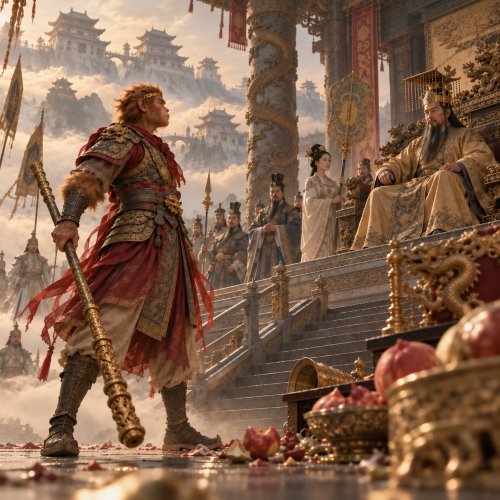
Hanuman is generally depicted in Cambodian tradition as a white monkey with a powerful humanoid body, long tail and expressive simian face. His appearance immediately identifies him as a member of the supernatural monkey forces who serve Preah Ream. Khmer artistic representations combine animal characteristics with elaborate royal imagery, giving Hanuman the appearance of both a warrior and a supernatural court figure.
His white colouring is particularly characteristic of Cambodian representations. In performance, Hanuman may appear in elaborate costumes, jewellery and a distinctive headdress that communicate his elevated status. In Lakhon Khol, Cambodia’s male masked theatre tradition based on episodes from the Reamker, performers use masks, costumes and stylised movement to bring characters such as Hanuman to life. UNESCO’s documentation specifically identifies performances featuring Hanuman fighting the demon general Virul Chambang.
Hanuman’s physical appearance also reflects the action associated with his character. He is frequently represented leaping, fighting or moving with extraordinary agility, visually expressing the speed and supernatural power that distinguish him from ordinary warriors.
Family
Hanuman’s family story in the Cambodian Reamker combines elements inherited from the wider Ramayana tradition with characters and relationships that developed within Khmer storytelling. He is associated with Vayu, the wind deity, and Anjana, giving him the divine ancestry traditionally connected with his extraordinary strength and supernatural abilities.
One of the most distinctive relationships in the Cambodian tradition is his encounter with Neang Maccha, a mermaid princess who attempts to prevent Hanuman and his monkey army from completing the causeway to Lanka. When Hanuman discovers that Neang Maccha and the mermaids are removing the stones thrown into the sea, he confronts her. Their encounter eventually turns into an alliance and a romantic relationship, and they become associated with Macchanu, their son, who combines monkey and aquatic characteristics.
The story of Neang Maccha is particularly important because it demonstrates how the Khmer Reamker developed its own narrative identity rather than simply reproducing the Sanskrit Ramayana. The episode gives Hanuman a romantic and adventurous dimension that is especially prominent in Southeast Asian retellings. In Cambodia, therefore, Hanuman is remembered not only as Preah Ream’s powerful monkey general but also as a character capable of wit, romance and personal adventure.
Other Names
In Cambodian tradition, Hanuman generally retains his familiar name in its Khmer form rather than receiving a completely separate local identity. His name is written in Khmer as ហនុមាន, while the major characters around him acquire distinctly Khmer forms, including Preah Ream for Rama, Neang Seda for Sita and Reap for Ravana.
This continuity of the name is significant because the Cambodian transformation of Hanuman happens primarily through his story and character rather than through a complete change of identity. The Khmer Hanuman remains recognisably the same legendary monkey warrior known across South and Southeast Asia, but his role in the Reamker gives him distinctive characteristics.
In Cambodia, Hanuman is particularly associated with his position as a monkey general and trusted warrior of Preah Ream. His intelligence, physical power, playfulness and romantic adventures all contribute to the character’s distinctive Khmer personality. Rather than relying on a long list of alternate names, Cambodian tradition is better understood through the different roles Hanuman assumes within the Reamker.
Powers and Abilities
Hanuman’s supernatural abilities are central to his role in the Reamker. He possesses extraordinary physical strength and agility, allowing him to fight powerful demons and perform feats beyond the abilities of ordinary warriors. His ability to leap enormous distances makes him particularly valuable to Preah Ream’s army, while his capacity to fly allows him to move rapidly across the landscape and between distant locations.
Shapeshifting is another important part of Hanuman’s supernatural character. He can alter his size and appearance when circumstances demand it, making him capable of both direct combat and deception. His powers therefore extend beyond physical strength; intelligence and adaptability are essential parts of his effectiveness as a warrior.
Hanuman is also presented as a clever strategist. He can use disguise, deception and quick thinking to overcome enemies rather than relying exclusively on force. This combination of intelligence and physical ability helps explain why he becomes such a prominent figure in the Reamker. His loyalty to Preah Ream gives these abilities a clear purpose, but Cambodian storytelling also allows him to display a mischievous and playful personality.
The result is a Hanuman who is not simply a powerful warrior. He is a versatile hero capable of fighting, travelling, transforming himself, deceiving opponents and navigating complicated situations. His supernatural abilities serve both the epic’s battles and its more adventurous episodes.
Modern Day Influence
Hanuman remains an important part of Cambodia’s living cultural heritage through the continuing performance and preservation of the Reamker. His character is particularly visible in Lakhon Khol, the traditional masked theatre in which male performers enact episodes from the epic through movement, masks, music and recitation. UNESCO inscribed Lkhon Khol Wat Svay Andet on the List of Intangible Cultural Heritage in Need of Urgent Safeguarding in 2018, recognising its ritual, cultural and social importance to the community.
Hanuman’s importance also extends beyond theatre. The Reamker has shaped Cambodian visual and performing arts for centuries, while scenes associated with the epic appear in Khmer artistic traditions. At Angkor Wat, representations connected with the Battle of Lanka include Hanuman among the monkey forces fighting for Rama, demonstrating how deeply the epic became embedded in Khmer artistic culture.
His continued appearance in performance is particularly significant because these traditions are not simply museum pieces. Lakhon Khol remains connected to community ritual, with performances historically serving purposes that extend beyond entertainment. UNESCO notes that the Wat Svay Andet tradition is performed in connection with local guardian spirits and community wellbeing, demonstrating how the Reamker can function within a living Cambodian cultural environment.
For modern Cambodia, Hanuman therefore represents more than inherited mythology. He is part of a cultural tradition in which an epic originating in India was reinterpreted through Khmer language, performance, art and storytelling. His enduring popularity demonstrates how mythological characters can travel across cultures while developing personalities and meanings that belong distinctly to the societies that adopt them.
Related Images


Source
Hanuman. (2002, October 5). In Wikipedia. https://en.wikipedia.org/wiki/Hanuman
WEPA: World Encyclopedia of Puppetry Arts. Hanuman. https://wepa.unima.org/en/hanuman/
Rajendran, A. (2024). Hanuman in Ramayana in Cambodia. Hindu Blog. https://www.hindu-blog.com/2024/10/hanuman-in-ramayana-in-cambodia.html
Know Your Epics. (n.d.). Hanuman’s Presence in Southeast Asian Mythology: Divine Influence. https://knowyourepics.com/hanumans-presence-in-southeast-asian-mythology-divine-influence
Wikipedia contributors. (2024). Suvannamaccha. Wikipedia. https://en.wikipedia.org/wiki/Suvannamaccha
Cravath, P. (1985). Earth in Flower: The Divine Mystery of the Cambodian Dance Drama. DatAsia Press.
Brandon, J. R. (1967). Theatre in Southeast Asia. Harvard University Press.
Pou, S. (1992). Ramayana in Southeast Asia: A Comparative Study. Journal of the Siam Society, 80(1), 45–58.
Groslier, B. P. (1968). Angkor and Cambodia in the Sixteenth Century. Oxford University Press.
Jacob, H. (2007). The Reamker: The Cambodian Ramayana. In Asian Theatre Journal, 24(2), 200–225.
Frequently Asked Questions
Who is Hanuman in Cambodian mythology?
Hanuman in Cambodian mythology is a central hero of the Reamker, the Khmer version of the Ramayana, known for his loyalty, strength, and divine powers.
How is Hanuman depicted in Cambodia?
Hanuman is portrayed as a white monkey warrior with a muscular humanoid body, often shown in ornate Khmer costumes in dance-drama performances.
Does Hanuman have a family in Cambodian stories?
Yes, Cambodian versions include his relationship with Suvannamaccha and introduce their son Macchanu, expanding his family beyond the Indian tradition.
What powers does Hanuman have in the Reamker?
He can fly, shapeshift, grow or shrink in size, fight demons, withstand fire, and use clever strategies to aid Preah Ream.
How is Hanuman represented in modern Cambodian culture?
He remains a prominent figure in classical dance, temple carvings, literature, and modern media, symbolizing courage, loyalty, and cultural pride.


