
Geno : The Supreme Creator of Fulani Tradition
At a glance
| Description | |
|---|---|
| Origin | Fulani Mythology |
| Classification | Gods |
| Family Members | N/A |
| Region | Nigeria, Mali, Guinea, Senegal |
| Associated With | Creation, Cosmic balance |
The Mythlok Perspective
In Mythlok’s Perspective, Geno represents one of the most refined expressions of a supreme creator—formless, distant, yet fundamentally present in all things. Unlike anthropomorphic deities, Geno embodies abstraction, aligning closely with philosophical interpretations of divine unity. This concept mirrors figures like the Yoruba Olodumare and the Egyptian Atum, both of whom exist beyond direct human interaction while shaping creation. However, Geno’s emphasis on moral correction through natural forces creates a uniquely Fulani perspective on balance, where humility is not just virtue but survival.
Geno
Introduction
Across the vast Sahel region of West Africa, the Fulani people have preserved one of the most profound and philosophically rich spiritual systems in Africa. At the center of this worldview stands Geno, the supreme creator and ultimate source of existence. Known also as Gueno or Doondari, Geno represents a force that is both all-powerful and distant, shaping the universe while remaining beyond direct human reach.
Fulani cosmology presents Geno not as a deity involved in everyday affairs, but as the origin of all things—life, nature, morality, and cosmic balance. In traditional narratives, Geno is said to have descended multiple times during creation, structuring existence through cycles of order and correction. These stories often emphasize humility, a core value in Fulani culture, where arrogance is met with divine counterforces such as blindness, sleep, worry, and death.
Even with the widespread influence of Islam among the Fulani, Geno continues to exist within cultural memory, embedded in oral traditions, proverbs, and spiritual philosophy. Rather than disappearing, this figure has evolved into a symbolic bridge between indigenous belief and later religious frameworks.
Physical Traits
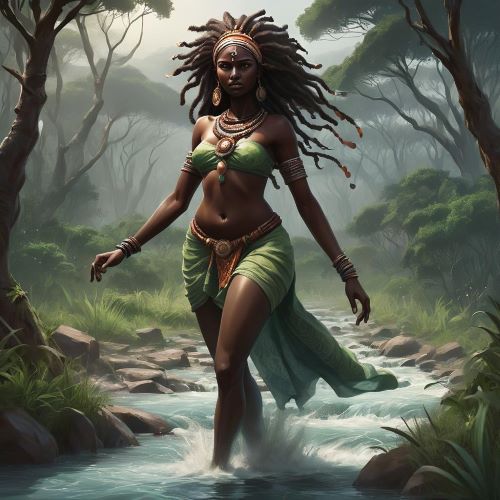
Geno stands apart from many mythological figures because there is no fixed physical description. Fulani traditions consistently portray Geno as formless, invisible, and beyond human comprehension. This absence of a defined body is not a limitation but a reflection of divine transcendence.
Instead of visual representation, Geno is understood through presence. The sky, the sun, and the moon are often seen as symbolic expressions of Geno’s essence. In some narratives, cosmic elements themselves emerge from Geno’s influence rather than from a physical act of creation. This reinforces the idea that Geno is not a being within the universe but the force that sustains it.
Certain myths hint at indirect manifestations. For example, Geno’s interaction with creation may occur through intermediaries such as the great serpent Tyanaba, suggesting that divine will operates through symbolic agents rather than direct appearance. Ultimately, Geno’s “form” is best understood as presence rather than shape—a constant, unseen force woven into the fabric of existence.
Family
Unlike many mythological systems filled with divine genealogies, Geno exists without a traditional family structure. There are no parents, consorts, or offspring in the conventional sense. Instead, Geno is regarded as the singular origin from which all existence flows.
Fulani cosmology describes a layered creation process rather than a family tree. From Geno emerge various beings and forces that shape the universe. Some traditions speak of a cosmic egg containing multiple entities, while others describe emanations that form the building blocks of life. Among these are the Lareeji, a group of spiritual entities that function within the cosmic order but do not stand as Geno’s children.
Humanity itself is part of this creative chain. The primordial being Neɗɗo, formed from multiple elements, represents the intersection of divine and material existence. From this point, human life unfolds, carrying traces of Geno’s original creative energy. Thus, instead of a family, Geno presides over a structured universe where all beings are expressions of a single divine source.
Other names
Geno is known by several names across different Fulani regions, each reflecting a slightly different aspect of the same supreme entity. The most common variation is Gueno, often interpreted as “the eternal one,” emphasizing timelessness and permanence.
Another important name is Doondari, meaning “the fearless one.” This title highlights Geno’s absolute authority and power, suggesting a being beyond limitation or opposition. In some contexts, the name also symbolizes unwavering control over destiny and cosmic balance.
Linguistic variations such as Guéno appear in regions influenced by French or local dialects, while in Islamic-influenced communities, Geno is sometimes conceptually aligned with the idea of a singular creator, blending indigenous and monotheistic interpretations. Despite these variations, all names point toward the same central idea—a supreme, eternal force that governs existence.
Powers and Abilities
Geno’s power is absolute and all-encompassing, extending across creation, morality, and the structure of reality itself. As the creator, Geno is responsible for bringing the universe into existence, often through symbolic processes that reflect transformation and balance.
In some narratives, creation begins with simple elements, such as a drop of milk, from which more complex forms emerge. Stone gives rise to iron, iron to fire, and so on, eventually leading to the formation of human beings. This layered creation reflects a worldview where everything is interconnected and evolves through divine intention.
Geno also governs moral order. When imbalance or arrogance appears in the world, Geno introduces corrective forces. Blindness counters pride, sleep counters awareness, worry challenges comfort, and death ultimately restores balance. These elements are not punishments alone but mechanisms that maintain harmony within existence.
Although distant, Geno interacts with the world indirectly. Intermediaries like Tyanaba act as conduits of divine will, ensuring that cosmic order continues without direct intervention. Geno is also associated with providence, particularly in relation to cattle, rain, and fertility—key elements in Fulani pastoral life. Through these abilities, Geno is not just a creator but a regulator of both the physical and moral universe.
Modern Day Influence
Today, the majority of Fulani people practice Islam, yet the legacy of Geno remains deeply embedded in cultural identity. Rather than disappearing, Geno has adapted, often blending with the concept of a single, all-powerful creator found in Islamic belief.
Traditional values such as Pulaaku, which emphasize humility, patience, and self-control, continue to reflect Geno’s moral framework. Stories about Geno are still passed down through oral traditions, songs, and storytelling practices, preserving a connection to ancestral belief systems.
In academic and cultural studies, Geno is increasingly recognized as a key figure in African cosmology. Scholars explore this deity as part of a broader understanding of how indigenous belief systems interpret creation, morality, and existence. Even in modern contexts, Geno remains a symbol of cosmic balance and cultural resilience, representing the enduring strength of Fulani spiritual heritage.
Related Images



Source
Fortes-Lima, C. A. (2025). Population history and admixture of the Fulani people. ScienceDirect. https://www.sciencedirect.com/science/article/pii/S0002929724004579
Hamma, M. (1966). The Fulɓe or Fulani of Mijú: Their culture. Abbia, 14-15. https://www.vestiges-journal.info/Abbia/Abbia_14-15_1966/Abbiav14-15n4.pdf
Konnect. (n.d.). Names of God in different Nigerian languages. https://konnect.com.ng/blog/names-of-god-in-different-nigerian-languages-and-their-meanings/
Nairaland. (2025). Fulani/Fulbe traditional beliefs and mythology. https://www.nairaland.com/2789038/fulani-fulbe-traditional-beliefs-mythology
TV Tropes. (n.d.). Fulani mythology. https://tvtropes.org/pmwiki/pmwiki.php/Myth/FulaniMythology
Yaden Africa. (2025). The Fulani: Ethnogenesis, spiritual traditions. https://www.yaden-africa.com/fulani/
Frequently Asked Questions
Who is Geno in Fulani tradition?
Geno is the supreme creator deity who formed the universe and governs cosmic and moral balance.
Does Geno have a physical form?
Geno is described as formless and invisible, existing beyond human understanding as a transcendent divine presence.
What are Geno’s main powers?
Geno governs creation, destiny, and moral order, controlling natural forces and maintaining balance within the universe.
Is Geno still worshipped today?
Though Islam is dominant, Geno remains in Fulani oral traditions, proverbs, and cultural beliefs as a symbol of divine order.
Are there other names for Geno?
Geno is also called Gueno or Doondari, with each name reflecting regional variations and aspects of divine power.