


Forseti : The Norse God of Justice and Mediation
Listen
At a glance
| Description | |
|---|---|
| Origin | Norse Mythology |
| Classification | Gods |
| Family Members | Baldr (Father), Nanna (Mother), Odin (Grandfather), Frigg (Grandmother) |
| Region | Norway, Sweden, Denmark, Iceland |
| Associated With | Justice, Law, Mediation |
The Mythlok Perspective
In Mythlok’s perspective Forseti represents the principle that justice is an act of balance rather than dominance. He does not conquer chaos through violence but dissolves it through clarity. In this way, he reflects a sophisticated dimension of Norse cosmology often overshadowed by tales of war. Comparable figures appear across cultures. The Egyptian goddess Ma’at embodies cosmic balance, while the Greek Themis presides over divine law. Unlike Tyr, who binds chaos through sacrifice, or Zeus, who enforces order through power, Forseti restores harmony through agreement. He stands as a reminder that even in warrior cultures, wisdom is the highest authority.
Forseti
Introduction
Forseti is one of the most understated yet philosophically powerful deities in Norse tradition. His Old Norse name means “the presiding one,” a title that perfectly captures his role as divine judge and mediator. Unlike thunder-wielding warriors or trickster gods who dominate the myths, Forseti governs through calm speech, wisdom, and reconciliation. He is mentioned only briefly in the Poetic Edda and the Prose Edda, yet those references establish him firmly as the god of justice, arbitration, and lawful order.
Forseti resides in Glitnir, a radiant hall in Asgard described as having golden pillars and a silver roof. From this luminous seat of judgment, he resolves disputes among gods and mortals alike. Every conflict brought before him ends in agreement, not because of force, but because of reason. In a culture often associated with warfare and heroism, Forseti represents another foundational Norse value: lawful harmony.
Physical Traits
The surviving sources provide no detailed physical description of Forseti. Unlike Thor with his hammer or Odin with his single eye, Forseti is not defined by dramatic physical markers. Instead, his identity is symbolically expressed through his hall, Glitnir, whose brightness reflects clarity, fairness, and incorruptibility. The silver and gold imagery suggests transparency and purity, qualities essential for a divine judge.
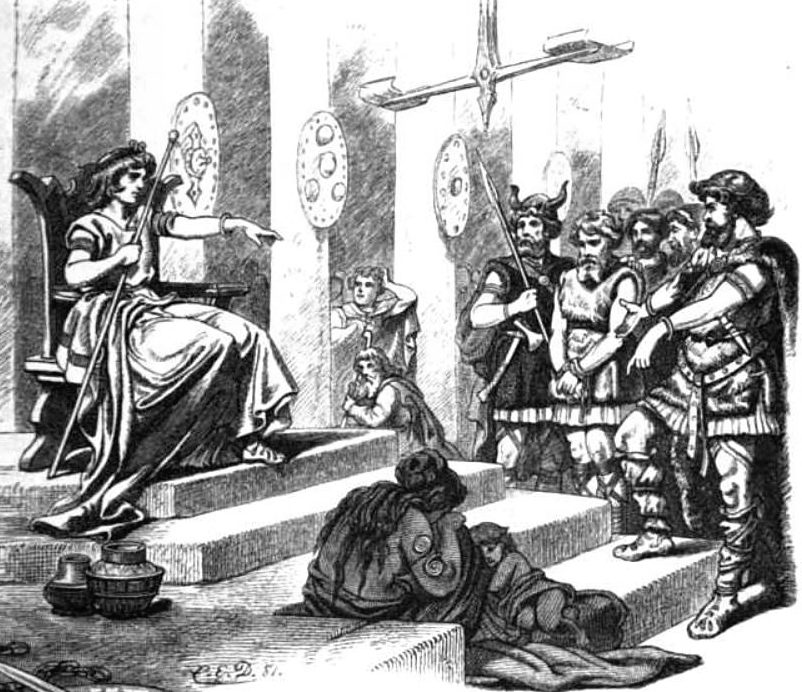
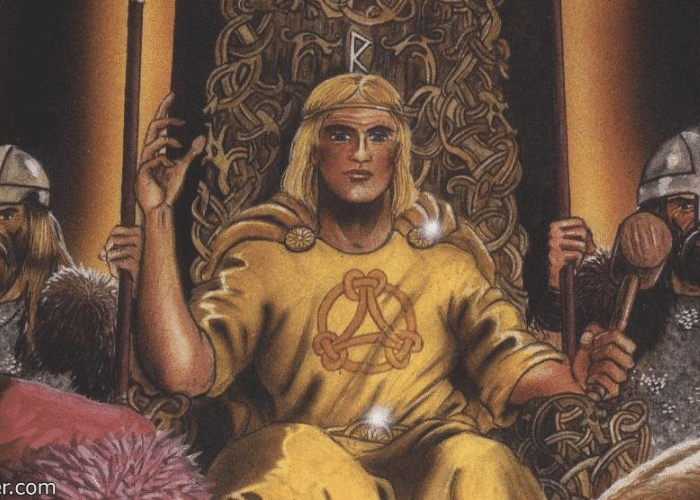
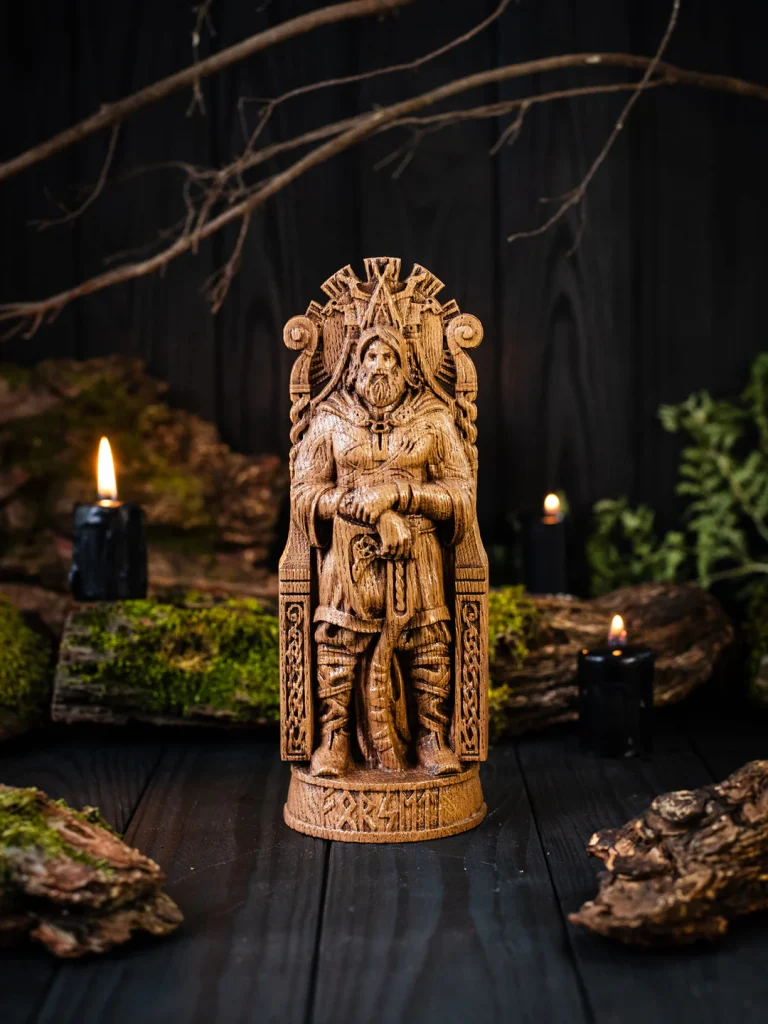
Later artistic interpretations, especially in 19th-century Romantic depictions, portray Forseti as a composed and dignified figure seated upon a high throne. He is typically shown as calm, mature, and authoritative rather than physically imposing. However, these images are artistic inventions rather than direct mythological descriptions. The primary texts focus on his function, not his form. In this sense, Forseti’s true “appearance” is his judgment itself.
Family
According to Snorri Sturluson’s Prose Edda, Forseti is the son of Baldr and Nanna. Baldr is the shining god associated with purity, light, and goodness, while Nanna embodies loyalty and devotion. This lineage is significant. Forseti inherits Baldr’s moral clarity and Nanna’s emotional depth, combining them into a temperament suited for mediation.
Baldr himself is the son of Odin and Frigg, which makes Forseti the grandson of Odin, the Allfather. Through this ancestry, Forseti belongs to the central divine family of Asgard. Yet unlike Odin’s pursuit of knowledge through sacrifice or Thor’s defense of cosmic order through strength, Forseti upholds order through dialogue. After Baldr’s tragic death, the myths do not describe Forseti’s reaction, nor is he mentioned as playing a role in Ragnarök. His silence in apocalyptic narratives reinforces his symbolic identity as a stabilizing presence rather than a warrior of destiny.
Other names
Forseti is sometimes identified with the Frisian deity Fosite. Early medieval sources, particularly the writings of Alcuin describing the missionary Willibrord, refer to an island called Fositesland where the god Fosite was worshipped. Scholars widely interpret Fosite as either a regional variant of Forseti or an earlier related deity whose name evolved linguistically.
The connection between Forseti and Fosite is supported by shared themes of law and sanctity. On Fositesland, sacred springs and strict legal customs were associated with the deity. The reverence for lawful conduct aligns strongly with Forseti’s mythological character. While absolute certainty is impossible due to limited evidence, the identification remains a strong scholarly consensus. The name Forseti itself survives in modern Icelandic, where “forseti” means “president,” directly reflecting the ancient meaning of “one who presides.”
Powers and Abilities
Forseti’s defining power is arbitration. He does not command storms or wage cosmic battles. Instead, he possesses unmatched eloquence, wisdom, and fairness. According to Grímnismál in the Poetic Edda, all who bring disputes before him leave reconciled. His judgments are so balanced that neither side departs dissatisfied.
This ability reflects the structure of the Norse legal assembly known as the þing. In Viking Age Scandinavia, disputes were settled publicly through recited law and negotiated compensation. The lawspeaker, or lögsögumaðr, memorized and proclaimed the law. Forseti mirrors this human institution at a divine level. His hall Glitnir functions as the celestial counterpart to the earthly assembly.
Unlike Tyr, another god associated with law who sacrifices his hand to bind Fenrir, Forseti represents restorative justice rather than sacrificial heroism. He resolves rather than restrains. His justice is daylight justice. Some later traditions suggest that his courts operated only during the brighter seasons, symbolizing clarity and openness.
In Frisian legend, Fosite is credited with establishing sacred laws after guiding elders stranded at sea. Though not directly attested in Old Norse sources, this story reinforces the archetype of Forseti as a bringer of lawful order.
Modern Day Influence
Forseti’s influence continues in subtle but meaningful ways. The Icelandic word for president preserves his name, embedding ancient legal symbolism into modern governance. The continued cultural respect for mediation and consensus-building in Nordic societies echoes the values Forseti represents.
He also appears in modern interpretations of Norse tradition, including literature, role-playing games, and reconstructed spiritual practices. In contemporary discussions of restorative justice, Forseti serves as a mythic archetype for balanced resolution rather than punitive dominance.
Even outside spiritual contexts, the name Forseti has been adopted in technological and organizational systems to symbolize integrity and oversight. Though these uses are secular, they retain the core association of fairness and structured order.
Related Images





Source
Lindow, J. (2002). Norse mythology: A guide to the gods, heroes, rituals, and beliefs. Oxford University Press.
Orchard, A. (1997). Dictionary of Norse myth and legend. Cassell.
Simek, R. (2007). Dictionary of Northern Mythology (A. Hall, Trans.). D.S. Brewer.
Sturluson, S. (1916). The Prose Edda (A. G. Brodeur, Trans.). The American-Scandinavian Foundation. https://en.wikisource.org/wiki/The_Prose_Edda_
Anonymous. (n.d.). Grímnismál. In Poetic Edda. https://en.wikipedia.org/wiki/Gr%C3%ADmnism%C3%A1l
History Cooperative. (n.d.). Forseti: The god of justice, peace, and truth in Norse mythology.
https://historycooperative.org/forseti/
History Lists. (2011). Forseti – God of Norse mythology. https://historylists.org/other/forseti-god-of-norse-mythology.html
Vikingr.org. (2024). Forseti: The Aesir god of justice and mediation in Norse myths.
https://vikingr.org/norse-gods-goddesses/forseti
Frequently Asked Questions
Who is Forseti in Norse mythology?
Forseti is the Norse god of justice, law, and reconciliation who presides over disputes in his hall Glitnir.
Is Forseti the son of Baldr?
Yes. According to the Prose Edda, Forseti is the son of Baldr and Nanna.
What is Glitnir?
Glitnir is Forseti’s hall in Asgard, described as having golden pillars and a silver roof, where he settles disputes.
Is Forseti the same as Fosite?
Most scholars believe Fosite, a Frisian deity, is either a regional variation or closely related figure to Forseti.
Did Forseti fight in Ragnarök?
Forseti is not mentioned as participating in Ragnarök in surviving Norse sources.