


Enumclaw : The Mythic Thunder Power of the Coast Salish
At a glance
| Description | |
|---|---|
| Origin | Coast Salish Mythology |
| Classification | Mortals |
| Family Members | Kapoonis (Brother) |
| Region | United States of America, Canada |
| Associated With | Thunder |
Enumclaw
Introduction
Enumclaw is a figure from an Indigenous tradition of the Pacific Northwest whose story explains the origin of Thunder. In the recorded account associated with Henry Sicade of the Nisqually and Puyallup Tribes, Enumclaw begins as a human hunter before becoming a supernatural force. He is the older brother of Kapoonis, and the two brothers share a desire to acquire the power of a great medicine man. Their search for supernatural abilities eventually gives them powers far beyond those of ordinary people.
Enumclaw develops extraordinary strength and becomes capable of throwing small stones from one mountain peak to another. His brother Kapoonis follows a different path, eventually acquiring a powerful fire spirit near the headwaters of the Cowlitz River. Their abilities grow so formidable that the brothers eventually test them against each other in a destructive contest. The Great Spirit decides that such powers are too dangerous to remain in human hands and transforms the brothers permanently. Enumclaw becomes thunder, while Kapoonis becomes lightning. The story therefore traces Enumclaw’s journey from mortal hunter to the supernatural force heard in the rumble of a storm.
Physical Traits
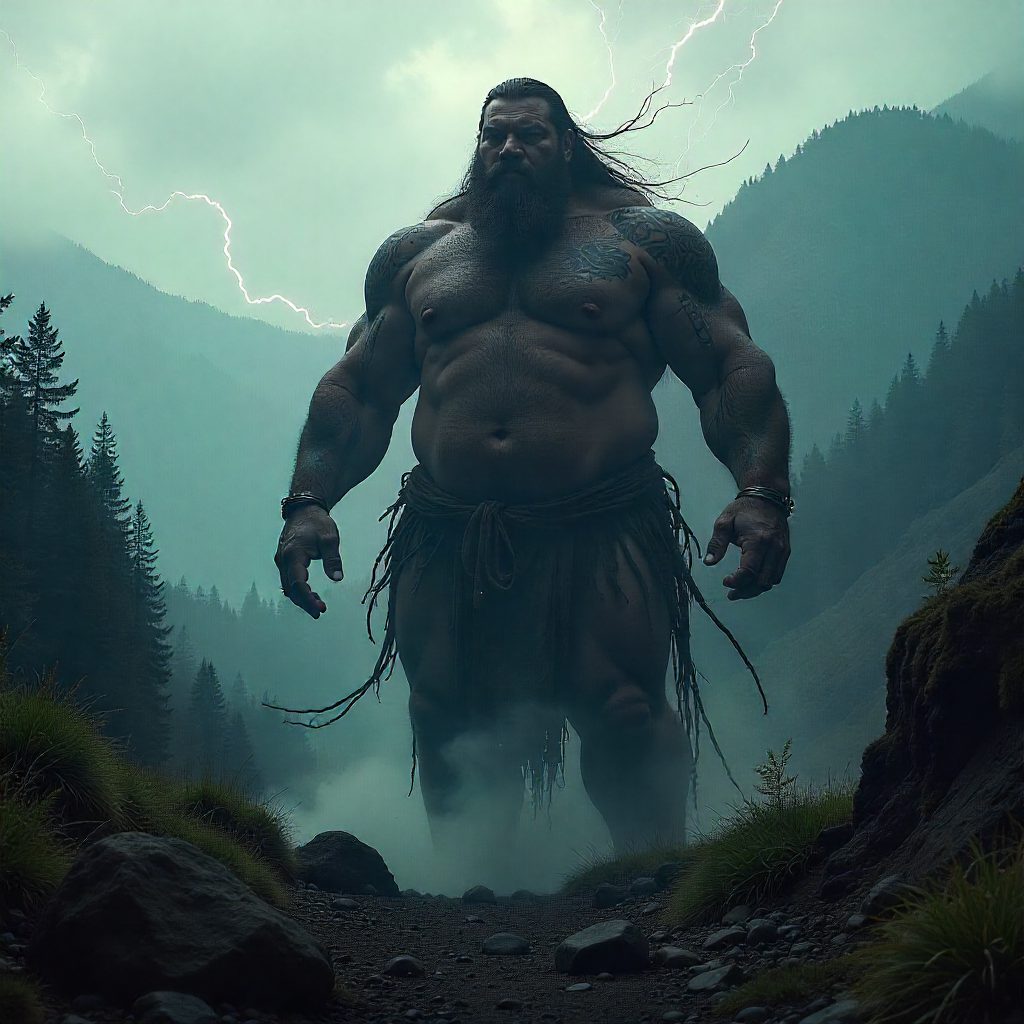
There is no detailed description of Enumclaw’s appearance after his transformation. The surviving account is more concerned with what he can do than with what he looks like. Before becoming a supernatural being, Enumclaw is described as a powerful human hunter whose physical strength allows him to perform extraordinary feats with stones.
His most distinctive ability is his capacity to throw small rocks between mountain peaks. When people approached the brothers’ home, Enumclaw could throw stones at different peaks as a signal. The resulting noise was described as terrifying, while flames could also be seen. The story later connects this extraordinary ability with the sounds of thunder.
After the Great Spirit transforms him, Enumclaw no longer exists simply as a human figure. He becomes associated with thunder itself. Because the traditional account does not establish a particular humanoid appearance for his transformed state, depicting him as an elaborately armoured or supernatural-looking warrior would go beyond the source. His identity is better represented through the physical strength and rock-throwing ability of his human form and the thunder associated with his transformed existence.
Family
Enumclaw’s closest family connection is with his younger brother, Kapoonis. The two brothers live near the mountain and are described in Henry Sicade’s account as great hunters who travel widely while seeking a spirit that could help them become great medicine men. Enumclaw is identified as the older brother and Kapoonis as the younger.
The brothers eventually develop different supernatural abilities. Enumclaw becomes extraordinarily strong and masters the throwing of stones, while Kapoonis takes solitary journeys and eventually acquires a powerful fire spirit near the headwaters of the Cowlitz River. Their abilities ultimately become connected with two phenomena that occur together during storms.
The relationship between the brothers becomes particularly important when they decide to test their powers against each other. What begins as a friendly rivalry becomes a destructive display of supernatural strength. Their contest demonstrates just how far their abilities have progressed and leads directly to their transformation.
The Great Spirit intervenes because such powers are considered unsafe for human beings. Enumclaw is transformed into thunder and Kapoonis into lightning, giving the brothers permanent supernatural identities connected to the forces they had come to embody.
Other Names
Enumclaw is principally known by this name in modern accounts of the story. He is commonly described as a thunder spirit because thunder becomes his defining association after his transformation. The name also has an important connection with the geography of Washington State. The city of Enumclaw and nearby Enumclaw Mountain preserve a name with Indigenous origins, although the precise meaning and history of the place name are treated differently in different sources. The City of Enumclaw describes the name as meaning “thundering noise,” while other historical explanations connect the name with the surrounding mountain and different Indigenous-language interpretations.
It is therefore important to distinguish Enumclaw the mythological figure from Enumclaw the place name. The existence of the city does not by itself prove that it was directly named after the thunder figure. Instead, both the story and the geographical name belong to the broader Indigenous history of the region. Thunder Spirit” is best understood as a descriptive title for Enumclaw rather than as a separate traditional personal name.
Powers and Abilities
Enumclaw’s most distinctive ability is his extraordinary physical strength. As a human, he becomes capable of throwing small stones from one mountain peak to another. This is not simply a symbolic association with thunder; it is one of the central supernatural abilities described in the recorded story. His stone throwing is powerful enough to create terrifying sounds across the mountains.
The brothers eventually decide to test their abilities in a contest. They sit on a rocky ridge south of Tacoma and agree to direct their powers toward another ridge. The contest becomes increasingly violent, and the force of their supernatural abilities destroys almost the entire ridge. According to the account, only a sharp rock remains standing where the ridge once stood. The story identifies this formation as Saw Tooth Rock, said to be somewhere south or southeast of Longmire’s Springs.
This contest is the turning point in Enumclaw’s story. The Great Spirit sees that such dangerous powers cannot safely remain with human beings and transforms the brothers permanently. Enumclaw becomes thunder, while Kapoonis becomes lightning.
Enumclaw’s power should therefore not be expanded into a general ability to control rain, weather, hunting, travel, or ecological cycles unless those claims are supported by separate sources. His defining power in this particular tradition is much more specific: extraordinary strength and the transformation into thunder.
Modern Day Influence
Enumclaw’s story remains connected to the cultural and geographical history of the Pacific Northwest. The name Enumclaw survives prominently in Washington State through the city of Enumclaw and Enumclaw Mountain, giving the story a continuing geographical association with the region. The city’s own historical material acknowledges an Indigenous connection to the name and describes its meaning in relation to thundering noise.
The story has also survived through written records of Indigenous oral traditions. One important version was recorded from Henry Sicade in 1924 and later preserved in accounts of the traditions surrounding Mount Rainier. Sicade was a Puyallup and Nisqually educator and community leader, making his recorded account particularly relevant when discussing the story’s connection to those communities.
Enumclaw’s story is especially notable because it connects a human experience—the pursuit of supernatural knowledge—with the dramatic landscape around Mount Rainier. Mountains, rivers, rocks, fire, thunder, and lightning all become part of the narrative. The transformation of the brothers provides a traditional explanation for the powerful sounds and flashes associated with storms while preserving the memory of two extraordinary human figures.
Rather than treating Enumclaw simply as a generic thunder god, the story is better understood as a specific Indigenous tradition in which a human hunter becomes the supernatural embodiment of thunder. His transformation, his rivalry with Kapoonis, and the dramatic destruction caused by their powers give the Enumclaw story its distinctive character within the mythology of the Pacific Northwest.
Related Images
Source
Wikipedia contributors. (2023, September 23). Enumclaw and Kapoonis. Wikipedia. https://en.wikipedia.org/wiki/Enumclaw_and_Kapoonis
New World Encyclopedia. (2001). Coast Salish. Retrieved from https://www.newworldencyclopedia.org/entry/Coast_Salish
Wikipedia contributors. (2014, March 14). History of the Coast Salish peoples. Wikipedia. https://en.wikipedia.org/wiki/History_of_the_Coast_Salish_peoples
Madrona Cultural Arts Center. (2025). Coast Salish Stories. Retrieved from https://www.madrona.org/news/coast-salish-stories
Gunther, E. (1973). Ethnobotany of Western Washington: The Knowledge and Use of Indigenous Plants by Native Americans. University of Washington Press.
Boas, F. (1921). Coast Salish Texts. Columbia University Contributions to Anthropology.
Suttles, W. (1990). Handbook of North American Indians, Volume 7: Northwest Coast. Smithsonian Institution.
Frequently Asked Questions
Who is Enumclaw in Coast Salish mythology?
Enumclaw is a thunder spirit who began as a skilled youth and was transformed by Sky Father into the embodiment of thunder.
What is the relationship between Enumclaw and Kapoonis?
Enumclaw and Kapoonis are twin brothers who became the spirits of thunder and lightning, representing complementary forces in storms.
What powers does Enumclaw have?
Enumclaw commands thunder, with the rumble of storms reflecting his transformed power from rock-throwing into cosmic sound.
Why is a city named Enumclaw?
Enumclaw, Washington, is named after the thunder spirit, preserving a significant aspect of Coast Salish cultural heritage.
How is Enumclaw relevant today?
Enumclaw’s story continues to inspire Indigenous cultural revival, environmental teachings, and modern artistic interpretations.


