


Kapoonis : The Coast Salish Hunter Who Became Lightning
At a glance
| Description | |
|---|---|
| Origin | Coast Salish Mythology |
| Classification | Mortals |
| Family Members | Enumclaw (Brother) |
| Region | United States of America, Canada |
| Associated With | Lightning |
Kapoonis
Introduction
Kapoonis is a figure from the Indigenous traditions of the Pacific Northwest whose story explains the origin of Lightning. He is closely connected with his twin brother, Enumclaw, and the two are remembered as extraordinary brothers whose search for supernatural power ultimately changed their destinies. In the traditional account associated with the Nisqually and Puyallup peoples, Kapoonis was originally a mortal human rather than a spirit or deity. The brothers were skilled hunters who wanted to become great medicine men, leading them to seek supernatural assistance.
Kapoonis eventually acquired a powerful fire spirit, and his abilities grew beyond what an ordinary human could safely possess. The Great Spirit judged the brothers’ powers too dangerous for them to retain in human form. Their transformation gave each brother a permanent place among the forces of the natural world: Enumclaw became associated with thunder, while Kapoonis became the power behind lightning. His story therefore follows a striking transformation from human seeker to supernatural being and provides a traditional explanation for the relationship between fire, lightning, thunder, and the storm.
Physical Traits
There is no detailed traditional description of Kapoonis as a humanoid being with a fixed appearance. This is important when interpreting the character because Kapoonis is best understood through his transformation and supernatural power rather than through a conventional physical form.
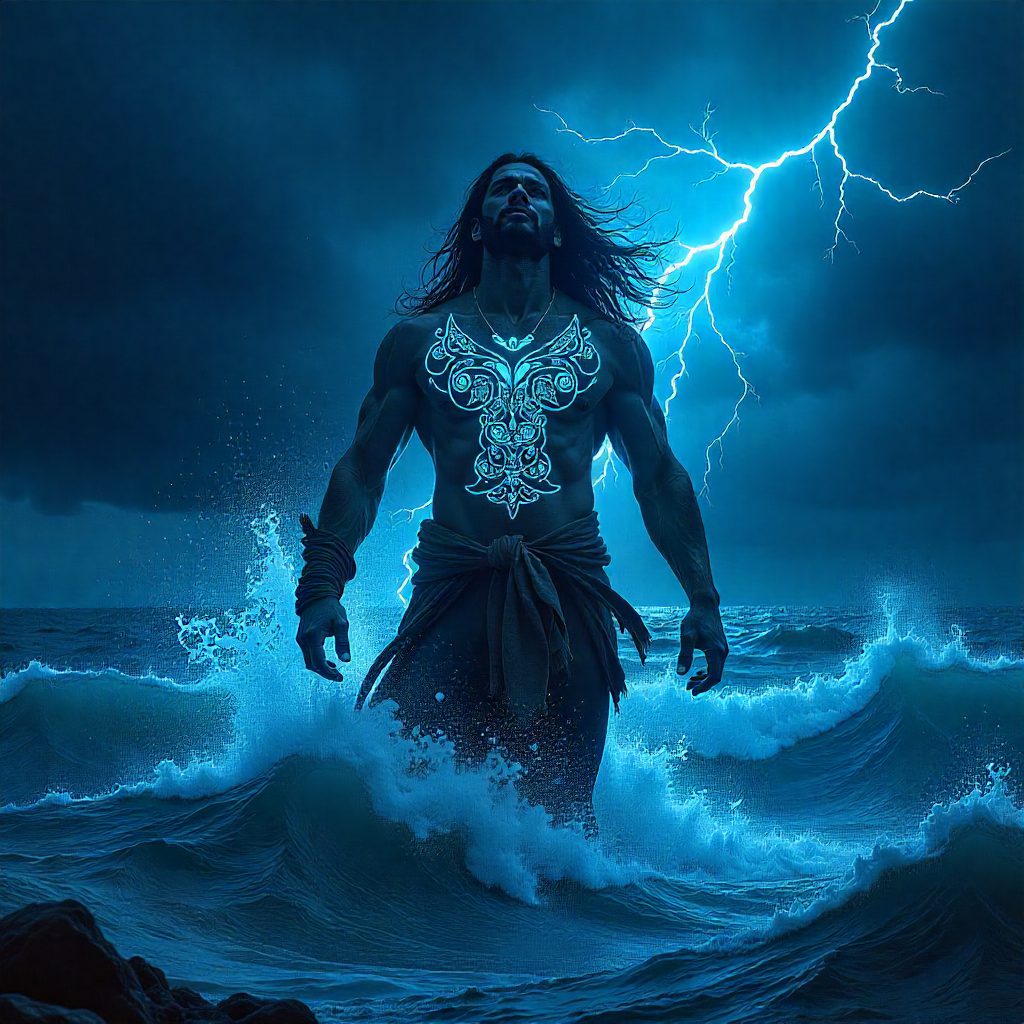
Before his transformation, Kapoonis appears in the story as a human brother and hunter. His defining supernatural characteristic develops through his relationship with a powerful fire spirit. After the Great Spirit transforms him, Kapoonis becomes associated with lightning itself. His presence can therefore be represented through flashes of light, fire, and the sudden energy of a storm rather than through a specific human-shaped appearance.
For Mythlok, Kapoonis is better understood as a transformed elemental being than as a conventional anthropomorphic god. The surviving account does not establish details such as glowing eyes, armour, weapons, or a specific body covered in lightning. Those visual elements belong to later artistic interpretation rather than the traditional narrative and should not be presented as established features of Kapoonis.
Family
Kapoonis is most closely associated with his twin brother, Enumclaw. The brothers begin their story as human hunters who share the ambition of becoming powerful medicine men. Their pursuit of supernatural abilities eventually leads both of them to transformations that permanently separate them from ordinary human life.
The brothers’ final identities are closely connected. Enumclaw becomes associated with thunder, while Kapoonis becomes associated with lightning. Their relationship consequently provides a traditional explanation for two phenomena that commonly appear together during storms. The connection between the brothers is central to Kapoonis’s story, rather than simply being a background family detail.
The Great Spirit is also an important figure in their story. After witnessing the power the brothers had acquired, the Great Spirit determines that such abilities are too dangerous for human beings. Their transformation is therefore the decisive event that turns Kapoonis and Enumclaw from mortal brothers into supernatural forces.
Other Names
Kapoonis is principally known by the name Kapoonis in the surviving accounts of the story. He is commonly identified in modern descriptions as a lightning spirit because lightning becomes his defining supernatural association following his transformation. The story is particularly associated with Indigenous traditions of the Pacific Northwest, including an account recorded from Henry Sicade, who was associated with the Nisqually and Puyallup peoples. Because Coast Salish communities have distinct languages, histories, and traditions, it is preferable not to assume that every Coast Salish nation shares exactly the same version of the Kapoonis story.
The descriptive term “Lightning Spirit” is useful for explaining Kapoonis’s role to modern readers, but it should not automatically be treated as a separate traditional name. Likewise, comparisons with thunder or storm beings from other Indigenous cultures can help place the story within a wider study of mythology, but those figures should not be treated as equivalent to Kapoonis.
Powers and Abilities
Kapoonis’s supernatural abilities are closely connected to fire and lightning. The most important part of his story occurs before his transformation, when he obtains a powerful fire spirit. This supernatural association becomes the foundation for his later identity. Following the intervention of the Great Spirit, Kapoonis becomes the force associated with lightning. His transformation represents a movement from human control of supernatural fire to a permanent elemental existence connected with the sky. Lightning consequently becomes the defining power associated with Kapoonis.
His story is not primarily about a list of individual magical abilities. Instead, his power is expressed through the natural phenomenon he comes to embody. Fire represents the supernatural ability he acquires as a mortal, while lightning represents the greater elemental power associated with his transformed state.
Kapoonis’s relationship with Enumclaw is equally important. The brothers become associated with lightning and thunder respectively, giving their story a natural connection to the experience of a storm. Rather than treating Kapoonis as a conventional weather god who controls every aspect of the weather, it is more accurate to describe him as the supernatural being associated with lightning in this particular tradition.
Modern Day Influence
Kapoonis remains of interest today because his story provides an example of how Indigenous traditions connect human experience with the natural world. His narrative is preserved through recorded Indigenous storytelling and has also entered modern discussions of Pacific Northwest folklore and Coast Salish traditions.
The story of Kapoonis and Enumclaw is particularly significant because it links supernatural transformation with a familiar feature of the regional environment. Lightning and thunder are not presented simply as abstract forces; they are connected to the destinies of two brothers whose search for supernatural knowledge changes them permanently.
The name Enumclaw also provides a continuing geographical connection to the story. Enumclaw, Washington, is associated with a local Indigenous legend concerning the two brothers, although the history and etymology of the place name have been discussed separately in historical sources. The presence of the story within the cultural history of the region demonstrates how Indigenous narratives can remain connected to the landscapes in which they developed.
For modern readers, Kapoonis is best understood not as a generic lightning god but as a transformed human figure whose story explains lightning through a distinctly Pacific Northwest Indigenous tradition. His journey from hunter and aspiring medicine man to supernatural lightning being is what makes Kapoonis a compelling figure in the mythology of the region.
Related Images

Source
Onat, J. (Year). Legends of the Coast Salish.
Canadian Museum of History. (n.d.). Coast Salish peoples. Retrieved from https://www.historymuseum.ca/coast-salish
SFU Bill Reid Centre. (2017). The history of Coast Salish peoples on Burnaby Mountain. Retrieved from https://the-peak.ca/2017/02/the-history-of-coast-salish-peoples-on-burnaby-mountain/
Kiddle, Kids Encyclopedia. (n.d.). Enumclaw and Kapoonis facts for kids. Retrieved from https://kids.kiddle.co/Enumclaw_and_Kapoonis
Boas, F. (1991). The myths of the Northwest Coast Indians. University of Washington Press.
Collective authors. (2024). Indigenous storm spirits: An exploration of Northwest Coast myths. Journal of Indigenous Studies, 18(3), 45-67.
Erdoes, R., & Ortiz, A. (1984). American Indian Myths and Legends. Pantheon Books.
Miller, J. (1999). Native Peoples of North America: An Encyclopedia of Culture, History, and Threats to Survival. Routledge.
Bastian, D. (2015). Thunder and Lightning in Indigenous Mythologies. Journal of American Folklore, 128(509), 45–67.
Frequently Asked Questions
Who is Kapoonis in Coast Salish mythology?
Kapoonis is the lightning spirit in Coast Salish mythology and the twin brother of Enumclaw, the thunder spirit. He represents the brilliance, speed, and transformative power of lightning in the natural world.
What does Kapoonis look like?
Kapoonis is described not as a human figure but as a radiant, fiery presence made of lightning. His form appears in the bright flashes that illuminate the sky during storms.
What powers does Kapoonis have?
Kapoonis controls lightning and celestial fire. His strikes symbolize speed, illumination, and spiritual communication, often interpreted as signs from the spirit world.
How is Kapoonis connected to Enumclaw?
Is Kapoonis still significant today?
Yes. Kapoonis remains an important figure in Coast Salish storytelling, cultural education, artistic expression, and discussions on ecological harmony and Indigenous cosmology.


