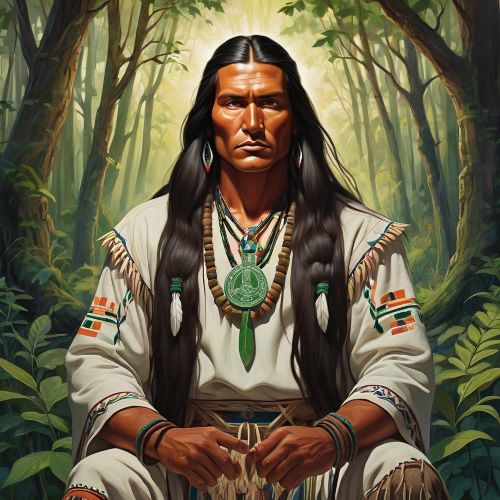


Deganawida : The Great Peacemaker of the Haudenosaunee
At a glance
| Description | |
|---|---|
| Origin | Haudenosaunee Mythology |
| Classification | Mortals |
| Family Members | N/A |
| Region | United States of America |
| Associated With | Peace, Unity, Governance, Diplomacy |
The Mythlok Perspective
In Mythlok’s Perspective, Deganawida represents a rare archetype where leadership is defined not by conquest but by reconciliation. His power lies in restructuring society itself, transforming conflict into cooperation. Unlike figures such as King Arthur who unify through kingship, or Ashoka who turns to peace after war, Deganawida begins with peace as his foundation. This places him closer to a philosophical architect than a ruler, shaping systems rather than commanding them.
Deganawida
Introduction
Deganawida widely known as the Great Peacemaker, stands at the heart of Haudenosaunee (Iroquois) tradition as the visionary who ended cycles of intertribal violence and established a lasting system of unity. Working alongside Hiawatha and Jigonhsasee, he brought together the Mohawk, Oneida, Onondaga, Cayuga, and Seneca nations into what became the Haudenosaunee Confederacy.
At the core of his mission was the Great Law of Peace, a sophisticated framework for governance rooted in consensus, balance, and collective responsibility. Rather than conquest, Deganawida’s vision emphasized reconciliation, symbolized through the planting of the Tree of Peace and the burial of weapons beneath it. Oral traditions portray him not just as a political founder, but as a spiritual messenger sent to restore harmony among people and between humanity and the natural world.
Physical Traits
Descriptions of Deganawida focus less on physical detail and more on symbolic presence. Oral traditions consistently highlight a calm, dignified demeanor that conveyed authority without aggression. One of the most frequently mentioned traits is his speech difficulty, often linked to a double row of teeth. This limitation did not weaken his influence; instead, it reinforced the importance of collaboration, as Hiawatha became his voice in councils and negotiations.
Rather than heroic physicality, Deganawida’s power is expressed through spiritual presence. His connection to orenda, the life force that flows through all beings, is what truly defines him. Accounts of his survival from seemingly fatal घटनाएँ—such as falling into rapids—serve to underline his role as a figure protected by higher forces, rather than a conventional warrior leader.
Family
The origins of Deganawida vary across Haudenosaunee oral traditions, reflecting the fluid and symbolic nature of his story. Many accounts describe him as born to a Huron woman, sometimes portrayed as a virgin, reinforcing his role as a divinely guided figure. Other traditions place his birth among the Onondaga, followed by adoption into the Mohawk community.
Stories of his early life often include attempts to test or even end his life as an infant, only for him to survive unharmed. These narratives are not literal biographies but symbolic affirmations of destiny. Unlike many mythic figures, Deganawida’s family is not central to his identity. His true “family” emerges through alliance, particularly with Hiawatha and Jigonhsasee, who together shaped the Confederacy’s foundation.
Other names
Deganawida is known by several names across Haudenosaunee languages, each reflecting a different aspect of his role. Variants such as Dekanawida, Tekanawí:ta, and Deganawidah appear in different oral traditions. In Mohawk, he is sometimes referred to as Skén:nen rahá:wi, meaning “he who brings peace.”
Out of respect, many Haudenosaunee people avoid using his personal name in everyday speech, choosing instead to call him the Great Peacemaker. The meaning often associated with his name—“two rivers flowing together”—captures the essence of his mission: uniting separate peoples into a single, harmonious current.
Powers and Abilities
Deganawida’s abilities are best understood as a blend of spiritual authority and transformative leadership. He is said to possess orenda, enabling him to influence hearts, heal divisions, and guide entire nations toward unity. His feats, while sometimes described as miraculous, function primarily as symbolic validations of his message.
Stories recount him crossing Lake Ontario in a stone canoe, surviving a fall into dangerous rapids, and causing a solar eclipse that convinced skeptics of his vision. Another powerful narrative involves the transformation of the Onondaga leader Tadodaho, whose chaotic mind was “combed” into order, symbolizing the restoration of balance.
His greatest achievement, however, lies in institutional creation. The Great Law of Peace established a council system, defined roles for leaders, and embedded checks and balances long before similar frameworks appeared elsewhere. The Tree of Peace, with its roots extending in all directions, became a lasting metaphor for unity and refuge.
Modern Day Influence
The influence of Deganawida extends far beyond oral tradition into political thought and cultural identity. The Haudenosaunee Confederacy remains one of the world’s oldest continuously practiced systems of participatory governance. Its emphasis on consensus, representation, and accountability continues to guide communities today.
Scholars and historians have long noted parallels between the Great Law of Peace and modern democratic systems. In 1988, the United States formally acknowledged the intellectual influence of the Confederacy on its constitutional development. Figures such as Benjamin Franklin studied Haudenosaunee governance, particularly its federal structure and emphasis on unity among distinct nations.
Culturally, Deganawida remains a living presence. His teachings are preserved through oral recitations, ceremonies, and community governance practices. Sites associated with his story, especially around Ontario and New York, continue to hold spiritual and historical significance. His legacy also appears in literature, film, and contemporary Indigenous movements advocating sovereignty and environmental stewardship.
Related Images
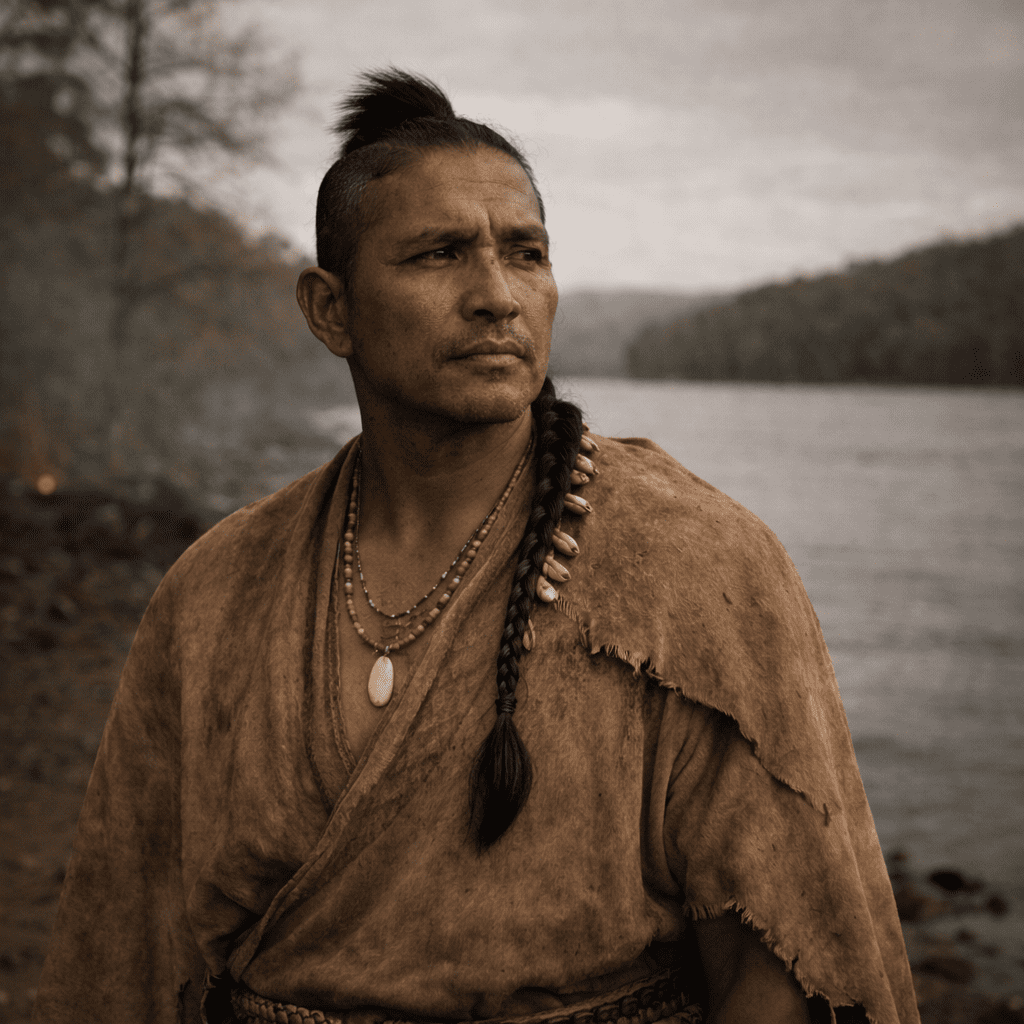
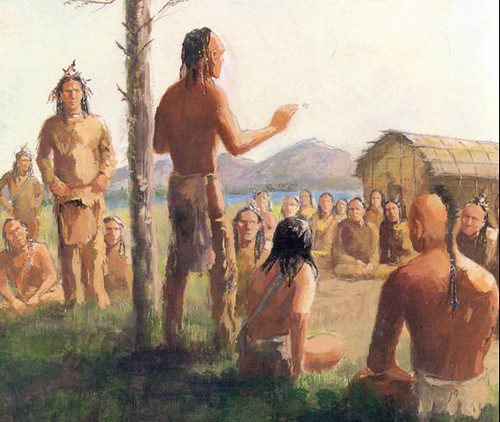

Source
Hale, H. (1883). The Iroquois book of rites. Thacker.
Parker, A. C. (1916). The constitution of the Five Nations, or the Iroquois book of the great law. New York State Education Department.
Snow, D. R. (1994). The Iroquois. Blackwell.
Wallace, P. A. W. (1946). The white roots of peace. University of Pennsylvania Press.
Wallace, P. A. W. (1966). Dekanahwideh (Deganawidah, Dekanahouideh, the Heavenly Messenger). In Dictionary of Canadian Biography (Vol. 1). University of Toronto/Université Laval. https://www.biographi.ca/en/bio/dekanahwideh_1E.html
Wikipedia contributors. (2026). Great Peacemaker. Wikipedia. https://en.wikipedia.org/wiki/Great_Peacemaker
Johansen, B. E. (1998). Forgotten founders: How the American Indian helped shape democracy. Harvard Common Press.
Mann, B. A., & Fields, J. L. (1997). A sign in the sky: Dating the League of the Haudenosaunee. American Indian Culture and Research Journal, 21(2), 105-140.
Frequently Asked Questions
Who was Deganawida?
Deganawida was the Great Peacemaker who founded the Haudenosaunee Confederacy and introduced the Great Law of Peace.
What is the Great Law of Peace?
It is a constitutional system promoting unity, consensus, and shared governance among the Haudenosaunee nations.
Did Deganawida have powers?
He is believed to possess orenda, enabling spiritual influence, healing, and uniting warring tribes.
Why is Deganawida important today?
His ideas influenced democratic systems and continue to guide Indigenous governance and identity.
Who helped Deganawida unite the nations?
Hiawatha and Jigonhsasee were key allies in spreading his message and forming the Confederacy.