


Boon of the Deadly Touch : Bhasmasura’s Gift of Turning Others to Ash
At a glance
| Description | |
|---|---|
| Mythology | Indian Mythology |
| Bestowed Upon | Bhasmasura |
| Granted By | Lord Shiva |
| Primary Effect | Ability to reduce anyone to ashes by touch |
| Conditions Attached | None |
Mythlok Perspective
From the Mythlok perspective, Bhasmasura’s Ashen Touch represents a warning about power acquired without the wisdom to govern it. The boon transforms physical touch into absolute destructive authority, but its greatest weakness is the unchecked desire of its possessor. When compared cross-culturally, this idea echoes the Greek myth of Midas, whose extraordinary gift ultimately becomes a burden through its unintended consequences. Like Midas, Bhasmasura discovers that power without restraint can turn a blessing into the instrument of its bearer’s own downfall.
Boon of the Deadly Touch
Introduction
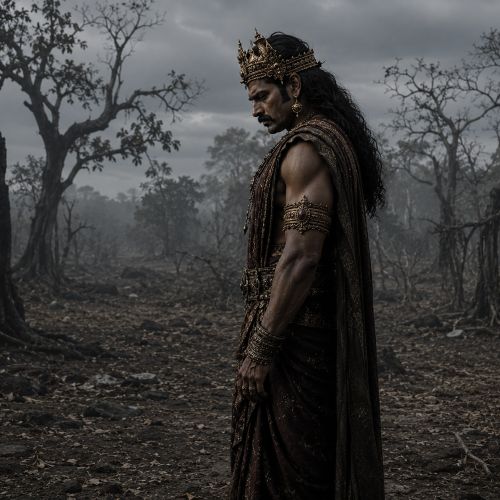
Bhasmasura’s Touch is one of the most memorable stories surrounding divine boons, unchecked ambition, and the consequences of using extraordinary power without wisdom. In the popular telling, Bhasmasura performs intense penance to please Shiva and asks for a terrifying ability: anyone whose head he touches should immediately be reduced to ashes. Shiva grants the boon, but Bhasmasura soon turns his newly acquired power against the very deity who gave it to him.
What follows is not simply a battle between a god and an asura. Vishnu appears as Mohini, an enchanting female form, and uses dance and imitation to make Bhasmasura place his own hand upon his head. The boon then acts exactly as promised, destroying its owner.
The story has an important textual complication. The closely related classical account in the Bhagavata Purana concerns an asura named Vrikasura, who receives a similar head-touching power from Shiva. In that version, Vishnu appears as a young Brahmin and persuades Vrikasura to test the boon on himself. The Bhasmasura-Mohini dance narrative belongs prominently to later and regional traditions.
Mythological Background
Bhasmasura is described in popular Indian tradition as an asura, a powerful supernatural being whose ambition leads him to seek an extraordinary boon from Shiva. The term asura should not automatically be understood as simply meaning “evil.” Indian mythological traditions contain many asuras who possess devotion, discipline, intelligence, or great spiritual power. Their stories often become cautionary when these qualities are overtaken by pride or uncontrolled desire.
The name Bhasmasura is associated with bhasma, the Sanskrit word for ash, reflecting the destructive nature of the power attributed to him. In the familiar story, his intense austerities, or tapas, attract Shiva’s attention. Shiva is frequently portrayed in mythology as a generous giver of boons to those who undertake severe penance, making him an important figure in stories where supernatural power is acquired through devotion.
The narrative also brings Shiva and Vishnu into complementary roles. Shiva provides the boon, while Vishnu ultimately finds a way to neutralize the danger created by it. This pattern is especially prominent in later retellings of the Bhasmasura story, where divine power is balanced by strategic intelligence rather than physical confrontation.
Granting of the Boon/Blessing
Bhasmasura’s power begins with tapas. After performing severe penance to gain Shiva’s favor, he is granted the opportunity to ask for a boon. His request is extraordinary: he wants the ability to turn a person into ashes simply by placing his hand upon that person’s head. Shiva grants the request. The moment is important because the story does not portray the boon itself as a conventional weapon. Bhasmasura does not receive a sword, missile, or magical object that can be separated from him. His own hand becomes the instrument of destruction. The power is therefore inseparable from the person who possesses it.
In the popular Bhasmasura-Mohini narrative, this blessing is granted without an obvious limitation that prevents Bhasmasura from using it against Shiva himself. That omission becomes the central problem. A gift obtained through devotion is transformed into a threat because the recipient’s ambition is greater than his judgment. The closely related Vrikasura episode in the Bhagavata Purana follows the same basic pattern: Vrikasura performs austerities, Shiva grants him the ability to kill anyone whose head he touches, and the demon then attempts to use the power against Shiva.
Nature of the Boon/Blessing
The defining feature of Bhasmasura’s Touch is its simplicity. The power does not depend upon a ritual, a weapon, or an elaborate invocation. The destructive act is reduced to a single gesture: placing the hand on the head. That simplicity makes the boon particularly dangerous. A person who possesses such a power does not need an army or battlefield advantage. Physical proximity becomes enough.
The head also carries considerable symbolic importance in Indian religious and cultural traditions. It can represent identity, consciousness, authority, and the individual self. A power that allows Bhasmasura to destroy someone through the head therefore becomes a direct expression of absolute control over another being.
There is also an ironic connection with Shiva. Ash, or bhasma, has an important place in Shaiva practice and symbolism. Sacred ash can represent mortality, impermanence, purification, and the destruction of worldly attachment. Bhasmasura takes an idea associated with Shiva and turns it into an instrument of personal domination. His problem, therefore, is not simply that he possesses destructive power. It is that he has transformed something associated with spiritual transcendence into a tool for satisfying his own desires.
Recipients and Key Figures
Bhasmasura is the central recipient of the boon. His extraordinary penance demonstrates determination and spiritual discipline, but his subsequent actions reveal that discipline of the body has not produced discipline of the mind. Shiva is the bestower of the boon. In the popular story, his generosity places him in an unexpected position: the deity who grants the power eventually becomes its intended target.
Vishnu becomes the figure responsible for resolving the crisis. In the familiar Bhasmasura-Mohini tradition, Vishnu assumes the form of Mohini, the enchantress, and confronts Bhasmasura through attraction, performance, and strategy rather than physical force.
Mohini is particularly important because her role extends beyond beauty. She represents transformation and strategic intelligence. The Central Government’s cultural resource material on Mohiniyattam explicitly connects the dance tradition with the Puranic story in which Vishnu assumes Mohini to defeat Bhasmasura. The Bhagavata Purana, however, presents a different version of the closely related Vrikasura episode: Vishnu appears as a young Brahmin rather than Mohini. This distinction matters when tracing the development of the story across different textual and performance traditions.
Effects and Consequences
Once Bhasmasura receives the boon, his behavior changes from devotion to domination. He attempts to use his new power against Shiva, forcing the deity to escape rather than simply allowing the boon to be revoked. The popular Mohini version then introduces a very different form of conflict. Vishnu becomes Mohini and approaches Bhasmasura. Captivated by her, Bhasmasura becomes willing to follow her instructions. Mohini proposes a dance in which he must imitate her movements.
The dance becomes the mechanism through which Bhasmasura defeats himself. Mohini eventually places her hand upon her own head. Bhasmasura, focused on matching her movements, copies the gesture. His own hand touches his head, activating the very boon he had intended to use against others. He is reduced to ashes.
This ending gives the story its distinctive dramatic structure. Bhasmasura is not destroyed because someone possesses a stronger weapon. His downfall comes from the exact power he sought and the lack of control with which he used it. The related Vrikasura version reaches the same basic conclusion through a different strategy. Vishnu, appearing as a Brahmin, causes Vrikasura to doubt Shiva’s promise and encourages him to test the boon on himself. Vrikasura does so and dies.
Symbolism and Spiritual Meaning
The central idea behind Bhasmasura’s Touch is the difference between possessing power and possessing the wisdom to use it. Bhasmasura succeeds in obtaining what he wants. His failure comes afterward. The boon does not make him wiser, more restrained, or more capable of understanding consequences. Instead, his new power amplifies qualities that were already present within him.
The story therefore treats desire as a potential weakness. Bhasmasura is powerful enough to threaten Shiva, yet Mohini does not need to overpower him. She changes the circumstances surrounding him and allows his own impulses to determine the outcome. The dance adds another layer to this idea. Bhasmasura imitates Mohini without questioning where the movements are leading. His willingness to copy becomes the mechanism of his destruction.
The transformation into ash also reinforces impermanence. Bhasmasura acquires a power intended to decide the fate of others, yet ultimately discovers that he himself is not beyond the consequences of mortality and destruction. The story’s spiritual emphasis is therefore less about avoiding power altogether and more about recognizing that power without discernment can become self-destructive.
Cultural Impact and Legacy
The Bhasmasura-Mohini story has had a lasting presence in Indian visual and performing arts. It has been represented in sculpture, painting, dance, theatre, cinema, and regional storytelling. A study of South Indian iconography notes that representations of Mohini and Bhasmasura became particularly prominent in Tamil Nadu during the late medieval period, appearing in stone sculpture and temple-carving traditions.
The story is also closely associated with Mohiniyattam, the classical dance tradition of Kerala. The Centre for Cultural Resources and Training identifies the Bhasmasura episode among the Puranic stories associated with Mohini and the tradition of Mohiniyattam. Yakshagana has likewise preserved the narrative as a performance story, with productions built around the confrontation between Bhasmasura and Mohini.
The tale even entered the earliest years of Indian cinema. Dadasaheb Phalke’s Mohini Bhasmasur, released in 1913, dramatized the story and featured Kamlabai Gokhale as Mohini. The film is historically significant as the first Indian film to feature a female actor. Its endurance comes from the story’s unusual combination of theology, comedy, dance, danger, and reversal. Bhasmasura believes he has obtained ultimate control, yet the power ultimately controls his fate. Mohini does not defeat him through greater physical strength; she creates the conditions in which Bhasmasura’s own behavior becomes his undoing.
That is why Bhasmasura’s Touch continues to resonate across Indian storytelling traditions. The story asks a simple but enduring question: what happens when someone receives exactly the power they desire before they have developed the wisdom required to handle it?


Source
Debroy, B. (2023). Shiva Purana (Vol. 1). Penguin India. https://www.penguin.co.in/book/shiva-purana/
Monier-Williams, M. (1899). A Sanskrit-English dictionary: Etymologically and philologically arranged. Clarendon Press. https://www.sanskrit-lexicon.uni-koeln.de/
Tagare, G. V. (Trans.). (1950). The Bhagavata Purana. Motilal Banarsidass. https://www.wisdomlib.org/hinduism/book/the-bhagavata-purana
Wisdom Library. (2024). Bhasmasura, Bhasmāsura: Seven definitions. https://www.wisdomlib.org/definition/bhasmasura
Wisdom Library. (2022). The Lord’s manifestation as Mohinī (The Enchantress). In The Bhagavata Purana. https://www.wisdomlib.org/hinduism/book/the-bhagavata-purana/d/doc1128822.html
Bhattacharji, S. (1992). Legends of Devi. New Delhi: Orient Longman.
Dimmitt, C., & van Buitenen, J. A. B. (1978). Classical Hindu Mythology: A Reader in the Sanskrit Puranas. Philadelphia: Temple University Press.
Doniger, W. (1999). Splitting the Difference: Gender and Myth in Ancient India. Chicago: University of Chicago Press.
Mani, V. (1975). Puranic Encyclopaedia. Delhi: Motilal Banarsidass.
Frequently Asked Questions
What is Bhasmasura’s Touch?
Bhasmasura’s Touch is the supernatural boon attributed to Bhasmasura in the popular Indian mythological tradition. It gives him the power to reduce a person to ashes by placing his hand upon that person’s head.
Who gave Bhasmasura his boon?
In the popular Bhasmasura story, Shiva grants Bhasmasura the destructive touch after the asura performs intense penance.
How did Bhasmasura die?
In the widely told Bhasmasura-Mohini version, Vishnu assumes the form of Mohini and leads Bhasmasura into a dance. When Mohini places her hand on her own head, Bhasmasura imitates her and touches his own head, causing the boon to destroy him.
Is the Bhasmasura and Mohini story in the Bhagavata Purana?
The Bhagavata Purana contains a closely related story about Vrikasura, not the familiar Bhasmasura-Mohini dance episode. In the Bhagavata version, Vishnu appears as a young Brahmin and persuades Vrikasura to test Shiva’s boon on himself.
What does the story of Bhasmasura symbolize?
Bhasmasura’s story is commonly interpreted as a warning about power without wisdom or self-control.


